







Exceptionally intelligent, sensitive and famous for an astonishing ability to imitate human speech, the African Grey is one of the world's most remarkable companion parrots.
🧠 QUICK SNAPSHOT
| Trait | African Grey Parrot |
|---|---|
| Scientific Name | Psittacus erithacus |
| Pet Type | Parrot / Companion bird |
| Natural Origin | Central and West Africa |
| Typical Lifespan | Around 40–60+ years |
| Adult Size | Around 30–35 cm |
| Typical Weight | Roughly 400–500 g |
| Diet | Balanced formulated diet with suitable fresh foods |
| Activity | Diurnal |
| Temperament | Highly intelligent, sensitive and observant |
| Noise Level | Moderate to high |
| Social Needs | Very high |
| Trainability | Exceptional |
| Beginner Friendly? | Generally better for experienced or highly prepared owners |
| Famous Feature | Extraordinary speech and sound mimicry |
📚 OVERVIEW
The African Grey Parrot (Psittacus erithacus) is widely regarded as one of the most intelligent birds kept as a companion animal.
Its grey plumage may appear understated beside more colourful parrots, but the brilliant red tail and extraordinary cognitive abilities make this bird unmistakable.
African Greys can imitate speech and household sounds with remarkable accuracy, and some individuals demonstrate an ability to associate particular words with objects, actions or situations rather than simply repeating noises.
That intelligence comes with responsibility. African Greys need daily social interaction, training, foraging opportunities and mental stimulation. Combined with a lifespan potentially exceeding half a century, this makes them one of the most rewarding — but demanding — companion birds.
✅ PROS & CONS
Pros
- Exceptionally intelligent
- Extraordinary ability to mimic speech
- Can learn extensive vocabularies
- Highly observant and engaging
- Excellent trainability
- Forms strong social bonds
- Fascinating problem-solving abilities
- Potentially lifelong companion
Cons
- Requires extensive daily interaction
- Easily bored without enrichment
- Can be sensitive to environmental changes
- May develop behavioural problems when understimulated
- Produces considerable feather dust
- Powerful beak
- Can be noisy
- Potential commitment of 40–60+ years
Are African Grey Parrots Good Pets?
Yes, for the right owner.
African Greys can be extraordinary companions, but their intelligence, sensitivity, social needs and longevity make them considerably more demanding than many smaller pet birds.
Are African Grey Parrots Good for Beginners?
They’re generally better suited to experienced bird owners or beginners prepared to undertake substantial research and commitment.
An African Grey needs much more than food and a cage. Mental stimulation and social interaction are fundamental parts of its care.
How Long Do African Grey Parrots Live?
African Greys can potentially live around 40–60 years or longer under excellent captive care.
Obtaining a young bird may therefore involve planning for its care across several decades and potentially beyond the owner’s own circumstances.
How Big Do African Grey Parrots Get?
Adults are generally around 30–35 cm long and commonly weigh approximately 400–500 grams.
They’re medium-sized parrots, although their intelligence and care requirements can rival those of much larger birds.
Can African Grey Parrots Talk?
Yes. African Greys are among the most accomplished vocal mimics in the animal world.
Some develop substantial vocabularies and reproduce human voices with astonishing clarity.
Not every individual will become an enthusiastic talker, however.
Do African Greys Understand What They Say?
Some African Greys can learn associations between particular words, objects, colours, actions or requests.
The most famous scientific example was Alex, an African Grey studied by animal cognition researcher Irene Pepperberg.
His abilities helped transform scientific discussion about how much parrots may understand.
Who Was Alex the African Grey Parrot?
Alex was an African Grey who participated in decades of cognition research.
He demonstrated abilities involving colours, shapes, quantities, categories and object identification, providing evidence that parrots can do considerably more than simply mimic sounds.
His work became one of the best-known examples of avian intelligence research.
How Many Words Can an African Grey Learn?
There’s no fixed limit that applies to every bird.
Some African Greys develop vocabularies containing hundreds of words and sounds, while others speak much less.
Vocabulary size isn’t a measure of whether an individual bird is intelligent or healthy.
Why Are African Grey Parrots So Good at Mimicking Sounds?
Parrots are naturally vocal animals with sophisticated sound-learning abilities.
African Greys are particularly accomplished vocal learners and can reproduce not only speech but also phones, alarms, whistles, doors, household appliances and other environmental sounds.
Sometimes rather too accurately.
Are African Grey Parrots Loud?
They can be.
Although they’re not necessarily as continuously loud as some larger parrots, African Greys can produce powerful calls, whistles and household imitations.
A bird that learns an irritating sound may also decide it’s worth repeating.
Frequently.
Are African Grey Parrots Affectionate?
Many form extremely strong relationships with their caregivers.
However, affection varies between individuals. Some enjoy head scratches and close interaction, while others prefer companionship without extensive physical contact.
Trust should never be forced.
Do African Grey Parrots Bond With One Person?
Some develop a particularly strong preference for one person.
Regular positive interaction with multiple household members can help encourage broader social confidence and reduce excessive dependence on one caregiver.
What Do African Grey Parrots Eat?
A nutritionally balanced formulated parrot diet can form the foundation, supplemented with appropriate vegetables, leafy greens and other bird-safe fresh foods.
A seed-only diet isn’t nutritionally adequate.
Fresh drinking water should always be available.
What Foods Are Toxic to African Grey Parrots?
Foods including avocado, chocolate, alcohol and caffeine can be dangerous to parrots.
Owners should always verify unfamiliar foods before offering them.
African Greys are clever enough to investigate human food, which doesn’t mean it’s safe for them to eat.
Do African Grey Parrots Need Extra Calcium?
African Greys can be vulnerable to calcium-related nutritional problems, making a properly balanced diet particularly important.
Supplementation shouldn’t simply be added indiscriminately because calcium, vitamin D and UV exposure need to be considered as part of the bird’s overall nutrition and veterinary care.
How Big Should an African Grey’s Cage Be?
The cage should be large enough for the bird to fully stretch its wings, climb and move comfortably, with room for suitable perches and enrichment.
Larger is generally preferable, provided bar spacing and construction are safe.
Daily activity outside the cage remains important.
Do African Greys Need Time Outside Their Cage?
Yes.
African Greys need regular opportunities for exercise, exploration, training and social interaction outside their primary enclosure.
Any room used for free movement needs to be thoroughly bird-safe.
Do African Grey Parrots Need Toys?
Absolutely.
Their intelligence makes enrichment particularly important.
Foraging toys, destructible materials, puzzles, training activities and opportunities to manipulate objects can help keep an African Grey mentally engaged.
Toys should be rotated to maintain interest.
Can African Grey Parrots Get Bored?
Very easily.
An intelligent bird living in an unstimulating environment can develop behavioural problems including repetitive behaviours, excessive vocalisation or feather damaging behaviour.
Keeping an African Grey mentally occupied isn’t optional enrichment — it’s an important part of responsible husbandry.
Why Do African Grey Parrots Pluck Their Feathers?
Feather damaging behaviour can have medical, environmental and behavioural causes, sometimes involving several factors simultaneously.
Stress or insufficient stimulation may contribute, but owners shouldn’t automatically assume a behavioural cause.
Veterinary investigation is important.
Do African Grey Parrots Need Another Bird?
Not necessarily.
A single African Grey can thrive when provided with sufficient interaction, enrichment and social contact.
However, a bird shouldn’t spend most of its life isolated simply because its human caregivers are busy.
Can African Grey Parrots Live With Other Birds?
They may live successfully in households containing other birds, but sharing the same cage is a different matter.
Differences in temperament, size and individual compatibility can create risks.
Separate housing is generally safer unless a specific pairing is known to be compatible.
Do African Grey Parrots Bite?
They can.
An African Grey has a powerful beak and may bite when frightened, overstimulated, territorial or when its warning signals have been ignored.
Learning parrot body language is essential.
Why Does My African Grey Growl?
African Greys can produce a distinctive growling sound when they’re frightened, uncomfortable or warning someone to keep away.
It’s a useful signal that the bird needs space.
Ignoring clear warnings can turn communication into biting.
Why Does My African Grey Copy the Phone or Microwave?
Because African Greys are exceptionally skilled vocal learners.
Frequently repeated household sounds can become part of their repertoire.
Some birds reproduce electronic noises so convincingly that their owners repeatedly check devices that never actually made a sound.
Do African Grey Parrots Recognise Their Owners?
Yes. African Greys can distinguish familiar individuals and learn extensive information about household routines.
Their ability to observe patterns means they can become remarkably good at predicting what people are about to do.
Are African Grey Parrots Intelligent?
Extremely.
Research has demonstrated abilities involving categorisation, numerical concepts, colour and shape recognition, vocal learning and problem-solving.
Comparisons with human intelligence should be made cautiously, but African Greys clearly possess sophisticated cognitive abilities.
Can African Grey Parrots Learn Tricks?
Yes.
Positive reinforcement can be used to teach behaviours including stepping up, targeting, recall and numerous tricks.
Training provides useful mental stimulation while also improving communication between bird and caregiver.
Do African Grey Parrots Produce Feather Dust?
Yes.
African Greys are powder-down birds and can produce considerable fine feather dust.
Regular cleaning and good air quality are important considerations, particularly in households containing people sensitive to airborne particles.
What Health Problems Are Common in African Grey Parrots?
Potential concerns include nutritional deficiencies, calcium-related problems, respiratory disease, obesity and feather disorders.
Birds can conceal illness remarkably well, so changes in appetite, droppings, breathing, weight or behaviour deserve prompt attention.
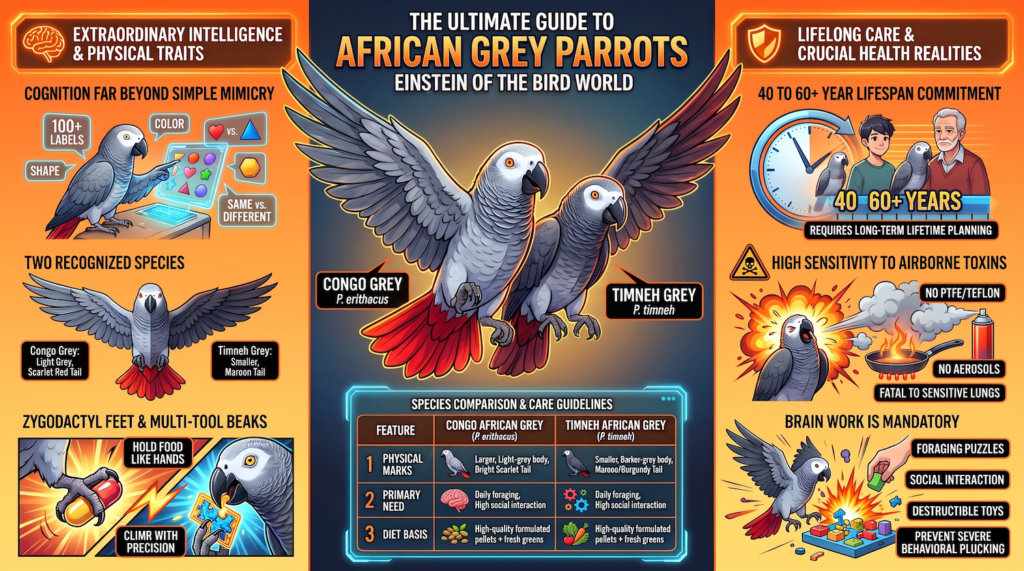
What Is the Difference Between a Congo and Timneh African Grey?
The birds traditionally called Congo African Greys are generally larger, lighter grey and have a bright red tail.
The Timneh African Grey is smaller and darker with a maroon-coloured tail and is now generally classified as a separate species, Psittacus timneh.
Both are exceptionally intelligent parrots.
Where Do African Grey Parrots Come From?
African Greys originate from Central and West Africa, where they inhabit forested environments and naturally live highly social lives.
Their wild social complexity helps explain why captive African Greys require substantial interaction and stimulation.
Are African Grey Parrots Endangered?
Wild African Grey populations have suffered serious declines because of factors including habitat loss and historical trapping for the international bird trade.
Responsible sourcing and compliance with wildlife trade regulations are therefore particularly important when obtaining one.
Are African Grey Parrots Legal to Keep as Pets?
Ownership and trade regulations vary between countries and regions.
African Greys are subject to significant international wildlife trade protections, and permits or documentation may be required in some places.
Always check current local regulations and obtain birds only from responsible legal sources.
Is an African Grey Parrot a Good First Bird?
Usually, it’s not the easiest first bird.
African Greys combine extraordinary intelligence with sensitivity, demanding social needs and potentially more than half a century of life.
For a well-prepared owner, however, few companion birds offer such an extraordinary opportunity to build a relationship with a genuinely remarkable animal.
What Makes the African Grey Parrot Unique?
Imagine living with an animal that doesn’t merely hear what happens in your home.
It studies it.
The microwave beeps.
The phone rings.
A particular person says the same phrase every morning.
The African Grey is listening.
And one day the microwave beeps again.
Except this time…
it was the parrot.
That’s entertaining enough, but African Grey intelligence goes much deeper than imitation.
Research with Alex showed that a parrot could learn concepts involving colour, shape, quantity and categories, helping challenge the old assumption that a “bird brain” was something simple.
Then consider the lifespan.
A young African Grey may potentially share 40, 50 or even 60 years of someone’s life.
During that time, it can learn the household’s voices, routines, sounds and personalities.
You’re not simply bringing home a bird that can talk.
You’re bringing home a bird that listens, learns, remembers — and may eventually start answering back.
Discover how African Grey Parrots learn human speech, why they’re considered among the world’s most intelligent birds, the extraordinary story of Alex and what it’s really like to share your life with a parrot that may live for decades.
Watch our African Grey Parrot video and discover what makes this remarkable bird one of the most fascinating companion animals in the world.