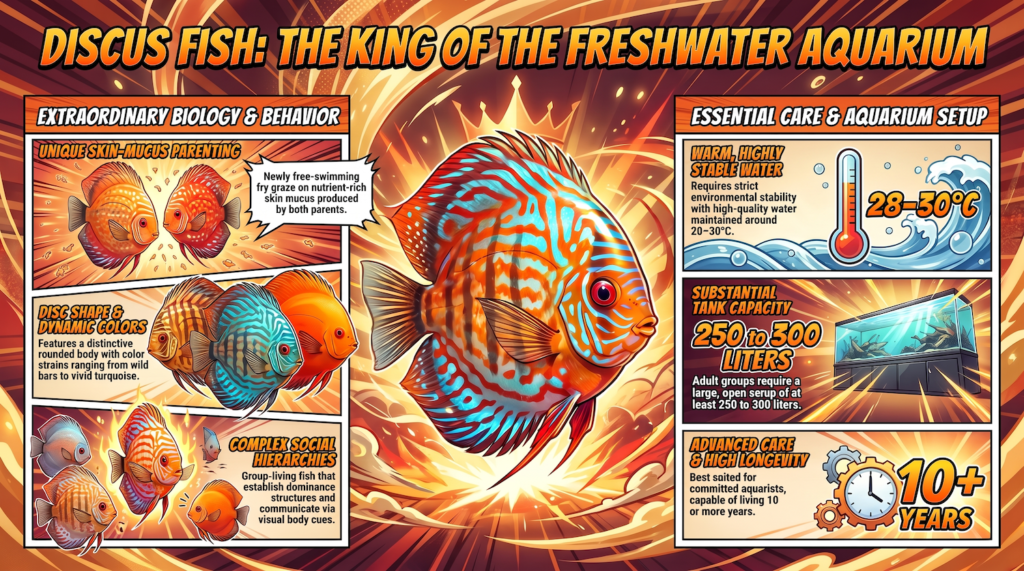








Known as the Kings of the Aquarium, Discus Fish are famous for their spectacular colours, elegant swimming and distinctive round bodies.
🧠 QUICK SNAPSHOT
Trait | Discus Fish |
|---|---|
Scientific Name | Symphysodon species |
Other Names | Discus, King of the Aquarium, Pompadour Fish |
Pet Type | Freshwater Aquarium Fish |
Natural Origin | Amazon River Basin, South America |
Typical Lifespan | Around 10–15 years |
Adult Size | Approximately 15–20 cm |
Adult Weight | Varies; typically around 150–250 g |
Colours | Blue, red, turquoise, green, yellow, white and patterned varieties |
Diet | Omnivore |
Activity | Diurnal |
Temperament | Generally peaceful, social and sometimes shy |
Noise Level | Silent |
Social Needs | Best kept in compatible groups |
Water Temperature | Approximately 28–30°C |
Water pH | Generally 6.0–7.5 for captive-bred fish |
Tank Size | Around 300 litres or larger for a group |
Beginner Friendly? | Generally not recommended |
Famous Feature | Disc-shaped body and extraordinary parental care |
📚 OVERVIEW
Discus Fish are spectacular freshwater cichlids native to the Amazon River Basin in South America. Their nearly circular bodies, graceful movements and vibrant colours have earned them the nickname Kings of the Aquarium.
Wild Discus inhabit warm, slow-moving waters, often among submerged roots and branches. Selective breeding has produced an extraordinary variety of aquarium strains, including Blue Diamond, Red Turquoise, Pigeon Blood and Leopard Discus.
Unlike many tropical fish, Discus prefer consistently warm water and are particularly sensitive to deteriorating water quality, sudden environmental changes and stress.
They require spacious aquariums, excellent filtration, stable temperatures, nutritious food and compatible companions. Their fascinating social behaviour and unusual breeding habits make them especially rewarding for experienced aquarists.
✅ PROS & CONS
👍 Pros
Spectacular colours and patterns
Elegant, graceful swimming
Peaceful temperament
Fascinating social behaviour
Extraordinary parental care
Many beautiful captive-bred varieties
Impressive aquarium centrepiece
Long potential lifespan
👎 Cons
Sensitive to poor water quality
Require consistently warm water
Need a large aquarium
Regular water changes essential
Can be expensive to purchase
May become stressed easily
Require careful tankmate selection
Not ideal for beginners
Are Discus Fish Good Pets?
Yes. Discus Fish make exceptional aquarium pets for experienced fishkeepers.
Their spectacular appearance, peaceful behaviour and fascinating social interactions make them rewarding to observe.
However, they require excellent water quality, stable temperatures and consistent maintenance.
Are Discus Fish Good for Beginners?
Generally, no.
Discus Fish are more demanding than many popular freshwater aquarium species.
Although healthy captive-bred Discus can be relatively adaptable, beginners may struggle with their temperature requirements, feeding habits and sensitivity to water quality.
How Long Do Discus Fish Live?
Discus Fish commonly live around 10–15 years with excellent care.
Their lifespan depends on genetics, nutrition, water quality and disease prevention.
Stable aquarium conditions are particularly important for long-term health.
How Big Do Discus Fish Get?
Adult Discus generally reach approximately 15–20 cm in height and length.
Their distinctive round bodies make them appear considerably larger than many similarly sized tropical fish.
Healthy adults develop a deep, almost circular body shape.
What Are the Different Types of Discus Fish?
Popular aquarium varieties include:
Blue Diamond Discus — striking solid-blue colouring
Red Turquoise Discus — red and turquoise patterns
Pigeon Blood Discus — orange, red and white markings
Leopard Discus — distinctive spotted patterns
Checkerboard Discus — intricate red patterning
Golden Discus — beautiful yellow and golden shades
Green Discus — natural greenish colouring and patterns
Many varieties have been developed through selective breeding.
Why Are Discus Fish So Expensive?
Discus Fish can be expensive because successful breeding and raising require specialised conditions.
High-quality specimens also reflect selective breeding, colour development and the time required to reach a suitable selling size.
Rare strains and large, well-developed adults often command higher prices.
Are Discus Fish Peaceful?
Generally, yes.
Discus are relatively peaceful cichlids that often coexist with compatible, calm aquarium species.
However, they establish social hierarchies and may become territorial during breeding.
How Many Discus Fish Should Be Kept Together?
Discus are social fish that generally do best in groups.
A group of five or six or more is commonly recommended, provided the aquarium is sufficiently large.
Keeping too few can increase bullying and stress, particularly when one fish becomes dominant.
Can Discus Fish Live Alone?
Solitary housing isn’t generally recommended for healthy, non-breeding Discus.
They naturally display social behaviours and benefit from compatible companions.
Established breeding pairs may be housed separately when appropriate.
What Size Tank Do Discus Fish Need?
A group of adult Discus generally needs an aquarium of approximately 300 litres or larger.
Larger tanks provide more stable water conditions, swimming space and opportunities for subordinate fish to avoid aggression.
Tank dimensions and filtration capacity are especially important.
What Water Temperature Do Discus Fish Need?
Discus thrive in warm water, generally around 28–30°C.
A reliable heater and accurate thermometer are essential.
Sudden temperature fluctuations can cause stress and increase susceptibility to illness.
What pH Do Discus Fish Prefer?
Wild Discus often inhabit soft, acidic water.
Many captive-bred Discus can thrive at approximately pH 6.0–7.5, provided conditions remain stable.
Avoid sudden chemical adjustments, which can be more harmful than a slightly imperfect but consistent pH.
Do Discus Fish Need Soft Water?
Wild Discus are naturally associated with soft, mineral-poor water.
Captive-bred varieties may tolerate moderately harder water, depending on their breeding history.
For breeding, softer water is often preferred, particularly when successful egg development is the goal.
How Often Should You Change Discus Tank Water?
Regular water changes are essential.
Many Discus keepers perform 25–50% water changes weekly, while heavily stocked tanks or growing juveniles may require more frequent changes.
The appropriate schedule depends on stocking, feeding, filtration and measured water quality.
What Do Discus Fish Eat?
Discus are omnivores.
A balanced diet can include high-quality Discus pellets, suitable frozen foods and specially formulated aquarium feeds.
Variety is beneficial, but food quality and hygiene are particularly important.
How Often Should You Feed Discus Fish?
Healthy adult Discus are commonly fed two or three small meals daily.
Young, growing Discus may require more frequent feeding.
Uneaten food should be removed promptly to prevent water quality problems.
Can Discus Fish Live With Angelfish?
Sometimes, but the combination requires caution.
Both are South American cichlids, and some individuals coexist peacefully.
However, Angelfish may compete aggressively for food, and both species can carry pathogens that affect the other.
Can Discus Fish Live With Neon Tetras?
Neon Tetras are not usually the best choice because Discus prefer unusually warm water.
Cardinal Tetras are often more suitable because they generally tolerate higher temperatures.
Any tankmates must be compatible with the Discus aquarium’s water conditions.
Can Discus Fish Live With Guppies?
Generally, this isn’t recommended.
Guppies usually prefer harder, more alkaline water than Discus.
Their different environmental requirements make long-term compatibility challenging.
Why Are My Discus Fish Hiding?
Discus may hide because of stress, unfamiliar surroundings, bullying, excessive activity or unsuitable water conditions.
Newly introduced fish often need time to settle.
Persistent hiding accompanied by poor appetite or abnormal behaviour should be investigated.
Why Are My Discus Fish Turning Dark?
Discus can darken their colours in response to stress, social interactions, environmental conditions or illness.
Some colour changes are normal, particularly during breeding and parental care.
Sudden darkening accompanied by lethargy or appetite loss may indicate a problem.
Why Are My Discus Fish Not Eating?
Food refusal can result from stress, unsuitable water conditions, bullying, parasites or disease.
Newly purchased Discus may also be reluctant to accept unfamiliar foods.
Persistent appetite loss should prompt water testing and investigation of possible health problems.
How Can You Tell Male and Female Discus Fish Apart?
Male and female Discus look very similar.
Differences in body shape and fin appearance are unreliable indicators.
The most dependable identification usually occurs during breeding, when the reproductive tubes become visible.
How Do Discus Fish Reproduce?
Discus form breeding pairs and lay eggs on cleaned vertical surfaces.
Both parents guard and care for the eggs.
After hatching, the fry remain close to their parents and display one of the most remarkable feeding behaviours in the fish world.
Do Baby Discus Fish Feed on Their Parents?
Yes.
Newly free-swimming Discus fry feed on a specialised nutritious skin mucus produced by their parents.
Both parents can provide this food, and the fry may move between them.
This extraordinary behaviour is one of the most fascinating examples of parental care among aquarium fish.
What Health Problems Are Common in Discus Fish?
Potential concerns include intestinal parasites, bacterial infections, gill problems and stress-related illnesses.
Poor water quality, unsuitable temperatures and inadequate nutrition can contribute to disease.
Quarantining new fish and maintaining stable aquarium conditions help reduce risks.
Where Do Discus Fish Come From?
Discus Fish originate from the Amazon River Basin in South America.
They inhabit warm, often slow-moving waterways with submerged roots, branches and sheltered areas.
Their natural environments help explain their preference for warm water and relatively calm aquarium conditions.
What Makes the Discus Fish Unique?
Imagine a fish so beautiful that aquarium enthusiasts call it the King of the Aquarium.
Now imagine that same fish feeding its babies directly from its own skin.
That’s the extraordinary Discus Fish.
With their nearly circular bodies, spectacular colours and graceful movements, Discus are among the most recognisable freshwater aquarium fish.
But their appearance is only part of their remarkable story.
Discus display one of the most unusual forms of parental care in the fish world.
After their eggs hatch and the young become free-swimming, the fry gather around their parents and feed on a specialised mucus produced by the adults’ skin.
Both parents can participate, sometimes exchanging responsibility for the hungry youngsters.
This extraordinary adaptation provides essential nutrition during the earliest stages of life.
Discus also have fascinating social relationships.
They establish hierarchies, communicate through body language and colour changes, and may form breeding pairs.
Then there’s their incredible variety.
Selective breeding has produced Discus in brilliant shades of blue, red, turquoise, gold and white, with patterns ranging from delicate spots to intricate stripes.
Despite their regal appearance, these fish can be surprisingly shy and sensitive to changes in their environment.
The Discus Fish isn’t simply a beautiful aquarium decoration — it’s an intelligent, social cichlid with one of the most extraordinary parenting strategies in the animal kingdom.