






Small, agile and capable of changing colour, the Green Anole is a fascinating American lizard famous for its brilliant green appearance, spectacular pink throat fan, lightning-fast movements and remarkable climbing abilities.
🧠 QUICK SNAPSHOT
Trait | Green Anole |
|---|---|
Scientific Name | Anolis carolinensis |
Other Names | American Green Anole, Carolina Anole, Red-Throated Anole, American Anole |
Pet Type | Reptile / Arboreal Lizard |
Natural Origin | Southeastern United States |
Typical Lifespan | Approximately 4–8 years in captivity; occasionally longer |
Adult Size | Approximately 13–20 cm, including tail |
Adult Weight | Approximately 2–6 g |
Skin Type | Fine, overlapping scales |
Colours | Bright green, olive, brown and intermediate shades |
Distinctive Feature | Expandable pink or reddish throat fan called a dewlap |
Diet | Primarily insectivore |
Activity | Diurnal |
Temperament | Alert, curious, territorial and easily stressed by handling |
Noise Level | Generally silent |
Social Needs | Solitary or carefully managed groups; males are territorial |
Housing | Tall, well-ventilated tropical-style terrarium |
Temperature | Ambient approximately 24–28°C, with a basking area around 30–32°C |
Humidity | Generally 60–80%, with good ventilation |
Lighting | Appropriate UVB lighting and a regular day-night cycle |
Substrate | Reptile-safe moisture-retaining substrate |
Grooming | No grooming required |
Exercise Needs | High relative to size; requires climbing and exploration |
Handling | Minimal; best suited to observation |
Beginner Friendly? | Suitable for prepared beginners with correct environmental management |
Famous Feature | Rapid colour changes, dramatic dewlap displays and exceptional climbing ability |
📚 OVERVIEW
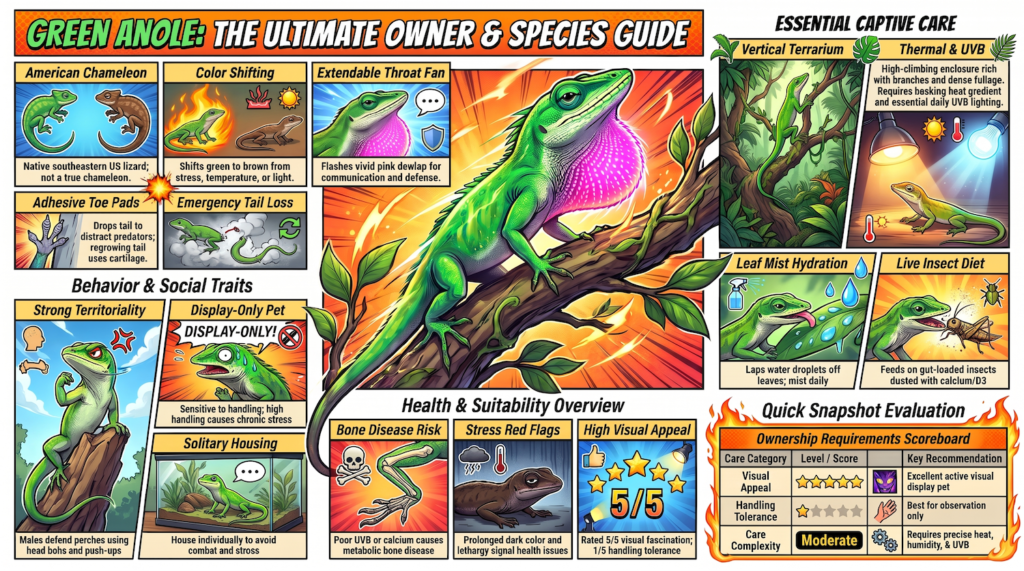
The Green Anole is a small, highly agile lizard native to the southeastern United States. Often found climbing through trees, shrubs, fences and garden vegetation, this remarkable reptile is famous for its ability to change between bright green and various shades of brown.
Although Green Anoles are sometimes called American Chameleons, they aren’t true chameleons. They belong to the family Dactyloidae and possess their own distinctive adaptations, including adhesive toe pads, impressive jumping abilities and expandable throat fans used for communication.
Green Anoles are active, visually oriented lizards that spend much of their time climbing, basking, hunting insects and observing their surroundings. Males are particularly well known for extending their colourful dewlaps while performing head-bobbing displays to communicate with rivals and potential mates.
Their care requires a tall, planted enclosure, appropriate UVB lighting, controlled temperatures, suitable humidity, live insect prey and minimal handling. Although small, Green Anoles are active reptiles that need carefully designed habitats rather than simple, sparsely furnished tanks.
✅ PROS & CONS
👍 Pros
Beautiful green and brown colour changes
Fascinating dewlap and head-bobbing displays
Small adult size
Excellent climbing and jumping abilities
Active and entertaining during daylight hours
Attractive addition to a planted terrarium
Interesting natural hunting behaviour
Suitable for prepared reptile enthusiasts
👎 Cons
Easily stressed by frequent handling
Require carefully controlled temperature and humidity
Need appropriate UVB lighting
Primarily eat live insects
Males can be highly territorial
Small size makes escape prevention essential
Sensitive to dehydration and poor husbandry
Ownership is restricted or prohibited in some countries or regions
Are Green Anoles Good Pets?
Yes. Green Anoles can make fascinating pets for people who enjoy observing active reptiles.
Their climbing, hunting and communication behaviours are particularly entertaining.
However, they are generally display animals rather than reptiles that enjoy frequent handling.
Are Green Anoles Good for Beginners?
Green Anoles can be suitable for well-prepared beginners.
However, they require more specialised environmental management than their small size might suggest.
Correct UVB lighting, humidity, temperature gradients and nutrition are essential.
How Long Do Green Anoles Live?
Green Anoles commonly live approximately 4–8 years in captivity.
Some individuals may live longer with excellent care.
Lifespan depends on genetics, nutrition, environmental conditions and veterinary attention.
How Big Do Green Anoles Get?
Adult Green Anoles generally measure approximately 13–20 cm from nose to tail tip.
Much of this length consists of their long, slender tail.
Males are typically larger and more robust than females.
How Much Do Green Anoles Weigh?
Adult Green Anoles usually weigh approximately 2–6 grams.
Despite their impressive length, they are remarkably lightweight.
Their slender bodies and low weight help them move efficiently through branches and vegetation.
Why Do Green Anoles Change Colour?
Green Anoles change colour through specialised pigment-containing cells in their skin.
Their appearance can shift between green and brown depending on temperature, light, stress, social interactions and other physiological factors.
A brown Green Anole isn’t necessarily unhappy or unhealthy.
Are Green Anoles Chameleons?
No.
Although Green Anoles are sometimes called American Chameleons, they aren’t true chameleons.
Their colour-changing abilities and arboreal lifestyles create superficial similarities, but they belong to different lizard families.
What Is the Difference Between a Green Anole and a Brown Anole?
Green Anoles belong to the species Anolis carolinensis, while Brown Anoles are Anolis sagrei.
Green Anoles can change between green and brown, whereas Brown Anoles generally remain within brown, grey and patterned colour ranges.
Brown Anoles also tend to have a stockier appearance and different body markings.
Are Green Anoles Friendly?
Green Anoles aren’t naturally affectionate towards humans.
However, captive individuals may become accustomed to familiar routines and nearby activity.
They generally prefer remaining within their enclosure rather than being picked up.
Do Green Anoles Recognise Their Owners?
Green Anoles can learn familiar feeding routines and respond to environmental cues.
Some become less fearful around regular caregivers.
However, there is limited evidence that they recognise individual humans in the same way as many social mammals.
Do Green Anoles Like Being Held?
Generally, no.
Green Anoles are small, fast-moving reptiles that can become stressed during handling.
They are best observed within a well-designed enclosure, with handling reserved for necessary care.
Do Green Anoles Bite?
Yes, although bites are usually defensive and rarely serious.
A frightened Green Anole may attempt to bite when restrained.
Their small jaws generally produce only minor discomfort, but unnecessary handling should still be avoided.
Are Green Anoles Aggressive?
Green Anoles aren’t generally aggressive towards humans.
However, males can be highly territorial towards other males.
They may perform head-bobbing displays, extend their dewlaps, chase rivals and occasionally fight.
What Is the Pink Thing Under a Green Anole’s Throat?
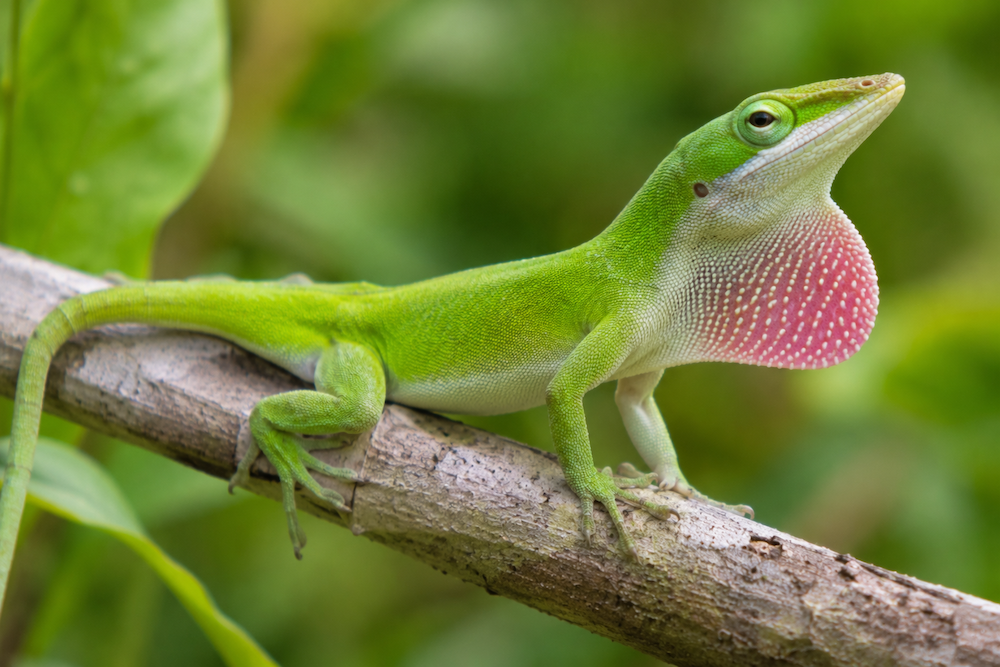
The colourful expandable throat fan is called a dewlap.
Males commonly display their dewlaps during territorial encounters and courtship.
Females may also possess smaller dewlaps, although their appearance varies.
Why Do Green Anoles Bob Their Heads?
Head-bobbing is an important communication behaviour.
Males frequently combine head movements with dewlap displays to signal territory ownership or attract potential mates.
The speed and pattern of these movements can convey different social signals.
Are Green Anoles Active?
Yes.
Green Anoles are active daytime lizards that regularly climb, bask and hunt insects.
They benefit from complex enclosures with branches, foliage and multiple resting locations.
Their activity makes them particularly entertaining to observe.
Are Green Anoles Nocturnal?
No.
Green Anoles are diurnal, meaning they are primarily active during daylight hours.
They usually rest among vegetation or on sheltered branches at night.
A consistent day-night lighting cycle supports normal behaviour.
Can Green Anoles Live Together?
Green Anoles can sometimes be housed in carefully managed groups.
However, males are territorial and should generally not share an enclosure.
Keeping one Green Anole individually is often the safest arrangement, particularly for beginners.
Can Male and Female Green Anoles Live Together?
A male and female may coexist in a sufficiently spacious, well-designed enclosure.
However, persistent courtship, competition and stress can occur.
Separate housing is often preferable unless the keeper has experience managing breeding behaviour and monitoring compatibility.
Can Green Anoles Live With Other Lizards?
Mixed-species housing is generally not recommended.
Different lizards may have incompatible environmental, dietary or behavioural requirements.
Competition, stress, injury and disease transmission are additional concerns.
What Size Enclosure Does a Green Anole Need?
Green Anoles require vertically oriented accommodation with substantial climbing space.
For one adult, a terrarium measuring approximately 45 × 45 × 60 cm is a reasonable starting point, although larger enclosures are preferable.
Additional height, branches and dense foliage support natural arboreal behaviour.
Do Green Anoles Need a Tall Terrarium?
Yes.
Green Anoles spend much of their time climbing through vegetation.
A tall enclosure provides opportunities for basking, exploring and selecting different microclimates.
Horizontal space is also important, so height shouldn’t come at the expense of adequate overall enclosure size.
What Temperature Do Green Anoles Need?
Green Anoles generally thrive with daytime ambient temperatures around 24–28°C.
A localised basking area of approximately 30–32°C allows them to warm themselves.
Cooler areas must remain available, and heating equipment should be controlled and monitored carefully.
What Humidity Do Green Anoles Need?
Green Anoles generally benefit from humidity around 60–80%, with natural fluctuations.
Regular misting, suitable plants and moisture-retaining substrate can help maintain appropriate conditions.
Good ventilation is equally important to prevent persistently stagnant, excessively damp conditions.
Do Green Anoles Need UVB Lighting?
Yes.
Appropriate UVB lighting is important for vitamin D synthesis and healthy calcium metabolism.
A suitable reptile-specific UVB lamp should be positioned according to manufacturer guidance and enclosure design.
UVB exposure must be balanced with access to shaded retreats.
Do Green Anoles Need Water Bowls?
Yes, a small, clean water dish can be provided.
However, Green Anoles frequently drink droplets from leaves and other surfaces.
Regular misting or an appropriately designed dripping system can encourage natural drinking behaviour.
What Do Green Anoles Eat?
Green Anoles are primarily insectivores.
Their captive diet may include appropriately sized crickets, small roaches, flies and other suitable feeder insects.
Prey should be gut-loaded and supplemented with calcium and vitamins according to an appropriate reptile feeding plan.
How Often Should You Feed a Green Anole?
Young Green Anoles generally require feeding more frequently than adults.
Many healthy adults are offered appropriately sized insects several times weekly.
Feeding frequency should reflect age, body condition, activity and veterinary guidance.
Can Green Anoles Eat Fruit?
Green Anoles are primarily insect-eating lizards.
Although they may occasionally investigate or lick soft fruit, fruit isn’t an essential component of their diet.
A varied selection of suitable feeder insects should form the foundation of captive nutrition.
Can Green Anoles Regrow Their Tails?
Yes.
Green Anoles can shed part of their tails through a defensive process called autotomy.
The detached tail may continue moving, distracting a predator while the lizard escapes.
A replacement tail can grow, although it usually differs in structure and appearance from the original.
How Do Green Anoles Breed?
Green Anoles reproduce by laying eggs.
Females typically deposit individual eggs in suitable moist, concealed locations and may produce multiple eggs throughout a breeding season.
Egg development depends on appropriate temperature and humidity.
Captive breeding requires careful planning and suitable accommodation for offspring.
What Health Problems Are Common in Green Anoles?
Potential concerns include metabolic bone disease, dehydration, nutritional deficiencies, respiratory infections, parasites and retained shed.
Improper lighting, poor humidity management and unsuitable temperatures can contribute to serious illness.
A reptile-experienced veterinarian should assess persistent refusal to eat, weakness, abnormal swelling or unusual behaviour.
Are Green Anoles Legal to Keep as Pets?
Green Anoles are legal pets in some countries, but some countries or regions restrict or prohibit their ownership, breeding, sale or importation.
In Australia, Green Anoles are exotic reptiles and are generally prohibited as private pets under strict biosecurity and wildlife regulations.
Prospective owners should verify current national, state and local requirements before attempting to obtain one.
What Makes the Green Anole Unique?
Imagine a tiny lizard capable of changing colour, leaping between branches, climbing smooth surfaces and suddenly displaying a brilliant pink throat fan.
That’s the extraordinary Green Anole.
These fascinating reptiles are among the most recognisable small lizards of the southeastern United States.
Their ability to change colour is perhaps their most famous characteristic.
A Green Anole may appear bright emerald green one moment and brown the next.
Unlike true chameleons, Green Anoles belong to a different evolutionary lineage, but they possess their own specialised colour-changing mechanisms.
Their colour changes can be influenced by temperature, light, stress and social interactions.
Another remarkable adaptation is their climbing ability.
Green Anoles possess specialised adhesive toe pads covered with microscopic structures that help them grip surfaces.
These adaptations allow them to climb branches, leaves, fences and even relatively smooth vertical surfaces.
Their long toes and sharp claws provide additional gripping ability.
Green Anoles are also impressive jumpers.
They can launch themselves between branches and vegetation with surprising speed and accuracy.
Their lightweight bodies and long tails help them manoeuvre through complex environments.
But perhaps their most spectacular feature is the dewlap.
Male Green Anoles possess a colourful expandable throat fan that is usually pink or reddish.
When displaying, a male extends this structure while performing rhythmic head-bobbing movements.
These displays help communicate territorial ownership and courtship intentions.
Scientific research has shown that Anole communication is remarkably sophisticated, with visual signals influenced by environmental conditions and social context.
Their vision is another extraordinary feature.
Green Anoles rely heavily on visual information to detect prey, recognise movement and communicate with other lizards.
Their eyes can move independently to some extent, helping them monitor their surroundings.
Another fascinating adaptation is their ability to escape predators by shedding their tails.
When grabbed by the tail, a Green Anole may release it at specialised fracture points.
The detached tail can continue wriggling, potentially distracting the predator.
Over time, a replacement tail develops, although it doesn’t recreate the original vertebral structure.
Their hunting behaviour is equally impressive.
Green Anoles are active insect predators that use keen vision and rapid movements to capture small prey.
They may remain motionless while watching an insect before suddenly lunging forward.
Their ecological importance is considerable.
In their native habitats, Green Anoles help regulate insect populations while also providing food for birds, snakes and other predators.
They are also important subjects in evolutionary and ecological research.
Scientists have studied Anoles extensively to understand adaptation, competition, communication and the evolution of specialised body structures.
One particularly fascinating area of research involves their interactions with introduced Brown Anoles.
In parts of the southeastern United States, competition with Brown Anoles has influenced where Green Anoles spend their time, often encouraging them to use higher vegetation.
Perhaps most surprising is how much complexity exists within such a tiny animal.
A Green Anole weighs only a few grams, yet it possesses sophisticated visual communication, remarkable climbing adaptations, rapid colour-changing abilities and an extraordinary defence mechanism.
The Green Anole isn’t simply a colourful little lizard — it’s an agile climber, sophisticated visual communicator and remarkable example of reptile adaptation, packed with extraordinary abilities despite its tiny size.