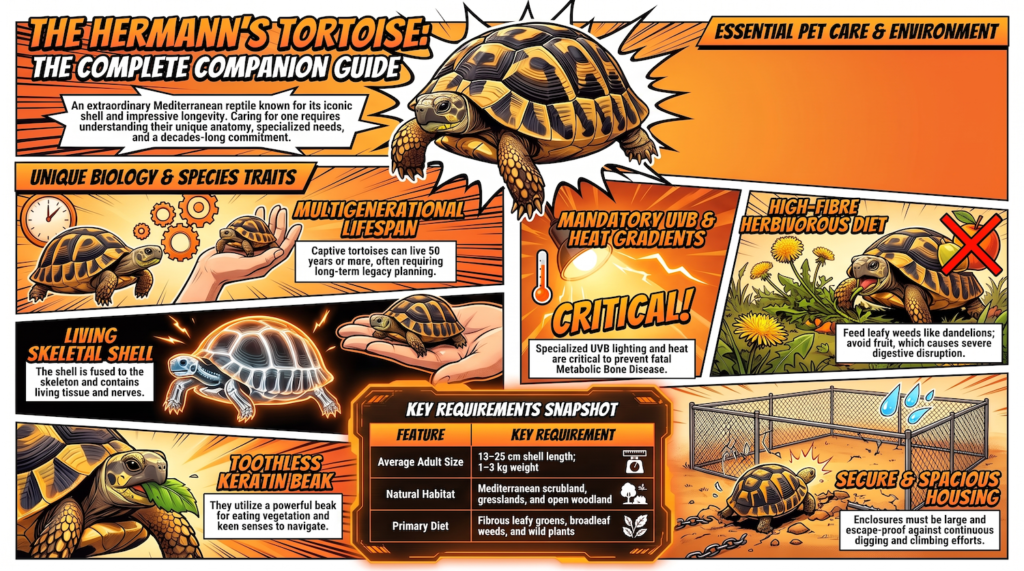








Small, charming and surprisingly full of personality, the Hermann's Tortoise is one of the world's most popular pet tortoises. Native to the Mediterranean.
🧠 QUICK SNAPSHOT
Trait | Hermann’s Tortoise |
|---|---|
Scientific Name | Testudo hermanni |
Other Names | Hermann’s Mediterranean Tortoise |
Pet Type | Land tortoise / Reptile |
Natural Origin | Southern Europe and the Mediterranean |
Typical Lifespan | Around 50–75+ years with excellent care |
Adult Size | Approximately 13–25 cm, depending on subspecies |
Adult Weight | Around 0.5–2.5 kg |
Diet | Primarily herbivorous |
Activity | Diurnal |
Temperament | Curious, active and generally solitary |
Noise Level | Very quiet |
Social Needs | Solitary housing generally recommended |
Housing | Spacious, secure terrestrial enclosure |
Special Requirements | UVB, basking heat and appropriate seasonal care |
Beginner Friendly? | Yes, with proper preparation |
Famous Feature | Beautiful yellow-and-black shell and exceptional longevity |
📚 OVERVIEW
The Hermann’s Tortoise (Testudo hermanni) is a small to medium-sized land tortoise native to parts of southern Europe, including Mediterranean woodlands, grasslands and scrubland.
Two commonly recognised subspecies are the Western Hermann’s Tortoise (Testudo hermanni hermanni) and Eastern Hermann’s Tortoise (Testudo hermanni boettgeri). They differ in average size, geographical distribution and some shell characteristics.
Hermann’s Tortoises are active, curious reptiles that spend much of their time walking, grazing, exploring and basking. Despite their reputation for moving slowly, they can be surprisingly determined explorers.
Their care requires generous floor space, suitable temperatures, UVB exposure, a high-fibre plant-based diet and careful seasonal management. They also need secure boundaries because they’re capable diggers and climbers.
With appropriate husbandry, these beautiful tortoises can remain part of a household for many decades.
✅ PROS & CONS
👍 Pros
Beautiful patterned shell
Fascinating natural behaviours
Generally quiet pets
Long potential lifespan
Curious and active personalities
Primarily plant-based diet
Relatively manageable adult size
Can become familiar with feeding routines
👎 Cons
Potential lifelong commitment
Requires substantial enclosure space
Needs UVB lighting and basking heat
Specialised dietary requirements
Seasonal brumation needs careful management
Not suitable for frequent handling
Can dig or climb out of insecure enclosures
Specialist reptile veterinary care may be needed
Are Hermann’s Tortoises Good Pets?
Yes. Hermann’s Tortoises can make excellent pets for people who appreciate reptiles and are prepared for a very long-term commitment.
They’re curious, active and fascinating to observe.
However, they’re not cuddly animals and require carefully maintained environmental conditions to remain healthy.
Are Hermann’s Tortoises Good for Beginners?
Hermann’s Tortoises are often considered suitable for dedicated beginner reptile keepers.
Their requirements are relatively well understood, but they still need appropriate heating, UVB lighting, nutrition and spacious accommodation.
Their exceptionally long lifespan should be considered before purchasing one.
How Long Do Hermann’s Tortoises Live?
Hermann’s Tortoises can live for 50–75 years or longer with excellent care.
Some individuals may exceed these ages, although lifespan varies according to genetics, health and environmental conditions.
A young Hermann’s Tortoise may outlive its original owner, making long-term care planning important.
How Big Do Hermann’s Tortoises Get?
Adult Hermann’s Tortoises generally reach approximately 13–25 cm in shell length, depending on subspecies, sex and genetics.
Western Hermann’s Tortoises are often smaller than Eastern Hermann’s Tortoises.
Females are generally larger than males.
What Is the Difference Between Eastern and Western Hermann’s Tortoises?
The two commonly recognised subspecies differ in geographical distribution, average size and certain shell characteristics.
Western Hermann’s Tortoises are generally smaller and often have bold yellow-and-black shell markings.
Eastern Hermann’s Tortoises are frequently larger and can show more variable shell patterns.
Individual appearance varies, so identification shouldn’t rely on colour alone.
Are Hermann’s Tortoises Friendly?
Hermann’s Tortoises can become comfortable around familiar caregivers.
Some will approach when they recognise feeding routines or see someone entering their enclosure.
However, they don’t seek affection in the same way as dogs or cats.
Do Hermann’s Tortoises Recognise Their Owners?
They can learn to recognise familiar visual cues, routines and feeding situations.
Some become noticeably more confident around regular caregivers.
Their behaviour reflects learning and familiarity rather than necessarily human-like emotional attachment.
Do Hermann’s Tortoises Like Being Held?
Generally, no.
Most tortoises prefer keeping their feet firmly on the ground.
Frequent handling can cause stress, so interaction should focus on observation and gentle, necessary care.
Do Hermann’s Tortoises Bite?
They can bite, particularly when mistaking fingers for food or feeling threatened.
Although they lack teeth, tortoises have strong, sharp-edged beaks.
Hand-feeding should be approached carefully to avoid accidental bites.
Are Hermann’s Tortoises Active?
Yes. Healthy Hermann’s Tortoises can be surprisingly active during suitable temperatures.
They spend time exploring, grazing, digging and basking.
Their activity levels naturally change with temperature, season and time of day.
What Do Hermann’s Tortoises Eat?
Hermann’s Tortoises are primarily herbivorous.
Their diet should consist mainly of high-fibre, calcium-rich leafy plants and suitable weeds, such as dandelion, plantain and other safe grazing vegetation.
A varied, appropriate plant-based diet helps support healthy digestion and shell development.
Can Hermann’s Tortoises Eat Fruit?
Fruit is generally unsuitable as a regular part of a Hermann’s Tortoise diet.
Their digestive systems are adapted to fibrous vegetation rather than sugary foods.
A diet based on suitable weeds, leaves and grasses is much more appropriate.
Can Hermann’s Tortoises Eat Lettuce?
Some suitable lettuce varieties can be offered occasionally, but lettuce shouldn’t dominate the diet.
Many types contain relatively little fibre and calcium compared with appropriate wild plants.
A varied selection of nutritious leafy vegetation is preferable.
Do Hermann’s Tortoises Need Calcium?
Yes.
Calcium is essential for healthy shell and bone development.
A suitable diet, access to an appropriate calcium source and correct UVB exposure all contribute to proper calcium metabolism.
Do Hermann’s Tortoises Need UVB Lighting?
Absolutely.
UVB exposure allows tortoises to produce vitamin D3, which is essential for calcium metabolism.
Outdoor access to suitable natural sunlight can be valuable, while indoor enclosures require appropriate reptile UVB lighting.
UVB bulbs must be positioned and replaced according to manufacturer guidance.
What Temperature Do Hermann’s Tortoises Need?
Hermann’s Tortoises need a suitable thermal gradient.
A basking area of approximately 32–35°C is commonly provided, with cooler areas available so the tortoise can regulate its body temperature.
Temperature requirements vary with age, season and enclosure design.
Can Hermann’s Tortoises Live Outside?
Yes, in suitable climates.
Outdoor enclosures can provide natural sunlight, fresh air and opportunities for grazing and exploration.
However, they must be secure, predator-resistant and designed to protect the tortoise from extreme heat, cold and excessive moisture.
How Big Should a Hermann’s Tortoise Enclosure Be?
Hermann’s Tortoises need generous floor space because they naturally travel while exploring and foraging.
For an adult, an enclosure of approximately 2 × 1 metres should be regarded as a starting point rather than an ideal maximum, with substantially larger outdoor areas strongly preferred.
Secure boundaries, varied terrain and suitable hiding places are essential.
Do Hermann’s Tortoises Need Water?
Yes.
Fresh drinking water should always be available in a shallow, easily accessible dish.
Although adapted to relatively dry environments, Hermann’s Tortoises still need adequate hydration.
Occasional appropriate soaking may be beneficial, particularly for younger animals.
Do Hermann’s Tortoises Hibernate?
Hermann’s Tortoises naturally undergo a winter dormancy period known as brumation in suitable seasonal conditions.
However, brumation must be managed carefully in captivity.
Age, health, weight and environmental conditions should be assessed by a reptile-experienced veterinarian before attempting a controlled brumation period.
How Long Do Hermann’s Tortoises Hibernate?
In their natural range, winter dormancy can last several months, depending on local climate.
Captive brumation periods vary according to the individual tortoise and management plan.
Improper temperatures, dehydration or underlying illness can make brumation dangerous.
Can Two Hermann’s Tortoises Live Together?
Sometimes, but solitary housing is generally safest.
Hermann’s Tortoises can become territorial, particularly males.
Multiple tortoises may compete for food, basking areas and space, and persistent aggression can cause injuries.
Do Hermann’s Tortoises Get Lonely?
Hermann’s Tortoises don’t require constant companionship from other tortoises.
A single animal can thrive when provided with appropriate housing, enrichment and care.
Keeping multiple tortoises together isn’t necessary for their wellbeing.
Can Hermann’s Tortoises Swim?
Hermann’s Tortoises are land tortoises, not aquatic turtles.
They may paddle briefly if placed in water, but they’re not adapted for sustained swimming and can drown.
Their enclosure should never contain deep, inaccessible water.
Why Does My Hermann’s Tortoise Dig?
Digging is a normal behaviour.
Hermann’s Tortoises may dig to find cooler temperatures, create shelter or investigate their surroundings.
Females may also dig nests when preparing to lay eggs.
Why Is My Hermann’s Tortoise Hiding?
Hiding can be completely normal.
Tortoises often seek shelter when resting, avoiding excessive heat or responding to unfamiliar surroundings.
However, persistent hiding accompanied by appetite loss, weakness or other symptoms may indicate a husbandry or health problem.
Why Is My Hermann’s Tortoise Not Eating?
Reduced appetite can result from unsuitable temperatures, stress, seasonal changes, dehydration or illness.
Because tortoises depend on environmental warmth for normal digestion, incorrect temperatures are a common concern.
Persistent appetite loss should be investigated by a reptile-experienced veterinarian.
What Health Problems Are Common in Hermann’s Tortoises?
Potential problems include metabolic bone disease, respiratory infections, shell abnormalities, parasites and nutritional deficiencies.
Poor UVB exposure, incorrect temperatures and inappropriate diets can contribute to serious health issues.
Preventative husbandry and veterinary care are essential.
What Causes Shell Pyramiding in Hermann’s Tortoises?
Pyramiding describes abnormal raised growth of the shell’s scutes.
It is associated with inappropriate growth conditions, including nutritional imbalance and unsuitable hydration or humidity.
Proper diet, UVB exposure, hydration and environmental management help support healthy shell development.
How Can You Tell if a Hermann’s Tortoise Is Male or Female?
Adult males generally have longer, thicker tails and a more concave underside of the shell.
Females are often larger and have shorter tails.
Sexing young tortoises can be difficult because these characteristics become more obvious with maturity.
How Do Hermann’s Tortoises Reproduce?
Hermann’s Tortoises reproduce by laying eggs.
Females dig nests in suitable soil and deposit a small clutch of eggs.
Incubation temperature influences development and can affect the sex of hatchlings.
Where Do Hermann’s Tortoises Come From?
Hermann’s Tortoises are native to parts of southern Europe, including areas around the Mediterranean.
Their natural habitats include scrubland, open woodland, grassland and rocky landscapes.
They rely on suitable seasonal temperatures, vegetation and shelter to survive.
Are Hermann’s Tortoises Endangered?
Hermann’s Tortoises face threats including habitat destruction, road mortality, wildfires and illegal collection.
The species is classified as Near Threatened on the IUCN Red List.
Responsible captive breeding and conservation efforts are important for protecting wild populations.
Are Hermann’s Tortoises Legal to Keep as Pets?
Ownership and trade regulations vary by country and region.
Hermann’s Tortoises are subject to international wildlife trade controls, and some locations require permits or documentation.
Always obtain tortoises from responsible, legal sources and verify local requirements.
Are Hermann’s Tortoises Good Pets for Children?
They can be fascinating educational pets for children under adult supervision.
However, their specialised care requirements and exceptionally long lifespan mean adults must take responsibility for their wellbeing.
They’re better suited to observation than frequent handling.
What Makes the Hermann’s Tortoise Unique?
Imagine bringing home a tiny tortoise that could still be exploring your garden 50 years from now.
That’s the remarkable reality of owning a Hermann’s Tortoise.
These Mediterranean reptiles have evolved to survive in landscapes where summers can be hot and dry, while winters bring much cooler conditions.
Their sturdy shells provide protection.
Their powerful legs allow them to navigate rocky terrain.
And their ability to adjust their activity according to temperature helps them cope with changing seasons.
But perhaps their most surprising feature is their determination.
A Hermann’s Tortoise may appear slow, yet it can spend hours investigating its surroundings, pushing through vegetation and searching for favourite foods.
They’re also capable of recognising familiar routines.
Some will enthusiastically approach when their caregiver appears, particularly if they associate that person with food.
And despite their relatively small size, these tortoises can have remarkably long lives.
A Hermann’s Tortoise purchased today might still be alive when today’s children become grandparents.
The Hermann’s Tortoise isn’t simply a pet for a few years — it can become a living connection between generations.
Discover why Hermann’s Tortoises can live for decades, how their beautiful shells develop, why they dig and explore, what happens during winter brumation and how these remarkable Mediterranean reptiles survive in the wild.
Watch our Hermann’s Tortoise video and discover the extraordinary secrets behind one of the world’s most popular pet tortoises.