





Beautiful, intelligent and famous for their spectacular colours, Koi are among the world's most treasured ornamental fish.
🧠 QUICK SNAPSHOT
Trait | Koi |
|---|---|
Scientific Name | Cyprinus carpio |
Other Names | Nishikigoi, Ornamental Carp |
Pet Type | Freshwater pond fish |
Origin of Ornamental Varieties | Japan |
Typical Lifespan | Around 20–40+ years |
Adult Size | Commonly 50–90 cm |
Potential Weight | Several kilograms, sometimes exceeding 10 kg |
Diet | Omnivore |
Activity | Diurnal |
Temperament | Generally peaceful and social |
Water Type | Freshwater |
Housing | Large, well-filtered outdoor pond |
Social Needs | Benefits from compatible fish companions |
Beginner Friendly? | Moderate to advanced |
Famous Feature | Spectacular colours and patterns |
📚 OVERVIEW
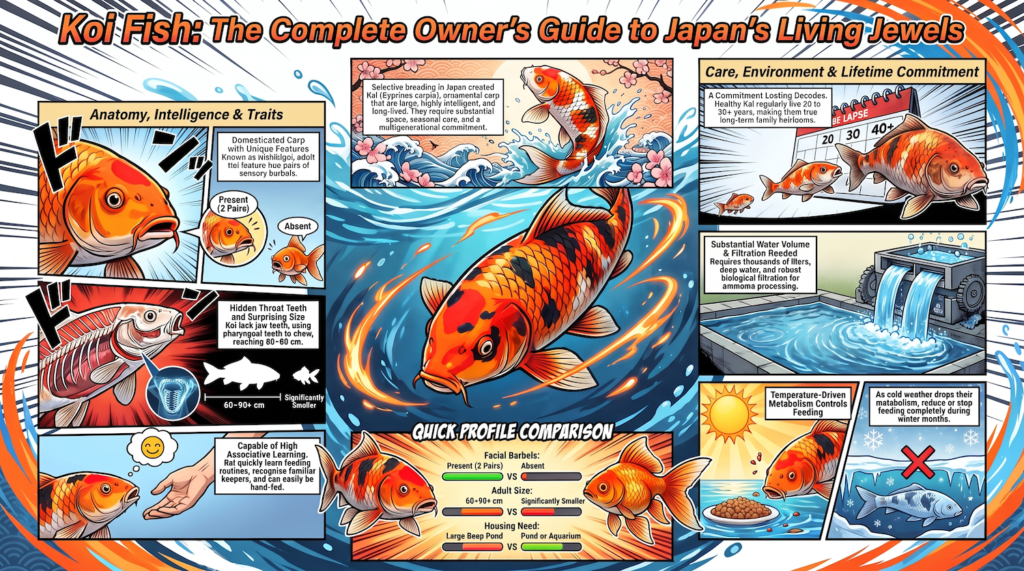
Koi (Cyprinus carpio) are domesticated ornamental varieties of the common carp, selectively bred for their extraordinary colours, patterns and body characteristics.
Known in Japan as Nishikigoi, meaning roughly “brocaded carp”, these remarkable fish have become symbols of beauty, perseverance and good fortune.
Koi are much more than colourful pond decorations. They’re intelligent, active fish that can learn feeding routines, recognise familiar visual cues and become surprisingly interactive with their keepers.
However, their substantial adult size means they require large ponds, powerful biological filtration, excellent water quality and appropriate long-term care.
A well-maintained Koi pond can become a magnificent feature of a garden — and its residents may remain there for decades.
✅ PROS & CONS
Pros
Spectacular colours and patterns
Intelligent and interactive
Generally peaceful temperament
Can recognise feeding routines
Fascinating social behaviour
Long lifespan
Numerous ornamental varieties
Beautiful addition to a suitable garden pond
Cons
Requires a large pond
Can grow extremely big
Powerful filtration is essential
Significant long-term maintenance
Sensitive to poor water quality
Vulnerable to predators
Specialist veterinary care may be needed
Potential commitment of several decades
Are Koi Good Pets?
Yes. Koi can make extraordinary pets for people with the space, resources and commitment to maintain a suitable pond.
They’re intelligent, interactive and often become remarkably comfortable around familiar caregivers.
However, they’re large, long-lived fish with substantial environmental needs.
Are Koi Good for Beginners?
Koi are generally better suited to people prepared to learn about pond filtration, water chemistry and fish health.
Their care isn’t necessarily complicated once a suitable system is established, but mistakes involving water quality can have serious consequences.
How Long Do Koi Live?
Koi commonly live around 20–40 years, with some individuals living considerably longer under exceptional conditions.
Claims of extraordinary ages exist, but they shouldn’t be treated as typical.
A young Koi may become a companion for several decades.
How Big Do Koi Get?
Adult Koi commonly reach around 50–90 cm, depending on genetics, nutrition and environmental conditions.
Some exceptional individuals grow even larger.
This is why Koi should never be purchased based solely on the size of a small juvenile.
What Is the Difference Between Koi and Goldfish?
Koi are ornamental varieties of common carp, while Goldfish are domesticated forms of Carassius auratus.
Koi generally grow much larger and usually possess small sensory structures called barbels around the mouth, which Goldfish lack.
Both belong to the carp family, Cyprinidae.
What Do Koi Eat?
Koi are omnivores.
A quality, nutritionally balanced Koi pellet or formulated pond fish food should form the foundation of their diet.
Suitable supplementary foods can provide variety, but feeding needs vary with water temperature, season and fish condition.
How Often Should Koi Be Fed?
Feeding frequency depends heavily on water temperature and activity.
During warmer conditions, healthy Koi may be fed small appropriate portions regularly.
As water temperatures fall, their metabolism slows and feeding requirements decrease substantially.
Can Koi Eat Fruit and Vegetables?
Some suitable vegetables and fruits can be offered occasionally as supplementary foods.
However, these shouldn’t replace a balanced formulated Koi diet.
Food should be offered in appropriate portions to avoid polluting the pond.
Do Koi Need a Large Pond?
Absolutely.
Koi grow into substantial fish and produce considerable waste.
They require a large pond with adequate swimming space, depth, filtration and oxygenation.
Small ornamental water features are generally unsuitable for long-term Koi keeping.
How Deep Should a Koi Pond Be?
A dedicated Koi pond commonly benefits from a depth of approximately 1.2–1.5 metres or more, depending on climate and design.
Depth helps provide stable conditions and room for large fish.
Pond volume, surface area, filtration and stocking levels are equally important.
Can Koi Live in an Aquarium?
Small juvenile Koi can sometimes be housed temporarily in appropriately sized aquarium systems.
However, their rapid growth and eventual adult size make ordinary household aquariums unsuitable as permanent homes.
A properly designed pond is generally the better long-term environment.
Do Koi Need a Filter?
Yes.
Koi produce substantial biological waste, making effective filtration essential.
A suitable pond system requires mechanical filtration to remove debris and biological filtration to process ammonia and nitrite.
Adequate water circulation and oxygenation are also important.
Do Koi Need an Air Pump?
Many Koi ponds benefit from additional aeration, particularly during warm weather or when fish stocking levels are high.
Dissolved oxygen is essential for both the fish and the beneficial bacteria involved in biological filtration.
Can Koi Live With Goldfish?
Yes, Koi and Goldfish can sometimes coexist successfully in a sufficiently large, well-maintained pond.
However, both species need appropriate space, nutrition and water quality.
Large Koi may also outcompete smaller fish during feeding.
Can Koi Live Alone?
Koi are generally social fish and benefit from an environment containing compatible fish companions.
They commonly swim and forage alongside other Koi.
However, adding more fish must never come at the expense of appropriate pond volume and filtration.
Are Koi Aggressive?
Koi are generally peaceful.
They may compete enthusiastically during feeding, and breeding behaviour can involve vigorous chasing.
Persistent aggression isn’t typical of healthy, appropriately housed Koi.
Can Koi Recognise Their Owners?
Koi can learn to associate familiar people, movements and environmental cues with feeding.
Some become comfortable approaching the pond edge when their regular caregiver appears.
This behaviour reflects learning and familiarity rather than necessarily human-like affection.
Can You Train Koi?
Yes.
Koi can learn simple routines through repeated positive associations.
They may respond to feeding locations, particular visual signals or familiar movements.
Their ability to learn is one reason they can become surprisingly interactive pets.
Do Koi Like Being Touched?
Some Koi become accustomed to approaching a person’s hand, especially during feeding.
However, frequent touching isn’t recommended because it can damage the fish’s protective mucus coating, which helps defend against infection.
Observation and appropriate feeding interaction are safer.
Why Do Koi Change Colour?
Koi colour can change as they mature.
Genetics, age, diet, environmental conditions and pigment development can all influence appearance.
Some varieties undergo particularly noticeable changes in pattern or colour intensity over time.
What Are the Most Popular Koi Varieties?
Some of the best-known varieties include:
Kohaku — white body with red markings
Taisho Sanke — white with red and black markings
Showa Sanshoku — black-based pattern with red and white
Ogon — metallic single-colour Koi
Asagi — blue-grey patterned back with red or orange areas
Shusui — a largely scaleless variety with distinctive dorsal scales
The enormous range of patterns makes Koi collecting particularly fascinating.
What Makes a Koi Valuable?
Koi value depends on factors including body conformation, colour quality, pattern, skin appearance, bloodline, size and overall condition.
High-quality show Koi can command extraordinary prices.
However, a beautiful and healthy pond fish doesn’t need to be an expensive competition specimen.
What Is the Most Expensive Koi Ever Sold?
An exceptional Kohaku named S Legend was reportedly sold at auction in 2018 for approximately ¥203 million, often described as around US$1.8 million at the time.
Such prices are extraordinary exceptions, reflecting elite breeding and competition standards rather than normal pet Koi values.
Do Koi Sleep?
Koi have periods of reduced activity and rest, although fish sleep differs from human sleep.
They may become less active during darkness or rest in sheltered areas.
Because Koi don’t have eyelids, they don’t close their eyes when resting.
Can Koi Survive Winter?
Koi can tolerate cool seasonal conditions when their pond is properly designed.
As temperatures fall, their metabolism slows and feeding requirements change.
In colder climates, sufficient pond depth, oxygenation and appropriate winter management are essential.
Why Are My Koi Gasping at the Surface?
Surface gasping can indicate low dissolved oxygen, poor water quality or problems affecting the gills.
It’s a warning sign that should be investigated promptly.
Checking oxygenation, temperature, ammonia and nitrite levels is particularly important.
What Health Problems Are Common in Koi?
Potential concerns include parasites, bacterial infections, ulcers, gill problems and diseases associated with poor water quality.
Koi herpesvirus disease is a particularly serious infectious disease affecting susceptible carp.
Quarantining new fish and maintaining excellent pond conditions help reduce health risks.
Why Is My Koi Rubbing Against the Pond?
Rubbing or flashing against surfaces may indicate irritation.
Possible causes include parasites, unsuitable water chemistry or other skin and gill problems.
Repeated flashing should prompt water testing and appropriate health investigation.
How Do Koi Reproduce?
Koi reproduce by spawning.
During breeding, males may chase females, which release eggs that are fertilised externally.
The adhesive eggs attach to aquatic plants or other suitable surfaces.
Adult Koi may eat eggs and young, so dedicated breeding arrangements are commonly used.
Where Did Koi Originate?
The ornamental Koi varieties familiar today were developed through selective breeding in Japan, particularly in the Niigata region.
Carp had been kept for food long before colourful individuals were selectively bred into the spectacular Nishikigoi varieties recognised today.
Are Koi Legal to Keep as Pets?
Ownership, importation and movement restrictions vary between countries and regions.
Because carp can cause significant environmental damage when introduced into unsuitable waterways, regulations may restrict Koi keeping in some locations.
Always check local requirements and never release Koi into natural waterways.
Are Koi a Good First Pond Fish?
They can be suitable for someone willing to invest in a properly designed pond and learn the fundamentals of fishkeeping.
However, their adult size, waste production and longevity make them more demanding than many smaller ornamental pond fish.
The pond should be designed for the fully grown Koi, not the tiny fish purchased today.
What Makes the Koi Unique?
Imagine keeping a fish that might still be swimming in your pond 30 or 40 years from now.
Now imagine that fish growing close to a metre long.
And recognising the routine that means dinner is about to arrive.
That’s the Koi.
But perhaps the most extraordinary part of their story is how they became so beautiful.
Their ancestors were ordinary carp.
Through generations of selective breeding, people developed fish with spectacular combinations of white, red, black, blue, yellow and metallic colours.
Some resemble living paintings.
Others appear almost sculpted from gold.
And the very best specimens have been sold for astonishing sums.
Yet even an ordinary pond Koi shares the same remarkable qualities.
Intelligence.
Longevity.
Size.
And a presence that becomes more impressive as the years pass.
A Koi pond isn’t simply a garden feature. It’s a living collection of animals that may grow and change alongside your family for decades.
Discover how Koi became some of the world’s most beautiful ornamental fish, why certain specimens sell for extraordinary prices, how these intelligent carp learn feeding routines and what it takes to care for a fish that may live for decades.
Watch our Koi video and discover why these magnificent fish have fascinated pond keepers for generations.