







Colourful, peaceful and constantly on the move, Molly Fish are among the most popular freshwater aquarium pets. These lively little fish come in an amazing variety of colours and shapes.
🧠 QUICK SNAPSHOT
Trait | Molly Fish |
|---|---|
Scientific Name | Poecilia species, particularly P. sphenops, P. latipinna and P. velifera |
Other Names | Molly, Common Molly, Black Molly |
Pet Type | Freshwater Aquarium Fish |
Natural Origin | Central America, Mexico and parts of North and South America |
Typical Lifespan | Around 3–5 years |
Adult Size | Approximately 6–15 cm, depending on variety |
Adult Weight | Usually just a few grams |
Colours | Black, white, orange, gold, silver and combinations |
Diet | Omnivore |
Activity | Diurnal |
Temperament | Generally peaceful, active and social |
Noise Level | Silent |
Social Needs | Best kept in compatible groups |
Water Temperature | Approximately 24–28°C |
Water pH | Generally 7.5–8.5 |
Tank Size | Around 75–110+ litres for smaller varieties; larger for Sailfins |
Beginner Friendly? | Yes, with stable water conditions |
Famous Feature | Live-bearing reproduction and remarkable colour varieties |
📚 OVERVIEW
Molly Fish are popular tropical aquarium fish belonging to the genus Poecilia. They’re closely related to Guppies and are famous for their colourful appearances, peaceful personalities and fascinating reproductive behaviour.
Popular varieties include Black Mollies, Dalmatian Mollies, Gold Dust Mollies, Balloon Mollies and Sailfin Mollies. Their appearance varies considerably, from compact fish with rounded fins to larger varieties with spectacular dorsal fins.
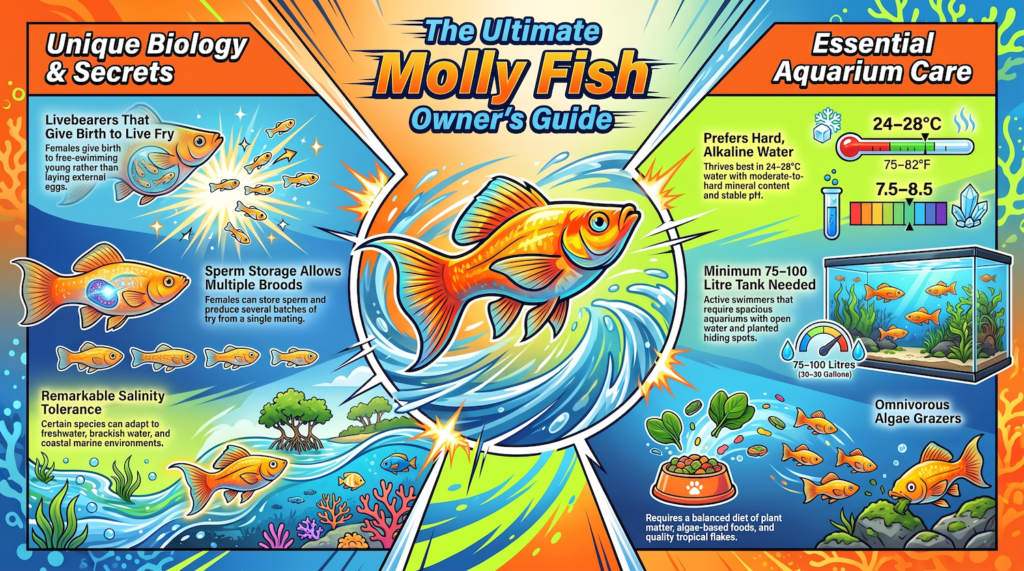
Mollies are active swimmers that enjoy exploring planted aquariums and grazing on algae. Unlike many other popular tropical fish, they generally prefer hard, alkaline water and can tolerate varying levels of salinity when properly acclimated.
They’re livebearers, meaning females give birth to free-swimming young rather than laying eggs. Their rapid reproduction makes them particularly interesting but requires careful aquarium planning.
✅ PROS & CONS
👍 Pros
Beautiful variety of colours
Generally peaceful temperament
Active and entertaining swimmers
Suitable for community aquariums
Relatively easy to feed
Fascinating live-bearing reproduction
Enjoy grazing on algae
Good for prepared beginners
👎 Cons
Breed very frequently
Prefer specific water conditions
Need adequate swimming space
Males may harass females
Sensitive to poor water quality
Some varieties grow quite large
Can develop health problems when stressed
Balloon varieties may have welfare concerns
Are Molly Fish Good Pets?
Yes. Molly Fish make excellent aquarium pets for people who enjoy colourful, active tropical fish.
They’re generally peaceful and adapt well to appropriately maintained community aquariums.
However, they need stable water conditions, sufficient swimming space and compatible tankmates.
Are Molly Fish Good for Beginners?
Yes, Molly Fish can be suitable for beginners who understand basic aquarium maintenance.
They are relatively hardy when kept in suitable conditions.
However, their preference for hard, alkaline water makes them less adaptable to some aquariums than other beginner fish.
How Long Do Molly Fish Live?
Molly Fish typically live around 3–5 years.
Their lifespan depends on genetics, water quality, nutrition and overall care.
Stable aquarium conditions and a balanced diet help support healthy ageing.
How Big Do Molly Fish Get?
Size varies considerably between species and varieties.
Common Mollies often reach approximately 6–10 cm, while larger Sailfin Mollies may reach 12–15 cm or more.
Females are generally larger than males.
What Are the Different Types of Molly Fish?
Popular Molly varieties include:
Black Molly — striking solid-black colouring
Dalmatian Molly — white or silver with black spots
Gold Dust Molly — distinctive gold-and-black pattern
Sailfin Molly — impressive enlarged dorsal fin
Lyretail Molly — elongated upper and lower tail extensions
Balloon Molly — unusually rounded body shape
White Molly — bright white or silver appearance
Many colour and fin varieties are produced through selective breeding.
Are Molly Fish Peaceful?
Generally, yes.
Mollies are social fish that usually coexist well with other peaceful aquarium species.
However, males may chase females or compete with other males, particularly in overcrowded tanks.
How Many Molly Fish Should Be Kept Together?
Mollies generally do best in compatible groups.
A group of four to six or more can work well when the aquarium is appropriately sized.
If keeping both sexes, maintaining more females than males helps reduce persistent mating harassment.
Can Molly Fish Live Alone?
Although a Molly can survive alone, solitary housing isn’t generally ideal.
Mollies benefit from the presence of compatible companions.
A suitable group provides opportunities for natural social behaviour.
What Size Tank Do Molly Fish Need?
For smaller common Molly varieties, an aquarium of approximately 75–110 litres or larger is a useful starting point.
Larger Sailfin Mollies need substantially more swimming space.
Tank dimensions, filtration and the number of fish are just as important as total water volume.
What Water Temperature Do Molly Fish Need?
Mollies generally thrive at temperatures around 24–28°C.
A reliable aquarium heater helps maintain stable conditions.
Sudden temperature fluctuations can cause stress and increase susceptibility to disease.
What pH Do Molly Fish Prefer?
Mollies generally prefer slightly alkaline to alkaline water.
A pH of approximately 7.5–8.5 is suitable for many commonly kept varieties.
They also benefit from adequate mineral hardness.
Stable conditions are more important than repeatedly adjusting water chemistry.
Do Molly Fish Need Salt in Their Tank?
Not necessarily.
Mollies can thrive in freshwater when the water contains suitable mineral hardness and alkalinity.
Some populations tolerate brackish conditions, but routine salt addition isn’t required for healthy freshwater Mollies.
Salt can also harm certain plants and tankmates.
What Do Molly Fish Eat?
Mollies are omnivores.
A balanced diet should include quality tropical fish food, algae-based foods and suitable vegetable matter.
Occasional small portions of frozen or live foods can provide additional variety.
Do Molly Fish Eat Algae?
Yes.
Mollies naturally graze on algae and other organic material growing on aquarium surfaces.
However, they won’t eliminate every type of algae and shouldn’t be relied upon as the aquarium’s cleaning system.
How Often Should You Feed Molly Fish?
Adult Mollies can generally be fed once or twice daily.
Offer only what they can consume within a short period.
Overfeeding can contribute to poor water quality and health problems.
Can Molly Fish Live With Guppies?
Yes, Mollies and Guppies can often live together successfully.
Both generally prefer hard, alkaline water and have peaceful temperaments.
However, adequate space and compatible water conditions are essential.
Can Molly Fish Live With Betta Fish?
Sometimes, but the combination can be unpredictable.
Some Bettas may react aggressively to active Mollies, while individual Mollies may nip fins.
Their water preferences can also differ, so this isn’t usually the easiest community aquarium combination.
Can Molly Fish Live With Goldfish?
Generally, no.
Goldfish usually prefer cooler water than tropical Mollies and produce considerable waste.
Their different environmental requirements make them unsuitable long-term tankmates.
How Can You Tell Male and Female Molly Fish Apart?
Male Mollies have a modified anal fin called a gonopodium, which is used during reproduction.
Females have a broader, fan-shaped anal fin and are often larger.
Males of some species also develop more prominent dorsal fins.
How Do Molly Fish Reproduce?
Mollies are livebearers.
After internal fertilisation, females give birth to fully formed, free-swimming fry.
Females can also store sperm and produce multiple broods following a previous mating.
How Many Babies Do Molly Fish Have?
A female Molly may give birth to approximately 20–100 fry, although the number varies considerably.
Larger, mature females may produce bigger broods.
Without population management, Molly numbers can increase rapidly.
How Long Are Molly Fish Pregnant?
Gestation commonly lasts approximately four to six weeks, depending on temperature, species and individual conditions.
Females may develop a noticeably enlarged abdomen as birth approaches.
A gravid spot may also become visible in some colour varieties.
Do Molly Fish Eat Their Babies?
Yes, adult Mollies may eat newborn fry.
Dense plants, floating vegetation and other hiding places can improve fry survival.
Separate rearing accommodation may be useful when intentionally breeding Mollies.
Why Is My Molly Fish Hiding?
Hiding can result from stress, bullying, unsuitable water conditions or illness.
Pregnant females may also seek sheltered areas.
Persistent hiding should prompt a check of water parameters and the fish’s overall behaviour.
What Health Problems Are Common in Molly Fish?
Potential concerns include ich, fin rot, fungal infections, parasites and swim bladder-related symptoms.
Poor water quality and unsuitable mineral conditions can contribute to illness.
New fish should ideally be quarantined before joining an established aquarium.
What Is Molly Fish Shimmies?
Shimmies describes a condition in which a fish rocks or shakes from side to side without swimming normally.
It is often associated with stress caused by unsuitable water chemistry, temperature or other environmental problems.
Correcting the underlying conditions is essential.
Where Do Molly Fish Come From?
Wild Molly species inhabit parts of Mexico, Central America and the Americas, depending on species.
They occur in freshwater habitats such as streams, rivers, ponds and coastal waterways.
Some populations also inhabit brackish environments.
What Makes the Molly Fish Unique?
Imagine an aquarium fish that can give birth to dozens of tiny, fully formed babies without ever laying an egg.
That’s the remarkable Molly Fish.
Unlike many familiar aquarium species, Mollies are livebearers.
Their young develop inside the female and emerge as miniature fish capable of swimming and feeding almost immediately.
Even more surprisingly, female Mollies can store sperm after mating, allowing them to produce additional broods without another encounter with a male.
But reproduction isn’t their only fascinating ability.
Mollies are unusually adaptable when it comes to water chemistry.
While most aquarium fish are strongly associated with freshwater or saltwater environments, some Molly species naturally inhabit both freshwater and brackish habitats.
Their bodies possess specialised mechanisms for regulating internal salt and water balance.
Then there are their spectacular appearances.
Selective breeding has produced Mollies in almost every imaginable combination of black, white, orange, yellow and silver.
Some have flowing lyre-shaped tails, while Sailfin Mollies can display dramatic dorsal fins during courtship.
And despite their delicate appearance, Mollies are active, curious fish that spend much of their day exploring and grazing.
The Molly Fish may be a familiar aquarium favourite, but its extraordinary reproductive abilities, colourful varieties and adaptability make it one of the most fascinating little fish you can keep.