







Colourful, peaceful and wonderfully easy to care for, Platy Fish are lively freshwater aquarium favourites that bring constant movement and personality to any tropical fish tank.
🧠 QUICK SNAPSHOT
Trait | Platy Fish |
|---|---|
Scientific Name | Xiphophorus maculatus and Xiphophorus variatus |
Other Names | Southern Platyfish, Variatus Platy, Platy |
Pet Type | Freshwater Aquarium Fish |
Natural Origin | Mexico and Central America |
Typical Lifespan | Around 3–5 years |
Adult Size | Approximately 4–7 cm |
Adult Weight | Usually a few grams |
Colours | Red, orange, yellow, blue, black, white and multicoloured |
Diet | Omnivore |
Activity | Diurnal |
Temperament | Peaceful, active and social |
Noise Level | Silent |
Social Needs | Best kept in compatible groups |
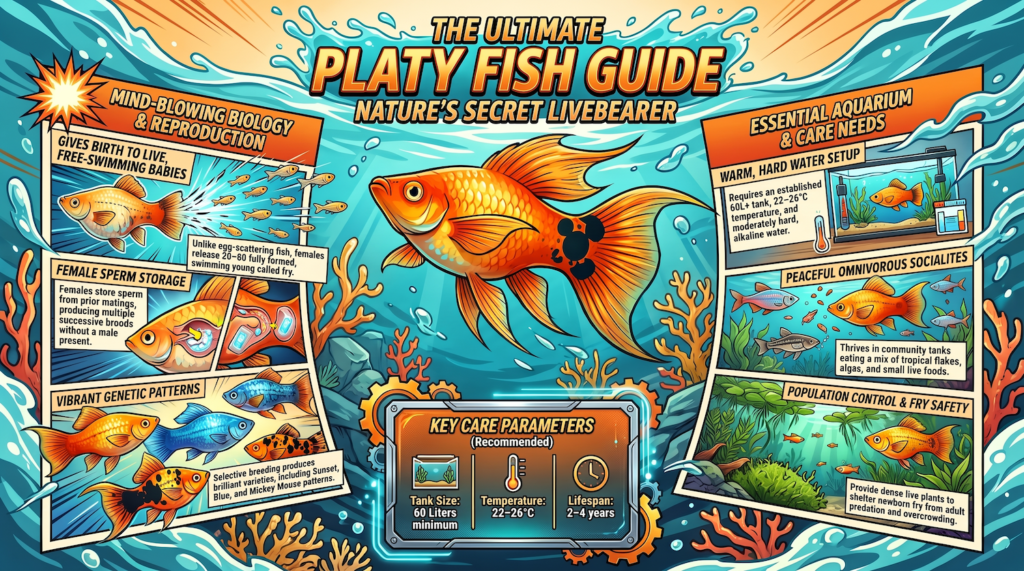
Water Temperature | Approximately 22–26°C for common Southern Platies |
Water pH | Approximately 7.0–8.2 |
Tank Size | Around 60–75 litres or larger for a small group |
Breeding | Livebearer |
Beginner Friendly? | Yes |
Famous Feature | Brilliant colours and ability to give birth to live young |
📚 OVERVIEW
The Platy Fish is one of the most popular freshwater aquarium fish, admired for its bright colours, peaceful temperament and relatively straightforward care requirements.
Native to Mexico and Central America, Platies belong to the Xiphophorus genus, which also includes Swordtails. Two commonly kept species are the Southern Platyfish (Xiphophorus maculatus) and the Variatus Platy (Xiphophorus variatus). Many aquarium varieties have been developed through selective breeding and hybridisation.
Platies are active, social fish that spend much of their time exploring the aquarium, searching for food and interacting with other fish. Their manageable size and adaptability make them particularly appealing to beginner aquarists.
Their care requires a properly cycled aquarium, stable water conditions, suitable filtration, a balanced diet and compatible tankmates. They also breed readily, so owners should be prepared for the possibility of unexpected baby fish.
✅ PROS & CONS
👍 Pros
Excellent beginner aquarium fish
Bright colours and beautiful patterns
Peaceful and generally sociable
Relatively easy to feed
Active and entertaining swimmers
Suitable for community aquariums
Many attractive colour varieties
Fascinating livebearing reproduction
👎 Cons
Breed rapidly in mixed-sex groups
Can overcrowd smaller aquariums
Require stable water quality
Need regular aquarium maintenance
Males may persistently chase females
Vulnerable to aggressive tankmates
Susceptible to common fish diseases
Prefer harder water than some tropical species
Are Platy Fish Good Pets?
Yes. Platy Fish are excellent aquarium pets, particularly for people beginning their fishkeeping journey.
They’re colourful, peaceful and entertaining to observe.
Their relatively simple care requirements make them a popular choice for community freshwater aquariums.
Are Platy Fish Good for Beginners?
Yes.
Platies are among the most beginner-friendly tropical fish.
They’re generally hardy, accept a variety of suitable foods and adapt well to stable aquarium conditions.
However, they still require a properly cycled tank and regular water testing.
How Long Do Platy Fish Live?
Platy Fish typically live around 3–5 years.
Their lifespan depends on genetics, diet, water quality and overall care.
Stable conditions and a balanced diet help support a healthy life.
How Big Do Platy Fish Get?
Adult Platies generally reach approximately 4–7 cm in length.
Females are usually larger and fuller-bodied than males.
Size varies depending on species, genetics and environmental conditions.
What Are the Different Types of Platy Fish?
Popular aquarium varieties include:
Red Wag Platy — red body with contrasting black fins
Sunset Platy — beautiful yellow-to-orange colouring
Mickey Mouse Platy — distinctive markings near the tail
Tuxedo Platy — dark body markings with colourful areas
Blue Platy — attractive bluish colouring
Panda Platy — contrasting black-and-white patterns
Variatus Platy — colourful, often slightly more elongated fish
Many varieties are selectively bred colour forms rather than separate species.
Are Platy Fish Peaceful?
Yes.
Platies are generally peaceful fish that coexist well with suitable community aquarium species.
However, males may chase females during courtship.
Adequate space, hiding places and appropriate group composition help reduce stress.
How Many Platy Fish Should Be Kept Together?
Platies are social fish that generally do best in small groups.
A group of five or more is a useful starting point when the aquarium is sufficiently large.
For mixed-sex groups, keeping more females than males can reduce persistent mating attention.
Can Platy Fish Live Alone?
Platies can survive alone, but solitary housing isn’t generally ideal.
They usually display more natural social behaviours when kept with compatible companions.
A suitable group is preferable when aquarium space allows.
What Size Tank Do Platy Fish Need?
A tank of approximately 60–75 litres or larger is a practical starting point for a small group of Platies.
Larger aquariums provide more swimming space and greater water stability.
Extra capacity is important if the fish begin breeding.
What Water Temperature Do Platy Fish Need?
Common Southern Platies generally thrive around 22–26°C.
Variatus Platies often tolerate somewhat cooler conditions.
Avoid sudden temperature changes, and choose a temperature appropriate for the particular variety and its tankmates.
What pH Do Platy Fish Prefer?
Platies generally prefer neutral to slightly alkaline water.
A pH of approximately 7.0–8.2 is commonly suitable.
They also tend to do well in moderately hard to hard water.
Stable conditions are more important than constantly adjusting water chemistry.
Do Platy Fish Need a Heater?
In many homes, yes.
A heater helps maintain a stable temperature, particularly where room temperatures fluctuate.
In consistently warm environments, additional heating may not always be necessary.
A thermometer should be used to monitor conditions.
Do Platy Fish Need a Filter?
Yes.
A suitable aquarium filter helps process waste and maintain healthy water conditions.
Biological filtration is especially important for controlling toxic ammonia and nitrite.
Regular maintenance and water changes remain necessary even with an effective filter.
How Often Should You Change Platy Tank Water?
Many Platy aquariums benefit from weekly water changes of approximately 20–30%.
The appropriate amount depends on stocking levels, feeding and measured water quality.
Replacement water should be dechlorinated and reasonably temperature-matched.
What Do Platy Fish Eat?
Platies are omnivores.
A balanced diet should include quality tropical fish flakes or micro-pellets, supplemented with suitable vegetable-based foods.
Occasional frozen or live foods can provide additional variety.
How Often Should You Feed Platy Fish?
Adult Platies are commonly fed once or twice daily.
Offer only what they can consume within a short period.
Overfeeding can pollute the aquarium and contribute to health problems.
Can Platy Fish Live With Guppies?
Yes.
Platies and Guppies are generally compatible because both are peaceful livebearers that prefer similar water conditions.
A sufficiently spacious aquarium helps prevent overcrowding.
Both species can reproduce rapidly.
Can Platy Fish Live With Mollies?
Yes.
Platies and Mollies often coexist successfully in community aquariums.
Both generally prefer harder, alkaline water.
However, Mollies can grow considerably larger and may need more space.
Can Platy Fish Live With Bettas?
Sometimes.
Compatibility depends heavily on the individual Betta’s temperament.
Some Bettas tolerate peaceful Platies, while others may chase or attack them.
Close observation and a backup housing option are important.
Can Platy Fish Live With Goldfish?
Generally, this isn’t recommended.
Goldfish often have different temperature preferences, grow much larger and produce substantial waste.
Larger Goldfish may also eat small Platies.
How Can You Tell Male and Female Platy Fish Apart?
Male Platies have a modified anal fin called a gonopodium, which is narrow and pointed.
Females have a broader, fan-shaped anal fin.
Females are also generally larger and more rounded.
How Often Do Platy Fish Have Babies?
Female Platies may give birth approximately every four to six weeks under suitable conditions.
The timing varies with temperature, age and individual health.
Females can also store sperm, allowing them to produce additional broods without another mating.
Do Platy Fish Lay Eggs?
No.
Platies are livebearing fish, meaning females give birth to free-swimming young rather than laying eggs externally.
The babies are known as fry.
They can begin swimming and searching for food shortly after birth.
How Many Babies Can a Platy Fish Have?
A female Platy may produce approximately 20–50 fry per brood, although numbers vary considerably.
Larger, mature females can sometimes produce more.
Not all fry survive, especially in community aquariums.
Do Platy Fish Eat Their Babies?
Yes.
Adult Platies may eat newborn fry, including their own offspring.
Dense plants and hiding places can improve fry survival.
Breeders may also use separate rearing aquariums.
What Health Problems Are Common in Platy Fish?
Potential concerns include ich, fin rot, fungal infections, parasites and swim bladder-related symptoms.
Poor water quality, stress and unsuitable temperatures can contribute to illness.
Quarantining new fish and maintaining stable aquarium conditions help reduce risks.
What Makes the Platy Fish Unique?
Imagine a tiny fish that comes in almost every colour of the rainbow, gives birth to fully formed babies and can produce several generations of offspring in a single year.
That’s the extraordinary Platy Fish.
These colourful little swimmers are among the most fascinating livebearing fish in the aquarium world.
Unlike many fish that lay eggs, female Platies give birth to live, free-swimming young.
A single female may produce dozens of babies at a time, and she can even store sperm after mating, allowing additional broods to develop later.
But their reproductive abilities are only part of their remarkable story.
Platies are closely related to Swordtails, and these fish have played an important role in scientific research, including studies involving genetics, pigmentation and cancer biology.
Their incredible variety of colours is another fascinating feature.
Selective breeding has produced Platies with brilliant red, orange, yellow, blue and black markings.
Some varieties even have a pattern near the tail resembling the silhouette of Mickey Mouse.
Despite their small size, Platies are active explorers.
They constantly investigate plants, decorations and feeding areas, making them particularly entertaining aquarium residents.
Their peaceful temperament also allows them to share suitable aquariums with many other small tropical fish.
The Platy Fish may be small, but its spectacular colours, remarkable reproductive abilities and lively personality make it one of the most delightful freshwater fish you can own.