







Colourful, energetic and instantly recognisable by their spectacular sword-shaped tails, Swordtail Fish are fascinating freshwater aquarium favourites famous for their lively personalities, beautiful colours and remarkable breeding abilities.
🧠 QUICK SNAPSHOT
Trait | Swordtail Fish |
|---|---|
Scientific Name | Xiphophorus hellerii |
Other Names | Green Swordtail, Red Swordtail, Swordtail Livebearer |
Pet Type | Freshwater Aquarium Fish |
Natural Origin | Mexico and Central America |
Typical Lifespan | Approximately 3–5 years |
Adult Size | Males approximately 8–12 cm; females 10–14 cm, excluding the male’s sword |
Adult Weight | Generally a few grams to around 20 g, depending on size |
Colours | Red, orange, green, yellow, black, white and multicoloured |
Diet | Omnivore |
Activity | Diurnal |
Temperament | Active, social and generally peaceful; males can be competitive |
Noise Level | Silent to humans |
Social Needs | Benefits from suitable group housing |
Water Temperature | Approximately 22–28°C |
Water pH | Approximately 7.0–8.3 |
Tank Size | Approximately 100–120 litres minimum for a small group; larger preferred |
Breeding | Livebearing |
Grooming | No grooming required |
Exercise Needs | High; active swimming space essential |
Beginner Friendly? | Yes, with appropriate preparation |
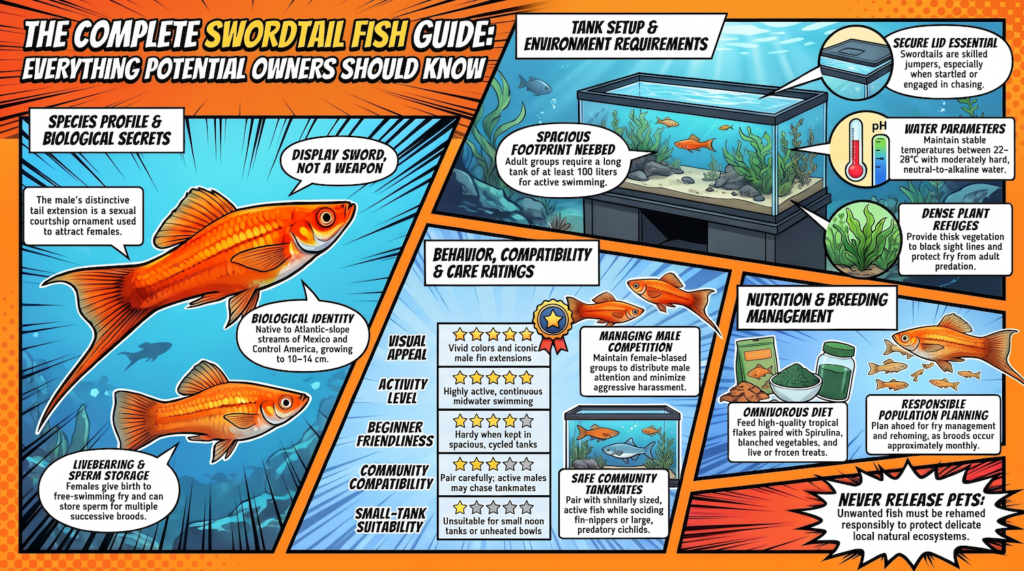
Famous Feature | Males possess an elongated, sword-shaped extension of the lower tail fin |
📚 OVERVIEW
The Swordtail Fish is a colourful freshwater species belonging to the family Poeciliidae, which also includes popular aquarium fish such as Guppies, Mollies and Platies. Native to Mexico and parts of Central America, Swordtails naturally inhabit rivers, streams and other freshwater environments.
Swordtails are particularly famous for the elongated lower tail fin displayed by many adult males. This remarkable extension resembles a sword and gives the species its common name. Females generally lack this feature and are often larger and more robust than males.
These fish are active swimmers with curious, engaging personalities. They spend much of their time exploring the aquarium, searching for food and interacting with other fish. Selective breeding has produced numerous spectacular colour varieties, including bright red, orange, yellow and patterned forms.
Their care requires adequate swimming space, stable water conditions, a balanced diet, compatible tankmates and carefully managed group sizes. Although generally hardy and suitable for beginners, Swordtails reproduce readily and can become stressed in overcrowded aquariums.
✅ PROS & CONS
👍 Pros
Beautiful colours and distinctive sword-shaped tails
Generally hardy and adaptable
Suitable for many beginner fishkeepers
Active and entertaining personalities
Usually peaceful with compatible tankmates
Straightforward feeding requirements
Fascinating livebearing reproduction
Wide variety of attractive colour forms
👎 Cons
Breed rapidly in suitable conditions
Males may become territorial or competitive
Require substantial swimming space
Can jump from uncovered aquariums
May harass females during courtship
Need stable, mineral-rich water
Can occasionally nip fins
Overcrowding can create health and behavioural problems
Are Swordtail Fish Good Pets?
Yes. Swordtails make excellent aquarium pets for people who enjoy colourful, active freshwater fish.
Their distinctive appearance and energetic behaviour make them entertaining to observe.
They’re particularly appealing to fishkeepers interested in livebearing species and natural breeding behaviours.
Are Swordtail Fish Good for Beginners?
Yes.
Swordtails are generally hardy and can adapt to a reasonable range of suitable aquarium conditions.
However, beginners must provide a properly cycled aquarium, stable water quality and sufficient swimming space.
Their rapid breeding also requires planning.
How Long Do Swordtail Fish Live?
Swordtails typically live approximately 3–5 years in captivity.
Some individuals may live longer with excellent care.
Lifespan depends on genetics, nutrition, water quality and overall aquarium conditions.
How Big Do Swordtail Fish Get?
Adult males commonly reach approximately 8–12 cm in body length, excluding their sword-shaped tail extension.
Females may reach around 10–14 cm.
Some individuals grow larger under favourable conditions.
Why Do Male Swordtail Fish Have Swords?
The sword is an elongated extension of the lower portion of the male’s tail fin.
It plays an important role in sexual selection and courtship.
Research suggests that female preferences and evolutionary pressures have contributed to the development of this remarkable feature.
Do Female Swordtail Fish Have Swords?
Females generally don’t develop the distinctive sword-shaped tail extension.
They usually have more rounded tail fins and fuller bodies.
However, sex-related physical characteristics can vary, particularly in immature fish and certain selectively bred varieties.
What Colours Do Swordtail Fish Come In?
Swordtails are available in numerous colours, including red, orange, yellow, green, black and white.
Popular varieties include Red Swordtails, Pineapple Swordtails, Marigold Swordtails and Tuxedo Swordtails.
Selective breeding has also produced unusual fin shapes and multicoloured patterns.
Are Swordtail Fish Aggressive?
Swordtails are generally peaceful community fish.
However, males may chase or compete with one another, particularly when females are present.
Aggression is more likely in cramped aquariums or poorly balanced groups.
Can Two Male Swordtail Fish Live Together?
Yes, but male compatibility depends on aquarium size and individual temperament.
Two males may compete intensely if one becomes dominant.
Larger aquariums with visual barriers and carefully planned stocking can help reduce conflict.
How Many Swordtail Fish Should Be Kept Together?
Swordtails generally do well in small, appropriately managed groups.
When keeping both sexes, a commonly recommended ratio is one male to two or three females to help distribute courtship attention.
An all-female group can also be a suitable option, although previously exposed females may still produce young.
Can Swordtail Fish Live Alone?
Swordtails aren’t strict schooling fish, but they benefit from suitable social environments.
Keeping them with compatible fish generally encourages natural activity.
However, group composition must be managed carefully to avoid harassment and territorial disputes.
Can Swordtail Fish Live With Guppies?
Yes.
Swordtails and Guppies can coexist in sufficiently spacious aquariums with compatible water conditions.
However, Swordtails are larger and more active, so very small or delicate Guppies may become stressed.
Can Swordtail Fish Live With Platies?
Yes.
Swordtails and Platies are often compatible aquarium companions.
Both prefer similar water conditions and are members of the genus Xiphophorus.
However, they can hybridise, so breeding them together should be carefully considered.
Can Swordtail Fish Live With Mollies?
Yes.
Swordtails and Mollies often coexist successfully in suitable community aquariums.
Both generally appreciate moderately hard, alkaline water.
However, adult size, temperament and swimming space must be considered.
Can Swordtail Fish Live With Bettas?
This combination requires caution.
Swordtails are active swimmers, and males may display competitive or fin-nipping behaviour.
Bettas may become stressed by highly active tankmates, so peaceful alternatives are often preferable.
Are Swordtail Fish Schooling Fish?
Swordtails aren’t true schooling fish in the same way as many Tetras or Danios.
They generally form loose social groups rather than tightly coordinated schools.
Their interactions often involve courtship, competition and exploration.
Are Swordtail Fish Intelligent?
Swordtails demonstrate learning, social recognition and responses to environmental cues.
They can become familiar with feeding routines and recognise changes in their surroundings.
Their courtship and social interactions have also attracted scientific interest.
What Size Tank Do Swordtail Fish Need?
Swordtails are active swimmers and need more space than their relatively modest size might suggest.
An aquarium of approximately 100–120 litres is a reasonable starting point for a small group, with larger tanks preferred.
A long aquarium footprint is particularly beneficial.
What Water Temperature Do Swordtail Fish Need?
Swordtails generally thrive at approximately 22–28°C.
Stable temperatures are important for their health and activity.
A reliable aquarium heater may be required depending on the surrounding climate.
What pH Do Swordtail Fish Prefer?
Swordtails generally prefer neutral to moderately alkaline water.
A pH of approximately 7.0–8.3 is suitable for many captive-bred individuals.
They also benefit from appropriate mineral content and stable water hardness.
Do Swordtail Fish Need Strong Filtration?
Swordtails require reliable biological filtration to maintain healthy water conditions.
Moderate water movement is generally suitable.
However, excessively strong currents should be avoided if they prevent normal swimming and resting behaviour.
Regular water changes remain essential.
What Do Swordtail Fish Eat?
Swordtails are omnivores.
They generally accept high-quality tropical flakes or pellets, supplemented with suitable vegetable matter and occasional frozen or live foods.
A varied diet supports healthy growth, colour and reproductive condition.
Do Swordtail Fish Eat Algae?
Yes.
Swordtails may graze on soft algae and biofilm growing on aquarium surfaces.
However, they aren’t specialised algae-cleaning fish.
They still require a complete, balanced diet.
Do Swordtail Fish Need Plants?
Live plants are highly beneficial.
They provide shelter, visual barriers and hiding places for young fish.
Floating plants and dense vegetation can also help reduce stress and provide protection for vulnerable individuals.
Open swimming areas should still be maintained.
How Do Swordtail Fish Breed?
Swordtails are livebearing fish.
Females give birth to free-swimming young rather than laying externally developing eggs.
A female can produce multiple broods after mating because she can store sperm for future fertilisation.
How Many Babies Can Swordtail Fish Have?
A female Swordtail may produce approximately 20–100 or more fry in a brood, depending on her size, age and condition.
Larger, mature females may produce particularly substantial broods.
Because Swordtails reproduce readily, population management is important.
How Can You Tell if a Swordtail Fish Is Pregnant?
Pregnant females often develop noticeably fuller abdomens.
Some may display a darker area near the rear of the abdomen, commonly called a gravid spot.
However, appearance alone doesn’t always reliably indicate pregnancy.
Do Swordtail Fish Eat Their Babies?
Yes.
Adult Swordtails may consume newborn fry.
Dense plants, floating vegetation and other hiding places can improve fry survival.
Fishkeepers who don’t intend to breed should plan carefully to avoid unwanted population growth.
Why Is My Swordtail Fish Chasing Other Fish?
Chasing may occur during courtship, territorial disputes or competition for food.
Males often pursue females and may compete with rival males.
Persistent harassment, damaged fins or stressed fish may indicate unsuitable stocking or inadequate space.
Can Swordtail Fish Jump Out of Aquariums?
Yes.
Swordtails are capable jumpers, particularly when startled or stressed.
A secure aquarium lid is strongly recommended.
Good water quality and suitable tankmates can also help reduce stress-related jumping.
What Health Problems Are Common in Swordtail Fish?
Potential concerns include white spot disease, bacterial infections, parasites, fin damage and stress-related illness.
Poor water quality, overcrowding and inappropriate nutrition can contribute to health problems.
Stable aquarium conditions and quarantining new fish help reduce disease risks.
Are Swordtail Fish Legal to Keep as Pets?
Swordtails are legal aquarium pets in many countries.
However, importation, sale and possession regulations vary between jurisdictions.
In Australia, Swordtails are commonly kept aquarium fish, but current biosecurity and local regulations should always be checked.
Never release Swordtails into natural waterways because introduced populations can threaten native aquatic ecosystems.
What Makes the Swordtail Fish Unique?
Imagine a brightly coloured fish swimming through a tropical stream with a long, elegant sword extending from its tail.
That’s the extraordinary Swordtail Fish.
These beautiful freshwater fish possess one of the most recognisable physical features in the aquarium world.
Their famous sword isn’t a weapon.
It’s an elongated extension of the lower tail fin, developed through evolutionary processes involving sexual selection.
In some males, this extension can become remarkably long relative to the body.
But their unusual tails are only part of what makes Swordtails fascinating.
Unlike egg-laying fish such as Danios and Barbs, Swordtails give birth to fully formed, free-swimming young.
This reproductive strategy is known as livebearing.
Even more remarkably, females can store sperm after mating, allowing them to produce multiple broods without additional contact with males.
Their reproductive abilities help explain why Swordtails can multiply so quickly in home aquariums.
Another fascinating feature is their relationship with Platies.
Both belong to the genus Xiphophorus, and scientists have studied these fish extensively to understand genetics, evolution and inherited characteristics.
Swordtails and Platies have also played important roles in research involving pigmentation and cancer biology.
Their colours are equally extraordinary.
Wild Green Swordtails are generally more subdued than many captive-bred varieties, often displaying olive-green or silvery bodies with distinctive markings.
Selective breeding has produced brilliant reds, oranges, yellows and unusual combinations of patterns.
Some aquarium varieties even display dramatic elongated fins in addition to their famous swords.
Swordtails also demonstrate interesting social behaviour.
Males may compete for access to females, display their fins and engage in elaborate courtship interactions.
Their active swimming and curious behaviour make them particularly entertaining aquarium residents.
Perhaps most surprising is the scientific interest surrounding their evolutionary history.
Researchers have used Swordtails to investigate how female preferences can influence the development of exaggerated male ornaments.
The Swordtail Fish isn’t simply a colourful aquarium favourite — it’s a fascinating example of evolution, remarkable reproductive biology and one of the most distinctive tail designs in the freshwater world.