Have you ever watched your dog twitch in their sleep or noticed your cat’s whiskers suddenly start moving while they’re curled up on the couch?
Perhaps you’ve seen little paws running, ears flicking, tails wagging or even heard a quiet bark or soft meow.
Do Pets Dream?
What Scientists Believe Dogs and Cats are Really Dreaming About
Have you ever watched your dog twitch in their sleep or noticed your cat’s whiskers suddenly start moving while they’re curled up on the couch?
Perhaps you’ve seen little paws running, ears flicking, tails wagging or even heard a quiet bark or soft meow.
It’s enough to make any pet owner wonder…
Do pets really dream?
Modern science suggests the answer is yes. While we may never know exactly what our pets experience while they sleep, researchers have discovered fascinating clues that reveal what may be happening inside their remarkable minds.
For many years, scientists weren’t sure whether animals dreamed in the same way humans do. Today, research into sleep patterns has provided strong evidence that dogs and cats experience REM (Rapid Eye Movement) sleep—the stage of sleep most closely associated with dreaming in people.
During REM sleep, the brain becomes highly active while the body remains mostly relaxed. This is when dreams are most likely to occur.
Because dogs and cats show remarkably similar brain activity during REM sleep, researchers believe they almost certainly dream too.
How can scientists tell?
Researchers have studied sleeping animals using brain-wave monitoring and have found that the sleep cycles of many mammals closely resemble our own.
Like humans, dogs and cats cycle between lighter sleep, deeper sleep and REM sleep several times throughout the night.
This strongly suggests that dreaming isn’t unique to people—it’s something we may share with our pets.
Why do dogs and cats sleep so much?
Sleep is far more than rest.
While sleeping, the brain:
- Processes memories.
- Strengthens learning.
- Organises new experiences.
- Supports healthy brain function.
- Helps regulate emotions.
For pets, a good night’s sleep is just as important as healthy food and regular exercise.
What Do Dogs and Cats Dream About?
This is the question every pet owner really wants answered.
Unfortunately, we can’t ask a sleeping dog what they were dreaming about.
But scientists have some fascinating theories.
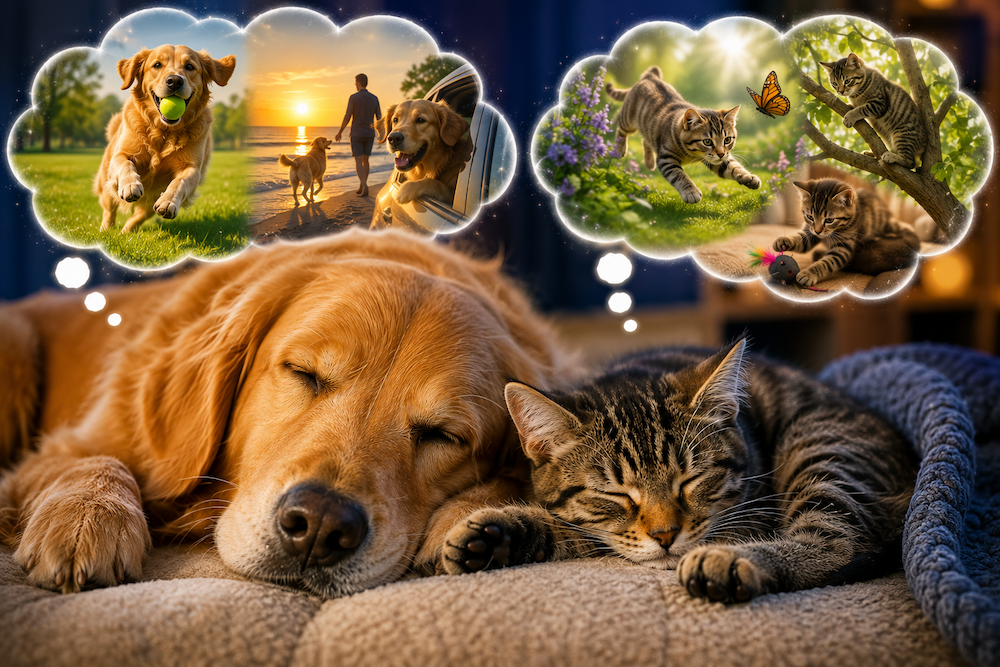
Dogs probably dream about everyday life
Research suggests dogs may replay important memories while sleeping.
They may dream about:
- Playing fetch.
- Running through the park.
- Swimming at the beach.
- Chasing a favourite toy.
- Greeting you when you arrive home.
- Going for walks.
- Playing with other dogs.
- Enjoying family adventures.
In many ways, their dreams may be similar to ours—built from the experiences that matter most.
Cats may dream about their natural instincts
Even the most pampered indoor cat still carries the instincts of a skilled hunter.
Scientists believe cats may dream about:
- Chasing birds.
- Stalking insects.
- Climbing trees.
- Exploring new places.
- Playing with favourite toys.
- Spending time with trusted people.
Their dreams may combine both instinctive behaviours and everyday experiences.
Could your pet dream about you?
While this hasn’t been proven, it’s certainly possible.
If dreams help process important memories, then the people who make up most of a pet’s world are likely to feature prominently.
Your morning walks.
Your cuddles on the couch.
The excitement of hearing your car pull into the driveway.
The quiet moments spent simply sitting together.
If your pet dreams, there’s every chance you’re part of those memories.
Why Do Pets Twitch, Bark or Run While Sleeping?
One of the most searched questions online is why dogs appear to run while they’re asleep.
The answer lies in REM sleep.
Why do dogs twitch?
During REM sleep, the brain becomes incredibly active.
Although the body naturally limits major muscle movement, tiny signals can still reach certain muscles.
This is why you might see:
- Paws gently running.
- Tails wagging.
- Ears flicking.
- Whiskers moving.
- Eyes moving beneath closed eyelids.
- Quiet barking or whining.
It’s almost as though small parts of the dream briefly escape into the real world.
Can pets have nightmares?
Just like people, scientists believe pets may occasionally experience unpleasant dreams.
A stressful event, frightening experience or emotional memory could potentially influence what they dream about.
If your dog suddenly cries out or your cat startles during sleep, it’s usually best to let them wake naturally.
Suddenly waking a dreaming pet can leave them confused or disoriented.
If they wake looking unsettled, simply offer calm reassurance and allow them to settle again.
Do puppies dream more than adult dogs?
Young animals spend significantly more time in REM sleep than adults.
Puppies are constantly learning about the world around them—new people, smells, sounds, places and experiences.
Many researchers believe this may explain why puppies often twitch, paddle their paws and appear particularly active while sleeping.
Their growing brains have an enormous amount of information to process.
Amazing Facts About Pet Dreams
Here are a few fascinating facts you may not know:
- Dogs and cats both experience REM sleep.
- Smaller dogs often have shorter but more frequent dream cycles.
- Larger dogs may dream less often, but their dreams may last longer.
- Puppies spend much more time dreaming than adult dogs.
- Cats can sleep between 12 and 16 hours each day, giving them plenty of opportunities to dream.
- Scientists believe dreaming helps strengthen memory and learning across many mammal species.
Do all pets dream?
Most mammals studied so far appear to experience REM sleep, making dreaming highly likely. Scientists continue to learn more about different animal species every year.
Should I wake my pet if they’re dreaming?
Generally, no. Unless they’re in immediate danger, it’s usually best to let them wake naturally.
Is twitching during sleep normal?
Yes. Gentle twitching, paw movements, ear flicks and quiet noises are all common during REM sleep.
If movements become unusually violent, frequent or you’re concerned about seizures or another medical condition, consult your veterinarian.
Final Thoughts
The sleeping minds of our pets remain one of nature’s most beautiful mysteries.
Science strongly suggests that dogs and cats really do dream, replaying moments that helped shape their day and strengthen their memories.
Whether they’re chasing a ball across a field, stalking imaginary butterflies, running through the waves or quietly reliving a peaceful evening beside the people they love, those tiny twitches and sleepy tail wags may offer a wonderful glimpse into their hidden world.
We may never know exactly what our pets dream about.
But perhaps that’s part of the magic.
The next time your dog softly runs in their sleep or your cat gently flicks their whiskers, take a moment to smile.
Somewhere behind those closed eyes, another adventure may have just begun.