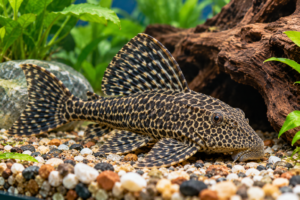
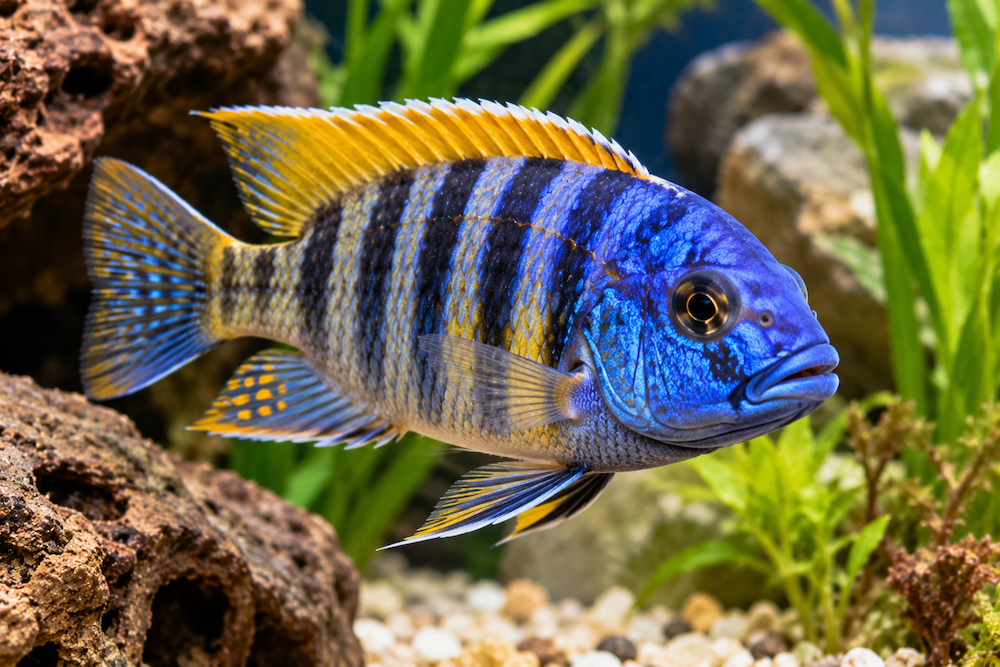







Colourful, intelligent and bursting with personality, Cichlid Fish are among the world's most fascinating freshwater aquarium fish, famous for their spectacular colours, complex behaviours and extraordinary parenting instincts.
🧠 QUICK SNAPSHOT
Trait | Cichlid Fish |
|---|---|
Scientific Family | Cichlidae |
Other Names | Cichlids, African Cichlids, American Cichlids |
Pet Type | Freshwater Aquarium Fish |
Natural Origin | Africa, Central and South America, parts of Asia |
Typical Lifespan | Approximately 5–15 years, depending on species |
Adult Size | Approximately 3–90 cm, depending on species |
Adult Weight | Highly variable; large species can weigh several kilograms |
Colours | Blue, yellow, red, orange, green, black, white and multicoloured |
Diet | Herbivore, omnivore or carnivore, depending on species |
Activity | Primarily diurnal |
Temperament | Intelligent, active, territorial and species-dependent |
Noise Level | Silent to humans |
Social Needs | Varies considerably between species |
Water Temperature | Commonly 24–28°C, depending on species |
Water pH | Approximately 6.0–9.0, depending on species |
Tank Size | Approximately 75–100 litres for some small species; 450 litres or more for large species |
Breeding | Egg-laying; many display advanced parental care |
Grooming | No grooming required |
Exercise Needs | Moderate to high; active swimming and territorial behaviour |
Beginner Friendly? | Some species are; others require considerable experience |
Famous Feature | Extraordinary colours, intelligence and parental care |
📚 OVERVIEW
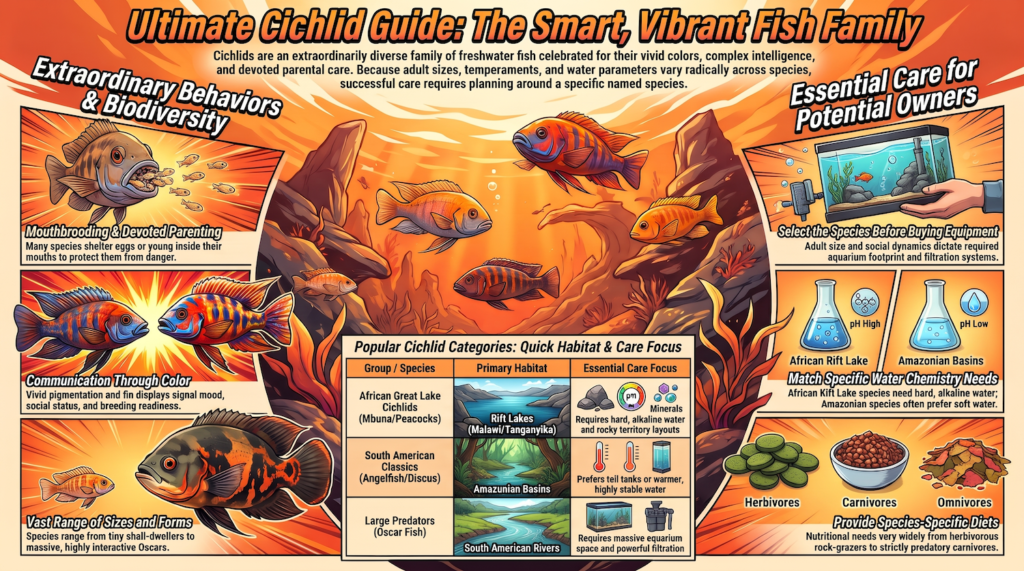
The Cichlid Fish belongs to the family Cichlidae, one of the largest and most diverse groups of freshwater fish in the world. With well over 1,700 scientifically described species, Cichlids inhabit an extraordinary range of environments, particularly throughout Africa and the Americas.
Cichlids are famous for their spectacular colours, distinctive personalities and complex social behaviour. African Rift Lake Cichlids are particularly celebrated for their brilliant blues and yellows, while South American species include popular aquarium favourites such as Angelfish, Discus and Oscars.
Unlike many peaceful schooling fish, numerous Cichlid species establish territories, recognise familiar routines and display elaborate courtship and breeding behaviours. Some are relatively peaceful, while others can become highly aggressive, especially when defending breeding sites.
Their care requires species-appropriate aquarium space, reliable filtration, stable water chemistry, suitable nutrition and carefully selected tankmates. Because Cichlids vary enormously in size and temperament, researching the exact species is essential before purchasing.
✅ PROS & CONS
👍 Pros
Spectacular colours and patterns
Remarkably intelligent and interactive
Fascinating breeding and parenting behaviours
Enormous variety of species
Many develop distinctive personalities
Some species are suitable for beginners
Long potential lifespan
Active and entertaining aquarium residents
👎 Cons
Many species can become aggressive
Water requirements vary significantly
Some grow extremely large
Territorial disputes can cause injuries
Require careful tankmate selection
May dig up plants and rearrange decorations
Breeding can increase aggression
Some require large, expensive aquariums
Are Cichlid Fish Good Pets?
Yes. Cichlids can make outstanding aquarium pets for fishkeepers who enjoy colourful, intelligent and interactive fish.
Their distinctive personalities and fascinating behaviours make them particularly rewarding.
However, their suitability depends heavily on the species, aquarium size and owner’s experience.
Are Cichlid Fish Good for Beginners?
Some Cichlids are suitable for beginners.
Species such as Bolivian Rams and certain captive-bred Angelfish can be approachable choices with appropriate preparation.
However, aggressive African Cichlids and large predatory species generally require greater experience.
How Long Do Cichlid Fish Live?
Many Cichlids live approximately 5–15 years in captivity.
Some smaller species have shorter lifespans, while larger species may live considerably longer.
Lifespan depends on species, genetics, nutrition and aquarium conditions.
How Big Do Cichlid Fish Get?
Cichlids vary enormously in size.
Some small shell-dwelling species reach only a few centimetres, while large species can exceed 60 cm.
The Giant Cichlid, Boulengerochromis microlepis, can approach 90 cm in length.
What Are the Different Types of Cichlid Fish?
Popular aquarium groups include:
Malawi Cichlids — colourful African Rift Lake species
Tanganyika Cichlids — diverse species with fascinating social behaviours
Victorian Cichlids — often brightly coloured African species
Angelfish — elegant South American Cichlids
Discus Fish — spectacular, rounded South American species
Oscar Fish — large, intelligent and interactive Cichlids
Ram Cichlids — smaller, colourful dwarf Cichlids
Convict Cichlids — hardy fish known for strong parental instincts
Each group has different environmental and behavioural requirements.
Are African Cichlids Different From American Cichlids?
Yes.
African Rift Lake Cichlids often prefer harder, more alkaline water, while many South American species naturally inhabit softer, more acidic environments.
However, requirements vary within both groups.
Their feeding habits, aggression levels and breeding behaviours also differ considerably.
Are Cichlid Fish Aggressive?
Many Cichlids display territorial or aggressive behaviour.
Aggression is particularly common during breeding or when competing for food and shelter.
However, some species are relatively peaceful and can coexist successfully with carefully selected tankmates.
Can Cichlid Fish Live Together?
Yes, but compatibility depends on species.
Some Cichlids thrive in carefully planned groups, while others require pairs or individual territories.
Aquarium size, sex ratios, hiding places and feeding requirements all influence compatibility.
Can Cichlids Live With Other Fish?
Some species can coexist with suitable community fish.
However, aggressive or predatory Cichlids may injure or eat smaller tankmates.
Fish should be selected according to adult size, temperament and water requirements.
Can African and South American Cichlids Live Together?
Generally, mixing these groups isn’t recommended.
Many African Rift Lake Cichlids prefer alkaline, mineral-rich water, while numerous South American species favour softer conditions.
Behavioural incompatibility can also create serious problems.
Are Cichlid Fish Intelligent?
Yes.
Cichlids demonstrate sophisticated learning, social recognition and territorial behaviours.
Some species can recognise familiar individuals, remember feeding routines and respond to changes in their environment.
Their complex social lives have attracted considerable scientific research.
Do Cichlid Fish Recognise Their Owners?
Some Cichlids appear to recognise familiar caregivers.
They may approach the aquarium when someone associated with feeding enters the room.
This behaviour reflects learning and recognition of familiar cues rather than necessarily indicating human-like affection.
Do Cichlid Fish Have Personalities?
Yes.
Individual Cichlids can display noticeably different behaviours.
Some are bold and curious, while others are shy, territorial or cautious.
These differences can make them particularly engaging aquarium residents.
What Size Tank Do Cichlid Fish Need?
Tank requirements depend heavily on species.
Some small Cichlids can live in appropriately equipped aquariums around 75–100 litres, while large species may require 450 litres or substantially more.
Aquarium footprint, territorial space and filtration are especially important.
What Water Temperature Do Cichlids Need?
Many tropical Cichlids thrive around 24–28°C.
However, certain species require warmer or cooler conditions.
A reliable heater and stable temperature are essential for species that require tropical water.
What pH Do Cichlid Fish Prefer?
Water requirements vary considerably.
Many South American Cichlids prefer slightly acidic to neutral conditions, while numerous African Rift Lake species thrive in alkaline water.
Always research the specific species rather than using one pH target for all Cichlids.
Do Cichlid Fish Need Strong Filtration?
Yes.
Effective biological and mechanical filtration helps maintain stable water quality.
Large or heavily stocked Cichlid aquariums may require particularly powerful filtration.
Regular water changes remain essential.
What Do Cichlid Fish Eat?
Cichlid diets vary significantly between species.
Some are primarily herbivorous, others are omnivorous, and many are carnivorous predators.
High-quality species-appropriate pellets or flakes should be supplemented with suitable foods according to their natural feeding requirements.
Can Cichlid Fish Eat Vegetables?
Many herbivorous and omnivorous Cichlids benefit from suitable vegetable matter.
Spirulina-based foods and appropriate blanched vegetables can provide useful dietary variety.
However, predominantly carnivorous species have different nutritional requirements.
Do Cichlid Fish Need Hiding Places?
Yes.
Rocks, caves, driftwood and other suitable structures provide shelter and territorial boundaries.
Hiding places can reduce stress and help less dominant fish avoid confrontation.
Decorations must be securely positioned because some Cichlids dig extensively.
Why Do Cichlid Fish Dig in the Gravel?
Digging is a common natural behaviour.
Cichlids may excavate breeding sites, establish territories or search for food.
Some species can dramatically rearrange aquarium substrates and decorations.
Why Do Cichlid Fish Change Colour?
Cichlids may change colour in response to mood, social status, breeding condition or environmental factors.
Dominant males often display particularly intense colours.
However, sudden colour loss accompanied by unusual behaviour may indicate stress or illness.
How Do Cichlid Fish Breed?
Cichlids reproduce by laying eggs.
Some deposit eggs on rocks, leaves or other surfaces, while others incubate eggs inside their mouths.
Many species display remarkably advanced parental care.
What Are Mouthbrooding Cichlids?
Mouthbrooding Cichlids protect their eggs and developing young inside their mouths.
This behaviour is particularly common among certain African Cichlid groups.
In many species, females carry the eggs and fry until they’re sufficiently developed to swim independently.
Do Cichlid Fish Care for Their Babies?
Yes.
Many Cichlid species display extraordinary parental behaviour.
Parents may guard eggs, defend territories, move fry to safer locations or protect offspring inside their mouths.
Some species even cooperate in caring for young.
What Health Problems Are Common in Cichlid Fish?
Potential concerns include parasitic infections, bacterial disease, nutritional deficiencies, injuries and stress-related illness.
Certain African Cichlids may also experience digestive conditions commonly referred to as Malawi bloat.
Stable water quality, appropriate feeding and compatible stocking are essential for prevention.
Are Cichlid Fish Legal to Keep as Pets?
Many Cichlid species are legal aquarium pets in numerous countries.
However, certain species may be restricted because of environmental or biosecurity concerns.
In Australia, importation and possession rules vary by species and jurisdiction, so local regulations should always be checked.
Never release aquarium fish into natural waterways.
What Makes the Cichlid Fish Unique?
Imagine a family of fish containing tiny shell-dwellers, enormous predators, spectacularly coloured aquarium favourites and devoted parents that protect their babies inside their mouths.
That’s the extraordinary world of Cichlid Fish.
Cichlids are among the most remarkable examples of evolutionary diversity in freshwater environments.
Nowhere is this more spectacular than in Africa’s Great Lakes.
Lake Malawi, Lake Tanganyika and Lake Victoria contain extraordinary collections of Cichlid species, many of which evolved from shared ancestors over relatively short evolutionary timescales.
This process, known as adaptive radiation, has produced fish with astonishingly different appearances, diets and behaviours.
Some Cichlids scrape algae from rocks.
Others hunt smaller fish, crush snails or specialise in eating particular aquatic organisms.
Certain Lake Tanganyika species even live and breed inside empty snail shells.
But perhaps their most extraordinary feature is their parenting behaviour.
Many Cichlids fiercely defend their eggs and young, displaying levels of parental investment rarely associated with aquarium fish.
Some species carry eggs inside their mouths until the young are ready to emerge.
Others guard nests, escort groups of fry or cooperate with additional family members to protect offspring.
Their intelligence is equally fascinating.
Researchers have studied Cichlids for their abilities to learn, recognise individuals, establish social hierarchies and respond to changing environments.
And their colours can rival those of tropical reef fish.
Brilliant electric blues, golden yellows, vivid reds and intricate patterns make some African Cichlids among the most visually spectacular freshwater animals.
Perhaps most astonishing is their diversity.
With well over 1,700 scientifically described species, the Cichlid family represents one of the most extraordinary evolutionary success stories among freshwater fish.
Cichlid Fish aren’t simply colourful aquarium residents — they’re intelligent, complex and endlessly fascinating animals that reveal some of nature’s most remarkable examples of evolution, family life and underwater behaviour.