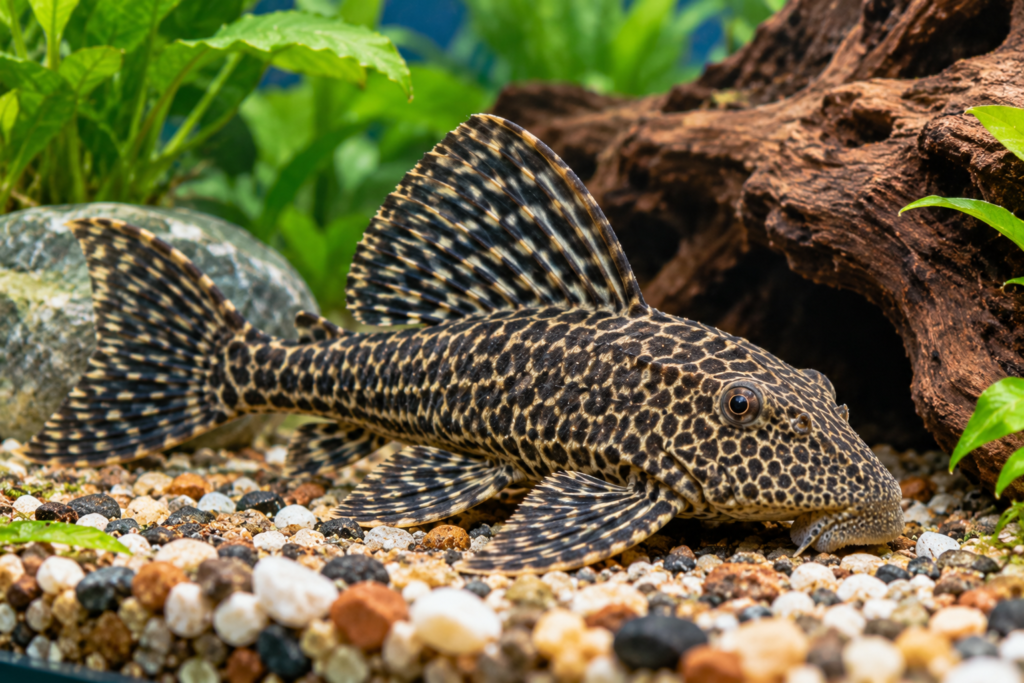







Armoured, fascinating and equipped with an extraordinary suction-cup mouth, the Pleco Fish is a remarkable freshwater aquarium favourite famous for its algae-grazing habits and prehistoric appearance.
🧠 QUICK SNAPSHOT
Trait | Pleco Fish |
|---|---|
Scientific Name | Hypostomus plecostomus and numerous related loricariid species |
Other Names | Plecostomus, Suckermouth Catfish, Armoured Catfish, Pleco |
Pet Type | Freshwater Aquarium Fish |
Natural Origin | Central and South America |
Typical Lifespan | Approximately 10–15 years; varies by species |
Adult Size | Approximately 8–60 cm or more, depending on species |
Adult Weight | Highly variable; large species can exceed 1 kg |
Colours | Brown, black, grey, gold, spotted, striped and patterned varieties |
Diet | Omnivore, herbivore or specialised feeder, depending on species |
Activity | Primarily nocturnal or crepuscular |
Temperament | Generally peaceful, but some become territorial |
Noise Level | Silent |
Social Needs | Usually suitable for solitary housing |
Water Temperature | Commonly 23–28°C, depending on species |
Water pH | Commonly 6.0–7.5, depending on species |
Tank Size | Approximately 75–100 litres for some small species; 450 litres or more for large Common Plecos |
Grooming | No grooming required |
Exercise Needs | Moderate; requires swimming and grazing space |
Beginner Friendly? | Some species are; Common Plecos require substantial planning |
Famous Feature | Suction-cup mouth, protective armour and algae-grazing behaviour |
📚 OVERVIEW
The Pleco Fish is a popular name for numerous freshwater catfish belonging to the family Loricariidae. These remarkable fish originate primarily from Central and South America and are instantly recognisable by their armoured bodies, specialised mouths and unusual bottom-dwelling behaviour.
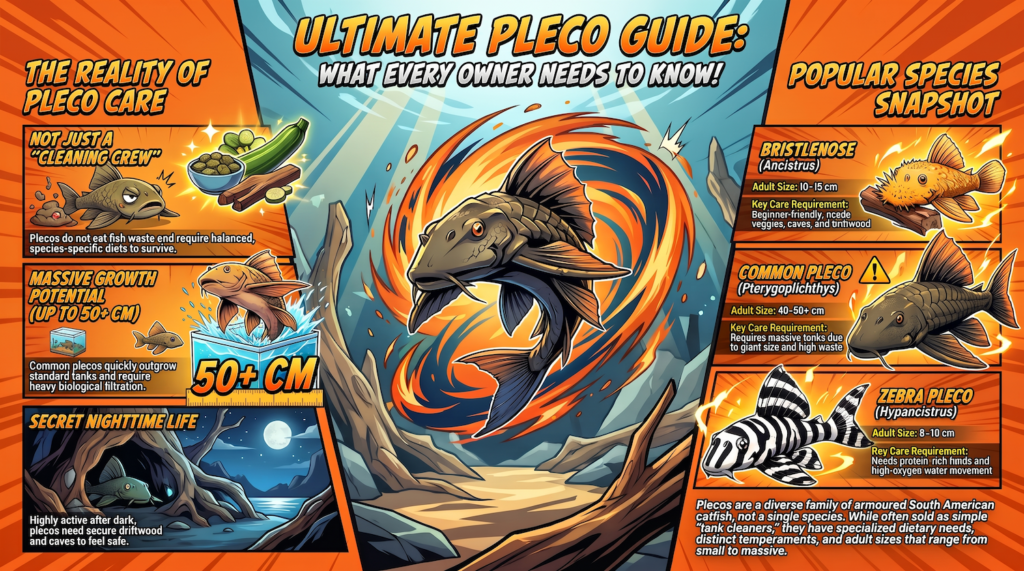
Plecos come in an extraordinary range of sizes, colours and patterns. Small Bristlenose Plecos may remain around 10–15 cm long, while Common Plecos and some related species can grow beyond 45 cm, making species identification essential before purchase.
Many Plecos spend considerable time exploring aquarium surfaces, grazing on algae, sheltering beneath driftwood and searching for food. Although commonly marketed as aquarium cleaners, they’re living animals with specialised nutritional and environmental requirements.
Their care requires species-appropriate aquarium space, reliable filtration, suitable food, hiding places, stable water conditions and careful tankmate selection. Choosing the correct species is particularly important because some popular Plecos become far larger than inexperienced fishkeepers expect.
✅ PROS & CONS
👍 Pros
Fascinating prehistoric appearance
Extraordinary suction-cup mouths
Many beautiful colours and patterns
Some species help graze aquarium algae
Generally quiet and unobtrusive
Interesting nighttime behaviours
Many species coexist with peaceful fish
Long potential lifespan
👎 Cons
Some species grow extremely large
Often incorrectly sold as tank cleaners
Produce substantial amounts of waste
Require specialised feeding
Some become territorial with age
Need hiding places and suitable substrates
May damage delicate aquarium plants
Species identification can be confusing
Are Pleco Fish Good Pets?
Yes. Plecos can make fascinating aquarium pets for fishkeepers who appreciate unusual freshwater species.
Their armoured appearance, specialised feeding behaviours and distinctive personalities make them rewarding to observe.
However, their suitability depends heavily on the particular species and its adult size.
Are Pleco Fish Good for Beginners?
Some species are suitable for beginners.
Bristlenose Plecos are often a better choice than Common Plecos because they remain considerably smaller.
However, all Plecos require appropriate nutrition, stable water quality and suitable aquarium accommodation.
How Long Do Pleco Fish Live?
Many Pleco species can live approximately 10–15 years in captivity.
Some may live considerably longer with excellent care.
Their lifespan depends on species, genetics, nutrition and aquarium conditions.
How Big Do Pleco Fish Get?
Adult size varies enormously between species.
Small Plecos may reach only 8–12 cm, while Common Plecos can grow approximately 30–50 cm or more.
Some of the largest loricariid catfish can exceed 60 cm.
What Are the Different Types of Pleco Fish?
Popular aquarium varieties include:
Common Pleco — large, powerful suckermouth catfish
Bristlenose Pleco — smaller species with distinctive facial bristles
Clown Pleco — compact, patterned wood-grazing catfish
Rubber Lip Pleco — smaller algae-grazing species
Zebra Pleco — striking black-and-white striped catfish
Royal Pleco — large, beautifully patterned wood-associated species
Gold Nugget Pleco — dark body with bright yellow spots
Each has different adult sizes, dietary requirements and environmental needs.
Do Pleco Fish Really Clean Aquariums?
Plecos can graze algae and organic material from aquarium surfaces.
However, they don’t replace proper aquarium maintenance.
They also produce waste and require additional feeding, so they’re not a complete aquarium-cleaning solution.
Do Pleco Fish Eat Algae?
Many species consume algae, particularly when young.
However, algae consumption varies significantly between Pleco species.
Some primarily eat wood-associated microorganisms, invertebrates or specialised prepared foods rather than large quantities of algae.
Do Pleco Fish Need Additional Food?
Yes.
Aquarium algae alone rarely provides complete nutrition.
Depending on the species, Plecos may require sinking pellets, algae wafers, vegetables, specialised foods or protein-rich supplements.
Researching the exact species is essential.
What Do Pleco Fish Eat?
Pleco diets vary considerably.
Many consume algae, biofilm, plant material and small aquatic organisms.
Some species require significant animal protein, while others are adapted to grazing on wood-associated material.
A species-appropriate diet is essential for long-term health.
Can Pleco Fish Eat Cucumber?
Many herbivorous and omnivorous Plecos will eat cucumber.
However, cucumber contains relatively little nutritional value and shouldn’t be a primary food.
Other suitable vegetables and balanced prepared foods provide more complete nutrition.
Do Pleco Fish Need Driftwood?
Many Plecos benefit from driftwood because it provides shelter and grazing surfaces.
Certain species, particularly some Panaque and related wood-feeding catfish, have specialised adaptations for consuming wood.
However, not every Pleco requires wood as a major dietary component.
Are Pleco Fish Nocturnal?
Many Plecos are primarily nocturnal or crepuscular.
They often become more active during the evening and night.
However, some species regularly emerge during daylight, particularly when they feel secure.
Are Pleco Fish Aggressive?
Many Plecos are peaceful towards unrelated fish.
However, some become territorial towards other bottom-dwelling species or similarly shaped Plecos.
Large individuals may also compete aggressively for food and shelter.
Can Two Pleco Fish Live Together?
Sometimes.
Compatibility depends on species, aquarium size, temperament and available hiding places.
Some Plecos tolerate companions, while others become territorial.
Providing separate shelters and sufficient feeding areas helps reduce conflict.
Can Pleco Fish Live With Goldfish?
Generally, this isn’t recommended.
Many Plecos require warmer water than Goldfish, and some may attach themselves to slow-moving fish.
Goldfish also produce considerable waste, creating additional filtration demands.
Can Pleco Fish Live With Bettas?
Some smaller, peaceful Pleco species may coexist with Bettas in appropriately sized aquariums.
However, compatibility isn’t guaranteed.
Tank size, water requirements, feeding competition and individual temperament must be considered.
Can Pleco Fish Live With Oscars?
Some large, robust Plecos can coexist with Oscar Fish in sufficiently spacious aquariums.
However, Oscars may harass smaller Plecos, and territorial disputes can occur.
Both species produce substantial waste and require excellent filtration.
What Size Tank Does a Pleco Fish Need?
Tank requirements depend heavily on species.
Some small Plecos can live in appropriately equipped aquariums around 75–100 litres, while large Common Plecos generally need 450 litres or more.
Aquarium footprint and swimming space are particularly important.
Do Pleco Fish Need Strong Filtration?
Yes.
Plecos, particularly larger species, can produce substantial amounts of waste.
Effective biological and mechanical filtration helps maintain water quality.
Regular water changes and substrate cleaning remain essential.
What Water Temperature Do Pleco Fish Need?
Many commonly kept Plecos thrive around 23–28°C.
However, requirements vary between species.
Some prefer cooler, highly oxygenated water, while others require warmer tropical conditions.
What pH Do Pleco Fish Prefer?
Many species do well in slightly acidic to neutral water, commonly around pH 6.0–7.5.
However, individual species may have different requirements.
Stable water chemistry is generally more important than repeatedly adjusting pH.
Do Pleco Fish Need Hiding Places?
Yes.
Plecos naturally seek shelter beneath wood, rocks and other structures.
Providing appropriately sized caves and hiding places helps reduce stress.
Some species also use caves for breeding.
Can Pleco Fish Damage Aquarium Plants?
Some Plecos may disturb or damage delicate plants.
Large individuals can uproot vegetation while moving around the aquarium.
Certain species may also graze on soft plant tissue, particularly when their nutritional needs aren’t being met.
Why Is My Pleco Fish Hiding All Day?
Hiding is normal behaviour for many Pleco species.
They often rest in caves or beneath driftwood during daylight hours.
However, persistent hiding accompanied by poor appetite or abnormal breathing may indicate stress or illness.
Do Pleco Fish Have Teeth?
Yes.
Plecos possess specialised teeth adapted to their feeding habits.
These teeth help them scrape algae, biofilm and other material from surfaces.
Tooth shape and arrangement vary between species.
Can Pleco Fish Breathe Air?
Some loricariid catfish can use specialised digestive structures to obtain oxygen from swallowed air.
This adaptation may help them survive temporarily in oxygen-poor environments.
However, Plecos still require well-oxygenated aquarium water.
What Health Problems Are Common in Pleco Fish?
Potential concerns include parasitic infections, bacterial disease, malnutrition, injuries and stress caused by poor water quality.
Sunken bellies, abnormal breathing, unusual spots or loss of appetite can indicate problems.
Appropriate nutrition and stable aquarium conditions are essential for prevention.
Are Pleco Fish Legal to Keep as Pets?
Ownership regulations vary by country and species.
Some Plecos are legal aquarium pets, while others are restricted because of their potential environmental impact.
In Australia, certain Pleco species are prohibited or subject to biosecurity restrictions, so exact species identification and local regulatory checks are essential.
Never release aquarium fish into natural waterways.
What Makes the Pleco Fish Unique?
Imagine a fish covered in protective armour, equipped with a powerful suction-cup mouth and capable of clinging to underwater surfaces while searching for food.
That’s the extraordinary Pleco Fish.
These fascinating freshwater catfish belong to the family Loricariidae, one of the most diverse groups of catfish in the world.
Scientists have described more than a thousand species within this remarkable family, with new discoveries continuing to expand our understanding of their diversity.
Their most recognisable feature is their specialised mouth.
Unlike many fish, Plecos have downward-facing mouths equipped with fleshy lips and specialised teeth that allow them to scrape food from rocks, wood and other underwater surfaces.
Many also possess rows of protective bony plates along their bodies, creating an appearance reminiscent of prehistoric armour.
But perhaps their most extraordinary adaptations involve feeding.
Some Plecos are specialised wood grazers, using their unusual teeth to scrape material from submerged timber.
Others feed on algae, biofilm, small invertebrates or combinations of different foods.
Their reproductive behaviour can be equally fascinating.
In several species, males guard eggs inside caves, protecting them until they hatch.
Certain Plecos also possess specialised structures that allow them to obtain oxygen from swallowed air under challenging environmental conditions.
And their appearance can be spectacular.
The Zebra Pleco displays striking black-and-white stripes, while the Gold Nugget Pleco features brilliant yellow spots against a dark body.
Perhaps most surprising is their enormous variation in size.
Some species remain small enough for modest aquariums, while others become powerful fish more than half a metre long.
The Pleco Fish isn’t simply an aquarium cleaner — it’s an extraordinary armoured catfish with remarkable feeding adaptations, fascinating behaviours and some of the most unusual appearances in the freshwater world.