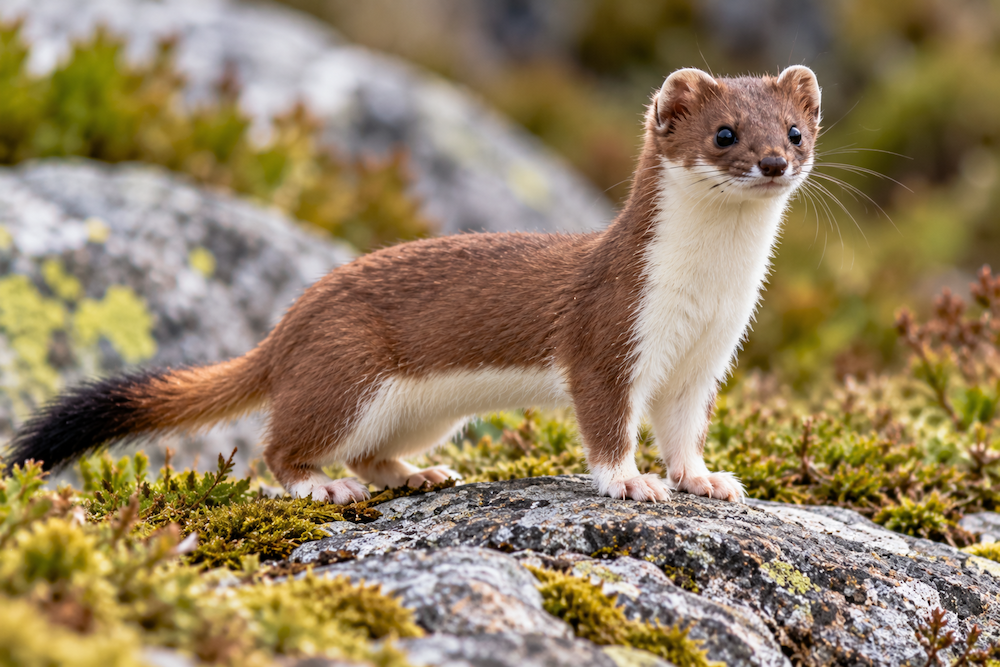







Small, lightning-fast and astonishingly fearless, the Stoat is a fascinating wild predator famous for its remarkable hunting abilities, playful-looking movements and spectacular seasonal coat changes.
🧠 QUICK SNAPSHOT
Trait | Stoat |
|---|---|
Scientific Name | Mustela erminea |
Other Names | Ermine, Short-Tailed Weasel |
Animal Type | Wild Mammal / Mustelid |
Natural Origin | Europe, Asia and North America |
Typical Lifespan | Around 1–3 years in the wild; potentially longer in captivity |
Adult Size | Approximately 17–33 cm body length, excluding tail |
Adult Weight | Approximately 100–450 g, depending on sex and region |
Coat Type | Short, dense and soft |
Coat Colours | Reddish-brown and cream; white winter coat in some populations |
Diet | Carnivore |
Activity | Active during day and night |
Temperament | Fierce, energetic, territorial and highly inquisitive |
Noise Level | Usually quiet; can hiss, squeak or chatter |
Social Needs | Primarily solitary |
Grooming | Self-grooming |
Housing | Specialist wildlife enclosure with extensive enrichment |
Exercise Needs | Extremely high |
Beginner Friendly? | No |
Domesticated? | No |
Famous Feature | Seasonal white ermine coat with a distinctive black tail tip |
📚 OVERVIEW
The Stoat is a small, remarkably agile carnivorous mammal belonging to the weasel family, Mustelidae. Its scientific name, Mustela erminea, identifies a species widely distributed across Europe, Asia and North America, where it occupies grasslands, woodlands, farmland and other habitats.
Stoats are famous for their long, slender bodies, short legs, sharp teeth and distinctive black-tipped tails. In colder regions, many develop a white winter coat known as ermine, providing camouflage against snowy surroundings.
Despite their small size, Stoats are highly capable predators. They hunt rodents, rabbits and other small animals, using speed, agility and their flexible bodies to pursue prey through narrow spaces and underground burrows.
Unlike domestic ferrets, Stoats are wild, undomesticated animals with demanding behavioural needs. They’re generally unsuitable as household pets and may be legally protected or prohibited from private ownership, depending on the country.
✅ PROS & CONS
👍 Pros
Extraordinary agility and speed
Fascinating seasonal coat changes
Highly intelligent and inquisitive
Remarkable natural hunting abilities
Beautiful, distinctive appearance
Interesting communication and behaviour
Important predators in native ecosystems
Fascinating animals to observe in the wild
👎 Cons
Not domesticated or suitable for typical households
Can bite severely when frightened
Extremely high activity and enrichment needs
Powerful hunting instincts
Skilled escape artists
Require specialist diets and facilities
Ownership may be illegal or restricted
Can threaten native wildlife outside their natural range
Are Stoats Good Pets?
Generally, no.
Stoats are wild carnivores with specialised behavioural, dietary and environmental needs.
Unlike domestic ferrets, they haven’t undergone generations of selective breeding for companionship and are best appreciated in their natural habitats.
Are Stoats Good for Beginners?
No.
Stoats require specialist knowledge of wildlife behaviour, nutrition and secure enclosure design.
Their speed, strong hunting instincts and defensive biting make them unsuitable for inexperienced keepers.
How Long Do Stoats Live?
Stoats commonly live around 1–3 years in the wild, although some survive longer.
Their short average wild lifespan reflects predation, food availability, disease and environmental pressures.
Under specialist captive conditions, individuals may live for several additional years.
How Big Do Stoats Get?
Adult Stoats generally measure approximately 17–33 cm in body length, excluding their tails.
Males are usually considerably larger than females.
Their long, flexible bodies allow them to enter narrow tunnels and pursue prey underground.
How Much Do Stoats Weigh?
Adult Stoats typically weigh approximately 100–450 grams, depending on sex, geography and individual condition.
Males can be substantially heavier than females.
Despite their lightweight bodies, Stoats are powerful predators.
What Is the Difference Between a Stoat and a Weasel?
Stoats and weasels are closely related members of the genus Mustela.
Stoats are generally larger than least weasels and have a distinctive black tip on their tails.
The black tail tip remains visible even when a Stoat develops its white winter coat.
What Is the Difference Between a Stoat and a Ferret?
Stoats are wild animals, while domestic ferrets descend from domesticated polecats.
Ferrets have been selectively bred for many generations and are generally more suitable for human-managed environments.
Stoats retain strong wild instincts and are not appropriate substitutes for pet ferrets.
Are Stoats Friendly?
Wild Stoats are generally wary of humans.
Although they may display curiosity, this shouldn’t be mistaken for friendliness.
They can become defensive when approached, restrained or cornered.
Do Stoats Bite?
Yes.
Stoats possess sharp teeth and powerful jaws relative to their size.
They may bite when frightened, threatened or handled.
Wild Stoats should never be approached or picked up unnecessarily.
Can Stoats Be Tamed?
Individual Stoats may become accustomed to human presence under specialist care.
However, taming an individual animal is not the same as domestication.
Even human-raised Stoats retain powerful predatory instincts and unpredictable defensive behaviours.
Are Stoats Intelligent?
Yes.
Stoats demonstrate sophisticated hunting strategies, spatial awareness and exploratory behaviour.
They can investigate complex environments and pursue prey through underground tunnels.
Their intelligence is closely connected to their demanding natural lifestyle.
Are Stoats Nocturnal?
Stoats can be active during both day and night.
Their activity patterns depend on prey availability, environmental conditions and disturbance.
They may hunt repeatedly throughout the day because their small bodies require substantial energy.
Do Stoats Live Alone?
Yes.
Stoats are primarily solitary animals outside mating and maternal care.
Adults maintain territories that may overlap with those of potential mates.
They don’t require the group companionship typical of highly social domestic animals.
What Do Stoats Eat?
Stoats are obligate carnivores that primarily consume animal prey.
Their diet commonly includes rodents, rabbits, birds and other small vertebrates.
They may also eat eggs and occasionally insects, depending on availability.
Do Stoats Eat Rabbits?
Yes.
Stoats are remarkable predators capable of hunting rabbits considerably larger than themselves.
Their agility, sharp teeth and specialised hunting behaviour allow them to tackle relatively large prey.
Rabbit populations can form an important part of their diet in some habitats.
How Fast Can Stoats Run?
Stoats are extremely quick and agile hunters.
They can sprint, leap, twist and change direction rapidly while pursuing prey.
Reliable standardised measurements of their maximum running speed are limited, but their agility is one of their most remarkable adaptations.
Can Stoats Climb Trees?
Yes.
Stoats are capable climbers and may pursue prey into trees or elevated structures.
Their sharp claws and flexible bodies help them navigate branches and uneven surfaces.
However, much of their hunting occurs on or beneath the ground.
Can Stoats Swim?
Yes.
Stoats can swim and may cross waterways while travelling or hunting.
Their slender bodies and energetic movements allow them to navigate different environments.
However, they aren’t specialised aquatic mammals.
Why Do Stoats Turn White in Winter?
In colder regions, many Stoats develop white winter fur as daylight hours shorten.
This seasonal transformation helps camouflage them against snowy surroundings.
In warmer regions, Stoats may retain their brown coats throughout the year.
What Is an Ermine?
An ermine is a Stoat displaying its white winter coat.
The term is also used historically to describe the animal’s white winter fur.
Ermine became particularly famous through its association with royal clothing and ceremonial garments.
Why Do Stoats Have Black-Tipped Tails?
The Stoat’s black tail tip is a distinctive feature that remains visible throughout the year.
Researchers have proposed that the contrasting tip may help divert predator attacks away from the animal’s head and body.
However, the precise evolutionary advantages remain an area of scientific interest.
Why Do Stoats Jump and Twist Around?
Stoats sometimes display dramatic jumping, twisting and rolling movements.
These behaviours may occur during play, exploration, hunting or highly aroused states.
The popular description of a hypnotic hunting dance is entertaining, but claims that Stoats deliberately hypnotise prey aren’t scientifically established.
Where Do Stoats Sleep?
Stoats shelter in burrows, rock crevices, hollow logs and other protected spaces.
They may occupy tunnels originally created by rodents or other animals.
Their resting locations provide protection from weather and predators.
What Animals Hunt Stoats?
Stoats may be preyed upon by larger carnivores and birds of prey.
Potential predators include foxes, owls, hawks and other mammalian hunters.
Their small size makes camouflage, speed and access to shelter important survival adaptations.
Are Stoats Endangered?
Globally, Stoats are classified as Least Concern by the IUCN.
However, local populations may face habitat changes, prey shortages and other environmental pressures.
In some countries where Stoats were introduced, they are considered invasive predators rather than conservation priorities.
Are Stoats Legal to Keep as Pets?
Ownership laws vary considerably between countries.
Stoats may be protected wildlife in their native range, while other jurisdictions restrict or prohibit their possession.
In Australia, Stoats are prohibited exotic animals for ordinary private pet ownership. They also pose a serious potential biosecurity threat to native wildlife.
What Makes the Stoat Unique?
Imagine a predator small enough to squeeze through a narrow burrow, fast enough to pursue an escaping rabbit and capable of changing its coat from brown to brilliant white.
That’s the extraordinary Stoat.
These remarkable little carnivores are among nature’s most impressive hunters.
Despite their small bodies, Stoats can tackle prey considerably larger than themselves.
Their elongated shape, flexible spine and short, powerful legs allow them to chase rodents through underground tunnels and move rapidly through dense vegetation.
But their most spectacular adaptation may be their seasonal transformation.
In colder regions, the Stoat’s reddish-brown summer coat can gradually become almost entirely white during winter.
Only the distinctive black tip of its tail remains dark.
This white winter appearance is known as ermine and has been associated with European royalty for centuries.
Stoats also possess extraordinary energy requirements.
Their small size and rapid metabolism mean they must hunt regularly to obtain enough food.
Another fascinating characteristic is their unusual reproductive biology.
Female Stoats can experience delayed implantation, allowing early embryos to remain dormant for an extended period before development resumes.
This helps coordinate the birth of young with favourable seasonal conditions.
And then there’s the famous Stoat dance.
Videos of Stoats leaping, twisting and rolling across the ground have fascinated wildlife enthusiasts around the world.
Although sometimes described as a technique for hypnotising prey, the true purpose of these movements isn’t always clear.
Stoats are also ecologically significant.
In their native habitats, they help regulate populations of small mammals and form part of complex predator-prey relationships.
However, their introduction into places such as New Zealand has had devastating consequences for vulnerable native birds.
The Stoat may be tiny, but its extraordinary speed, remarkable winter transformation and fearless hunting abilities make it one of the most fascinating small predators in the natural world.