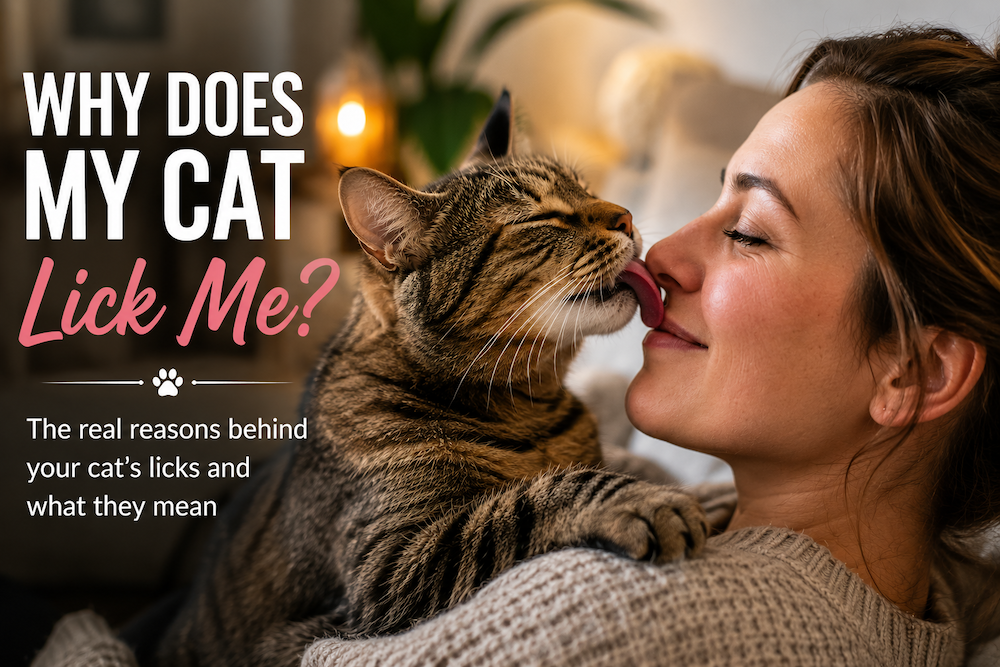
Why Does My Cat Lick Me?
You’re relaxing on the couch when your cat curls up beside you, starts purring and then begins licking your hand with that unmistakable sandpaper tongue.
It’s sweet… for about the first ten seconds.
But why does your cat lick you?
Is your cat showing affection? Grooming you? Trying to tell you something? Or do you simply taste particularly interesting?
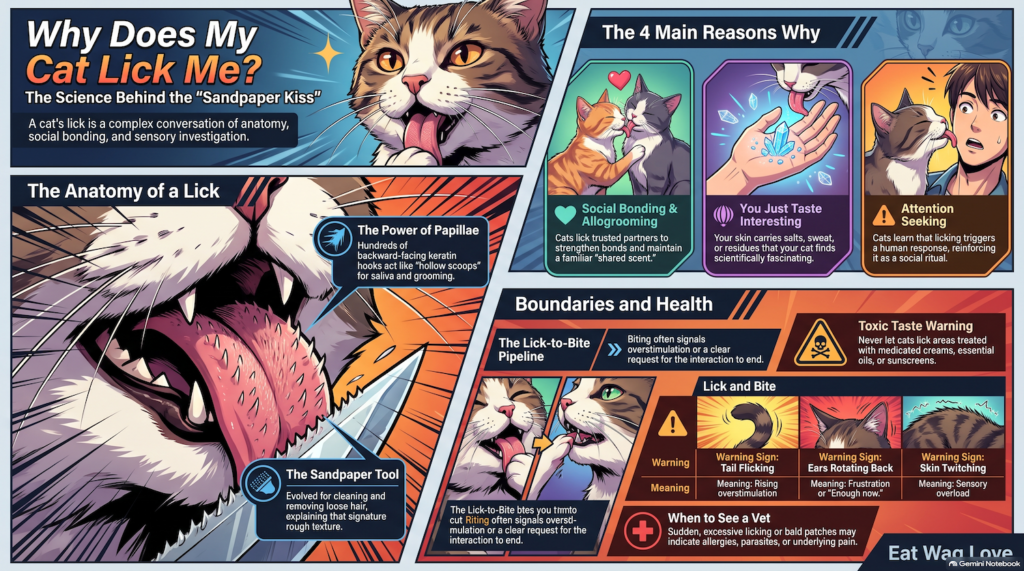
The answer is more fascinating than you might expect. Licking is an important part of feline behaviour, and cats can lick their owners for several different reasons. It can be associated with social bonding and grooming, but taste, attention, habit and even overstimulation can also play a role.
The secret is not to interpret the lick by itself.
Look at what the rest of your cat is telling you.
Why Do Cats Lick You?
One of the most likely explanations is that your cat is treating you as someone within their social circle.
Cats spend a considerable amount of time grooming themselves, but they can also groom other cats with whom they have an established social relationship.
This behaviour is called allogrooming.
Your cat may be grooming you
Socially connected cats sometimes groom one another, particularly around the head and neck where it’s harder for a cat to groom itself.
Your cat may extend similar grooming behaviour towards you.
This doesn’t necessarily mean your cat believes you’re a giant, strangely hairless cat. That’s a fun explanation, but it oversimplifies feline behaviour.
Instead, cats can adapt some of the social behaviours they use with other cats when interacting with humans they are comfortable around.
If your cat voluntarily climbs onto your lap, settles down, purrs and gently starts licking your hand, arm or even your hair, social grooming is a reasonable explanation.
It can be a sign of affection and bonding
Does a cat licking you mean “I love you”?
It can certainly be associated with affection and a positive social relationship, but we shouldn’t assume every lick has the same meaning.
Cats form meaningful social bonds with people and can show those relationships in numerous ways.
A comfortable cat might:
- Rub against you.
- Follow you around the house.
- Sleep beside you.
- Slow blink at you.
- Knead while sitting with you.
- Seek physical contact.
- Groom or lick you.
Look at the entire interaction.
A relaxed cat licking your hand while purring and cuddling beside you is providing considerably more information than the licking alone.
You might simply taste good
There is also a considerably less romantic explanation.
You might taste interesting.
Human skin can contain salt from perspiration, and cats have a highly developed sense of smell.
You may notice your cat becoming particularly interested in licking you after exercise or on a warm day.
Food smells on your fingers can provide another obvious attraction.
So yes, sometimes your cat may be expressing a wonderful social bond.
And sometimes…
you might just be a little salty.
Your cat may have learned that licking gets attention
Cats are excellent at learning what works.
Imagine your cat licks your hand.
You immediately look at them, speak to them and give them a pat.
From your cat’s perspective:
Lick human → human provides attention.
If the response is rewarding, there’s a good chance the behaviour will happen again.
Over time, licking can become part of a regular routine between you and your cat.
What Does It Mean When A Cat Licks You?
There isn’t one universal translation for a cat lick.
That’s why context matters.
Instead of asking only “Why did my cat lick me?”, look at what happened immediately before and after it.
Look at your cat’s body language
A happy, relaxed interaction may include:
- Soft or partially closed eyes.
- Slow blinking.
- Relaxed ears.
- Purring
- Kneading
- Rubbing against you.
- A loose, comfortable body position.
- Choosing to stay close to you.
If your cat looks comfortable and chooses to continue interacting with you, the licking is more likely to be part of a positive social experience.
But the meaning can change when the rest of the body changes.
Watch for:
- Tail flicking or lashing.
- Ears turning backwards.
- Skin twitching.
- Enlarged pupils.
- Body tension.
- Suddenly turning towards your hand.
- Trying to move away.
These can indicate that your cat is becoming overstimulated or has simply had enough interaction.
Why does my cat lick my hair?
Hair can be a particularly appealing target because grooming it can resemble the way cats groom fur.
Some cats will carefully lick, nibble or work through their owner’s hair.
It may be social grooming, a familiar ritual or simply an interesting texture and smell.
Be cautious, however, if you’ve recently used hair products. Cats shouldn’t be allowed to ingest products that may be unsafe for them.
Why does my cat lick my hands?
Hands are an obvious target.
They smell strongly of you, may carry traces of food and are normally the part of your body doing the patting.
That means hand licking could involve several motivations at once.
Your cat might be grooming you, enjoying a taste, seeking attention or simply repeating a familiar bonding ritual.
Why is a cat’s tongue so rough?
If you’ve ever wondered why being licked by a cat feels like being rubbed with tiny sandpaper, there’s some fascinating biology behind it.
A cat’s tongue contains hundreds of backward-facing structures called papillae.
They’re made from keratin—the tough material also found in hair and fingernails.
These specialised structures help cats groom their coats effectively, including helping saliva penetrate into the fur.
Your cat’s tongue is essentially an extraordinarily sophisticated built-in grooming brush.
Which is fantastic for the cat.
Perhaps slightly less comfortable for your cheek.
Why Does My Cat Lick Me Then Bite Me?
This is where cat behaviour gets particularly interesting.
Some owners experience a familiar sequence:
Lick. Lick. Lick. Lick… BITE.
It can feel as though your affectionate cat suddenly changed their mind about you.
Usually, there’s more going on.
Your cat may be overstimulated
Some cats enjoy physical contact only up to a certain point.
They may initially purr, cuddle and lick before becoming increasingly stimulated.
The bite can effectively communicate:
“Okay. That’s enough.”
Often, the cat has already provided subtler warnings.
A twitching tail, rotating ears, tense body or sudden glance towards your hand can appear before the bite.
Learning these signals allows you to end the interaction before your cat feels the need to make the message considerably clearer.
It could also be play
A gentle nibble isn’t necessarily aggression.
Cats frequently combine grooming, wrestling and playful biting during social interactions.
A cat may simply transition from one type of interaction into another.
Again, look at the whole animal rather than judging one behaviour in isolation.
When can licking indicate a problem?
Occasionally, licking deserves closer attention.
Excessive grooming can sometimes occur alongside medical or behavioural problems.
Possible underlying causes can include:
- Fleas or other parasites.
- Allergies
- Skin problems.
- Pain
- Stress
- Compulsive behaviour.
If your cat suddenly begins licking themselves much more than usual, develops bald patches, repeatedly targets one area or shows other changes in behaviour, talk to your veterinarian.
Don’t automatically assume excessive grooming is simply anxiety. Medical causes should be considered.
Should I let my cat lick me?
Usually, occasional licking is harmless if both you and your cat are comfortable with it.
There are some sensible exceptions.
Avoid allowing your cat to lick:
- Open wounds.
- Broken skin.
- Surgical wounds.
- Your eyes or mouth.
- Areas where you’ve applied medication.
- Skin covered with products that could be harmful if swallowed.
Be particularly cautious with medicated creams, essential oils and other topical products. Something that’s perfectly safe on human skin isn’t automatically safe inside a cat.
If you don’t enjoy being licked, you don’t need to tolerate it either.
Simply redirect your cat gently.
Move your hand away, offer a toy or change the interaction.
There’s no need to shout, punish your cat or spray them with water.
Understanding Your Cat’s Sandpaper Kisses
So, why does your cat lick you?
They may be socially grooming you.
They may be showing affection.
They might be seeking attention.
They may have turned licking into a familiar ritual.
Or perhaps you’ve just returned from a workout and taste unusually salty.
Sometimes more than one explanation can be true at once.
The important lesson is that cat behaviour shouldn’t be interpreted from one action alone.
Watch the eyes.
Watch the ears.
Watch the tail.
Notice when the licking starts and what happens afterwards.
Your cat is communicating with you constantly, and learning to recognise those small signals can help you better understand the animal sharing your home.
So the next time your cat settles beside you and starts enthusiastically sandpapering your hand, take a moment to look at the bigger picture.
It might be grooming.
It might be attention.
It might be affection.
And whatever the precise motivation, it’s another fascinating glimpse into the wonderfully complicated way cats communicate with the people in their lives.