How Do Dogs See the World?
Human Vision vs Dog Vision
Have you ever wondered what your dog actually sees when looking around the park, searching for a ball or watching you from across the room?
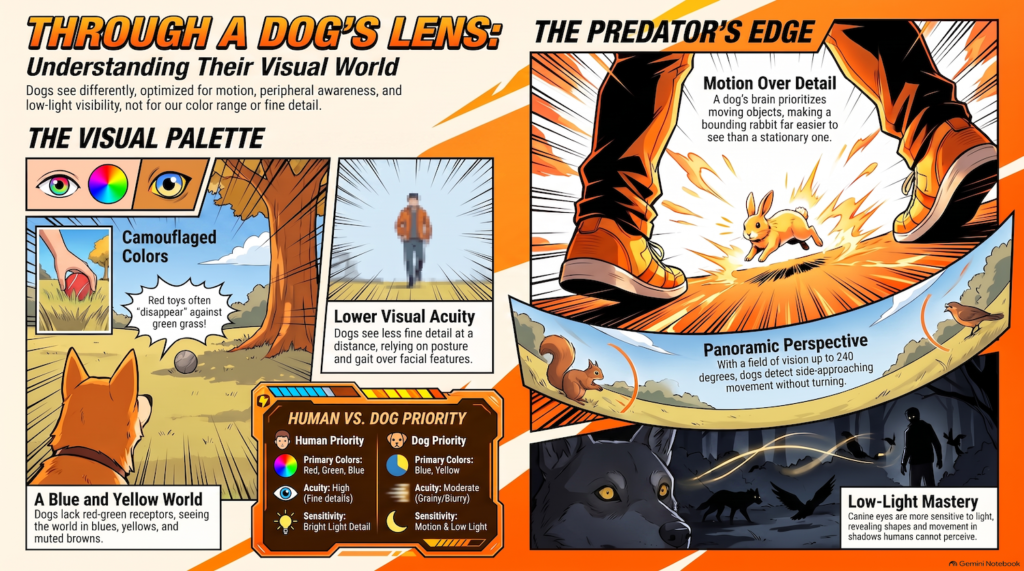
Dogs don’t see the world in black and white, but they don’t experience the same range of colours, clarity or visual detail that humans do. Their eyes are adapted for different priorities, including seeing in lower light, noticing activity around them and surveying a wider area.
That means you and your dog can stand in exactly the same place while experiencing two surprisingly different versions of the world.
Our side-by-side comparisons reveal how colourful toys, distant animals, familiar faces, nighttime streets and movement may appear through human and canine eyes.
What Colours Can Dogs See?
One of the most persistent dog myths is that dogs see only in black and white. Dogs do have colour vision—it is simply more limited than ours.
Humans normally have three types of colour-sensitive cone cells, while dogs have two. This is known as dichromatic vision, and it gives dogs colour perception somewhat comparable to red-green colour blindness in humans. Research supports the conclusion that dogs have difficulty distinguishing red from green, while blue and yellow are much easier for them to recognise. Research published through the US National Library of Medicine has demonstrated red-green colour blindness in domestic dogs.
What Does Red Look Like to a Dog?
Dogs don’t necessarily see every red object as exactly the same colour. Its appearance can be influenced by brightness, lighting and the colours surrounding it.
In general, bright reds can appear as dull brown, dark grey or muted yellowish tones. Greens may appear yellowish, grey or tan.
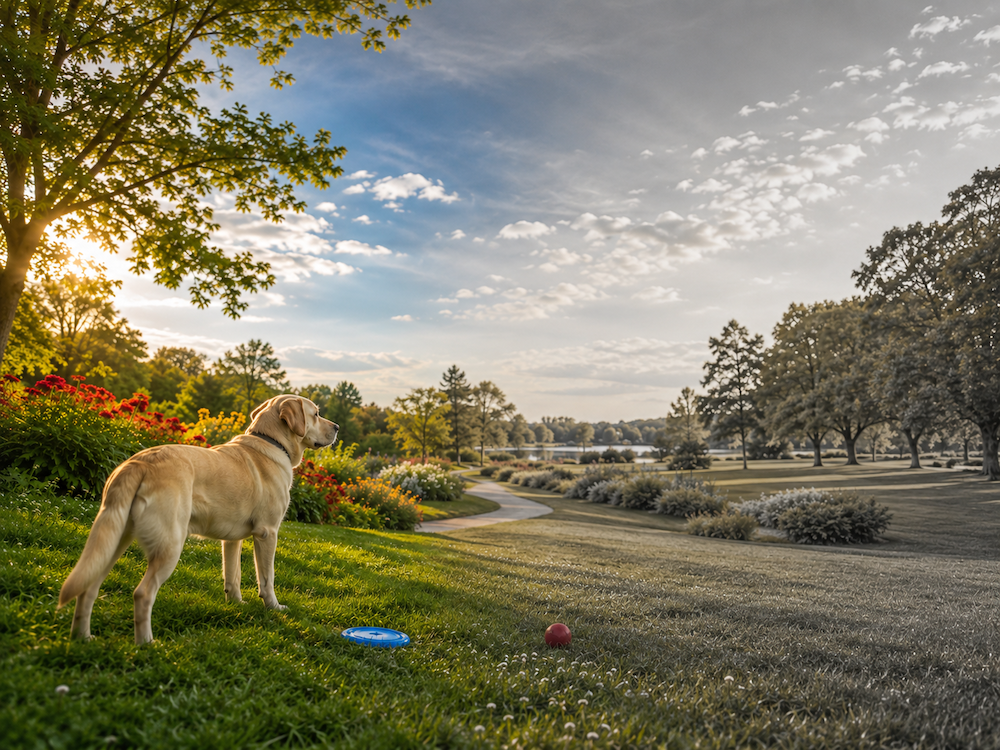
This helps explain why a red ball can be surprisingly difficult for a dog to locate on green grass. To a human, the ball and lawn create a strong colour contrast. To a dog, they may occupy similar parts of a muted yellow-brown colour range.
Your dog may not be ignoring the ball. You may have accidentally purchased camouflage.
What Toy Colours Are Best for Dogs?
Blue and yellow toys are usually the easiest for dogs to distinguish.
A vivid blue frisbee, ball or training dummy should stand out well against grass. Yellow can also be highly visible, although a yellow toy may be harder to distinguish against dry grass, sand or similarly coloured flooring.
When choosing visually stimulating dog toys, consider:
- Blue for playing on grass.
- Yellow for darker flooring or contrasting outdoor surfaces.
- A combination of blue and yellow for strong visibility.
- Shape, movement and scent as well as colour.
Red, orange and green toys aren’t harmful or unusable. Your dog may simply rely more heavily on movement, smell and memory to find them.
The American College of Veterinary Ophthalmologists confirms that dogs see blues and yellows particularly well and have difficulty distinguishing between red and green. Read its overview of vision in pets.
How Does Dog Vision Compare to Human Vision?
Humans generally have an advantage when viewing fine details, faces and stationary objects at a distance. Dogs experience a softer, less detailed version of the scene.
This does not mean everything appears hopelessly blurry to a dog. Nearby bowls, furniture, toys and people can still be recognisable. The loss of visual detail becomes more important when an object is small, camouflaged or far away.
Can Dogs Recognise Their Owners From Far Away?
Imagine your owner standing across a large park and waving.
A human observer may be able to distinguish the person’s face, expression, clothing and fingers. A dog is likely to receive less facial detail at the same distance.
However, recognising someone involves much more than seeing a perfectly clear face. Dogs can also use:
- Overall body shape.
- Posture and gestures.
- Walking style and characteristic movements.
- Voice.
- Scent once the person is closer.
Your dog may pause when you call from across a field because it is collecting more information—not because it has forgotten who you are.
Individual dogs also vary. Age, eye health, lighting, distance and breed-related head shape can all influence what a dog sees.
Can Dogs See Stationary Animals in the Distance?
A motionless rabbit sitting among long grass may be relatively easy for a human to recognise by its ears and body outline. For a dog, reduced fine detail and limited colour contrast can allow the rabbit to blend into the landscape.
Once the rabbit runs, its extended silhouette and sudden change of position become much more noticeable.
This is slightly reminiscent of the famous advice from Jurassic Park: “Don’t move, and it won’t see you.”
Unfortunately for anyone being pursued by a T. rex—or an enthusiastic terrier—that idea is not scientifically reliable. Dogs can see stationary objects. Movement simply provides an additional and often very compelling visual cue.
It is also important not to claim that dogs outperform humans in every test of motion perception. Research comparing humans and dogs using moving dot displays found that the human participants detected coherent motion more effectively under those particular experimental conditions. Read the study in Scientific Reports. Real-world canine responses to a running rabbit also involve contrast, learned behaviour, attention and prey drive—not just one universal “motion detector” inside the eye.
Do Dogs Have Better Peripheral Vision?
Most dogs have a wider field of view than humans because their eyes are positioned more towards the sides of the head.
This allows them to monitor more of their surroundings without turning their head. A dog looking along a park path may notice a cyclist approaching from one side and another dog appearing on the other, even while its head remains pointed forwards.
There is no single field-of-view measurement that represents every dog. Eye placement and head shape vary enormously between a Pug, Labrador and Greyhound.
Dogs with longer heads and more laterally positioned eyes generally have wider peripheral coverage. Short-faced dogs often have more forward-facing eyes and greater visual emphasis towards the centre. Research has found connections between canine head shape, retinal structure and visually guided behaviour, although vision is only one element of breed behaviour.
The trade-off for a wider field can be less binocular overlap—the area seen by both eyes simultaneously—which contributes to depth perception. Humans have a narrower overall view but substantial overlap between the visual fields of our two forward-facing eyes.
Can Dogs See in the Dark?
Dogs cannot see in complete darkness. Like humans, they need at least some available light.
However, dogs are generally better equipped than humans to use low levels of light. Their eyes contain many rod photoreceptors, which are important for dim-light vision, and most dogs possess a reflective structure behind the retina called the tapetum lucidum.
Why Do Dogs’ Eyes Glow at Night?
The tapetum lucidum reflects light back through the retina, giving light-sensitive cells another opportunity to respond.
This improves the eye’s ability to function under dim conditions. It is also responsible for the familiar glow that may appear when headlights, a torch or a camera flash catches a dog’s eyes.
A study examining the canine tapetum describes it as reflective tissue that enhances low-light vision by returning light through the retina. Read the research on canine retinal and tapetal anatomy.
Dogs may therefore detect shapes, pathways and activity in shadowed areas that appear much darker to us.
Do Dogs See Clearly at Night?
Better low-light sensitivity does not mean dogs see a sharp, colourful nighttime world.
Their night vision involves compromises:
- Colours become even less useful as light levels fall.
- Fine details remain limited.
- Distant faces and small objects can be difficult to resolve.
- Bright streetlights may create glare or a halo effect.
- Movement and silhouettes may attract attention more readily than fine features.
During a nighttime walk, your dog might notice something moving near a hedge before you do. That does not necessarily mean they know exactly what it is.
This may explain the occasional late-night stare into apparently empty darkness. Your dog could have detected subtle movement—or they could be conducting an important investigation into a plastic bag.
Does Every Dog See the Same Way?
Our comparison images represent general canine vision rather than an exact view for every dog.
Vision can be affected by:
- Breed and head shape.
- Eye position.
- Age.
- Cataracts or other eye conditions.
- Retinal health.
- Lighting.
- Distance.
- The colour and movement of the object.
If your dog suddenly starts colliding with furniture, hesitates on stairs, becomes reluctant to walk at night, cannot locate familiar objects or develops cloudy, red or painful-looking eyes, arrange a veterinary examination. Changes in vision should not automatically be dismissed as normal ageing.
Final Thoughts
Dogs don’t see an inferior version of the human world. They see a world adapted to different needs.
Humans are particularly good at appreciating a wide spectrum of colour, recognising fine facial features and examining stationary details. Dogs experience a more restricted blue-and-yellow colour range, reduced distant detail, a generally wider view and better use of low-level light.
Vision is also only part of the story. While we are looking at flowers, streetlights and scenery, our dogs are exploring an enormous invisible landscape of scents.
The next time your dog loses a red ball, hesitates before recognising someone far away or becomes fascinated by movement in a dark garden, remember: you may be sharing the same surroundings, but your dog is experiencing a very different world.