





Fast, athletic, and naturally spotted — the Egyptian Mau is a striking cat with vivid green eyes, an extraordinary running ability, and a devoted personality that can be surprisingly affectionate with the people it trusts.
🧠 QUICK SNAPSHOT
- Temperament: Affectionate, intelligent, alert
- Energy Level: High
- Size: Medium
- Good With Families: Yes
- Indoor Living: Excellent with sufficient enrichment
- Trainability: High
- Grooming: Low
- Best For: Active families, interactive owners, homes offering plenty of climbing and play
- Typical Lifespan: Around 12–15 years
📚 OVERVIEW
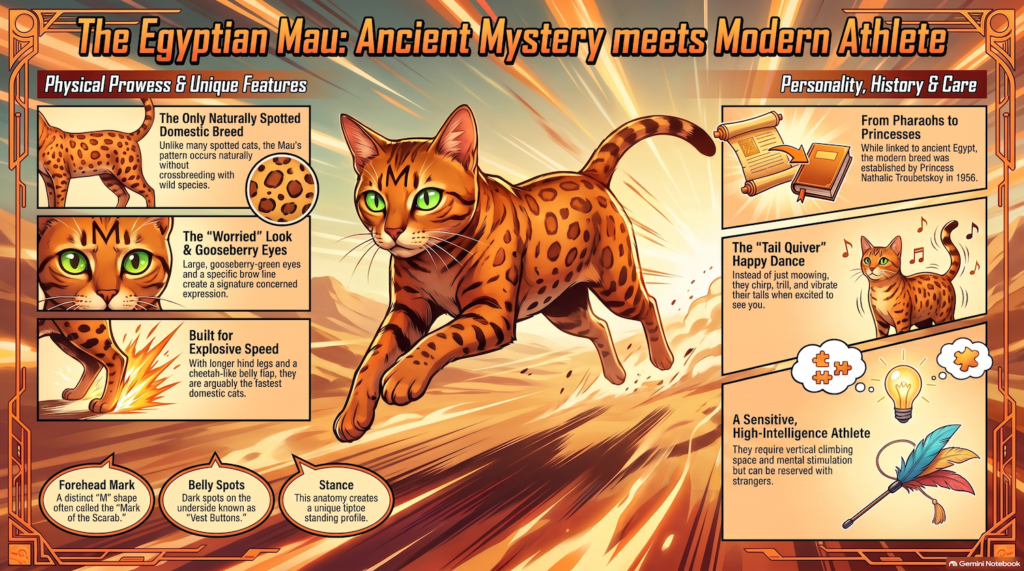
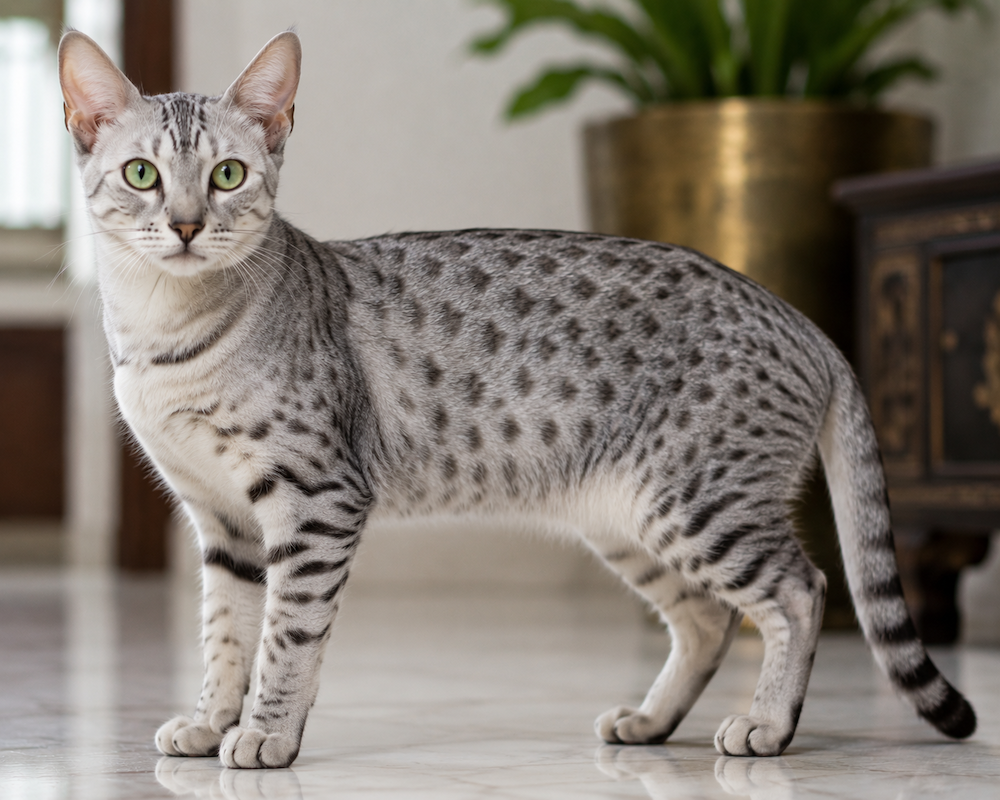
The Egyptian Mau is an elegant, athletic cat best known for its beautiful naturally occurring spotted coat. Unlike breeds in which spots were deliberately introduced through selective crossing, spotting is an inherent characteristic of the Mau, appearing not only on the coat but also as pigmentation on the skin beneath.
Its name is wonderfully appropriate: “mau” is the ancient Egyptian word commonly associated with cat.
The breed’s appearance certainly evokes the spotted cats depicted in ancient Egyptian art, although claims that today’s pedigree Egyptian Mau descends directly and continuously from the cats of the pharaohs should be treated cautiously. The documented modern breed was established during the 20th century, with Princess Nathalie Troubetskoy playing an important role in its development outside Egypt.
The Egyptian Mau combines elegance with serious athletic ability. Its powerful hindquarters, loose skin extending towards the rear legs, and muscular body contribute to impressive acceleration and agility.
At home, however, there’s another side to the Mau. These cats can be deeply affectionate and devoted to their families while remaining more cautious around unfamiliar people.
✅ PROS & CONS
Pros
- Affectionate and devoted to its family
- Extremely athletic and playful
- Highly intelligent
- Naturally beautiful spotted coat
- Straightforward grooming requirements
- Excellent companion for interactive households
Cons
- Needs plenty of physical and mental stimulation
- Can be reserved around strangers
- May dislike sudden changes in routine
- Athletic ability means plenty of vertical space is needed
- Can become bored without enrichment
- Relatively rare compared with mainstream cat breeds
Is an Egyptian Mau a Good Family Cat?
Yes, the Egyptian Mau can be an excellent family cat, particularly for households that appreciate an active, intelligent companion and allow the cat to develop relationships at its own pace.
With trusted family members, Egyptian Maus are often extremely affectionate. Some develop a particularly strong attachment to one or two people and may follow them around the home, greet them enthusiastically, and seek regular physical contact.
They can live successfully with respectful children, especially children old enough to understand that a cat shouldn’t be chased, grabbed, or forced to interact. Their playful nature makes games an excellent way for children and cats to build a relationship.
Egyptian Maus can also live with other cats and cat-friendly dogs when introduced gradually. Their natural caution means rushed introductions should be avoided.
This breed may initially disappear when visitors arrive rather than immediately demanding attention. Once a Mau trusts someone, however, its reserved exterior can reveal a remarkably loving and loyal companion.
Can an Egyptian Mau Live Indoors or in an Apartment?
Yes, an Egyptian Mau can live very successfully indoors or in an apartment, but its environment needs to accommodate an unusually athletic cat.
Vertical territory is particularly important. Tall cat trees, sturdy climbing structures, shelves, scratching towers, and window perches allow the Mau to climb, jump, observe, and explore even when floor space is limited.
Owners should also provide interactive toys, tunnels, puzzle feeders, hiding places, and daily play. Rotating toys can help keep an intelligent cat interested.
Secure indoor living has significant advantages, particularly for a rare pedigree cat, protecting it from traffic, fights, infectious diseases, poisoning, theft, and other hazards. Secure outdoor enclosures can provide additional stimulation.
An Egyptian Mau doesn’t necessarily need a huge home. It needs an interesting home.
A well-designed apartment offering climbing opportunities, regular play, and plenty of interaction can provide a much richer life than a large but unstimulating house.
How Much Exercise and Play Does an Egyptian Mau Need?
The Egyptian Mau is a high-energy, exceptionally athletic cat that needs daily exercise and interactive play. Several energetic play sessions throughout the day help satisfy its natural desire to run, stalk, leap, and chase.
Fishing-wand toys, balls, feather toys, tunnels, climbing towers, and games involving rapid changes of direction are excellent choices.
Many Maus also enjoy retrieving toys and learning games that combine physical movement with problem-solving.
Mental exercise is equally important. Puzzle feeders, treat hunts, clicker training, scent-based games, and rotating toys provide challenges for an intelligent cat that may otherwise become bored.
The breed’s speed is particularly impressive. Egyptian Maus are frequently described as among the fastest domestic cats, with their powerful rear legs and distinctive body structure contributing to remarkable acceleration.
Owners don’t need to recreate a feline racetrack in their living room, but they should provide safe opportunities for this natural athlete to move.
Is an Egyptian Mau Easy to Train?
Yes, the Egyptian Mau is generally highly trainable because it is intelligent, observant, and often strongly motivated by interaction, food, or play.
Positive reinforcement can be used to teach a Mau to come when called, retrieve toys, enter a carrier voluntarily, use scratching posts, tolerate routine handling, and even walk on a harness.
Clicker training can be particularly effective because it gives the cat a precise way to understand which behaviour earned a reward.
Training should always remain voluntary and rewarding. Punishment can damage trust, which is particularly counterproductive with a breed that can already be naturally cautious.
Egyptian Maus are also excellent observers of household routines. They quickly learn when meals are served, where favourite toys are stored, and which human is most likely to provide attention.
Their intelligence makes training enjoyable, but it also means owners should provide constructive challenges — because a bored Mau is perfectly capable of discovering its own activities.
Does an Egyptian Mau Shed?
Yes, the Egyptian Mau does shed, but its short coat is relatively easy to maintain. Shedding is generally moderate, although the amount can vary between individuals and may increase seasonally.
A gentle brushing approximately once a week is usually sufficient to remove loose hairs and help keep the coat in excellent condition. More frequent brushing during heavier shedding periods can reduce loose hair around the home.
The coat itself requires no professional trimming and bathing is rarely necessary unless there is a specific reason.
Routine grooming should also include regular nail trimming, dental care, and checks of the ears, skin, and body condition.
The Egyptian Mau is not considered hypoallergenic. Even cats with short, relatively easy-care coats produce allergens through saliva and skin secretions.
For people primarily concerned about grooming workload rather than allergies, however, the Mau’s beautiful spotted coat is considerably easier to maintain than that of many long-haired breeds.
What Health Problems Are Common in an Egyptian Mau?
The Egyptian Mau is generally a healthy breed, but responsible breeding and preventative veterinary care remain important. A typical lifespan is approximately 12–15 years, although well-cared-for individuals may live longer.
As with many pedigree cats, breeders should pay attention to genetic diversity and maintain detailed knowledge of health within their lines. Heart disease, including hypertrophic cardiomyopathy (HCM), is an important consideration across the wider feline population and should be discussed with breeders and veterinarians where relevant.
Dental disease, obesity, urinary problems, and kidney disease can also affect cats regardless of breed, particularly as they age.
Prospective owners should choose breeders who are transparent about health history and use appropriate veterinary screening rather than making unrealistic claims that their cats are completely free of genetic disease.
Regular veterinary examinations, dental care, balanced nutrition, maintaining a lean body condition, and quickly investigating changes in appetite, thirst, weight, breathing, toileting, or behaviour give an Egyptian Mau the best opportunity for a long and healthy life.
⭐ Is the Egyptian Mau Really an Ancient Egyptian Cat?
The answer is more complicated than the name suggests.
Spotted cats certainly appear in ancient Egyptian artwork, and cats held enormous cultural importance in ancient Egypt. The modern Egyptian Mau also has an appearance that makes the historical connection incredibly tempting.
However, saying that every modern pedigree Egyptian Mau is a directly documented descendant of the pharaohs’ cats goes beyond the available evidence.
The modern breed’s reliably documented history is much more recent.
A major figure was Princess Nathalie Troubetskoy, who obtained spotted cats and helped establish the breed after emigrating to the United States during the 1950s. Her breeding program played an important role in developing the Egyptian Mau recognised by modern cat registries.
So there are really two fascinating stories: the ancient history of spotted Egyptian cats and the documented modern development of the Egyptian Mau.
They’re related culturally and visually, but shouldn’t simply be presented as one continuous pedigree stretching back thousands of years.
⭐ Why Does the Egyptian Mau Have Spots?
The Egyptian Mau is particularly special because its spots are naturally occurring rather than an appearance created by crossing domestic cats with wild feline species.
The markings can vary considerably in shape and size across the body. Some are round while others are more irregular, giving each cat an individual pattern.
The Mau also has characteristic facial markings, including dark lines extending from around the eyes and distinctive markings across the forehead.
Perhaps the most fascinating detail is underneath the fur.
The pigmentation associated with the spotted pattern can also be visible on the skin beneath the coat, reinforcing that the markings are part of the cat’s underlying pigmentation rather than merely the way individual hairs happen to lie.
Combine those spots with large expressive eyes — traditionally described as gooseberry green in mature show cats — and the result is one of the most distinctive naturally patterned pedigree cats in the world.
⭐ How Fast Is an Egyptian Mau?
The Egyptian Mau has a reputation as one of the fastest domestic cat breeds, and its body provides some clues as to why.
It has muscular hind legs and a distinctive loose fold of skin extending along the underside towards the rear legs. This allows considerable extension during running and contributes to the breed’s remarkable athletic movement.
Claims of speeds around 30 mph (48 km/h) are widely repeated, although precise breed-specific maximum-speed measurements should be treated cautiously because domestic cats aren’t routinely subjected to standardised scientific speed trials.
What owners don’t need laboratory equipment to discover is that the Mau is extraordinarily quick.
When one decides to sprint across the house, climb a cat tree, chase a toy, and disappear around a corner, its elegant appearance suddenly makes much more sense.
The Egyptian Mau isn’t merely a beautiful spotted cat.
Underneath that exotic coat is a serious little athlete.