





Affectionate, intelligent, and gloriously sociable — the Tonkinese combines traits associated with the Siamese and Burmese into a playful companion that loves people, conversation, games, and being right in the middle of family life.
🧠 QUICK SNAPSHOT
- Temperament: Affectionate, outgoing, intelligent
- Energy Level: High
- Size: Medium
- Good With Families: Excellent
- Indoor Living: Excellent with sufficient enrichment
- Trainability: Very High
- Grooming: Low
- Best For: Families, interactive owners, multi-pet homes, apartment living
- Typical Lifespan: Around 12–16 years
📚 OVERVIEW
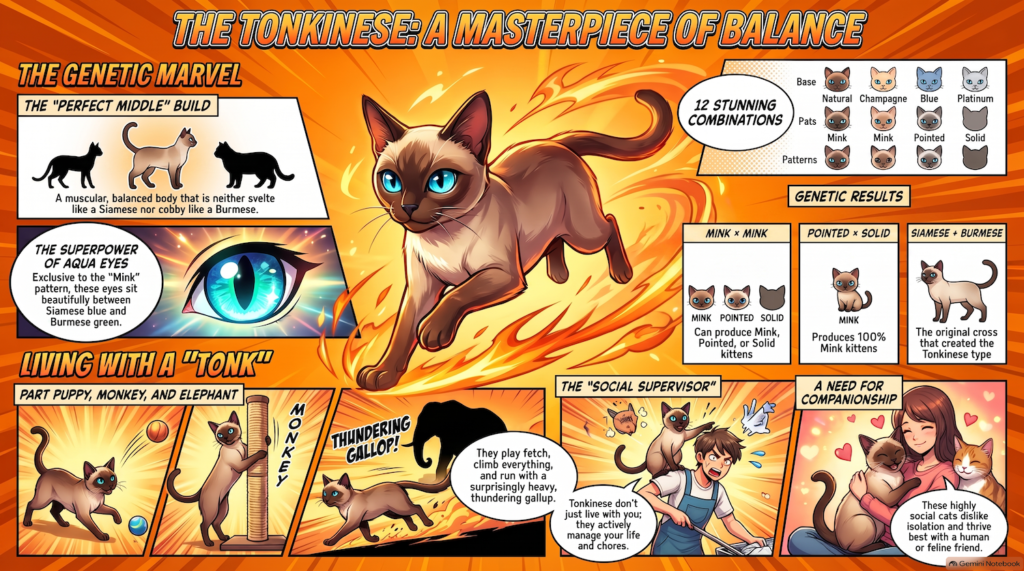
The Tonkinese is a highly social, intelligent cat closely connected to two famous breeds: the Siamese and Burmese. Modern Tonkinese breeding programs deliberately brought these lines together, producing cats that combine an elegant, muscular appearance with an exceptionally outgoing temperament.
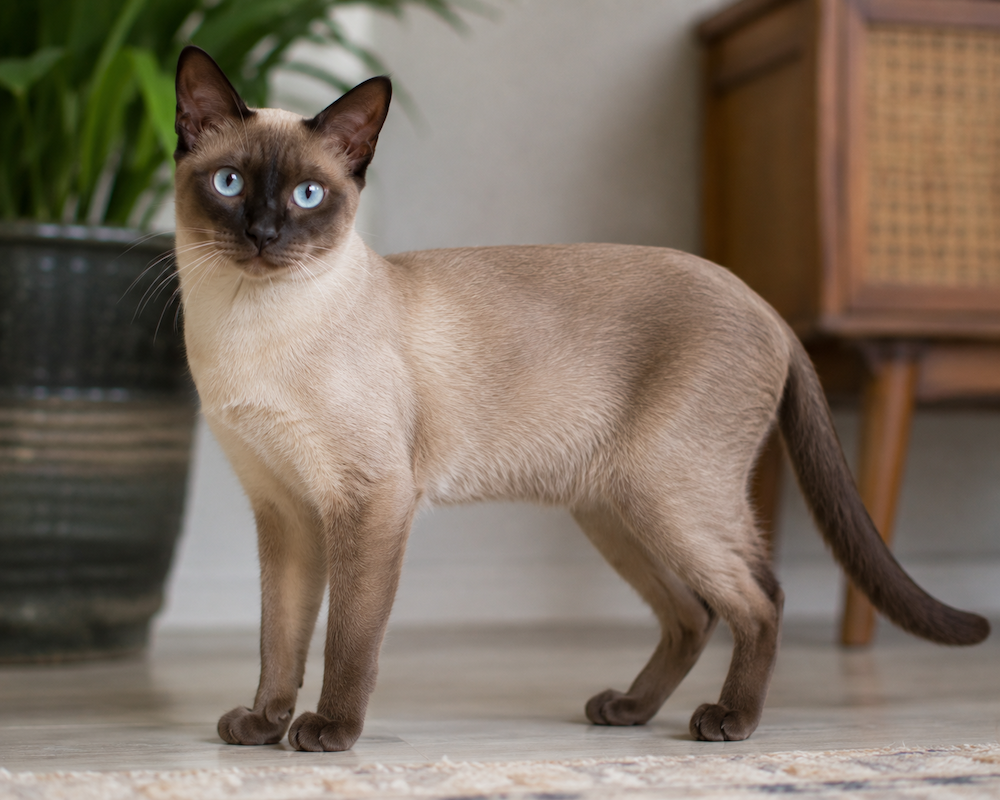
One of the breed’s most striking features is its eyes. Depending on coat pattern, Tonkinese can have shades ranging from blue through green and yellow-green, while cats with the characteristic mink pattern are particularly famous for their beautiful aqua-coloured eyes.
Their short, silky coat lies close to the body and requires very little grooming. Underneath it is a surprisingly muscular, athletic cat that often feels heavier when picked up than its elegant appearance suggests.
Personality is where the Tonkinese really stands out. These cats tend to be curious, playful, affectionate, and intensely interested in their humans. Many follow people from room to room, greet visitors, investigate household activities, and happily hold vocal conversations.
A Tonkinese doesn’t simply want somewhere comfortable to live.
It generally wants to be part of the household team.
✅ PROS & CONS
Pros
- Exceptionally affectionate and sociable
- Highly intelligent and trainable
- Excellent with families
- Often thrives with other pets
- Low-maintenance short coat
- Playful personality that often continues into adulthood
Cons
- Doesn’t enjoy prolonged isolation
- Can be demanding of attention
- Needs substantial daily play and enrichment
- Can be vocal
- Intelligent cats can become mischievous when bored
- May be too socially intense for someone wanting an independent cat
Is a Tonkinese a Good Family Cat?
Yes, the Tonkinese is generally an excellent family cat, especially for households wanting an affectionate, interactive companion rather than an independent cat that spends much of its time alone.
Tonkinese typically form strong bonds with their humans and often enjoy interacting with several members of the household. Their playful personality can make them particularly entertaining companions for respectful children who enjoy games and understand how to handle cats appropriately.
They also tend to be good candidates for multi-pet households. Many enjoy living with another sociable cat, and Tonkinese can often adapt successfully to cat-friendly dogs when introductions are gradual.
Their need for companionship is important. A Tonkinese regularly left alone for long working days may become lonely or bored, particularly without another compatible animal for company.
For a busy, interactive household where someone usually wants to play, cuddle, or talk to the cat, however, the Tonkinese can fit into family life exceptionally well.
Can a Tonkinese Live Indoors or in an Apartment?
Yes, the Tonkinese is very well suited to indoor and apartment living, provided owners compensate for limited space with plenty of enrichment, climbing opportunities, exercise, and companionship.
Tonkinese are athletic cats that make excellent use of vertical territory. Tall cat trees, climbing shelves, window perches, scratching towers, tunnels, and safe elevated resting areas can make even a relatively small apartment much more interesting.
Interactive toys and puzzle feeders are also valuable because this is an intelligent breed that can quickly become bored with an unchanging environment.
Owners should schedule daily play rather than expecting the cat to exercise itself. A secure outdoor enclosure can provide additional stimulation where practical, while some Tonkinese can learn to enjoy harness walks.
One apartment consideration is vocalisation. Although individual cats vary, the breed’s Siamese ancestry means some Tonkinese are enthusiastic conversationalists.
Fortunately, they usually have plenty worth talking about.
How Much Exercise and Play Does a Tonkinese Need?
The Tonkinese is a high-energy cat that needs plenty of daily play, climbing, and mental stimulation. Several interactive play sessions throughout the day are preferable to one long session, particularly for kittens and young adults.
Fishing-wand toys, balls, tunnels, feather toys, climbing towers, and chasing games allow the Tonkinese to express natural hunting behaviours while burning energy.
Many Tonkinese are particularly enthusiastic about fetch. Some will repeatedly retrieve a favourite toy and bring it back for another throw, contributing to the breed’s occasionally dog-like reputation.
Mental exercise is equally important. Puzzle feeders, clicker training, treat hunts, rotating toys, and learning new tricks help challenge an intelligent cat.
Tonkinese often remain playful well beyond kittenhood, so prospective owners shouldn’t assume activity requirements will disappear once the cat matures.
Provide plenty of legitimate entertainment and you’ll have an energetic companion. Fail to do so and your Tonkinese may decide that opening cupboards or rearranging your possessions is an equally acceptable hobby.
Is a Tonkinese Easy to Train?
Yes, the Tonkinese is highly trainable because it combines intelligence, curiosity, confidence, and a strong desire to interact with people.
Using positive reinforcement, many Tonkinese can learn to come when called, sit, retrieve toys, give a paw, enter a carrier voluntarily, walk on a harness, and perform an impressive selection of tricks.
Clicker training can be particularly effective because it turns learning into an interactive game.
Training also has practical benefits. Teaching a cat to accept nail trimming, dental checks, carrier travel, grooming, and routine handling can make everyday care considerably easier.
Sessions should remain short, positive, and rewarding. Punishment can damage trust and should not be used.
The Tonkinese’s intelligence also means owners need to be consistent. These cats are very good at learning which behaviours produce attention — including behaviours their humans never intended to encourage.
Sometimes the Tonkinese isn’t the only member of the household being trained.
Does a Tonkinese Shed?
Yes, the Tonkinese sheds, but its short, close-lying coat is very easy to maintain. Shedding is generally light to moderate, making the breed a good choice for owners who want minimal coat maintenance.
A gentle brushing approximately once a week is normally enough to remove loose hair and maintain the coat’s smooth, glossy appearance. Many Tonkinese also enjoy the extra attention that grooming provides.
Bathing is rarely necessary unless the cat becomes unusually dirty or there is a veterinary reason.
Routine maintenance should include nail trimming, dental care, and regular checks of the ears, eyes, skin, and overall body condition.
The Tonkinese is sometimes included on lists of cats supposedly better for allergy sufferers, but it should not be considered genuinely hypoallergenic. Major feline allergens are produced through saliva and skin glands, so a short-haired or relatively low-shedding cat can still trigger significant allergic reactions.
What Health Problems Are Common in a Tonkinese?
The Tonkinese is generally a healthy breed, but its close relationship with Siamese and Burmese cats means responsible breeders should be aware of inherited conditions occurring within those populations.
Potential concerns can include progressive retinal atrophy (PRA), which can lead to vision loss, and heart conditions such as hypertrophic cardiomyopathy (HCM). Conditions affecting Burmese or Siamese breeding lines may also be relevant depending on ancestry.
Dental disease is another important consideration, as it is for cats generally. Regular home dental care and veterinary assessment can help identify problems before they become painful.
Responsible breeders should use available genetic tests and other health screening appropriate to their breeding lines and be transparent about health problems occurring among related cats.
Maintaining a healthy body weight, providing balanced nutrition, arranging regular veterinary examinations, and investigating unexplained changes in appetite, thirst, weight, breathing, toileting, or behaviour can help identify illness early.
With responsible breeding and good care, many Tonkinese live approximately 12–16 years or longer.
⭐ Is a Tonkinese Half Siamese and Half Burmese?
The modern Tonkinese breed was developed through Siamese and Burmese ancestry, but describing every Tonkinese alive today simply as a 50/50 Siamese-Burmese cross is misleading.
Early breeding programs deliberately crossed the two breeds to establish the characteristics breeders wanted. Once Tonkinese breeding populations became established, Tonkinese could be bred to other Tonkinese according to the rules of different cat registries and breeding programs.
Interestingly, cats with characteristics resembling today’s Tonkinese existed before the modern breed was formally developed.
One particularly famous cat in feline history is Wong Mau, brought to the United States from Southeast Asia in the 1930s. She became enormously important in the development of the modern Burmese breed, and genetic breeding experiments demonstrated characteristics consistent with the relationship between Burmese, Siamese, and intermediate mink-type cats.
So the Tonkinese isn’t simply a modern designer cross.
Its genetics provide a fascinating window into the relationship between some of Southeast Asia’s most famous cat types.
⭐ Why Do Some Tonkinese Have Aqua Eyes?
Those remarkable aqua eyes are one of the Tonkinese breed’s signature features, and they are closely connected to its genetics.
Siamese cats possess the colourpoint pattern associated with blue eyes, while Burmese cats have a different form of temperature-sensitive pigmentation and typically yellow to gold eyes.
Tonkinese can inherit an intermediate expression known as the mink pattern.
Mink Tonkinese have more body colour than a pointed Siamese but greater contrast between the body and extremities than a typical solid or sepia Burmese-type pattern.
The eye colour associated with this intermediate pattern is often an extraordinary shade somewhere between blue and green — commonly described as aqua.
Tonkinese can also occur in pointed and solid/sepia patterns, and those cats may have different eye colours.
This means coat pattern and eye colour aren’t simply unrelated decorative features.
They’re visible clues to the fascinating genetics connecting the Siamese, Burmese, and Tonkinese.