




Beautiful, athletic, and endlessly curious — the Somali is the long-haired relative of the Abyssinian, combining a spectacular fox-like coat and bushy tail with an intelligent, playful personality that seems determined to investigate everything.
🧠 QUICK SNAPSHOT
- Temperament: Intelligent, playful, curious
- Energy Level: High
- Size: Medium
- Good With Families: Excellent
- Indoor Living: Excellent with sufficient enrichment
- Trainability: Very High
- Grooming: Moderate
- Best For: Active families, interactive owners, multi-pet households
- Typical Lifespan: Around 12–16 years
📚 OVERVIEW
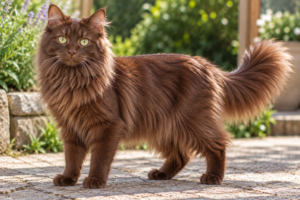
The Somali is essentially the long-haired relative of the Abyssinian, sharing the Abyssinian’s elegant athletic build, enormous curiosity, intelligence, and distinctive ticked coat. Add a luxurious semi-long coat, magnificent bushy tail, and facial markings, however, and the Somali develops an appearance that has earned it the nickname “fox cat.”
Long-haired kittens occasionally appeared in Abyssinian breeding lines during the 20th century. Initially they weren’t always welcomed by breeders seeking the traditional short Abyssinian coat, but enthusiasts eventually recognised their appeal and deliberately developed them into the Somali breed.
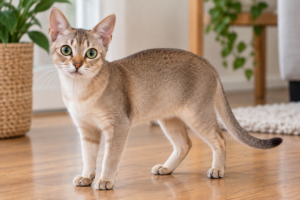
The coat is particularly striking because individual hairs feature alternating bands of colour, creating the characteristic ticked or agouti appearance rather than conventional stripes or spots across most of the body.
Personality is equally distinctive. Somalis tend to be active, playful, inquisitive, and exceptionally interested in their surroundings. They frequently climb to high vantage points, investigate cupboards, chase toys, and supervise whatever their owners are doing.
This is a cat for someone who wants an active participant in the household — not merely a beautiful ornament.
✅ PROS & CONS
Pros
- Highly intelligent and entertaining
- Affectionate and people-oriented
- Excellent with active families
- Extremely playful
- Highly trainable
- Usually enjoys other sociable pets
Cons
- High exercise and enrichment requirements
- Can become mischievous when bored
- Needs regular coat maintenance
- Loves climbing onto high surfaces
- May dislike being routinely left alone
- Not ideal for someone wanting a quiet, sedentary cat
Is a Somali a Good Family Cat?
Yes, the Somali can be an excellent family cat, particularly for an active household wanting an intelligent, playful companion. Somalis tend to enjoy human company and frequently involve themselves in whatever their family is doing.
They can be wonderful companions for respectful children who enjoy interactive play. Fishing-wand toys, retrieving games, puzzle toys, and supervised training provide far better ways for children to interact with a Somali than constantly picking it up.
Somalis can also live successfully with other cats and cat-friendly dogs after appropriate introductions. A compatible animal companion may be particularly valuable in households where people are absent during parts of the day.
Although affectionate, the Somali isn’t necessarily a conventional lap cat. Many prefer following their owners, playing beside them, or watching household activity from a nearby high perch.
For families wanting an interactive cat with plenty of personality, intelligence, and energy, the Somali has tremendous appeal.
Can a Somali Live Indoors or in an Apartment?
Yes, a Somali can live very successfully indoors or in an apartment, but its environment needs to be designed around an athletic, inquisitive cat.
Vertical territory is essential. Tall cat trees, climbing shelves, window perches, scratching towers, and other secure elevated spaces dramatically increase the usable environment and satisfy the Somali’s natural desire to climb.
Owners should also provide tunnels, interactive toys, puzzle feeders, scratching surfaces, hiding places, and opportunities to watch outdoor activity safely through windows.
The size of an apartment matters less than how stimulating it is. A large house offering nothing interesting can be considerably less satisfying than a smaller home filled with opportunities for climbing, playing, exploring, and interacting.
Secure indoor living also protects cats from traffic, fights, infectious diseases, poisoning, predators, and other hazards.
A secure cat enclosure can provide additional stimulation, and some Somalis can be trained to enjoy harness walks.
How Much Exercise and Play Does a Somali Need?
The Somali is a high-energy cat that needs substantial daily play and mental stimulation. Several interactive sessions spread throughout the day are ideal, with kittens and young adults often wanting even more activity.
Fishing-wand toys, balls, tunnels, climbing towers, feather toys, and games involving chasing and pouncing allow the Somali to express natural hunting behaviours.
Many Somalis also enjoy retrieving toys and can learn to play fetch.
Mental stimulation is just as important. Puzzle feeders, treat hunts, clicker training, rotating toys, and problem-solving games challenge the breed’s considerable intelligence.
Climbing opportunities deserve particular emphasis. Somalis frequently seek the highest accessible location in a room and may find their own route upwards if owners don’t provide one.
Without sufficient enrichment, these clever cats may create their own entertainment by investigating cupboards, climbing curtains, moving objects, or exploring places their humans considered inaccessible.
With a Somali, boredom is rarely a passive experience.
Is a Somali Easy to Train?
Yes, the Somali is highly trainable for a cat because it combines intelligence, curiosity, athleticism, and an enthusiasm for interactive activities.
Positive reinforcement can be used to teach behaviours such as coming when called, sitting, giving a paw, retrieving toys, entering a carrier voluntarily, and walking on a harness.
Clicker training is particularly useful because it turns learning into a problem-solving game. Food rewards work well for many cats, although favourite toys and interactive play can also provide powerful motivation.
Training can have practical benefits too. Teaching comfortable nail handling, brushing, dental checks, carrier use, and veterinary-style examination can make routine care much easier.
Sessions should remain short, interesting, and rewarding. Punishment should be avoided because it can damage trust without teaching the desired behaviour.
The Somali’s intelligence means it also learns by observation. Don’t be surprised if your cat figures out where treats are stored or how a particular door works without receiving any formal lessons.
Does a Somali Shed?
Yes, the Somali does shed, and its semi-long coat requires regular grooming, although it is generally less demanding than the extremely dense coats of some long-haired breeds.
Brushing approximately two or three times each week helps remove loose hair, prevent tangles, and keep the coat in excellent condition. More frequent grooming may be useful during periods of heavier seasonal shedding.
Particular attention should be given to the ruff, belly, rear legs, and magnificent bushy tail, where longer fur can tangle.
Fortunately, the Somali’s coat generally isn’t excessively woolly, making regular maintenance manageable for owners who establish a routine.
Bathing is normally required only occasionally. Nail trimming, dental care, and regular ear and skin checks should accompany coat grooming.
The Somali is not considered hypoallergenic. Cat allergies are primarily triggered by proteins produced in saliva and skin secretions rather than simply the amount or length of fur.
What Health Problems Are Common in a Somali?
The Somali is generally a healthy breed, but because it shares its ancestry with the Abyssinian, several inherited health conditions deserve particular attention.
One important concern is pyruvate kinase deficiency (PK deficiency), an inherited disorder affecting red blood cells that can cause anaemia. A DNA test is available, allowing responsible breeders to avoid producing affected kittens.
Progressive retinal atrophy (PRA) can also occur and may eventually lead to blindness. Genetic screening can help manage relevant inherited forms.
Some Abyssinian and Somali lines have also experienced renal amyloidosis, involving abnormal protein deposits that can damage the kidneys.
Dental disease is another concern across the feline population, making routine dental care valuable.
Prospective owners should choose breeders who understand these inherited risks and can explain their health-testing program. Regular veterinary examinations, balanced nutrition, weight management, dental care, and early investigation of changes in behaviour, appetite, thirst, weight, or toileting help support long-term health.
Many Somalis live approximately 12–16 years, with some reaching older ages.
⭐ Why Does the Somali Look Like a Little Fox?
The comparison becomes obvious the moment you see a Somali walking towards you with its bushy tail held proudly behind it.
Several features combine to create the fox-like effect.
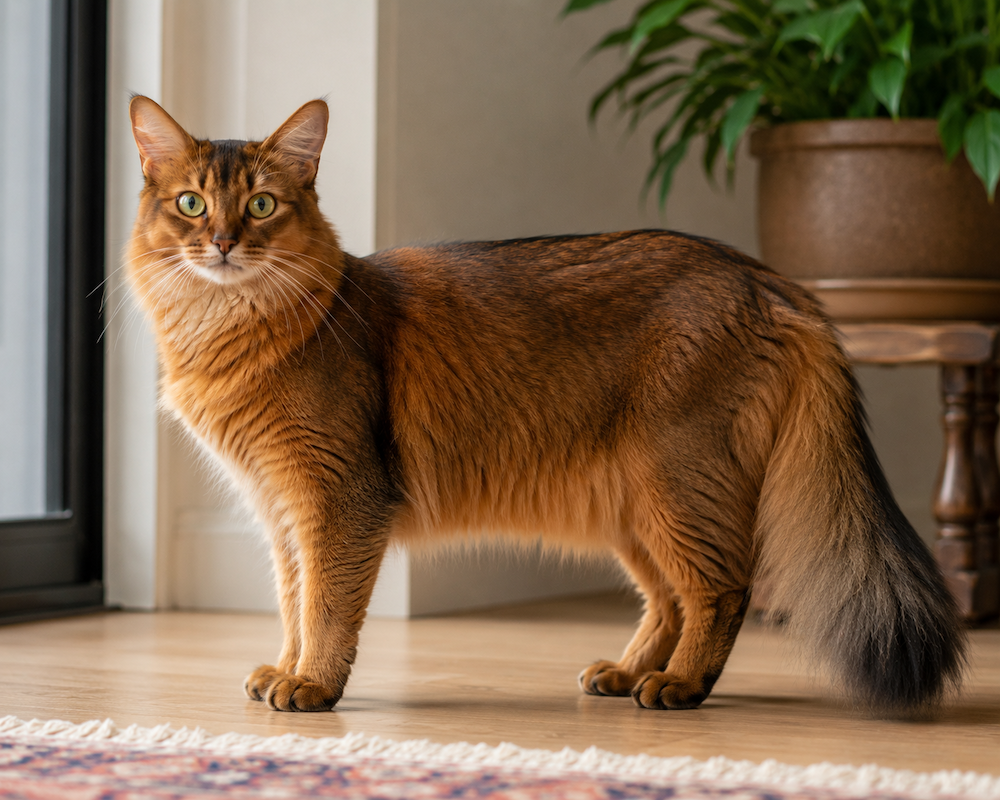
The coat is semi-long and particularly full around the neck, hindquarters, and tail. Large ears give the head an alert appearance, while expressive almond-shaped eyes are surrounded by dark markings that enhance the cat’s intense expression.
Most importantly, the Somali has a ticked coat.
Rather than every hair being a single colour, individual hairs contain alternating bands of lighter and darker pigmentation. This produces a warm, subtly shimmering appearance similar to the agouti colouring found in many wild mammals.
Ruddy Somali cats can look particularly fox-like because their warm reddish coat, dark facial markings, and enormous fluffy tail create an unmistakable resemblance.
But despite the nickname “fox cat,” there is no fox involved.
Underneath that wild-looking exterior is completely domestic feline ancestry — and usually a cat wondering what you’re doing and whether it can join in.
⭐ Is the Somali Really a Long-Haired Abyssinian?
Essentially, yes.
The Somali and Abyssinian are extremely closely related, and the Somali emerged when long-haired kittens appeared within Abyssinian breeding lines.
Long hair is produced by recessive genetic variants. Cats carrying the relevant trait can have short coats themselves while still passing the long-haired version to their offspring. When kittens inherit compatible long-hair variants from both parents, the longer coat can appear.
For breeders trying to maintain short-haired Abyssinians, these fluffy kittens were initially unexpected.
Eventually, however, enthusiasts realised they had something worth preserving.
Selective breeding established the long-haired cats as the Somali, retaining much of the Abyssinian’s characteristic body shape, ticking, intelligence, and high-energy personality while adding the luxurious coat and spectacular tail.
The result wasn’t really an entirely new type of cat.
It was more like discovering that the Abyssinian had been hiding a glamorous long-haired version of itself all along.
⭐ Why Does a Somali’s Coat Seem to Change Colour?
A Somali’s coat can appear remarkably different depending on lighting and movement because of its unusual ticked hairs.
Instead of conventional stripes covering the body, each hair can contain multiple bands of pigmentation.
When thousands of these banded hairs lie together, they create a rich, complex colour that can seem to shimmer as the cat moves.
The effect is particularly impressive in natural light.
Different registries recognise colours including variations such as ruddy, red or sorrel, blue, and fawn, with terminology varying between organisations and regions.
Kittens may also look different as they mature because the characteristic ticking and adult coat continue developing.
This means a photograph doesn’t always capture what makes a Somali coat so spectacular.
Watch one move through sunlight and the individual bands interact with the light, creating subtle shifts in colour across the body.
It is one of those rare occasions when the cat genuinely looks better in motion than in the photograph.