





Athletic, elegant, and born to run — the English Pointer is a remarkable sporting dog famous for freezing almost statue-still when it locates game, yet at home can be an affectionate, gentle, and devoted family companion.
🧠 QUICK SNAPSHOT
- Temperament: Affectionate, energetic, even-tempered
- Energy Level: Very High
- Size: Medium to Large
- Good With Families: Excellent for active households
- Trainability: High
- Grooming: Low
- Best For: Active families, runners, hikers, rural homes, outdoor lifestyles
- Typical Lifespan: Around 12–15 years
📚 OVERVIEW
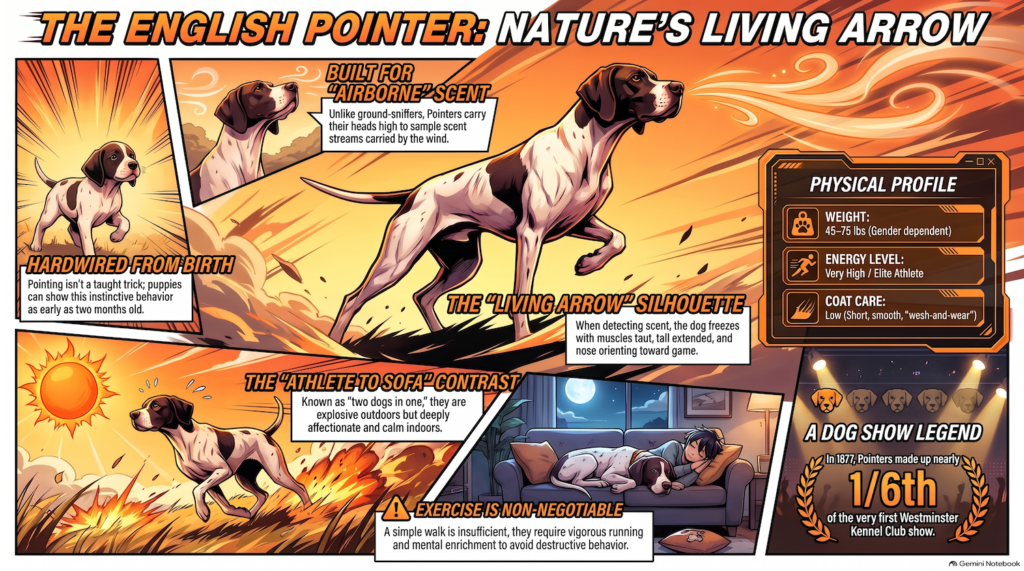
The English Pointer — usually known simply as the Pointer — is an athletic sporting breed developed to locate game birds and indicate their position to hunters. Its name comes directly from its extraordinary working behaviour: when a Pointer detects game, it can stop and direct its muzzle towards the location, often raising one front leg and creating the classic “pointing” pose.
Pointers have existed in Britain for several centuries, with their development influenced by European hunting dogs. As bird shooting techniques evolved, breeders produced an increasingly specialised dog capable of searching large areas rapidly while using its exceptional nose to locate hidden birds.
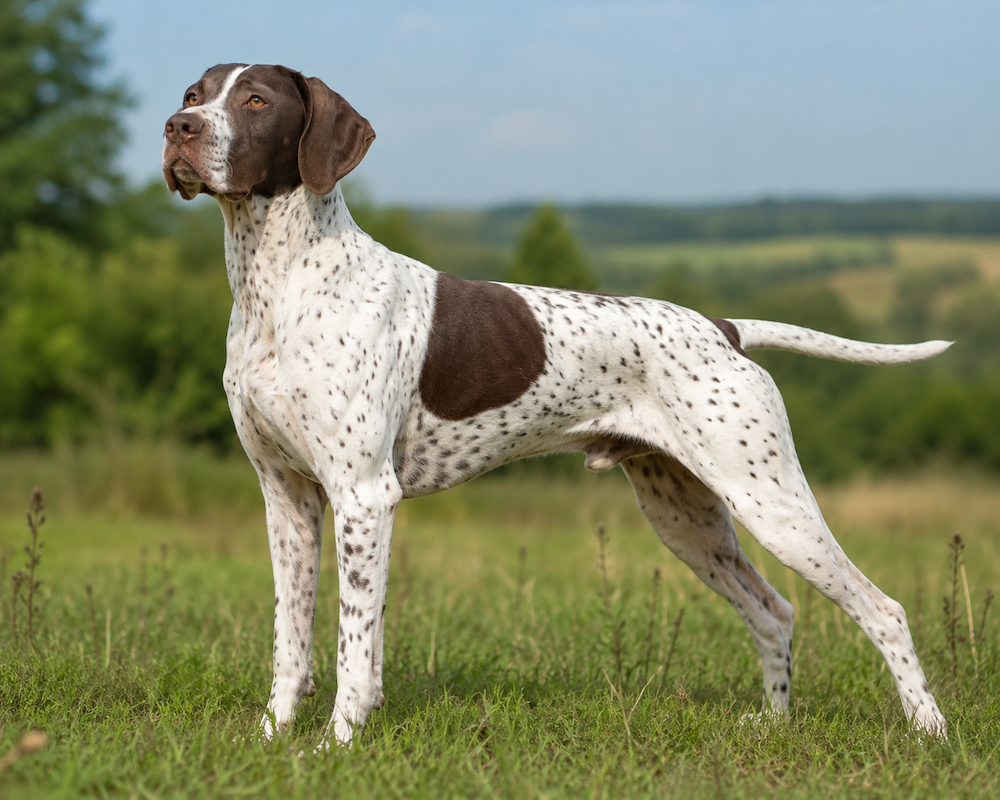
Everything about the modern Pointer reflects this athletic history. It has a lean, muscular body, powerful hindquarters, deep chest, long legs, and tremendous stamina.
Yet its working intensity can give a misleading impression of life at home. Properly exercised Pointers are typically affectionate, gentle, and highly people-oriented. Many are enthusiastic cuddlers once the day’s activities are finished.
The major question for prospective owners isn’t whether a Pointer can make a wonderful companion.
It’s whether they can provide enough exercise for one.
✅ PROS & CONS
Pros
- Affectionate and loyal with family
- Usually excellent with children
- Highly athletic and energetic
- Intelligent and responsive to training
- Excellent companion for runners and hikers
- Extremely easy-care short coat
Cons
- Very high exercise requirements
- Strong hunting and prey instincts
- Can become destructive when under-exercised
- Recall around wildlife requires substantial training
- Needs plenty of space and activity
- Not ideal for sedentary households
Is an English Pointer a Good Family Dog?
Yes, the English Pointer can be an excellent family dog for an active household. Despite its intense working heritage, the breed is typically affectionate, gentle, sociable, and strongly attached to its people.
Pointers can be particularly good companions for respectful children. Their playful personality means they often enthusiastically participate in family games and outdoor adventures, although their speed and exuberance can accidentally knock over very young children.
They generally live successfully with other dogs when properly socialised. Relationships with cats can also work, particularly when dogs are raised alongside them, but the Pointer’s powerful bird-hunting and prey instincts mean introductions to smaller animals require care.
Pointers tend to thrive when included in family life. They aren’t best suited to being exercised briefly and then isolated in a garden for the remainder of the day.
For a family that hikes, runs, explores, and wants a dog accompanying them on adventures, the Pointer can be exceptional. For a household wanting a quiet dog requiring minimal exercise, it is a poor match.
How Much Exercise Does an English Pointer Need?
An adult English Pointer generally needs at least 90 minutes to two hours of exercise every day, and young, healthy individuals may happily handle considerably more.
This is an endurance athlete developed to cover large areas of countryside while searching for birds. A couple of leisurely walks around the block will rarely satisfy its physical needs.
Running, hiking, long walks, retrieving games, scent work, field activities, canicross, and opportunities to run safely in large secure areas are excellent choices.
Mental exercise is equally important. Searching games, scent trails, training exercises, and activities that engage the Pointer’s remarkable nose provide a more satisfying routine than physical exercise alone.
Recall training deserves particular attention because the sudden appearance of wildlife can activate powerful hunting instincts.
Puppies shouldn’t receive excessive forced exercise while their joints are developing. Activity should increase gradually as they mature.
When properly exercised, Pointers can be surprisingly relaxed indoors. Without sufficient activity, however, that enormous reserve of energy has to go somewhere.
Is an English Pointer Easy to Train?
Yes, the English Pointer is generally intelligent and highly trainable, although its strong hunting instincts can create challenges when exciting scents, birds, or wildlife are present.
Pointers were bred to work cooperatively with hunters, so they tend to respond well to human direction. Positive reinforcement using food, toys, praise, and access to enjoyable activities usually produces excellent results.
Training should begin early, with particular emphasis on recall, loose-lead walking, impulse control, and calm behaviour around distractions.
Harsh methods are unnecessary and can be counterproductive with a sensitive dog. Consistent, reward-based training builds both responsiveness and trust.
Early socialisation should expose puppies positively to different people, dogs, environments, sounds, surfaces, vehicles, and everyday experiences.
Committed first-time owners can succeed with a Pointer if they understand its exercise requirements. Owners interested in advanced activities can also explore scent work, tracking, obedience, retrieving, field sports, and other disciplines that put the breed’s considerable intelligence and athleticism to productive use.
Does an English Pointer Shed?
Yes, the English Pointer sheds, but its short, smooth coat is exceptionally easy to maintain. Shedding is generally light to moderate, although individual dogs may shed more during seasonal changes.
A quick weekly brushing with a rubber grooming mitt or soft short-coat brush removes loose hairs and helps maintain the coat’s natural shine. More frequent brushing during heavier shedding periods can reduce the amount of hair deposited around the home.
Bathing is required only occasionally unless the dog becomes particularly dirty during outdoor adventures.
The Pointer’s hanging ears should be inspected regularly, especially after swimming or exploring wet vegetation. Routine nail trimming and dental care are also important.
The breed does not require clipping, elaborate coat styling, or routine professional grooming.
Pointers are not hypoallergenic, but for owners wanting an athletic dog without an equally demanding grooming schedule, the Pointer’s coat is one of its significant advantages.
What Health Problems Are Common in an English Pointer?
The English Pointer is generally a robust and athletic breed, but responsible breeding and health screening remain important. Many Pointers live approximately 12–15 years.
Potential orthopaedic concerns include hip dysplasia and elbow dysplasia, making appropriate evaluation of breeding dogs valuable. Certain inherited eye disorders can also occur.
Epilepsy has been reported within the breed, while some Pointers may experience thyroid problems. Responsible breeders should understand health conditions occurring within their lines and use appropriate testing and screening rather than relying simply on the athletic appearance of their dogs.
As a deep-chested breed, owners should also understand the signs of gastric dilatation-volvulus (GDV or bloat), a potentially life-threatening emergency requiring immediate veterinary treatment.
Maintaining a lean body condition is particularly important for an athletic dog. Balanced nutrition, appropriate exercise, dental care, preventative healthcare, and regular veterinary examinations all help maximise the chances of a long, active life.
⭐ Why Do English Pointers “Point”?
The Pointer’s signature behaviour is one of the most extraordinary examples of selective breeding shaping canine behaviour.
When a Pointer detects the scent of a game bird, it can suddenly freeze.
The dog’s head and nose indicate the direction of the scent, its body becomes intensely focused, and one front paw may lift from the ground.
Instead of rushing forward and frightening the bird away, the dog effectively tells the hunter:
“It’s over there.”
Humans didn’t invent pointing behaviour from nothing. Hunting dogs displaying useful tendencies towards pausing and indicating game were selectively bred over generations, strengthening the behaviour until it became a defining characteristic.
The instinct can be so strong that even Pointer puppies with no hunting experience may spontaneously display pointing behaviour.
Some pet Pointers will even point at birds, insects, or other interesting things during everyday walks.
It’s an extraordinary reminder that hundreds of years of breeding can leave behavioural fingerprints that remain visible even when a dog has never performed its original job.
⭐ How Good Is an English Pointer’s Sense of Smell?
The Pointer possesses an exceptional sense of smell, but what makes the breed remarkable isn’t simply its ability to detect scent.
It’s how the dog uses it while moving.
Pointers were developed to search substantial areas of countryside efficiently, often running with their heads held relatively high while detecting airborne scent carried from game birds.
Once the dog identifies the location strongly enough, its behaviour changes dramatically from rapid searching to almost complete stillness.
That combination of speed, scenting ability, concentration, and instinctive pointing made the breed extraordinarily effective for hunters.
Modern owners can put those abilities to work without hunting. Scent games, tracking exercises, hidden-object searches, and structured nose work can provide tremendous mental enrichment.
A long walk exercises the Pointer’s legs.
Giving it something interesting to find exercises the equipment that generations of selective breeding made truly exceptional.
⭐ Is the English Pointer One of the Most Athletic Dog Breeds?
It certainly deserves to be considered among them.
The Pointer was developed to cover large distances at speed while maintaining enough stamina to continue searching for extended periods. Its entire body reflects that purpose.
Long legs provide an efficient stride. Powerful hindquarters generate acceleration. A deep chest accommodates the cardiovascular machinery required for endurance, while the lean overall construction avoids unnecessary weight.
This explains an important contradiction that prospective owners often encounter.
Inside the house, a well-exercised Pointer can appear remarkably relaxed, affectionate, and comfortable.
Take the same dog outside into open country and it can suddenly transform into an extraordinary canine athlete.
That “off switch” is one of the breed’s greatest attractions — but it only works properly when owners satisfy the other half of the equation.
Before you get the Pointer happily occupying your sofa, you need to give those very long legs somewhere worthwhile to go.