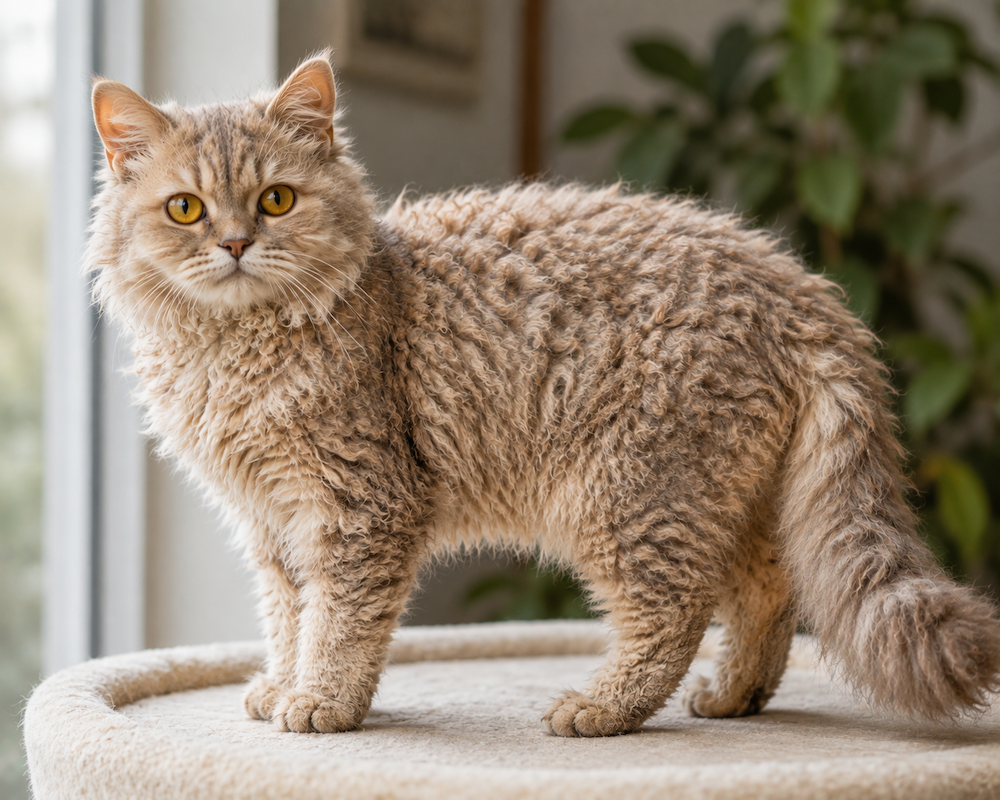






Curly, cuddly, and wonderfully laid-back — the Selkirk Rex is famous for its plush, tousled coat and whiskers, but underneath those extraordinary curls is a gentle, affectionate cat that usually loves being part of family life.
🧠 QUICK SNAPSHOT
- Temperament: Affectionate, gentle, easygoing
- Energy Level: Moderate
- Size: Medium to Large
- Good With Families: Excellent
- Indoor Living: Excellent
- Trainability: High
- Grooming: Moderate
- Best For: Families, apartment dwellers, multi-pet homes, people wanting an affectionate companion
- Typical Lifespan: Around 12–15 years
📚 OVERVIEW
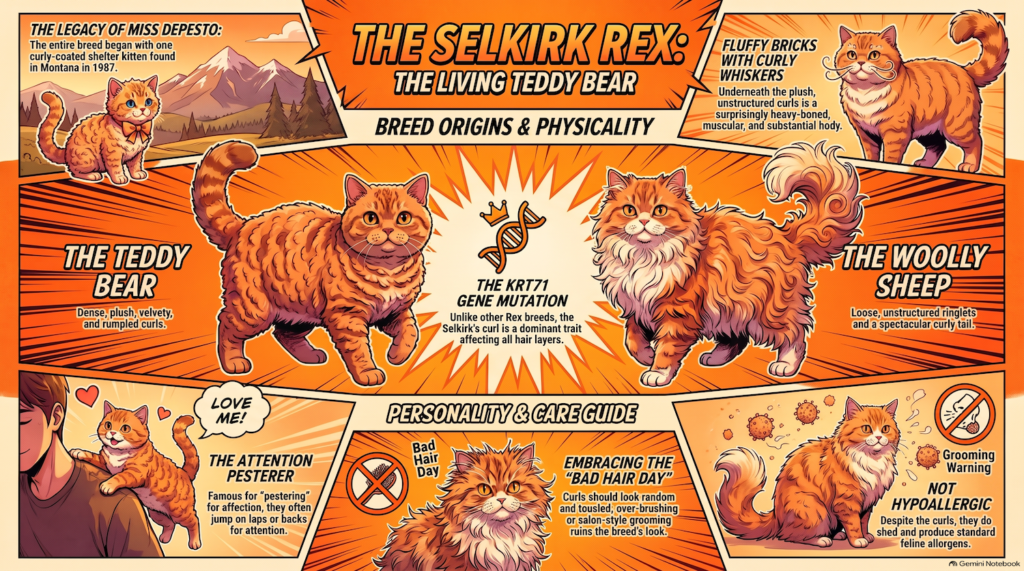
The Selkirk Rex is one of the most distinctive curly-coated cats in the world. Its plush coat can form loose waves or pronounced curls, while even the whiskers may be curly, creating the wonderfully tousled appearance for which the breed is famous.
Unlike many ancient breeds, we know remarkably precisely where the Selkirk Rex story began.
In Montana, USA, in 1987, an unusually curly-coated kitten was born in a litter at an animal shelter. Persian breeder Jeri Newman adopted the kitten, named her Miss DePesto of Noface, and later bred her to a Persian. Several curly kittens resulted, demonstrating that the unusual coat trait could be inherited.
A new breed was underway.
The Selkirk Rex was subsequently developed using breeds including Persians, Exotic Shorthairs, and British Shorthairs, helping create its substantial body, rounded features, and calm temperament.
Both short-haired and long-haired Selkirk Rex cats exist.
Despite the unusual appearance, this isn’t generally an eccentric cat in temperament. Selkirks tend to be patient, affectionate, playful, and easygoing, making them particularly appealing as family companions.
✅ PROS & CONS
Pros
- Affectionate and people-oriented
- Usually excellent with families
- Often gets along well with other pets
- Moderate rather than extreme energy levels
- Playful but generally easygoing
- Unique curly coat and whiskers
Cons
- Curly coat requires appropriate grooming
- Can shed considerably
- Not hypoallergenic
- May dislike prolonged periods alone
- Coat can become greasy or tangled without care
- Responsible health screening is important
Is a Selkirk Rex a Good Family Cat?
Yes, the Selkirk Rex is generally an excellent family cat thanks to its affectionate, patient, and relatively easygoing temperament. It tends to enjoy human companionship without necessarily having the relentless activity levels of some highly energetic breeds.
Selkirks can be wonderful with respectful children, particularly when children understand that curly fur isn’t an invitation for constant handling. Their sturdy build can also make them less physically delicate than some finely boned breeds.
Many live happily with other cats and cat-friendly dogs after gradual introductions. Their typically tolerant personality can make the transition to a multi-pet household easier, although individual temperament always matters.
Selkirk Rex cats often enjoy sitting beside or on their humans and may follow family members between rooms to remain involved in household life.
They still need play, companionship, and mental stimulation, but their combination of affection and relative calm makes them suitable for a wide variety of homes, including families, couples, singles, and active retirees.
Can a Selkirk Rex Live Indoors or in an Apartment?
Yes, the Selkirk Rex is very well suited to indoor and apartment living. Its moderate activity level means it doesn’t require an enormous property, provided the home includes opportunities for climbing, scratching, playing, and exploring.
A sturdy cat tree, window perch, scratching posts, toys, puzzle feeders, and comfortable resting places can provide an excellent indoor environment.
Selkirks enjoy play but are generally less relentlessly energetic than breeds such as the Abyssinian or Oriental Shorthair. This can make them particularly adaptable to smaller homes.
Indoor living also protects cats from traffic, fights, infectious diseases, predators, poisoning, and other hazards. Secure cat enclosures can provide additional outdoor stimulation where practical.
Owners should still encourage daily activity because a relatively relaxed indoor lifestyle can contribute to unwanted weight gain.
For the Selkirk Rex, companionship and environmental quality generally matter more than sheer floor space, making the breed a strong candidate for apartment dwellers.
How Much Exercise and Play Does a Selkirk Rex Need?
The Selkirk Rex has moderate exercise requirements and should receive interactive play every day. Several short sessions using toys that encourage chasing, stalking, and pouncing can help maintain fitness while satisfying natural feline behaviours.
Fishing-wand toys, balls, tunnels, toy mice, climbing towers, and puzzle feeders are all good choices.
Selkirks are intelligent and can also enjoy clicker training, food puzzles, treat hunts, and learning simple tricks. Rotating toys periodically helps keep familiar activities interesting.
Although kittens can be extremely playful, many adult Selkirks develop a pleasant balance between activity and relaxation. They may happily chase a toy around the room and then spend the next hour stretched across a favourite sofa.
Regular exercise becomes particularly important for indoor cats because the breed’s substantial build shouldn’t be allowed to turn into excess body fat.
The goal isn’t exhausting a Selkirk Rex. It’s providing enough daily movement and mental engagement to keep both body and brain healthy.
Is a Selkirk Rex Easy to Train?
Yes, the Selkirk Rex is generally quite easy to train for a cat. It tends to be intelligent, curious, food-motivated, and interested in interacting with people.
Positive reinforcement can teach useful behaviours such as coming when called, entering a carrier voluntarily, using scratching posts, accepting grooming, and tolerating nail trimming.
Some Selkirks can also learn tricks, retrieve toys, or become comfortable walking on a harness.
Training comfortable grooming behaviour is especially valuable because coat care will be a lifelong requirement. Introducing brushes, combs, paw handling, and body checks positively during kittenhood can prevent grooming from becoming a battle later.
Short sessions using treats, toys, or praise work best. Punishment should be avoided because it can create anxiety without teaching the desired behaviour.
The breed may not display the relentless problem-solving drive of some highly active cats, but its combination of intelligence and cooperative temperament makes everyday training relatively straightforward.
Does a Selkirk Rex Shed?
Yes. Despite its curly appearance, the Selkirk Rex does shed and is not a hypoallergenic cat.
Both short-haired and long-haired varieties exist, and grooming needs differ somewhat between them. The coat can be extremely plush, with curls occurring through multiple layers of hair rather than only in a fine undercoat.
Curly coats require a slightly different approach from conventional cat fur. Excessive brushing can straighten or disrupt the curls, while insufficient grooming may allow tangles to form, particularly in long-haired cats.
Gentle combing once or twice a week is a useful starting point, adjusted according to the individual cat’s coat. Long-haired Selkirks may require additional attention around the belly, legs, and other areas prone to tangling.
Some cats develop oily coats and may occasionally require bathing.
Importantly, curls do not prevent allergen production. People with cat allergies should never assume a Selkirk Rex will automatically be suitable simply because it has unusual fur.
What Health Problems Are Common in a Selkirk Rex?
The Selkirk Rex is generally a healthy breed, but its developmental history means responsible breeders should monitor several inherited conditions associated with breeds used in its foundation.
Polycystic kidney disease (PKD) is particularly important because Persian cats contributed to Selkirk Rex development. PKD causes fluid-filled cysts to develop within the kidneys and can eventually impair kidney function. DNA testing makes responsible management of the inherited form possible.
Hypertrophic cardiomyopathy (HCM), involving abnormal thickening of the heart muscle, is another condition breeders and owners should be aware of.
Hip dysplasia has also been reported within the breed and may be relevant to breeding programs.
These risks don’t mean every Selkirk Rex will become ill. They demonstrate why buying from breeders who perform appropriate health testing is important.
Regular veterinary examinations, good dental care, balanced nutrition, weight management, and prompt investigation of health changes can help a Selkirk Rex enjoy its typical 12–15 year lifespan, with some individuals living longer.
⭐ Why Does the Selkirk Rex Have Curly Hair?
The Selkirk Rex owes its extraordinary appearance to a naturally occurring genetic mutation affecting the structure of its hair.
The breed’s story began with one curly kitten born in a Montana animal shelter in 1987.
That kitten, Miss DePesto of Noface, was adopted by breeder Jeri Newman. When Miss DePesto was later bred to a Persian male, some of the kittens inherited her unusual curls.
This revealed something particularly interesting.
Unlike the recessive mutations associated with the curly coats of the Cornish Rex and Devon Rex, the Selkirk Rex curl is generally inherited as a dominant trait.
The curls can affect the guard hairs, awn hairs, and undercoat, creating the breed’s characteristically plush appearance. Even the whiskers can curl.
The amount of curl varies between individuals and can change with age, hormones, climate, and coat length.
So every modern Selkirk Rex ultimately owes those remarkable curls to an unusual shelter kitten discovered in Montana.
⭐ Is the Selkirk Rex Related to the Cornish Rex and Devon Rex?
Not in the way the names might suggest.
The Selkirk Rex, Cornish Rex, and Devon Rex have curly coats caused by different genetic mutations.
The Cornish Rex began with a curly kitten born in Cornwall, England, in 1950. The Devon Rex emerged from another curly-coated cat discovered in Devon during the following decade.
Then, thousands of kilometres away and decades later, Miss DePesto appeared in Montana with yet another form of curly fur.
The breeds also feel very different.
Cornish Rex cats have exceptionally fine, wavy coats and slender athletic bodies. Devon Rex cats are famous for their pixie-like faces and unusual coats. Selkirk Rex cats tend to be heavier and more substantial, with thick, plush curls that can give them an almost woolly appearance.
“Rex” simply became the terminology used for these unusual curly coats.
So the Selkirk Rex isn’t a larger version of the Cornish or Devon Rex.
Nature effectively invented the curly cat more than once.
⭐ Why Is the Selkirk Rex Sometimes Called the “Cat in Sheep’s Clothing”?
One look at a particularly curly long-haired Selkirk Rex makes the nickname understandable.
Its dense coat can form soft, loose curls across the body, while the neck, belly, and tail can become especially plush. Add curly whiskers and a rounded face and the cat can look remarkably like a tiny feline wearing a sheep’s fleece.
The comparison is purely visual, of course.
The coat is genuine cat hair, and its texture varies considerably between individuals. Some Selkirks develop dramatic curls, while others have looser waves.
Kittens can also go through awkward coat stages. A beautifully curly kitten may temporarily lose some of its curl before the mature coat develops.
Perhaps the funniest contrast is personality.
Underneath that eccentric, permanently tousled exterior is often a remarkably relaxed cat.
The Selkirk Rex may look like it has just emerged from a wind tunnel.
It generally couldn’t be less concerned about it.