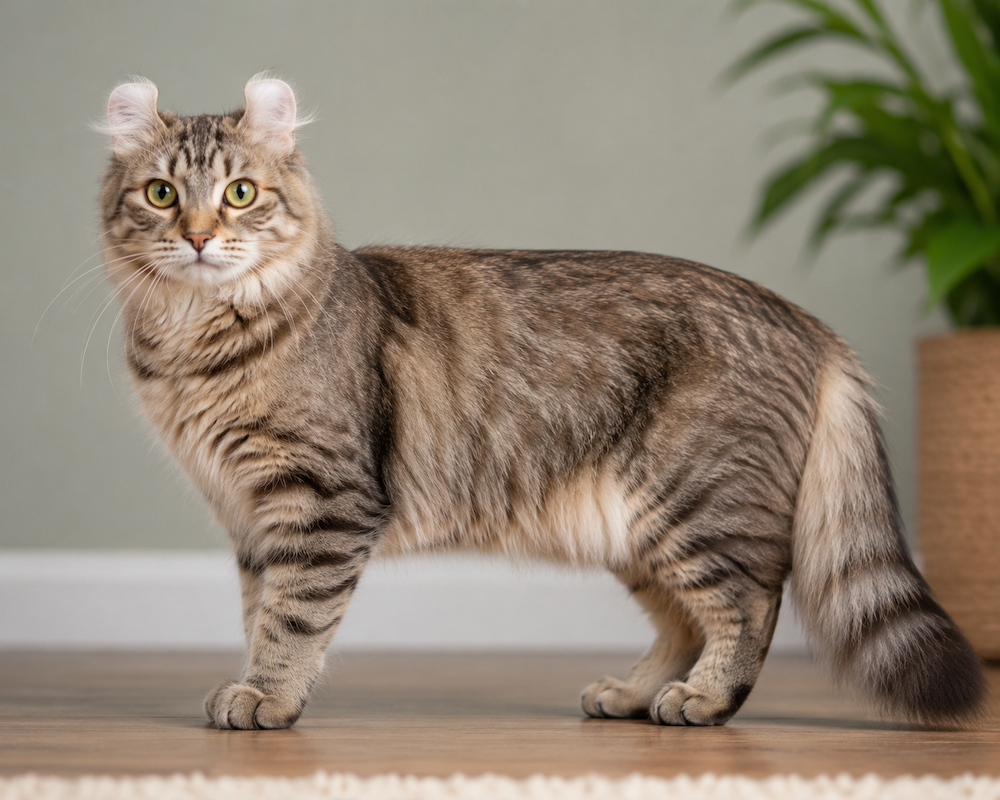






Affectionate, curious, and instantly recognisable by its remarkable backward-curving ears — the American Curl is a playful family cat with an unusual origin story and a famously youthful personality that often continues well into adulthood.
🧠 QUICK SNAPSHOT
- Temperament: Affectionate, curious, sociable
- Energy Level: Moderate to High
- Size: Small to Medium
- Good With Families: Excellent
- Indoor Living: Excellent
- Trainability: High
- Grooming: Low to Moderate
- Best For: Families, apartment dwellers, multi-pet households, interactive owners
- Typical Lifespan: Around 12–16 years
📚 OVERVIEW
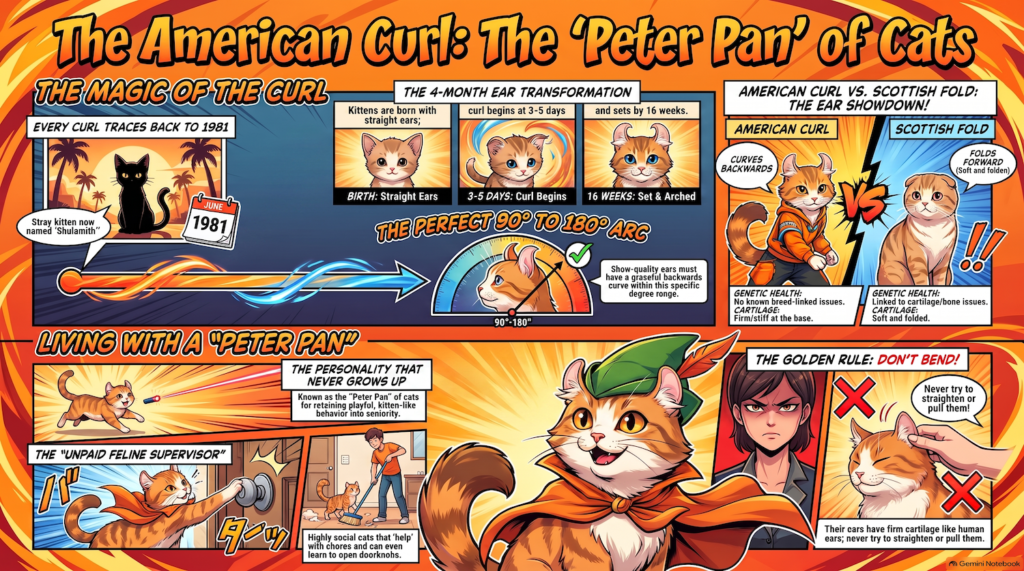
The American Curl is one of the easiest cat breeds to recognise. Instead of standing upright like conventional feline ears, its ears curve gracefully backwards towards the centre of the skull, creating an alert and permanently surprised expression.
Even more remarkable is how recently the breed appeared.
The story began in California in 1981, when Joe and Grace Ruga discovered a stray black long-haired kitten with unusual curled ears. They named her Shulamith. When Shulamith later produced kittens and some inherited the same distinctive ears, it became clear that the trait was genetic.
Breeders subsequently began developing the American Curl, and Shulamith became the foundation cat behind the breed.
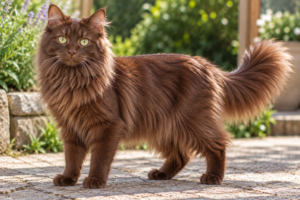
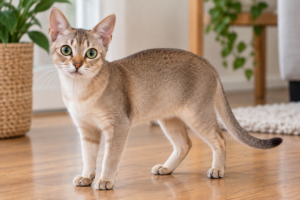
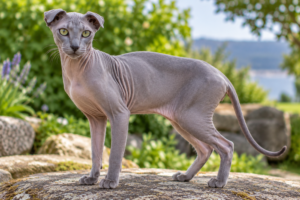
Both long-haired and short-haired American Curls exist, and the breed occurs in many colours and patterns.
The ears may attract the initial attention, but temperament is a major reason people fall in love with these cats. American Curls are typically affectionate, playful, intelligent, and sociable without necessarily being excessively demanding.
They are also famous for retaining an unusually kitten-like curiosity throughout adulthood.
✅ PROS & CONS
Pros
- Affectionate and people-oriented
- Usually excellent with families
- Adaptable to apartment living
- Often good with other pets
- Playful well into adulthood
- Relatively straightforward grooming
Cons
- Distinctive ears require gentle handling
- Doesn’t enjoy prolonged isolation
- Needs regular play and mental stimulation
- Ear structure requires routine monitoring
- Not hypoallergenic
- Pedigree kittens can be relatively difficult to find
Is an American Curl a Good Family Cat?
Yes, the American Curl is generally an excellent family cat thanks to its affectionate, playful, and adaptable temperament. These cats tend to enjoy being involved with their humans without always demanding constant attention.
American Curls often interact particularly well with respectful children. Their playful personality makes them enthusiastic participants in games, and many retain this youthful enthusiasm throughout adulthood.
Children must be taught one particularly important rule: never pull, bend, or manipulate the cat’s curled ears. The cartilage is different from that of conventional feline ears and should always be handled gently.
American Curls can also live successfully with other cats and cat-friendly dogs when introductions are managed gradually.
Many greet family members at the door, follow people between rooms, and investigate household activities.
For families wanting an affectionate cat that offers plenty of interaction while generally remaining easygoing, the American Curl can be an excellent choice.
Can an American Curl Live Indoors or in an Apartment?
Yes, the American Curl is very well suited to indoor and apartment living, provided it receives regular play, climbing opportunities, mental stimulation, and companionship.
A large property isn’t essential. Tall cat trees, scratching posts, shelves, window perches, tunnels, toys, and comfortable resting places can transform even a relatively compact home into an excellent feline environment.
American Curls tend to be curious, so puzzle feeders, rotating toys, and new objects to investigate can help keep indoor life interesting.
Secure indoor living also protects cats from traffic, infectious diseases, fights, poisoning, predators, and other hazards. A secure cat enclosure can provide additional outdoor stimulation where practical.
Their moderate-to-high activity level means owners should still schedule interactive play every day rather than assuming the cat will exercise itself.
With enough enrichment and human interaction, an American Curl can be extremely comfortable living entirely indoors.
How Much Exercise and Play Does an American Curl Need?
The American Curl has moderate-to-high exercise requirements and benefits from several interactive play sessions throughout the day.
Fishing-wand toys, balls, tunnels, toy mice, climbing structures, and games involving chasing and pouncing allow the cat to express natural feline behaviours while remaining physically active.
Many American Curls retain their playful behaviour well into adulthood, leading to their reputation as feline “Peter Pans.”
Mental stimulation is equally valuable. Puzzle feeders, treat hunts, clicker training, rotating toys, and learning simple tricks provide additional challenges for an intelligent and inquisitive cat.
Climbing opportunities should also be available. Although American Curls aren’t generally considered among the most extreme feline athletes, they still enjoy exploring vertical territory.
Regular activity helps maintain healthy muscle tone and body weight while preventing boredom.
The American Curl’s exercise needs are very manageable for most households — but this isn’t a cat that should be expected to spend its entire life sleeping on the sofa.
Is an American Curl Easy to Train?
Yes, the American Curl is generally easy to train for a cat because it tends to be intelligent, curious, playful, and interested in interacting with people.
Positive reinforcement using treats, praise, toys, or clicker training can teach behaviours such as coming when called, sitting, retrieving toys, entering a carrier voluntarily, and even walking on a harness.
Practical training is equally useful. Teaching comfortable nail trimming, dental checks, ear inspection, and carrier use during kittenhood can make routine care considerably easier throughout life.
Ear handling deserves particular care. Owners should teach the cat to accept gentle inspection without ever forcing or bending the ears backwards.
Short, enjoyable sessions are preferable to repetitive training. Punishment should be avoided because it can damage trust without explaining what behaviour is actually wanted.
The American Curl’s playful personality means training can become another form of entertainment rather than feeling like work — for both the cat and owner.
Does an American Curl Shed?
Yes, the American Curl does shed, although coat maintenance is generally straightforward.
Both short-haired and long-haired varieties exist. The coat typically has relatively little undercoat, which can reduce matting and make grooming easier than the appearance of a long-haired Curl might suggest.
Short-haired cats may need brushing approximately once a week, while long-haired American Curls generally benefit from brushing once or twice weekly to remove loose hair and prevent tangles.
More frequent grooming may be useful during seasonal shedding.
The ears should be inspected regularly but cleaned only when necessary using an appropriate method recommended by a veterinarian. Their unusual shape does not mean owners should straighten them to clean inside.
Routine nail trimming and dental care should accompany coat maintenance.
The American Curl is not hypoallergenic. Even relatively low-maintenance cats produce feline allergens through their saliva and skin secretions.
What Health Problems Are Common in an American Curl?
The American Curl is generally regarded as a healthy breed, and the genetic mutation responsible for its unusual ears has not been associated with the same widespread skeletal abnormalities seen in some other mutation-based breeds.
However, responsible breeding and veterinary care remain essential.
The curled ears deserve routine monitoring for wax accumulation, irritation, infection, or damage, particularly because the unusual cartilage makes careful handling important.
Beyond this, American Curls can experience general feline health problems including dental disease, obesity, kidney disease, urinary conditions, and heart disease as they age.
Because the breed originated from a relatively recent mutation, responsible breeders should maintain genetic diversity and avoid selecting cats purely for increasingly extreme ear curvature.
Prospective owners should seek breeders who prioritise overall health, temperament, and structural soundness.
Regular veterinary examinations, dental care, good nutrition, weight management, and early investigation of health or behavioural changes can help an American Curl enjoy a typical lifespan of around 12–16 years, with some living longer.
⭐ Why Do American Curl Cats Have Curled Ears?
The American Curl’s extraordinary ears result from a naturally occurring genetic mutation.
And unlike many breed-origin stories, we know exactly where the modern story began.
In 1981, a stray black kitten with unusual backward-curving ears appeared at the California home of Joe and Grace Ruga.
They named her Shulamith.
When Shulamith later had kittens, some developed the same curled ears. This demonstrated that the characteristic could be inherited.
The gene responsible behaves as a dominant trait, meaning a kitten only needs to inherit one copy to develop curled ears.
Interestingly, American Curl kittens are born with straight ears.
The ears begin curling backwards during the first few days after birth and continue changing during early kittenhood before eventually settling into their adult shape.
So even the most spectacular adult American Curl began life looking much more conventional.
⭐ Are American Curl Ears Fragile?
They require more careful handling than ordinary cat ears.
The cartilage within an American Curl’s ears is relatively firm and extends farther through the ear than in a conventional cat. The ear should therefore never be forcibly bent, flattened, or straightened.
This is particularly important in households with children, who may understandably be curious about the unusual shape.
The ears aren’t decorations to be manipulated.
Normal gentle touching around the head is fine for a comfortable cat, and routine inspection is important. Owners should watch for excessive wax, redness, odour, discharge, or persistent scratching and seek veterinary advice when necessary.
Interestingly, the ears vary considerably between individual Curls. Some have relatively modest curvature, while show cats may display a much more pronounced backward arc.
Responsible breeding should always prioritise a functional, healthy ear rather than simply attempting to produce the most extreme curl possible.
⭐ Is Every Kitten in an American Curl Litter Born With Curled Ears?
No — and initially none of them are.
American Curl kittens enter the world with straight ears.
At around three to five days old, kittens carrying the Curl trait generally begin showing the characteristic backward curvature. The ears continue developing over the following weeks and can change considerably before their final shape becomes apparent.
Depending on the parents’ genetics, a litter may contain both kittens that develop curled ears and kittens whose ears remain straight.
Straight-eared kittens from American Curl breeding programs are still perfectly normal cats. They simply didn’t inherit the gene responsible for the distinctive curl and generally cannot compete as standard show examples of the breed.
This creates an unusual situation for breeders.
When the kittens arrive, the breed’s most famous characteristic hasn’t appeared yet.
They literally have to wait for the ears to reveal the answer.
⭐ Is the American Curl Related to the Scottish Fold?
No. Although both breeds are famous for unusual ears, the American Curl and Scottish Fold involve different genetic mutations and completely different ear shapes.
The American Curl’s ears curve backwards.
The Scottish Fold’s ears fold forward and downward.
More importantly, the health implications aren’t equivalent. The Scottish Fold mutation affects cartilage throughout the body and is associated with osteochondrodysplasia, which can cause painful skeletal disease.
The mutation responsible for the American Curl’s ears has not been shown to produce that same systemic cartilage disorder.
That doesn’t mean breeding American Curls requires no health considerations. Their ears still need careful handling, responsible breeding, and routine monitoring.
But visually similar ideas — unusual ears caused by inherited mutations — shouldn’t lead owners to assume the two breeds have the same genetics or health consequences.
They are very different cats with very different stories.