





Athletic, affectionate, and naturally Brazilian — the Brazilian Shorthair developed from the ordinary street and domestic cats of Brazil before breeders recognised that this adaptable population had distinctive characteristics worthy of becoming a breed of its own.
🧠 QUICK SNAPSHOT
- Temperament: Affectionate, intelligent, playful
- Energy Level: Moderate to High
- Size: Medium
- Good With Families: Very Good
- Indoor Living: Very Good with sufficient enrichment
- Trainability: High
- Grooming: Low
- Best For: Families, active households, apartment living, interactive owners
- Typical Lifespan: Around 12–16 years
📚 OVERVIEW
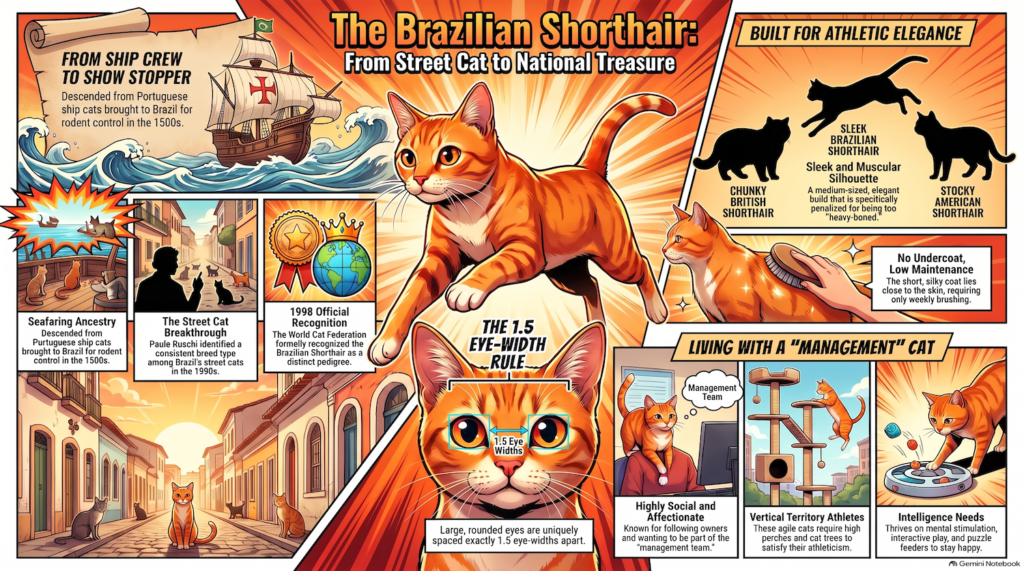
The Brazilian Shorthair is unusual among pedigree cats because its story didn’t begin with breeders deliberately crossing two established breeds.
Instead, it emerged from the naturally occurring domestic cat population of Brazil.
For generations, short-haired cats lived alongside people throughout Brazilian towns and cities. During the 1980s, Brazilian cat breeder and engineer Paulo Samuel Ruschi began studying these cats and concluded that the population displayed sufficiently consistent characteristics to justify development as a recognised breed.
Selective breeding and documentation followed, producing what became known as the Brazilian Shorthair.
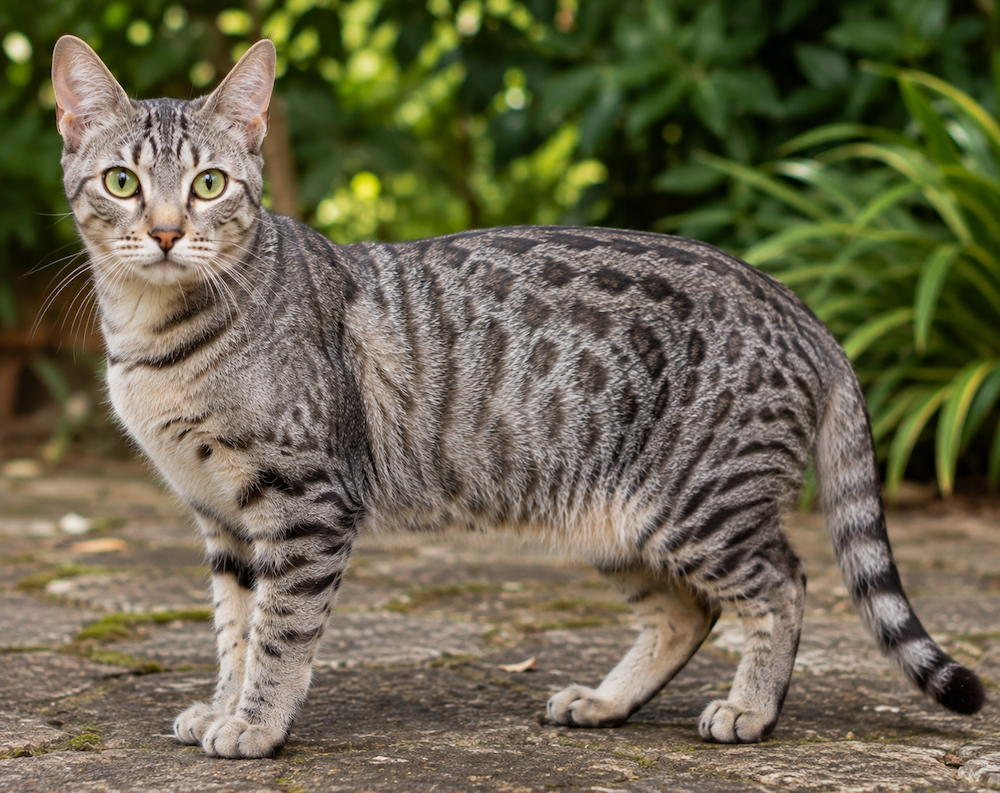
The breed generally has a medium-sized, athletic body, relatively long legs, expressive eyes, and a short coat that can occur in a wide range of colours and patterns. Its overall appearance remains functional and balanced rather than exaggerated.
Brazilian Shorthairs are typically described as intelligent, active, affectionate, and adaptable. Their background as naturally developed cats also means they tend to retain plenty of curiosity and athleticism.
The Brazilian Shorthair is therefore an interesting example of humans not really creating a cat breed from scratch.
Instead, breeders recognised something distinctive that was already there.
✅ PROS & CONS
Pros
- Affectionate and people-oriented
- Intelligent and playful
- Extremely easy-care coat
- Adaptable to different households
- Athletic without extreme physical features
- Generally well suited to families
Cons
- Needs regular exercise and enrichment
- Can become bored without stimulation
- May have strong hunting instincts
- Not hypoallergenic
- Rare outside Brazil
- Genuine pedigree cats may be difficult to locate internationally
Is a Brazilian Shorthair a Good Family Cat?
Yes, the Brazilian Shorthair can be a very good family cat, particularly for households wanting an affectionate, playful, and interactive companion.
These cats tend to enjoy human company and can form strong relationships with their families. Many retain enough independence to entertain themselves for periods while still actively seeking interaction when people are available.
Brazilian Shorthairs can live successfully with respectful children, particularly when children understand appropriate feline handling and use interactive toys rather than chasing or grabbing the cat.
They may also adapt well to other cats and cat-friendly dogs when introductions are gradual.
Because the breed developed from a broad domestic-cat population rather than an extremely narrow behavioural breeding program, individual temperament can vary. Early socialisation remains particularly important.
For families prepared to provide daily play, affection, climbing opportunities, and mental stimulation, the Brazilian Shorthair can become an engaging and adaptable companion.
Can a Brazilian Shorthair Live Indoors or in an Apartment?
Yes, a Brazilian Shorthair can live successfully indoors or in an apartment, provided its environment offers enough activity and stimulation.
These are athletic cats, so vertical territory is valuable. Tall cat trees, climbing shelves, scratching towers, window perches, and secure elevated resting areas increase the usable space available within an apartment.
Puzzle feeders, tunnels, interactive toys, and rotating enrichment activities help keep intelligent cats occupied.
Daily human interaction and active play are also important. Simply providing a collection of toys and leaving them untouched indefinitely isn’t enough for many cats.
Secure indoor living protects cats from traffic, fights, infectious diseases, poisoning, and other hazards. A secure cat enclosure can provide additional outdoor stimulation where practical.
The Brazilian Shorthair doesn’t necessarily require a large property.
A stimulating apartment providing opportunities to climb, chase, investigate, scratch, and interact can meet its needs very well.
How Much Exercise and Play Does a Brazilian Shorthair Need?
The Brazilian Shorthair has moderate-to-high exercise requirements and should receive interactive play every day.
Several shorter sessions spread throughout the day work particularly well. Fishing-wand toys, balls, tunnels, climbing structures, toy mice, and chasing games encourage natural stalking, pouncing, and hunting behaviours.
Mental exercise matters too.
Puzzle feeders, treat hunts, scent games, clicker training, and regularly rotated toys provide useful challenges for an intelligent cat.
The breed’s naturally developed background means Brazilian Shorthairs can retain considerable athletic ability and hunting instinct. Indoor cats benefit from activities that allow them to express those behaviours safely.
Young cats may be particularly energetic, while mature individuals often develop a more balanced routine between activity and relaxation.
Without sufficient enrichment, however, a clever cat may find alternative entertainment.
And whatever you’ve placed on the highest shelf could suddenly become part of the activity program.
Is a Brazilian Shorthair Easy to Train?
Yes, the Brazilian Shorthair is generally intelligent and trainable, particularly when positive reinforcement makes learning rewarding.
Treats, favourite toys, praise, and clicker training can be used to teach behaviours such as coming when called, entering a carrier voluntarily, sitting, retrieving toys, and walking on a harness.
Practical training can be even more valuable.
Teaching a kitten to accept nail trimming, dental checks, carrier travel, and gentle body handling can significantly reduce stress throughout its life.
Training sessions should be short, positive, and interesting. Punishment should be avoided because it can create fear without teaching the cat what behaviour is actually desired.
Brazilian Shorthairs also tend to be observant. They can quickly learn household routines, recognise feeding times, and work out where favourite toys or treats are kept.
With intelligent cats, training doesn’t always happen in only one direction.
Sometimes they become remarkably successful at teaching their humans too.
Does a Brazilian Shorthair Shed?
Yes, the Brazilian Shorthair sheds, but its short coat is exceptionally easy to maintain.
A gentle brushing approximately once a week is generally sufficient to remove loose hair, distribute natural skin oils, and maintain the coat’s healthy appearance.
More frequent grooming can be useful during periods of heavier seasonal shedding.
The breed doesn’t require clipping, elaborate coat styling, or routine professional grooming. Bathing is generally necessary only when there is a specific reason.
Routine maintenance should include nail trimming, dental care, and checks of the ears, eyes, skin, and overall body condition.
The Brazilian Shorthair is not hypoallergenic. Like other cats, it produces allergens primarily through proteins found in saliva and skin secretions, so short fur doesn’t guarantee compatibility with people who have cat allergies.
For owners primarily concerned about grooming workload, however, this is a genuinely low-maintenance coat.
What Health Problems Are Common in a Brazilian Shorthair?
The Brazilian Shorthair is a naturally developed breed and isn’t currently associated with a long list of well-established breed-specific inherited diseases.
However, that statement needs some context.
The breed remains relatively uncommon internationally, and there is considerably less published breed-specific health data than exists for widely studied cats such as Persians, Maine Coons, or Siamese. It would therefore be misleading to claim that Brazilian Shorthairs have no inherited health problems.
Like all cats, they can develop conditions such as dental disease, obesity, kidney disease, urinary tract problems, heart disease, arthritis, and age-related disorders.
Responsible breeders should prioritise genetic diversity, good physical structure, temperament, and the health histories of breeding cats.
Owners should maintain appropriate vaccinations and parasite control for their region, alongside regular veterinary examinations and dental care.
Balanced nutrition and maintaining a lean body condition are equally important.
With responsible breeding and good lifelong care, Brazilian Shorthairs can commonly live around 12–16 years, with some potentially living longer.
⭐ Is the Brazilian Shorthair Really From Brazil?
Yes — and unlike the confusing names of several other cat breeds, this one genuinely does describe its origins.
The Brazilian Shorthair developed from ordinary short-haired domestic cats living throughout Brazil.
These weren’t originally carefully protected pedigree animals living exclusively in breeding programs. They were the cats sharing Brazilian towns, homes, farms, and streets with people.
During the 1980s, Brazilian breeder Paulo Samuel Ruschi began studying the country’s domestic cat population.
He believed these cats had developed sufficiently consistent physical characteristics to represent a recognisable natural population.
Breeding programs were subsequently established to preserve and standardise those characteristics.
This gives the Brazilian Shorthair an interesting identity.
Its history isn’t really about creating an exotic new cat.
It’s about looking closely at familiar local cats and realising that Brazil already had a cat of its own.
⭐ Did Brazilian Street Cats Really Become a Pedigree Breed?
Essentially, yes.
And that’s one of the most fascinating things about the Brazilian Shorthair.
Many pedigree breeds were created by carefully crossing existing breeds to combine particular colours, coats, or physical characteristics.
The Brazilian Shorthair took a different route.
Breeders examined a naturally occurring population of Brazilian domestic cats, selected animals representing the desired type, and began recording pedigrees and developing a breed standard.
This process is known as developing a natural breed or landrace-derived breed.
Of course, that doesn’t mean every short-haired street cat in Brazil is automatically a pedigree Brazilian Shorthair.
Once a formal breed population exists, pedigree status depends on documented ancestry and the rules of the relevant registry.
But the genetic roots remain closely connected to Brazil’s ordinary domestic cats.
It’s a remarkable transformation:
street cat → recognised local type → pedigree breed.
⭐ What Does a Brazilian Shorthair Look Like?
The Brazilian Shorthair doesn’t rely on one spectacular mutation such as folded ears, curly fur, or hairlessness to distinguish itself.
Its appearance is more subtle and natural.
The breed is generally medium-sized, athletic, and relatively slender, with long legs, a moderately shaped head, and expressive eyes.
The coat is short, close-lying, and available in a wide variety of colours and patterns.
One particularly noticeable feature is the eyes. They are relatively large and expressive, contributing considerably to the breed’s alert appearance.
Because the Brazilian Shorthair developed from a functional domestic-cat population, its overall body isn’t supposed to look exaggerated.
This can make identification difficult for someone unfamiliar with the breed because many ordinary domestic shorthairs may look superficially similar.
A genuine Brazilian Shorthair isn’t defined simply by looking like a cat from Brazil.
Pedigree and adherence to the recognised breed type are what distinguish it.
⭐ Is Every Cat From Brazil a Brazilian Shorthair?
No.
A Brazilian domestic cat and a pedigree Brazilian Shorthair aren’t automatically the same thing.
Brazil has an enormous population of cats with tremendous genetic and physical diversity. A short-haired cat born on a Brazilian street may resemble the breed and could share ancestry with the population from which it developed.
That doesn’t automatically give the cat pedigree status.
Registered Brazilian Shorthairs descend through recognised breeding programs designed to maintain the characteristics described within the breed standard.
This is similar to the distinction between other natural breeds and the broader cat populations from their regions of origin.
In fact, this distinction makes the breed’s history more interesting.
The Brazilian Shorthair represents a carefully preserved sample of characteristics that breeders identified within a much larger natural population.
In other words, Brazilian cats existed first.
The pedigree came later.
⭐ Why Isn’t the Brazilian Shorthair Better Known?
Outside Brazil, the breed remains relatively uncommon.
One reason is simply competition.
The international pedigree cat world already contains numerous well-established short-haired breeds, many with highly distinctive characteristics and decades of recognition behind them.
The Brazilian Shorthair also lacks an instantly recognisable novelty such as the Sphynx’s hairlessness, Scottish Fold’s ears, or Toyger’s tiger stripes.
Instead, its appeal lies in something more subtle: natural athleticism, adaptability, Brazilian heritage, and a relatively unexaggerated body type.
Recognition also varies between feline organisations, which affects how easily breeders can exhibit, register, and promote cats internationally.
But rarity doesn’t make the breed less interesting.
In some ways, it makes its story more compelling.
The Brazilian Shorthair isn’t remarkable because humans designed an extraordinary-looking cat.
It’s remarkable because someone looked at Brazil’s everyday cats closely enough to realise they were already worth preserving.