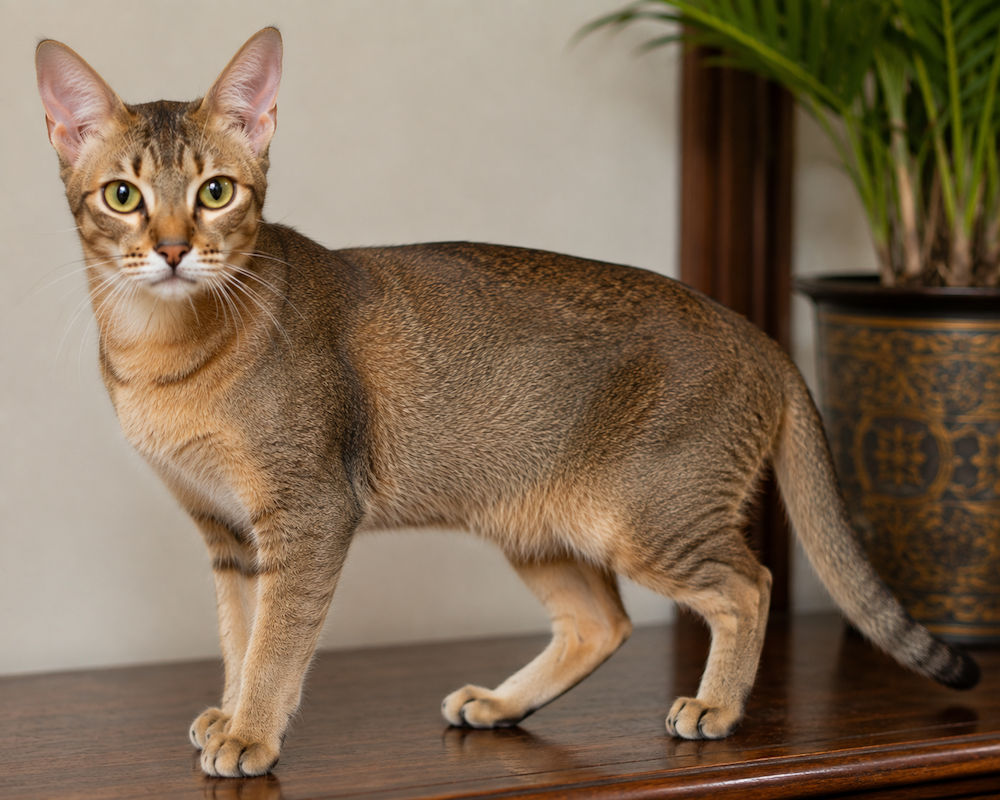






Affectionate, intelligent, and surprisingly diverse — the Asian is a family of elegant cats developed from Burmese ancestry, combining a sleek, muscular body with a highly social personality and an impressive range of colours, patterns, and coat types.
🧠 QUICK SNAPSHOT
- Temperament: Affectionate, intelligent, sociable
- Energy Level: Moderate to High
- Size: Medium
- Good With Families: Excellent
- Indoor Living: Excellent
- Trainability: High
- Grooming: Low to Moderate
- Best For: Families, interactive owners, apartment living, multi-pet households
- Typical Lifespan: Around 12–16 years
📚 OVERVIEW
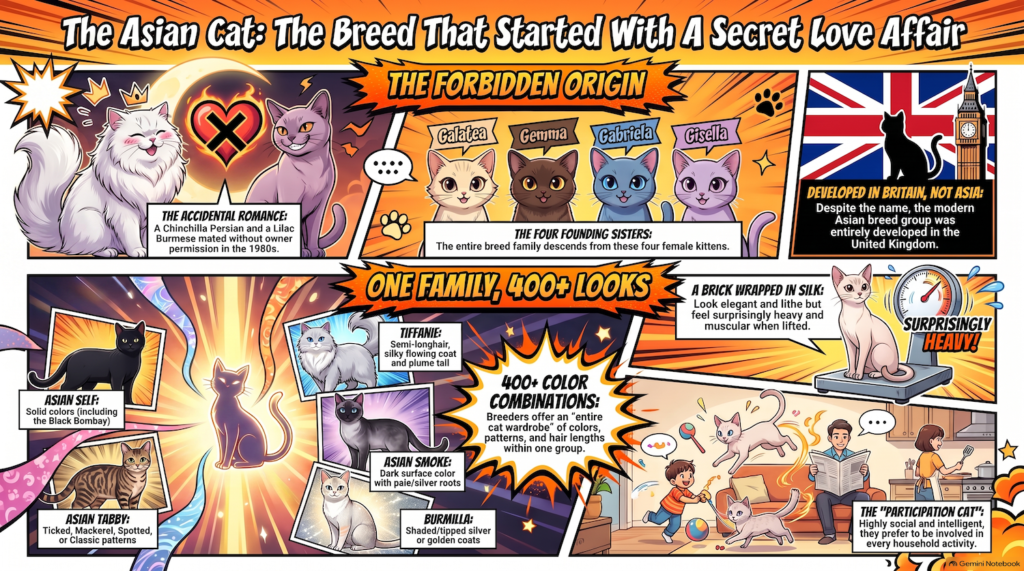
The Asian, sometimes referred to historically as the Asian Group or Asian Shorthair, is a relatively modern group of pedigree cats developed in Britain. Despite the name, the breed itself wasn’t developed in Asia.
The story began in the early 1980s when an accidental mating involving a Burmese and a Chinchilla Persian produced an attractive litter of kittens. British breeder Baroness Miranda von Kirchberg recognised their potential and began developing new breeding lines.
The result eventually became a fascinating family of closely related cats sharing a generally Burmese-style body and temperament while displaying a much broader selection of colours, patterns, and coat types.
Depending on the registry, the Asian family can include varieties such as the Burmilla, Asian Self, Asian Smoke, Asian Tabby, and the semi-longhaired Tiffanie.
Although terminology and classification differ between feline organisations, the underlying attraction is straightforward: these are typically elegant, muscular cats with expressive faces and exceptionally people-oriented personalities.
Asian cats tend to be affectionate, intelligent, curious, and playful. Many form strong relationships with their owners and prefer participating in family life rather than observing it from a distance.
✅ PROS & CONS
Pros
- Exceptionally affectionate and people-oriented
- Intelligent and playful
- Usually excellent with families
- Well suited to indoor living
- Available in numerous colours and patterns
- Often enjoys living with other social pets
Cons
- Doesn’t usually enjoy prolonged isolation
- Can be vocal and demanding of attention
- Needs regular play and mental stimulation
- Some individuals retain a strong Burmese-like personality
- Grooming requirements vary by coat type
- Breed terminology can be confusing between registries
Is an Asian Cat a Good Family Cat?
Yes, the Asian is generally an excellent family cat, particularly for households wanting an affectionate, interactive companion. Its Burmese heritage contributes strongly to a temperament that tends to be sociable, curious, playful, and interested in people.
Many Asian cats enjoy respectful children and happily participate in games. Children should still be taught appropriate handling and understand when a cat wants to be left alone.
Asian cats can also thrive in multi-pet households. Many enjoy another sociable cat for company and can adapt successfully to living with cat-friendly dogs when introductions are handled gradually.
Their strong desire for companionship is worth considering. An Asian routinely left alone for long periods may become lonely or bored, particularly without another compatible animal.
Some individuals form particularly intense relationships with their humans and may follow them around the home.
For families wanting a cat that genuinely becomes part of everyday household life, the Asian can be an outstanding choice.
Can an Asian Cat Live Indoors or in an Apartment?
Yes, the Asian is very well suited to indoor and apartment living, provided the home offers sufficient exercise, enrichment, climbing opportunities, and companionship.
These cats don’t require an enormous house, but they do need an interesting environment. Tall cat trees, scratching towers, shelves, window perches, tunnels, and comfortable elevated resting areas help make effective use of vertical space.
Puzzle feeders, rotating toys, and interactive games are particularly valuable because Asian cats tend to be intelligent and inquisitive.
Daily human interaction is also important. An apartment containing plenty of toys but very little companionship may still be unsatisfying for such a social cat.
Secure indoor living protects cats from traffic, fights, infectious diseases, poisoning, and other outdoor hazards. Secure cat enclosures can provide additional stimulation, while some individuals can learn to walk on a harness.
For the Asian, the quality of the environment matters much more than the size of the property.
How Much Exercise and Play Does an Asian Cat Need?
The Asian has moderate-to-high exercise requirements and benefits from several interactive play sessions throughout the day.
Fishing-wand toys, balls, toy mice, tunnels, climbing structures, and games involving stalking and chasing provide excellent physical exercise.
Many Asian cats remain playful well into adulthood. Their Burmese heritage often produces a cat that doesn’t simply abandon kitten-like games once maturity arrives.
Mental exercise is equally important. Puzzle feeders, treat hunts, clicker training, rotating toys, and problem-solving activities can help satisfy their considerable curiosity.
Climbing opportunities should also be available, particularly for young and energetic individuals.
Exercise needs vary between cats, but owners should expect an active companion rather than a decorative sofa ornament.
Without enough stimulation, an intelligent Asian may invent alternative entertainment involving cupboards, shelves, plants, toilet rolls, or anything else that appears sufficiently interesting.
Giving that curious brain something constructive to do is much easier than trying to convince it that your possessions aren’t toys.
Is an Asian Cat Easy to Train?
Yes, the Asian is generally highly trainable for a cat because it combines intelligence, curiosity, sociability, and a strong interest in interacting with people.
Positive reinforcement using treats, toys, praise, and clicker training can teach behaviours such as coming when called, sitting, retrieving toys, entering a carrier voluntarily, and walking on a harness.
Practical training is equally valuable. Teaching comfortable nail trimming, dental checks, grooming, carrier travel, and gentle body examination can make routine care considerably easier.
Short, enjoyable sessions work better than repetitive drills. Punishment should be avoided because it can damage trust without showing the cat what behaviour is wanted.
Asian cats are also good observers. They quickly learn household routines and can become remarkably skilled at predicting when meals, play sessions, or other interesting events are about to happen.
Training one can therefore occasionally become a two-way process.
Does an Asian Cat Shed?
Yes, the Asian does shed, although grooming requirements depend partly on which variety of the Asian group you own.
Short-haired Asians generally have sleek, fine coats that are extremely easy to maintain. A gentle brushing approximately once a week is normally sufficient to remove loose hairs and maintain their glossy appearance.
The semi-longhaired Tiffanie variety requires somewhat more regular grooming to prevent tangles, particularly around areas where the coat is longest.
Seasonal shedding can increase grooming requirements temporarily.
Routine maintenance should also include nail trimming, dental care, and checks of the ears, eyes, skin, and overall body condition.
Asian cats are not considered hypoallergenic. Even cats with short, relatively low-maintenance coats produce the proteins in saliva and skin secretions responsible for most feline allergies.
For owners primarily concerned about coat maintenance, however, the short-haired Asian varieties are relatively easy cats to groom.
What Health Problems Are Common in an Asian Cat?
The Asian is generally a healthy breed group, but its Burmese and Persian-related ancestry means responsible breeders should understand inherited health conditions occurring within those populations.
One important condition associated with some Burmese lines is hypokalaemic polymyopathy, an inherited disorder involving low potassium levels that can cause muscle weakness. Genetic testing is available for relevant breeding populations.
Some Burmese ancestry may also make particular inherited craniofacial abnormalities relevant depending on breeding lines.
Polycystic kidney disease (PKD) has historically been important in Persian-related cats. Because Persian ancestry contributed to the development of the Asian group, responsible breeders should understand whether testing is appropriate within their lines.
Heart disease, including hypertrophic cardiomyopathy (HCM), and common feline conditions such as dental disease, obesity, kidney disease, and urinary disorders should also be considered.
Prospective owners should seek responsible breeders who use appropriate health testing and maintain good genetic diversity. Regular veterinary care, balanced nutrition, dental care, and weight management help support a lifespan commonly around 12–16 years.
⭐ Is the Asian Cat Actually From Asia?
No — and this is probably the most confusing thing about the breed.
The modern Asian breed group was developed primarily in Britain, not Asia.
The name reflects its strong connection with the Burmese and related Asian-type cats rather than the geographic location where the breeding program took place.
Its modern story began during the early 1980s when a mating involving a Burmese female and a Chinchilla Persian male produced an unexpected litter.
Breeder Baroness Miranda von Kirchberg recognised the potential of these kittens and developed breeding programs that eventually produced several related varieties.
This means the Asian joins an amusing collection of cat breeds whose names can create misleading assumptions about their origins.
You don’t need to travel to Southeast Asia to find the birthplace of the modern Asian cat.
For that, you need to head to Britain.
⭐ Is the Asian One Breed or Several Different Cats?
This is where things become interesting.
The term Asian can refer to a wider family of closely related cats rather than one single coat colour or pattern.
Depending on the feline registry and country, the group can include varieties such as:
- Asian Self — essentially solid-coloured cats
- Asian Tabby — cats displaying tabby patterning
- Asian Smoke — cats with dramatic smoke colouring
- Burmilla — famous for its shaded silver appearance
- Tiffanie — the semi-longhaired member of the family
They share common ancestry and broadly similar physical characteristics, but coat length, colour, and pattern can vary dramatically.
Registry terminology isn’t completely uniform internationally, which can make researching the breed confusing.
The easiest way to think about it is as an extended feline family built around a broadly Burmese-style cat but dressed in a much larger wardrobe of colours and coats.
⭐ How Did an Accidental Mating Create an Entire Breed Group?
The Asian’s history demonstrates how one unplanned event can change the pedigree cat world.
In Britain during the early 1980s, a lilac Burmese female and a Chinchilla Persian male unexpectedly mated.
The resulting kittens were striking.
Instead of simply treating the litter as an accident, breeder Baroness Miranda von Kirchberg saw an opportunity to develop something new.
The original breeding ultimately contributed to the development of the Burmilla, while subsequent breeding programs expanded the idea into the wider Asian group.
Carefully planned matings were used to produce additional colours, patterns, and coat varieties while maintaining a recognisable overall type and companion temperament.
It’s an excellent reminder that not every established pedigree breed began with someone following a detailed master plan.
Sometimes genetics produces something unexpected.
Then a breeder looks at the kittens and thinks:
“We should probably do that again.”
⭐ What Is the Difference Between an Asian Cat and a Burmese?
The breeds are closely related, but they aren’t identical.
The Burmese is traditionally recognised within a more restricted range of coat colours and has its own established breed standards.
The Asian group was developed using Burmese ancestry while deliberately introducing a much wider selection of colours, patterns, and, in the case of the Tiffanie, longer hair.
Physically, Asian cats generally retain a muscular, elegant body and expressive appearance reminiscent of their Burmese relatives.
Personality can also feel familiar. Both tend to be affectionate, intelligent, playful, and strongly interested in their humans.
The easiest distinction is therefore often the coat.
Imagine taking some of the fundamental characteristics people love about the Burmese and allowing breeders a much broader palette of colours and patterns.
That’s essentially part of the attraction of the Asian.
The family resemblance remains.
The wardrobe became considerably bigger.