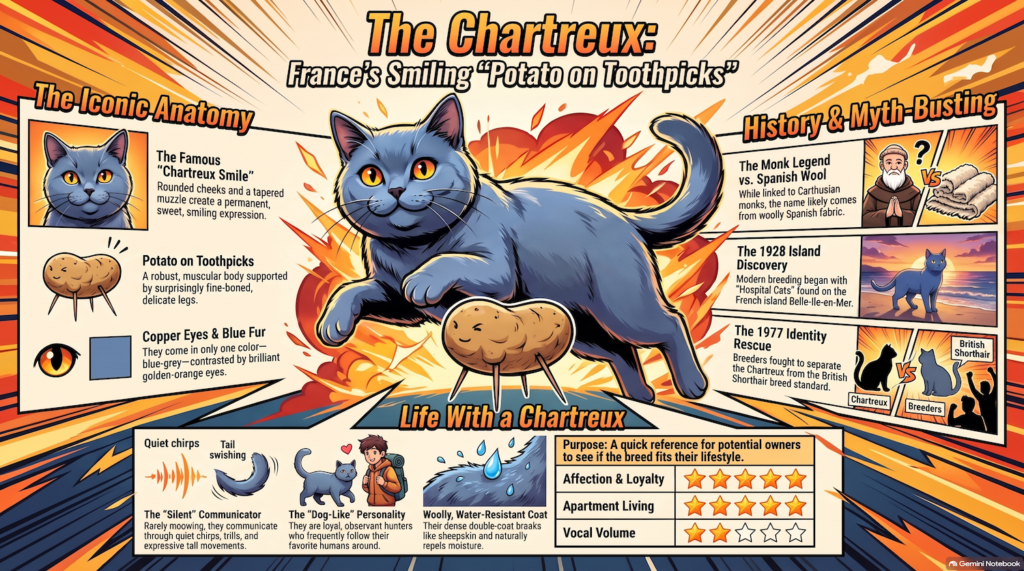
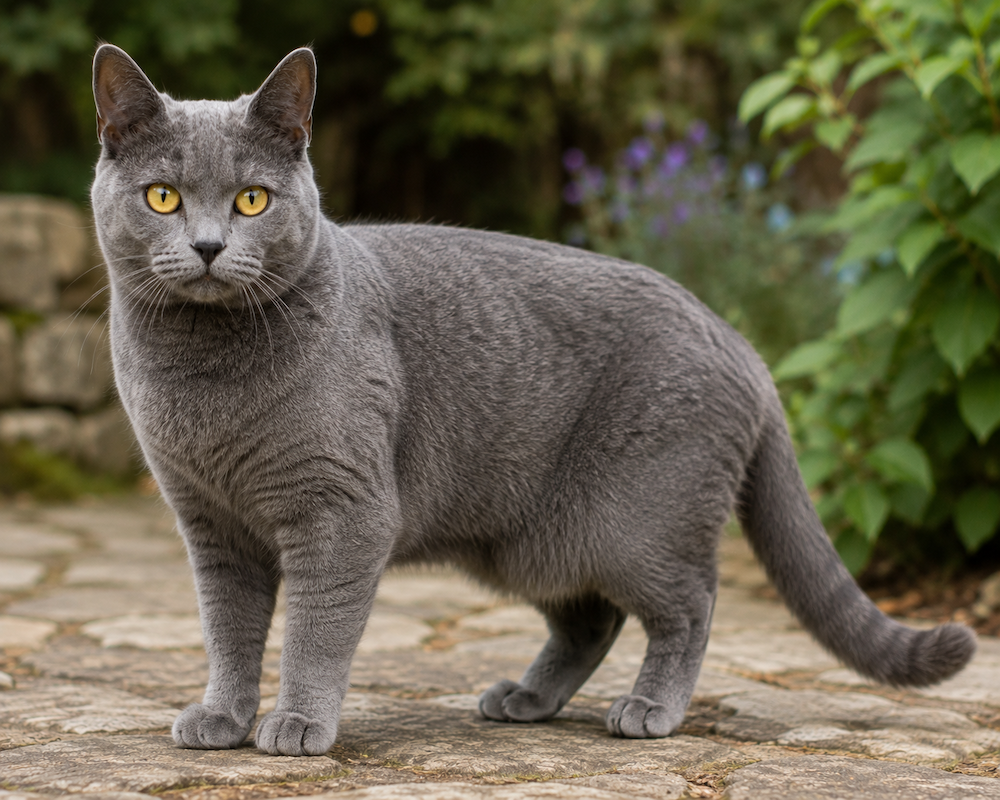






Quiet, powerful, and wrapped in a beautiful blue-grey coat — the Chartreux is an historic French cat known for its copper-gold eyes, famously subtle voice, exceptional hunting ability, and affectionate personality that often makes it a devoted shadow to its favourite people.
🧠 QUICK SNAPSHOT
- Temperament: Affectionate, calm, intelligent
- Energy Level: Moderate
- Size: Medium to Large
- Good With Families: Excellent
- Indoor Living: Excellent
- Trainability: High
- Grooming: Low to Moderate
- Best For: Families, quieter households, apartment living, people wanting an affectionate but undemanding companion
- Typical Lifespan: Around 12–15 years
📚 OVERVIEW
The Chartreux is an old French breed instantly recognisable by its dense blue-grey coat, powerful body, and brilliant copper or gold eyes.
Although its exact early history is uncertain, blue-grey cats resembling the Chartreux have been described in France for centuries. By the 18th century, naturalists were using the name Chartreux when describing a distinctive type of French cat.
Modern organised breeding began during the 20th century, particularly through the work of the Léger sisters, who discovered a population of blue cats on Belle-Île-en-Mer off the coast of Brittany and began breeding them selectively.
The Second World War devastated many European pedigree cat populations, and careful breeding was required to preserve the Chartreux afterwards.
Physically, the breed combines a broad head, relatively narrow muzzle, muscular body, fine-boned legs, and an extraordinarily thick coat. The shape of the muzzle can create the impression that the cat is smiling.
Its personality provides another interesting contrast. Chartreux cats can be formidable hunters and surprisingly athletic, yet at home they are usually calm, affectionate, observant, and notably quiet.
Some rarely meow at all.
✅ PROS & CONS
Pros
- Affectionate without usually being excessively demanding
- Calm and adaptable temperament
- Usually excellent with families
- Well suited to indoor and apartment living
- Intelligent and playful
- Generally much quieter than many vocal breeds
Cons
- Dense coat can shed heavily seasonally
- Can gain excess weight without sufficient activity
- Strong hunting instincts
- Genuine pedigree Chartreux can be difficult to find
- Not hypoallergenic
- Can be confused with other blue-grey cat breeds
Is a Chartreux a Good Family Cat?
Yes, the Chartreux is generally an excellent family cat, particularly for households wanting an affectionate companion without the constant vocal demands of some more extroverted breeds.
Chartreux cats often form very strong relationships with their humans. Many follow favourite people around the home, quietly settling nearby rather than constantly demanding physical attention.
They can be very good companions for respectful children. Their substantial build makes them relatively sturdy, but children should still be taught gentle handling and allowed to recognise when the cat wants space.
Chartreux cats can also live successfully with other cats and cat-friendly dogs when introductions are gradual and properly managed.
Their relatively calm temperament can make them suitable for quieter homes as well as families.
However, calm doesn’t mean uninterested. The Chartreux generally wants to know where its people are and what they’re doing.
It may simply supervise the household without feeling the need to provide a running commentary.
Can a Chartreux Live Indoors or in an Apartment?
Yes, the Chartreux is very well suited to indoor and apartment living.
Its moderate energy level and relatively quiet personality make it particularly adaptable, provided the home includes sufficient opportunities for play, climbing, scratching, and mental stimulation.
A sturdy cat tree is important because adult Chartreux cats can be surprisingly solid and muscular. Window perches, scratching posts, tunnels, puzzle feeders, and comfortable resting areas also help create an interesting indoor environment.
Daily interactive play remains essential. The breed’s calm appearance can sometimes lead owners to underestimate its athletic ability and hunting instincts.
Secure indoor living protects cats from traffic, infectious diseases, fights, poisoning, predators, and other outdoor hazards. A secure cat enclosure can provide additional stimulation where practical.
Apartment dwellers may particularly appreciate another Chartreux characteristic:
they are famously quiet cats.
That doesn’t guarantee complete silence, but many are considerably less vocal than breeds such as the Siamese or Oriental Shorthair.
How Much Exercise and Play Does a Chartreux Need?
The Chartreux has moderate exercise requirements and should receive interactive play every day.
Fishing-wand toys, toy mice, balls, tunnels, climbing structures, and games involving stalking and pouncing are excellent choices, particularly because the breed has a strong historical reputation as a skilled mouser.
Several shorter play sessions throughout the day generally work well.
Mental stimulation is equally valuable. Puzzle feeders, hidden treats, clicker training, and rotating toys provide additional challenges for an intelligent cat.
Chartreux kittens can be highly playful and energetic. Adults often become calmer but should still be encouraged to remain active.
This is particularly important because the breed’s naturally solid build and dense coat can make excess weight harder to notice.
Running your hands gently over the cat’s body during routine grooming can help monitor body condition.
A Chartreux may look like a plush blue teddy bear.
Underneath all that fur should still be a muscular cat rather than an overweight one.
Is a Chartreux Easy to Train?
Yes, the Chartreux is generally intelligent and quite trainable, although its quiet, independent personality means it may approach learning differently from intensely attention-seeking breeds.
Positive reinforcement using treats, toys, praise, and play works best.
Chartreux cats can learn behaviours such as coming when called, entering a carrier voluntarily, using appropriate scratching areas, retrieving toys, and performing simple tricks.
Some individuals are particularly enthusiastic about games involving retrieving objects.
Practical training is also worthwhile. Teaching comfortable nail trimming, grooming, dental checks, carrier travel, and gentle body examination can make routine care considerably easier.
Training sessions should remain short and enjoyable. Punishment should be avoided.
The Chartreux’s intelligence can sometimes be understated because these cats don’t necessarily advertise everything they’re thinking.
They are often extremely observant.
Your Chartreux may have learned your household routine long before you realised the cat was paying attention.
Does a Chartreux Shed?
Yes. The Chartreux does shed, and its extraordinary double coat can produce a noticeable amount of loose hair, particularly during seasonal coat changes.
The coat is one of the breed’s defining features. It is short to medium-short, exceptionally dense, and can have a slightly woolly texture.
Gentle grooming approximately once or twice a week is usually appropriate, increasing during heavier shedding periods.
A comb can help remove loose undercoat, but grooming should be gentle to avoid unnecessarily stripping or damaging the characteristic texture.
Bathing is rarely required. The dense coat can also take considerable time to become completely wet and dry.
Routine care should include nail trimming, dental care, and checks of the ears, eyes, skin, and body condition.
The Chartreux is not hypoallergenic. Its beautiful coat doesn’t prevent production of the proteins in saliva and skin secretions responsible for feline allergies.
What Health Problems Are Common in a Chartreux?
The Chartreux is generally considered a robust breed, but several health issues deserve attention.
One condition associated with the breed is patellar luxation, where the kneecap moves out of its normal position. Severity can vary considerably, and responsible breeders should pay attention to sound joint structure.
Chartreux cats can also develop common feline health problems such as dental disease, obesity, kidney disease, urinary conditions, arthritis, and heart disease.
Weight management deserves particular attention. The breed is naturally muscular and substantial, but excessive body fat places unnecessary strain on joints and contributes to numerous health problems.
Because the Chartreux has a comparatively limited pedigree population, responsible breeding should also emphasise genetic diversity and careful knowledge of family health histories.
Prospective owners should seek breeders who are transparent about health screening and the longevity of their lines.
With appropriate nutrition, regular veterinary care, dental maintenance, exercise, and weight control, Chartreux cats commonly live around 12–15 years, with some reaching considerably older ages.
⭐ Why Is the Chartreux Called France’s National Cat?
The Chartreux has become one of the cat breeds most strongly associated with France.
Blue-grey cats identified as Chartreux have appeared in French writings for centuries, and descriptions resembling the breed can be traced back hundreds of years.
The Chartreux even appears in French literature and cultural history.
One particularly famous owner was the French writer Colette, who featured her Chartreux cat Saha in her writing.
French statesman Charles de Gaulle is also frequently associated with a Chartreux named Gris-Gris.
The breed’s survival wasn’t guaranteed. Like many European pedigree animals, Chartreux populations were badly affected by the two World Wars, and breeders had to work carefully to preserve them.
Today, the Chartreux is internationally recognised yet remains inseparably connected with its French heritage.
France has produced extraordinary wine, cheese, art, fashion and cuisine.
It also gave the world a blue cat that looks permanently amused by all of it.
⭐ Did Monks Really Breed Chartreux Cats?
This is one of the most famous stories about the breed — and one that should be treated cautiously.
A popular legend claims that Chartreux cats were bred by Carthusian monks, perhaps even living alongside them in monasteries and developing their famously quiet personalities in that environment.
It’s a wonderful story.
Unfortunately, there is little solid historical evidence proving it.
The similarity between the words Chartreux and Carthusian helped the legend grow, while the breed’s quiet personality made the monastery connection seem even more believable.
Alternative explanations for the name have also been proposed, including an association with a type of Spanish wool known historically as pile de Chartreux, perhaps because the cat’s thick coat resembled the wool.
What we can say confidently is that blue-grey cats called Chartreux have a long history in France.
Whether medieval monks were quietly sharing their monasteries with generations of them is considerably less certain.
Sometimes the legend is simply better documented than the truth.
⭐ Why Does the Chartreux Look Like It’s Smiling?
The famous “Chartreux smile” comes from the shape of the cat’s head and muzzle.
Chartreux cats have broad, rounded heads that narrow towards a comparatively small muzzle. Combined with full cheeks and expressive golden or copper eyes, this can create the appearance of slightly upturned corners around the mouth.
The result is remarkably human-looking.
A relaxed Chartreux can appear to be quietly smiling at whatever is happening around it.
Of course, cats don’t use human-style smiles to communicate happiness. Feline emotional state is better judged through body posture, eyes, ears, tail position, vocalisation, and behaviour.
But that hasn’t stopped the expression becoming one of the breed’s most endearing characteristics.
It also suits the Chartreux personality remarkably well.
These cats often sit silently observing their humans with an expression that suggests they know something we don’t.
⭐ Why Are Chartreux Cats So Quiet?
The Chartreux has a reputation for being one of the less vocal pedigree cat breeds.
Many individuals use soft chirps, trills, or tiny noises rather than powerful meows. Some rarely vocalise at all.
This can be surprising when it comes from such a substantial cat.
There is no evidence that Chartreux cats are physically incapable of normal feline vocalisation. Rather, low vocalisation appears to be a characteristic commonly associated with the breed’s temperament.
That doesn’t mean they struggle to communicate.
A Chartreux may follow you, stare at you, touch you with a paw, sit beside an object it wants, or simply position itself where ignoring it becomes impossible.
In other words, the breed can be remarkably effective at communicating without saying very much.
For apartment dwellers or people who prefer quieter cats, this can be a significant advantage.
Just don’t mistake silence for lack of opinion.
⭐ Is a Chartreux the Same as a British Shorthair or Russian Blue?
No. All three can have beautiful blue-grey coats, but the Chartreux, British Shorthair, and Russian Blue are distinct breeds.
The Chartreux typically has a muscular body, dense slightly woolly blue coat, and gold to copper eyes.
The Russian Blue is generally more slender and elegant, with a shimmering blue coat and characteristic green eyes.
The British Shorthair is typically heavier and rounder, with a broad face and extremely plush coat. Although blue is its most famous colour, British Shorthairs actually occur in many colours and patterns.
Historically, European breeding practices sometimes created overlap and confusion between blue cats, particularly during periods when breed populations were being rebuilt.
Today, however, their breed standards and identities are clearly separate.
If you’re trying to identify a mysterious blue cat, the eyes provide an excellent starting clue.
Green suggests Russian Blue.
Copper or gold might point towards Chartreux or British Shorthair.
And pedigree papers provide a considerably more reliable answer than guessing from colour alone.