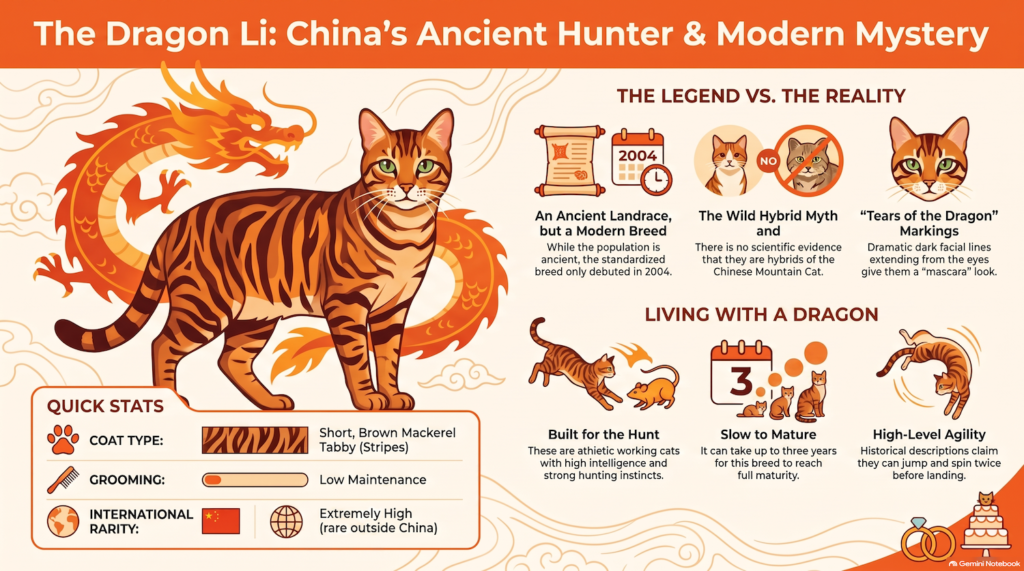






Ancient-looking, athletic, and distinctly Chinese — the Dragon Li is a naturally developed cat breed known for its golden-brown mackerel tabby coat, strong hunting instincts, intelligence, and unusually deep connection to China’s native domestic cat population.
🧠 QUICK SNAPSHOT
- Temperament: Intelligent, loyal, alert
- Energy Level: Moderate to High
- Size: Medium
- Good With Families: Very Good
- Indoor Living: Very Good with sufficient enrichment
- Trainability: High
- Grooming: Low
- Best For: Families, active households, experienced cat owners, people wanting a natural breed
- Typical Lifespan: Around 12–15 years
📚 OVERVIEW
The Dragon Li is one of the most distinctive natural cat breeds associated with China.
It is also known as the Li Hua Mao, a name referring to its characteristic patterned coat. Unlike many modern pedigree cats created through deliberate crossing, the Dragon Li developed from China’s native domestic cat population and was later standardised as a recognised breed.
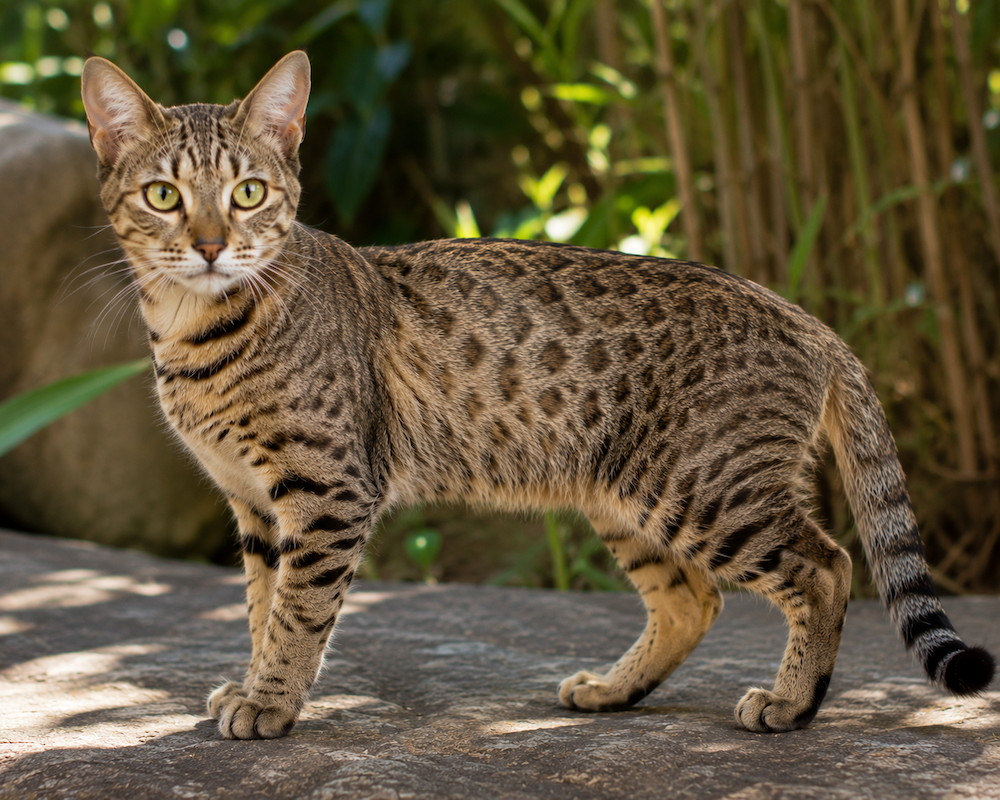
The breed typically has a strong, muscular body, rounded head, well-developed cheeks, and a short coat displaying a distinctive brown or golden mackerel tabby pattern. The hairs are often ticked or banded, helping produce the rich, wild-looking appearance for which the breed is known.
Dragon Li cats are usually intelligent, observant, confident, and active without necessarily being hyperactive. Many form strong bonds with their families while retaining a degree of independence.
They also tend to be skilled hunters and enjoy activities that involve stalking, climbing, and problem-solving.
Outside China, genuine pedigree Dragon Li cats remain uncommon.
That rarity, combined with their natural origins and strong cultural association with China, makes the Dragon Li particularly fascinating.
✅ PROS & CONS
Pros
- Intelligent and highly observant
- Loyal and affectionate with family
- Athletic and playful
- Very easy-care coat
- Naturally developed breed
- Generally adaptable to indoor living
Cons
- Rare outside China
- Needs regular mental and physical stimulation
- Can have a strong prey drive
- May be reserved with strangers
- Not hypoallergenic
- Genuine pedigree cats can be difficult to locate
Is a Dragon Li a Good Family Cat?
Yes, the Dragon Li can be a very good family cat, especially in a household that appreciates an intelligent and somewhat independent companion.
These cats often form strong bonds with the people they know well. They may not always demand constant physical affection, but many enjoy staying close to family members and participating in household life.
Dragon Li cats can do well with respectful children who understand how to interact appropriately with cats. They may also live successfully with compatible cats and cat-friendly dogs when introductions are gradual.
Their hunting instinct deserves consideration in homes with birds, rodents, or other small prey animals.
The breed can also be somewhat cautious around unfamiliar people, particularly if not extensively socialised as a kitten.
For families wanting a cat that is affectionate without necessarily being clingy, the Dragon Li can offer an appealing balance.
It tends to be a companion that chooses to stay involved rather than one that constantly demands attention.
Can a Dragon Li Live Indoors or in an Apartment?
Yes, a Dragon Li can live successfully indoors or in an apartment, provided the environment offers enough enrichment.
These are athletic cats, so vertical territory is particularly valuable. Tall cat trees, shelves, scratching posts, secure elevated resting areas, and window perches all help create a stimulating indoor environment.
Interactive play and puzzle feeders should also be part of daily life.
Because the Dragon Li comes from a naturally developed population with strong hunting instincts, indoor cats benefit from activities that mimic stalking, chasing, and searching.
Secure indoor living protects cats from traffic, poisoning, fights, infectious diseases, and other hazards. A secure cat enclosure can provide additional outdoor stimulation where practical.
Apartment size matters less than environmental quality.
A smaller home with plenty to climb, explore, scratch, chase, and investigate can suit a Dragon Li very well.
A large but unstimulating home may not.
How Much Exercise and Play Does a Dragon Li Need?
The Dragon Li has moderate-to-high exercise requirements and benefits from interactive play every day.
Fishing-wand toys, balls, toy mice, tunnels, climbing structures, and games involving stalking and pouncing are particularly suitable.
Several shorter sessions throughout the day are usually more effective than one long session.
Mental stimulation is equally important. Puzzle feeders, treat hunts, scent games, clicker training, and rotating toys can keep an intelligent Dragon Li occupied.
These cats are often alert and curious, so environmental variety matters.
Owners should also provide suitable scratching surfaces and high vantage points.
Without enough activity, a clever Dragon Li may start creating its own entertainment.
And given its hunting background, that entertainment may involve anything that rolls, rustles, moves unexpectedly, or appears to be hiding under the sofa.
Is a Dragon Li Easy to Train?
Yes, the Dragon Li is generally intelligent and trainable, although individual cats can also show a strong independent streak.
Positive reinforcement using treats, toys, praise, and play works best.
Dragon Li cats may learn to come when called, enter a carrier voluntarily, use appropriate scratching areas, retrieve toys, or perform simple tricks.
Clicker training can be particularly useful because it provides mental enrichment as well as teaching desirable behaviour.
Practical training should include comfortable nail trimming, dental checks, carrier travel, and gentle body handling.
Punishment should be avoided. It can damage trust and often produces avoidance rather than understanding.
The Dragon Li’s intelligence also means it can quickly learn household routines.
Food locations, door-opening patterns, favourite sleeping spots, and the exact sound of a treat packet are unlikely to remain mysteries for very long.
Does a Dragon Li Shed?
Yes, the Dragon Li sheds, but its short coat is very easy to maintain.
A gentle brushing approximately once a week is usually enough to remove loose hair, distribute natural skin oils, and maintain the coat’s glossy appearance.
More frequent brushing can be useful during periods of seasonal shedding.
Bathing is rarely necessary unless there is a specific reason.
Routine grooming should also include nail trimming, dental care, and regular checks of the ears, eyes, skin, and body condition.
The Dragon Li is not considered hypoallergenic. Like all cats, it produces allergens primarily through proteins found in saliva and skin secretions.
From a coat-care perspective, however, this is a genuinely low-maintenance breed.
Its striking appearance comes mostly from natural pigmentation and pattern rather than a coat requiring complicated upkeep.
What Health Problems Are Common in a Dragon Li?
The Dragon Li is a naturally developed breed and is generally regarded as robust, but breed-specific health data is comparatively limited.
Because genuine pedigree Dragon Li cats remain uncommon outside China, there is not the same depth of long-term health research available for breeds such as the Persian, Maine Coon, or Siamese.
There are no widely recognised major inherited diseases considered unique to the Dragon Li.
However, that doesn’t mean the breed is immune to health problems.
Like all cats, Dragon Li cats can develop dental disease, kidney disease, urinary disorders, obesity, arthritis, and heart conditions.
Maintaining a healthy body weight is particularly important because excess weight can reduce mobility and increase the risk of several chronic diseases.
Responsible breeders should prioritise genetic diversity, sound structure, temperament, and the health history of breeding cats.
Regular veterinary examinations, dental care, balanced nutrition, and daily exercise can help support a lifespan commonly around 12–15 years, with some individuals potentially living longer.
⭐ Is the Dragon Li an Ancient Chinese Cat Breed?
The Dragon Li has ancient natural roots, but the modern pedigree breed itself is much more recent.
Cats resembling the Dragon Li have lived in China for generations and form part of the country’s native domestic-cat population.
However, formal breed recognition and organised breeding are modern developments.
The breed began gaining official attention in China during the early 2000s, when native cats were evaluated and standardised within emerging pedigree breeding programs.
This distinction is important.
The Dragon Li wasn’t invented recently.
Rather, people recently began formally recognising and documenting a naturally occurring Chinese cat type that had existed long before pedigree paperwork did.
In that sense, the breed is both ancient and modern at the same time.
Its ancestry is old.
Its official pedigree identity is comparatively new.
⭐ Is the Dragon Li Related to the Chinese Mountain Cat?
This is one of the most persistent myths surrounding the breed.
The Dragon Li has sometimes been claimed to descend directly from the Chinese mountain cat, a wild feline native to China.
Current genetic understanding does not support the idea that the Dragon Li is a domesticated version of the Chinese mountain cat.
The Dragon Li belongs to the domestic-cat population associated with the species Felis catus, which ultimately derives primarily from the Near Eastern wildcat lineage involved in cat domestication.
Research has shown that domestic cats in China have occasionally hybridised with Chinese mountain cats, but that doesn’t make the Dragon Li itself a direct domesticated form of that wild species.
The distinction matters.
The Dragon Li looks naturally wild and has ancient Chinese roots.
But it is still fundamentally a domestic cat, not a tamed Chinese mountain cat.
⭐ What Makes the Dragon Li’s Coat Special?
The Dragon Li’s coat is one of its defining features.
It typically displays a brown or golden mackerel tabby pattern, with narrow dark stripes running across the body.
Individual hairs can show bands of different colour, which helps create a rich, almost shimmering appearance.
The overall effect can look surprisingly wild.
The face often includes strong tabby markings around the eyes and forehead, while the body remains muscular and naturally proportioned.
Unlike breeds created around a dramatic mutation such as folded ears, curly hair, or hairlessness, the Dragon Li’s appearance is subtle.
Its attraction comes from the combination of natural structure, warm colouring, and traditional tabby patterning.
It looks less like a cat designed by breeders and more like a cat that has simply been perfected by generations of natural adaptation.
Which, in many ways, is exactly what it is.
⭐ Why Is the Dragon Li Sometimes Called Li Hua Mao?
In China, the breed is commonly associated with the name Li Hua Mao.
“Mao” simply means cat, while “Li Hua” refers broadly to the patterned or flower-like appearance of the coat.
English-language use of the name Dragon Li helped give the breed a more distinctive international identity.
The word “Dragon” also creates an immediate cultural association with China, although it isn’t a literal translation of the traditional Chinese name.
This means prospective owners may encounter several names referring to essentially the same breed or closely related native cat type.
Dragon Li.
Chinese Li Hua.
Li Hua Mao.
Different names, but the same basic idea:
A naturally developed Chinese cat recognised for its distinctive tabby coat, muscular build, and local heritage.
⭐ Did a Dragon Li Really Become Famous in a Chinese Wedding?
One of the breed’s most charming modern stories involves a Dragon Li named Needy, who reportedly became famous after taking part in a traditional-style feline wedding ceremony in China.
The event attracted attention because the cats were presented in elaborate traditional clothing and ceremonial surroundings.
Stories like this helped raise public awareness of native Chinese cat breeds at a time when imported pedigree breeds were often receiving considerably more attention.
Whether a cat fully appreciates the significance of a wedding ceremony is another question.
But the publicity did something useful.
It reminded people that China had distinctive native cats worthy of preservation and recognition.
For a breed that spent generations living relatively quietly alongside people, the Dragon Li suddenly found itself becoming something of a cultural celebrity.
⭐ Why Is the Dragon Li So Rare Outside China?
The Dragon Li remains rare internationally for several reasons.
Formal breeding programs are relatively young, and the breed has never developed the huge international breeder networks enjoyed by cats such as the Maine Coon, British Shorthair, or Ragdoll.
Export numbers have also been limited.
Another challenge is identification.
Because the Dragon Li has a natural brown tabby appearance, an ordinary domestic shorthair can sometimes look superficially similar.
That doesn’t make every brown tabby a Dragon Li.
A genuine pedigree Dragon Li must come from recognised breeding lines and meet the relevant breed standard.
Its rarity therefore creates an important warning for prospective buyers.
A seller advertising an ordinary brown tabby as an exotic “Dragon Li” should be treated cautiously unless pedigree documentation supports the claim.
Sometimes the rarest-looking cat isn’t the one with the strangest appearance.
It’s the one whose ancestry is difficult to prove.