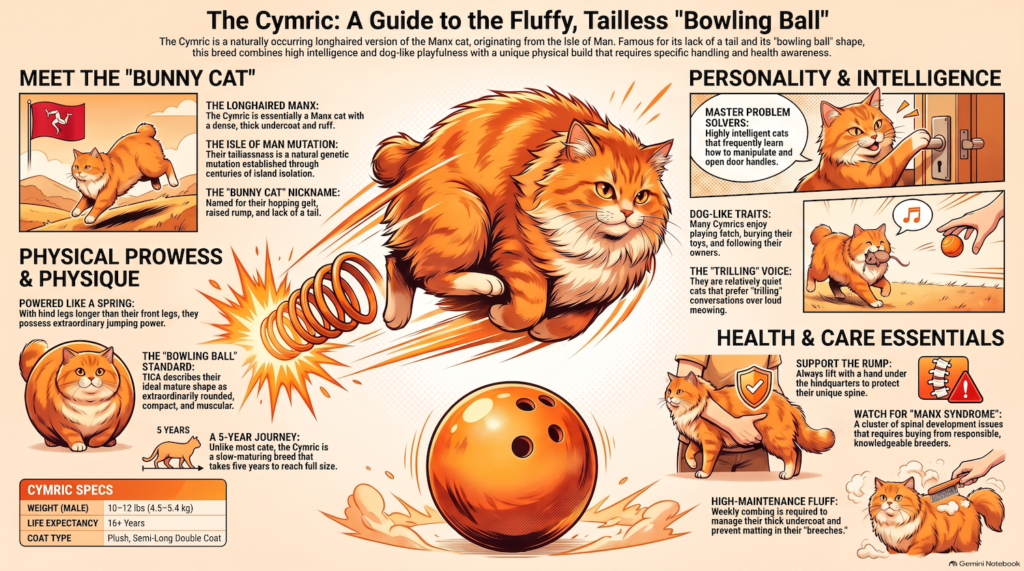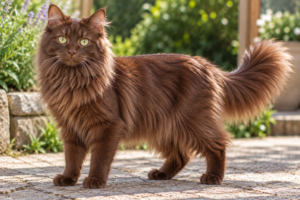
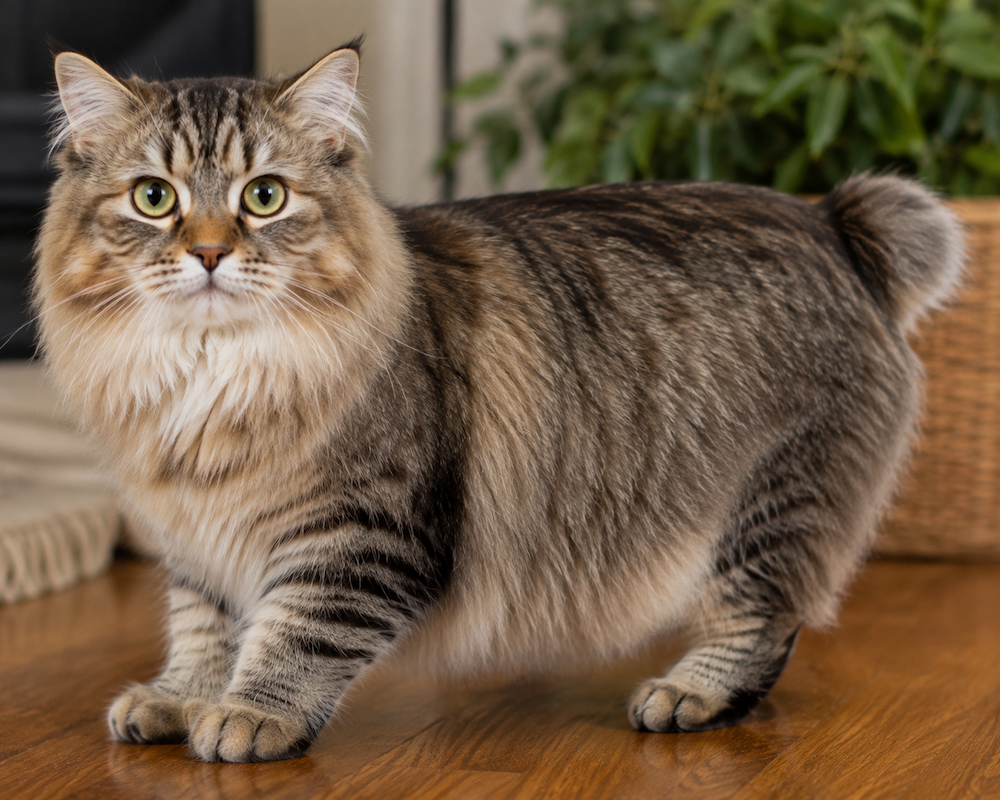






Round, powerful, and famous for having little or no tail — the Cymric is essentially the long-haired relative of the Manx, combining an unusual naturally occurring mutation with a thick double coat, strong hindquarters, playful intelligence, and a loyal family-oriented personality.
🧠 QUICK SNAPSHOT
- Temperament: Affectionate, loyal, playful
- Energy Level: Moderate
- Size: Medium
- Good With Families: Excellent
- Indoor Living: Excellent
- Trainability: High
- Grooming: Moderate to High
- Best For: Families, interactive owners, quieter homes, people wanting an unusual long-haired cat
- Typical Lifespan: Around 12–15 years
📚 OVERVIEW
The Cymric is best understood as the long-haired version of the Manx, the famous tailless cat associated with the Isle of Man.
Both breeds share the same underlying genetic mutation affecting tail development. The major difference is coat length.
Cymrics have a thick, soft, semi-long double coat that gives them an even rounder and more substantial appearance than their short-haired Manx relatives.
Their bodies are compact and muscular, with especially powerful hind legs. The rear legs are longer than the front legs, creating a slightly rising topline and giving the breed its characteristic rabbit-like movement.
Not every Cymric is completely tailless. Depending on genetics, kittens may be born with no tail at all, a small bump, a short partial tail, or a near-normal tail.
Personality is one of the breed’s biggest attractions. Cymrics are often affectionate, intelligent, playful, and strongly bonded to their families. Many enjoy interactive games and can remain kitten-like well into adulthood.
They are unusual-looking cats, but their real appeal is usually temperament rather than novelty.
✅ PROS & CONS
Pros
- Affectionate and family-oriented
- Intelligent and trainable
- Playful without usually being hyperactive
- Often good with children
- Well suited to indoor living
- Distinctive appearance and personality
Cons
- Dense coat needs regular grooming
- Tail-related spinal problems can occur
- Not every kitten is completely tailless
- Can gain weight if under-exercised
- Rare in many countries
- Not hypoallergenic
Is a Cymric a Good Family Cat?
Yes, the Cymric is generally an excellent family cat.
These cats are often affectionate, loyal, and strongly people-oriented without necessarily being excessively demanding. Many develop close relationships with one or more household members and enjoy following them around the home.
Cymrics can be very good with respectful children, particularly those who enjoy interactive play. Their sturdy build makes them relatively robust, but children should still be taught to handle them gently.
They can also live successfully with other cats and cat-friendly dogs when introductions are managed properly.
One characteristic owners frequently appreciate is the breed’s balance between sociability and independence. A Cymric may happily join family activities and then settle nearby without requiring constant physical attention.
This makes them suitable for households wanting a companionable cat that genuinely integrates into everyday life.
They can also be surprisingly playful, so don’t assume the calm, plush appearance means they are permanently sedentary.
Can a Cymric Live Indoors or in an Apartment?
Yes, the Cymric is very well suited to indoor and apartment living, provided it receives enough exercise and enrichment.
Because the breed has strong hind legs and enjoys climbing, sturdy cat trees and secure elevated resting areas are useful.
Window perches, scratching posts, tunnels, shelves, and interactive toys can help make a smaller home more interesting.
Daily play is important. A Cymric that spends too much time inactive may gain excess weight, which is particularly undesirable in a breed where spinal and joint health deserve careful attention.
Secure indoor living also protects cats from traffic, fights, poisoning, infectious disease, and other outdoor hazards.
A secure cat enclosure can provide additional stimulation if space allows.
Apartment dwellers should also appreciate that Cymrics are usually not among the noisiest pedigree breeds. Individual cats vary, but they tend to communicate without the constant vocal intensity associated with breeds such as the Siamese.
How Much Exercise and Play Does a Cymric Need?
The Cymric has moderate exercise requirements but is often more athletic than its rounded appearance suggests.
Its powerful hindquarters give it excellent jumping ability, and many enjoy climbing, chasing, and interactive games.
Fishing-wand toys, balls, tunnels, toy mice, and puzzle feeders are all good choices.
Several short play sessions throughout the day work well.
Mental stimulation is also important. Cymrics are intelligent and can enjoy clicker training, treat hunts, puzzle toys, and learning household routines.
Some even develop a reputation for retrieving toys and behaving in ways owners describe as almost dog-like.
Because the breed can become relatively solid-bodied, weight management matters. Exercise should be combined with appropriate portion control rather than relying on free feeding.
A healthy Cymric should feel muscular beneath that thick coat.
The fluff can make it harder to notice when “sturdy” has quietly turned into “overweight.”
Is a Cymric Easy to Train?
Yes, the Cymric is generally intelligent and quite trainable.
Positive reinforcement works best. Treats, toys, praise, and clicker training can be used to teach behaviours such as coming when called, sitting, retrieving toys, entering a carrier voluntarily, and using designated scratching areas.
Many Cymrics are curious and food-motivated, which can make training enjoyable.
Practical handling training is particularly useful. Teaching a kitten to accept nail trimming, grooming, dental checks, carrier travel, and gentle body examination can reduce stress throughout its life.
Punishment should be avoided because it can undermine trust and rarely teaches the desired alternative behaviour.
Owners often report that Cymrics quickly learn household patterns. They may recognise feeding times, favourite games, cupboard locations, and routines with impressive accuracy.
They are clever enough to learn what you want.
They are also clever enough to decide whether your suggestion is worth cooperating with.
Does a Cymric Shed?
Yes. The Cymric does shed, and its thick double coat requires regular maintenance.
The coat is semi-long, dense, and soft, with considerable undercoat. It can become especially full around the belly, hindquarters, and neck.
Most Cymrics benefit from brushing two or three times a week, with more frequent grooming during periods of heavier seasonal shedding.
A comb can help reach the undercoat and prevent tangles from forming.
Because mats can become uncomfortable and pull on the skin, coat care should be started when the cat is young so grooming becomes part of the normal routine.
Routine maintenance should also include nail trimming, dental care, and checks of the ears, eyes, skin, and body condition.
The Cymric is not hypoallergenic. Like all cats, it produces allergens through proteins in saliva and skin secretions.
Its beautiful coat comes with more work than the short-haired Manx version.
What Health Problems Are Common in a Cymric?
The most important health concern in the Cymric relates directly to the gene responsible for its shortened or absent tail.
That gene affects spinal development. In some cats, abnormal spinal formation can lead to a group of problems often referred to as Manx syndrome.
These can include spinal deformities, weakness or paralysis of the hindquarters, abnormal gait, bowel or bladder control problems, and difficulties associated with shortened vertebrae.
Not every tailless cat develops these problems, but responsible breeding is extremely important.
Another key point is that breeding two completely tailless cats together can increase risks because inheriting two copies of the mutation can be lethal before birth. Responsible breeders understand this inheritance pattern and plan matings carefully.
Like other cats, Cymrics can also develop dental disease, obesity, arthritis, kidney disease, urinary disorders, and heart disease.
Prospective owners should choose breeders who are transparent about spinal health, breeding practices, and kitten development.
With appropriate breeding and lifelong care, many Cymrics live around 12–15 years.
⭐ Is the Cymric Really a Separate Breed From the Manx?
That depends on the cat registry.
Some organisations recognise the Cymric as a separate breed, while others classify it simply as a long-haired Manx.
Genetically, that second description is very accurate.
The two share the same ancestry, body type, tail mutation, and general temperament. Coat length is the major distinguishing feature.
Long-haired kittens appeared naturally in Manx breeding lines because the gene for long hair can be carried recessively.
When two carriers were bred together, long-haired kittens could appear.
Over time, breeders began deliberately developing and exhibiting those long-coated cats.
Whether you call them Cymrics or long-haired Manx, the biological relationship is extremely close.
Think of them less as distant cousins and more as:
the same family wearing different coats.
⭐ Why Are Some Cymrics Completely Tailless While Others Have Tails?
The answer lies in the genetics behind the famous Manx mutation.
The tail-shortening gene has variable expression, meaning it doesn’t produce exactly the same result in every kitten.
Cymrics may therefore be classified by tail length.
A rumpy has no visible tail.
A rumpy-riser may have a small rise of bone at the base of the spine.
A stumpy has a short partial tail.
A longy or longie has a longer, sometimes nearly normal tail.
All of these can occur within the same breed.
This means “Cymric” doesn’t automatically mean completely tailless.
In fact, responsible breeding programs need cats with different tail lengths to help maintain healthier genetic diversity and reduce risks associated with the mutation.
The breed is defined by much more than whether the tail is missing.
⭐ Did Cymrics Really Come From the Isle of Man?
Their roots are directly connected with the Manx cat population of the Isle of Man, although the long-haired variety was later developed more deliberately elsewhere.
The Isle of Man is a relatively isolated island in the Irish Sea.
A spontaneous mutation causing shortened tails became established among the island’s domestic cats, probably because the isolated population allowed the gene to become unusually common.
Over generations, these cats became closely associated with the island and eventually developed into the recognised Manx breed.
Long-haired kittens occasionally appeared when cats carrying the recessive long-hair gene reproduced.
Those kittens were initially less valued by some breeders because they didn’t fit the standard short-haired Manx appearance.
Eventually, however, breeders recognised that the long coat created an attractive breed in its own right.
The result became the Cymric.
⭐ Why Is the Breed Called “Cymric” If It Comes From the Isle of Man?
This is one of the strangest things about the breed’s name.
The word Cymric is connected with Wales rather than the Isle of Man.
“Cymru” is the Welsh name for Wales, and “Cymric” essentially means Welsh.
Yet the breed itself originates from Manx ancestry.
The name was adopted during the development of the long-haired variety, likely to give it a distinctive Celtic identity that sounded appropriate alongside its Isle of Man connection.
So despite the name, the Cymric isn’t actually a Welsh cat breed.
It’s effectively a long-haired Manx with a Welsh-sounding label.
Cat breed naming is rarely as geographically logical as it first appears.
⭐ Why Does the Cymric Sometimes Move Like a Rabbit?
The Cymric’s unusual movement comes from its powerful hind legs.
The back legs are noticeably longer than the front legs, producing a slightly elevated rump and giving the cat enormous pushing power when running or jumping.
This can create a hopping or bounding gait that some owners compare with a rabbit.
The effect is particularly noticeable during rapid acceleration.
Despite its rounded appearance, the Cymric can be surprisingly athletic.
Those hindquarters allow it to launch itself onto high furniture or sprint after toys with impressive speed.
However, an abnormal hopping gait can also be associated with spinal problems in affected cats, so owners should distinguish between normal breed movement and signs of neurological difficulty.
If a Cymric shows weakness, pain, incontinence, or unusual mobility changes, veterinary assessment is important.
⭐ Did People Really Believe Manx Cats Lost Their Tails on Noah’s Ark?
Yes — at least according to one of the breed’s most famous legends.
The story claims that the Manx cat was the last animal rushing aboard Noah’s Ark before the flood.
As the cat entered, Noah supposedly closed the door too quickly and accidentally trapped its tail.
The cat got aboard.
The tail didn’t.
It’s obviously folklore rather than history, but the story became one of many colourful explanations people created before genetics provided a much better answer.
Other myths claimed the tailless cats descended from shipwrecked animals or resulted from unusual crosses with rabbits.
Modern genetics shows that a natural mutation affecting spinal and tail development is responsible.
The truth may be less theatrical.
But the Noah’s Ark version is certainly easier to remember.