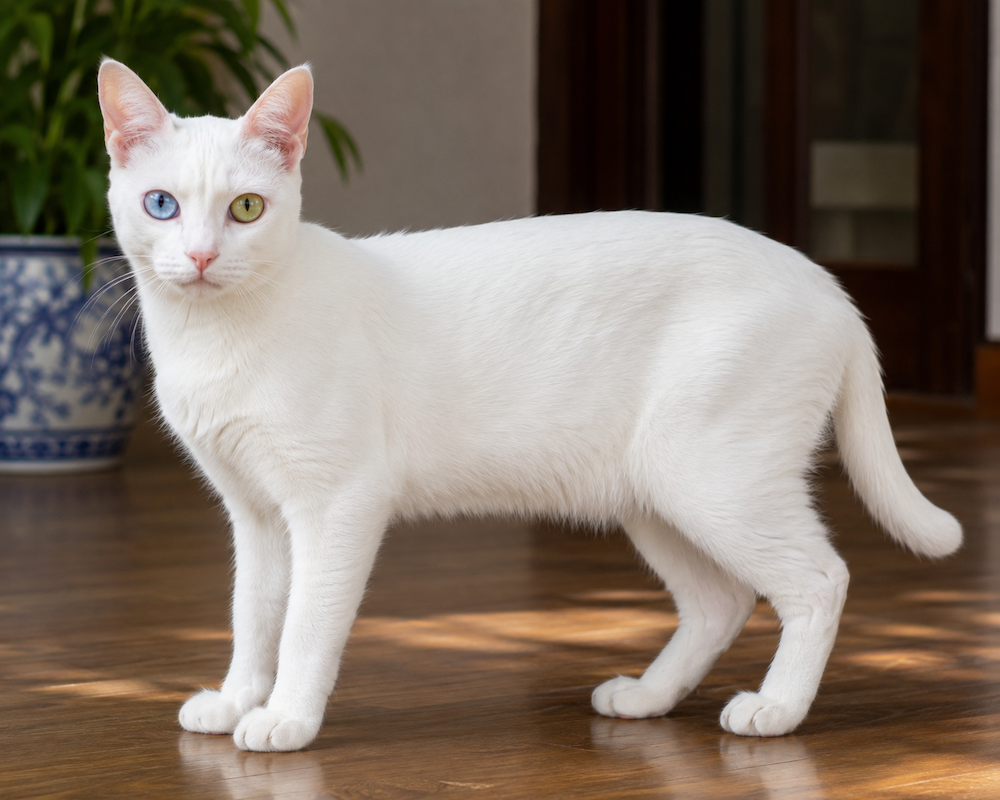






Brilliant white, jewel-eyed, and treasured in Thailand for centuries — the Khao Manee is an ancient natural cat breed famous for its dazzling coat, striking blue, gold or odd-coloured eyes, sociable personality, and long association with Thai royalty and good fortune
🧠 QUICK SNAPSHOT
- Temperament: Affectionate, intelligent, sociable
- Energy Level: Moderate to High
- Size: Medium
- Good With Families: Excellent
- Indoor Living: Excellent
- Trainability: High
- Grooming: Low
- Best For: Families, apartment living, interactive households, people wanting a highly social cat
- Typical Lifespan: Around 12–15 years
📚 OVERVIEW
The Khao Manee is an ancient natural cat breed from Thailand, where white cats of this type have been known for hundreds of years.
Its name is generally translated as “white gem”, an appropriate description for a cat with a pure white coat and brilliantly coloured eyes.
Khao Manees may have blue, gold, yellow-green or differently coloured eyes. Odd-eyed individuals — with one blue eye and one gold or greenish eye — are particularly famous and contribute to the breed’s almost jewel-like appearance.
Unlike long-haired white breeds, the Khao Manee has a short, smooth coat lying close to a lean but muscular body. The overall appearance should be athletic and natural rather than heavily exaggerated.
Its history is even more remarkable than its appearance.
White cats resembling the Khao Manee appear in Thailand’s historic cat manuscripts, and the breed became associated with prestige, prosperity, and the Thai royal household.
For centuries it remained little known outside its homeland. International breeding only began relatively recently, making the Khao Manee an ancient breed with a surprisingly modern global presence.
Personality is another major attraction. These cats are typically outgoing, playful, intelligent, and highly interested in their humans.
✅ PROS & CONS
Pros
- Extremely affectionate and sociable
- Intelligent and playful
- Excellent family companion
- Easy-care short coat
- Well suited to indoor living
- Fascinating ancient Thai history
- Spectacular eye colours
Cons
- Rare outside Thailand
- Can dislike being left alone for long periods
- Needs regular play and interaction
- White cats can be susceptible to deafness
- Not hypoallergenic
- Genuine pedigree kittens can be expensive and difficult to find
Is a Khao Manee a Good Family Cat?
Yes, the Khao Manee is generally an excellent family cat, especially for households wanting an interactive and people-oriented companion.
These cats tend to be confident, affectionate, and highly social. Rather than quietly observing family life from another room, many Khao Manees prefer being directly involved in whatever their humans are doing.
They can be excellent companions for respectful children who understand gentle handling and enjoy interactive play.
Khao Manees may also live successfully with other cats and cat-friendly dogs when introductions are handled properly. A compatible animal companion can be particularly valuable if human family members spend significant periods away from home.
Their sociability does have another side.
This isn’t necessarily the ideal breed for someone wanting a very independent cat that can routinely spend long days alone without interaction.
The Khao Manee tends to thrive when it receives companionship, play, mental stimulation, and affection.
For the right family, that can make it an exceptionally engaging companion.
Can a Khao Manee Live Indoors or in an Apartment?
Yes, the Khao Manee is very well suited to indoor and apartment living, provided its physical and mental needs are met.
A large house isn’t essential.
A stimulating environment is.
Cat trees, shelves, scratching posts, window perches, tunnels, puzzle feeders, and interactive toys can turn relatively limited floor space into an interesting feline territory.
Because Khao Manees are intelligent and active, daily interaction is important. Rotating toys and introducing new games can help prevent boredom.
Secure indoor living has additional benefits for a rare white cat. It protects against traffic, fights, theft, disease, and excessive sun exposure.
White cats have less protective pigment in their skin and can be more vulnerable to sun damage, particularly on sparsely haired areas such as the ears and nose.
A secure cat enclosure can provide outdoor stimulation while reducing many of these risks.
With enough enrichment and companionship, the Khao Manee can make an outstanding apartment cat.
How Much Exercise and Play Does a Khao Manee Need?
The Khao Manee has moderate-to-high exercise requirements and benefits from active play every day.
These are agile, curious cats that enjoy chasing, climbing, jumping, exploring, and investigating their surroundings.
Fishing-wand toys, balls, tunnels, toy mice, climbing structures, and games involving stalking and pouncing are excellent options.
Several shorter play sessions throughout the day usually work better than relying on one long session.
Mental stimulation is equally valuable.
Puzzle feeders, clicker training, treat hunts, rotating toys, and simple problem-solving games can help keep an intelligent Khao Manee occupied.
Many also enjoy interactive games directly involving their owners.
The objective isn’t simply to exhaust the cat physically.
It’s to satisfy its curiosity.
A bored Khao Manee is perfectly capable of finding something interesting to investigate without your assistance.
Unfortunately, the cat’s definition of “interesting” may include cupboards, shelves, bags, drawers, and anything you were hoping it wouldn’t notice.
Is a Khao Manee Easy to Train?
Yes, the Khao Manee is generally intelligent and highly trainable.
Positive reinforcement using treats, toys, praise, and clicker training tends to produce the best results.
Many can learn behaviours such as coming when called, sitting, retrieving toys, entering a carrier voluntarily, using designated scratching areas, or performing simple tricks.
Some may also adapt well to harness training.
Training is especially useful because it provides mental stimulation while strengthening communication between cat and owner.
Practical handling should begin during kittenhood. Nail trimming, dental checks, carrier travel, ear examination, and gentle body handling are much easier when introduced positively from an early age.
Punishment should be avoided. It can damage trust and doesn’t clearly communicate what behaviour is wanted instead.
The Khao Manee’s intelligence also means it quickly learns household routines.
You may train it to come when called.
It may simultaneously train you to provide treats whenever it does.
Does a Khao Manee Shed?
Yes, the Khao Manee sheds, but its short coat is very easy to maintain.
The coat should be smooth, close-lying, and pure white.
A gentle brushing approximately once a week is usually sufficient to remove loose hair and keep the coat looking glossy.
Seasonal changes may temporarily increase shedding.
Bathing is rarely necessary unless the cat becomes particularly dirty.
Routine grooming should also include nail trimming, dental care, and checks of the ears, eyes, skin, and body condition.
Because the coat is white, dirt, tear staining, and skin changes may be more noticeable than on darker cats.
The Khao Manee is not considered hypoallergenic.
Cat allergies are primarily caused by proteins produced in saliva and skin secretions, so having short hair — even very little shedding — does not eliminate allergens.
From a grooming perspective, however, this is one of the easier pedigree cats to maintain.
What Health Problems Are Common in a Khao Manee?
The Khao Manee is generally considered a relatively robust natural breed, but one health concern deserves particular attention: congenital deafness.
The genetic mechanisms responsible for white coats and blue eyes in cats can also be associated with abnormal development of structures within the inner ear.
This doesn’t mean every white or blue-eyed Khao Manee is deaf.
Many hear perfectly normally.
However, the risk is higher in white cats, particularly those with blue eyes. Odd-eyed cats can sometimes be deaf in the ear on the same side as the blue eye, although this is not inevitable.
Responsible breeders can use BAER testing (Brainstem Auditory Evoked Response) to objectively assess hearing.
White cats also need protection from excessive ultraviolet exposure because unpigmented skin is more vulnerable to sun damage and potentially squamous cell carcinoma.
Like other cats, Khao Manees can develop dental disease, kidney problems, urinary disorders, obesity, arthritis, and heart disease.
With responsible breeding and good lifelong care, many Khao Manees can live approximately 12–15 years or longer.
⭐ Is the Khao Manee Really an Ancient Thai Cat?
Yes. The Khao Manee’s history reaches back hundreds of years in Thailand.
Thailand has an extraordinary pedigree-cat heritage.
Historic manuscripts known collectively as the Tamra Maew, or Cat-Book Poems, describe and illustrate different types of Thai cats and the qualities traditionally associated with them.
White cats resembling the ancestors of today’s Khao Manee appear within this historic feline tradition.
For generations, these cats were known within Thailand but remained largely unknown to the international pedigree-cat community.
This creates an interesting contrast.
To many Western cat enthusiasts, the Khao Manee seems like a relatively new and exotic breed.
In Thailand, its story is much older.
The breed didn’t suddenly appear when international registries discovered it.
The rest of the world simply arrived very late to the party.
⭐ What Does “Khao Manee” Mean?
The name Khao Manee is commonly translated as “white gem” or “white jewel”.
It’s difficult to imagine a more appropriate name.
The brilliant white coat creates a striking background for the breed’s intensely coloured eyes, which may be blue, gold, yellow-green, or mismatched.
Odd-eyed cats can look particularly spectacular because each eye resembles a different gemstone.
The modern name also helps distinguish the breed internationally from other Thai cats.
Its appearance is deceptively simple.
There are no spots, dramatic stripes, curls, folded ears, or enormous coat.
Just a white cat with remarkable eyes.
Yet that simplicity is precisely what makes a well-bred Khao Manee so visually dramatic.
⭐ Why Do Some Khao Manees Have Two Different-Coloured Eyes?
Khao Manees can display heterochromia, meaning the two eyes have different colours.
The classic combination is one blue eye and one gold, yellow or greenish eye.
This occurs because eye colour depends partly on the amount and distribution of melanin, the pigment responsible for colour in the eyes, skin, and hair.
The genetic processes that create a completely white coat can interfere with pigment cells during development.
If pigment develops differently between the two eyes, one may remain blue while the other develops a more pigmented colour.
The result is spectacular, but heterochromia itself doesn’t mean something is wrong with the cat.
It also isn’t unique to the Khao Manee.
What makes it so memorable in this breed is the combination of pure white coat and contrasting jewel-like eyes.
⭐ Are All Khao Manees Born Pure White?
Khao Manees are known as white cats, but there is a fascinating exception.
Some kittens can be born with a small darker patch of colour on the head.
This may look surprising in a breed defined by its brilliant white appearance.
The patch can gradually fade as the kitten matures and may disappear completely.
Similar temporary head markings can occur in other genetically white cats.
This is useful for owners to know because a tiny patch on a young kitten doesn’t necessarily mean it cannot develop into the classic all-white adult appearance.
Genetics sometimes leaves a little temporary clue to the colour that has effectively been hidden beneath the dominant white coat.
⭐ Were Khao Manees Really Royal Cats?
The Khao Manee has a long-standing association with Thai royalty, prestige, prosperity, and good fortune.
The breed is frequently linked particularly with the royal court during the reign of King Chulalongkorn, Rama V, who ruled Siam from 1868 to 1910.
Stories surrounding royal Thai cats can sometimes become mixed with legend, so claims that particular cats were exclusively reserved for kings should be treated cautiously unless well documented.
What is clear is that distinctive Thai cats were culturally significant and valued long before modern Western pedigree registries became involved.
The Khao Manee therefore represents more than an attractive coat and eye colour.
It belongs to a much older Thai tradition in which different cats could be associated with luck, wealth, status, and desirable qualities.
Few modern cat breeds arrive with quite that much cultural baggage.
⭐ Is the Khao Manee the Same as a White Siamese?
No.
Although both breeds come from Thailand, the Khao Manee and Siamese are distinct native Thai cat types.
A Siamese has the famous colourpoint pattern, with darker colouring concentrated on cooler parts of the body such as the face, ears, paws, and tail.
A Khao Manee should appear white.
Their traditional body types and historical breed identities also differ.
The confusion is understandable because Thailand — formerly known internationally as Siam — gave the world several remarkable native cat populations.
These include ancestors of breeds now known as the Siamese, Korat and Khao Manee.
Rather than thinking of Thailand as producing one famous cat, it is more accurate to think of the country as possessing an unusually rich feline genetic and cultural heritage.
⭐ Are Khao Manees Really Worth Thousands of Dollars?
They can be expensive, particularly outside Thailand.
International headlines have occasionally described the Khao Manee as one of the world’s most expensive cat breeds, with dramatic prices quoted for rare kittens.
Those figures should be treated cautiously.
There is no single official “Khao Manee price”, and actual cost depends on location, pedigree, breeder reputation, health testing, availability, and whether the cat is intended as a companion, show animal, or breeding cat.
What genuinely drives the price is rarity.
The international breeding population remains relatively small, while demand is increased by the breed’s unusual appearance and fascinating history.
Prospective owners should therefore focus less on finding the cheapest kitten and more on verifying pedigree, hearing testing, health practices, and breeder credibility.
With a rare breed, paying a premium for excellent breeding is one thing.
Paying a premium for an ordinary white domestic cat being advertised under an exotic name is something entirely different.
⭐ Why Did the Khao Manee Take So Long to Reach the Rest of the World?
For much of its history, the Khao Manee remained primarily a Thai cat.
Other Thai breeds became established internationally much earlier. Siamese cats, for example, were already creating enormous interest in Europe during the late 19th century.
The Khao Manee largely stayed behind.
International development began much later, particularly when breeders started importing foundation cats from Thailand around the end of the 20th century.
Recognition by major cat organisations followed gradually.
As a result, the breed presents an unusual combination:
centuries of history but only decades of widespread international awareness.
That also helps explain why the Khao Manee remains rare today.
It isn’t a newly invented designer breed trying to establish a history.
It is an old cat that the international pedigree world only relatively recently began to appreciate.