





Powerful, playful, and famous for a naturally unique pom-pom tail — the Kurilian Bobtail is a rare natural cat from the Russian Far East, shaped by generations of island life and known for its remarkable jumping ability, hunting instincts, intelligence, and surprisingly gentle family personality.
🧠 QUICK SNAPSHOT
- Temperament: Intelligent, affectionate, confident
- Energy Level: Moderate to High
- Size: Medium to Large
- Good With Families: Excellent
- Indoor Living: Very Good with sufficient enrichment
- Trainability: High
- Grooming: Low to Moderate
- Best For: Families, active households, multi-pet homes, interactive owners
- Typical Lifespan: Around 12–17 years
📚 OVERVIEW
The Kurilian Bobtail is a rare natural cat breed originating from the Kuril Islands and surrounding areas of the Russian Far East.
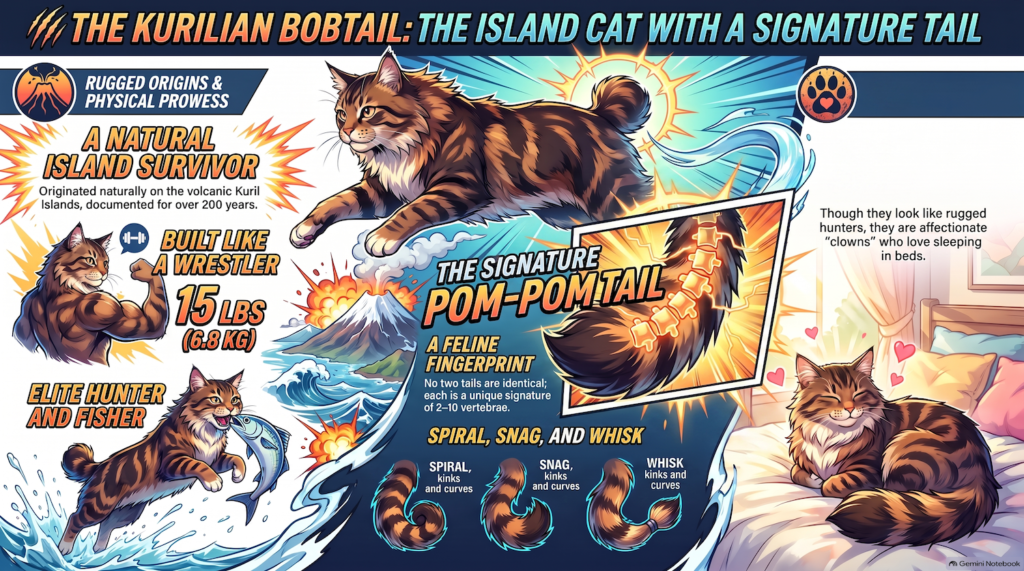
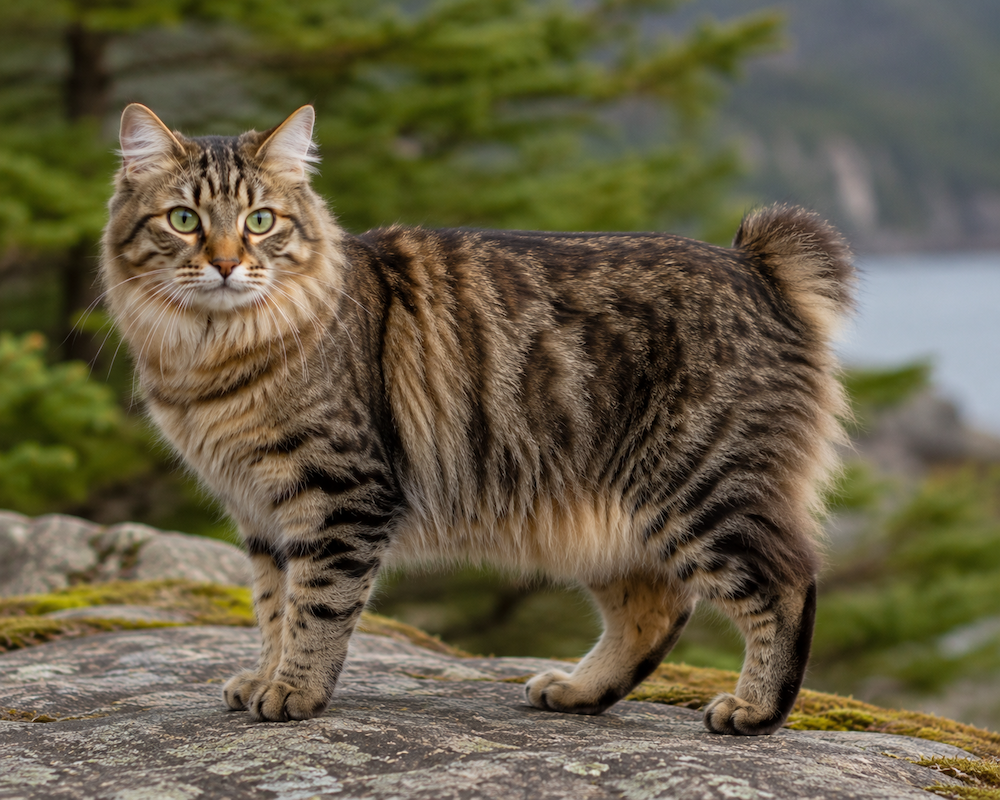
Its most famous feature is its naturally shortened tail. Rather than forming one standard shape, the tail contains different combinations of bends, curves and kinks covered in fur, creating a distinctive pom-pom appearance.
In fact, individual tails can be so different that they are often compared with fingerprints.
The Kurilian Bobtail wasn’t originally created by breeders trying to produce an unusual-looking cat. Bobtailed cats developed naturally within relatively isolated populations before eventually attracting the attention of cat breeders.
These are substantial, muscular cats with powerful hind legs. Their physical strength reflects their reputation as capable hunters and agile climbers.
Both short-haired and semi-long-haired varieties exist.
Despite the rugged appearance, Kurilian Bobtails are typically affectionate, intelligent and strongly attached to their families. Many are confident rather than nervous and enjoy being directly involved in household life.
The breed remains relatively uncommon outside Russia and parts of Europe, making it one of the more unusual natural bobtail breeds.
✅ PROS & CONS
Pros
- Affectionate and family-oriented
- Intelligent and trainable
- Strong, athletic build
- Playful and interactive
- Distinctive naturally bobbed tail
- Often adapts well to other pets
- Generally straightforward grooming
Cons
- Rare in many countries
- Strong hunting instincts
- Needs plenty of exercise and enrichment
- May not suit homes with small prey animals
- Semi-long-haired cats need additional grooming
- Not hypoallergenic
Is a Kurilian Bobtail a Good Family Cat?
Yes, the Kurilian Bobtail is generally an excellent family cat, particularly for households wanting an affectionate but active companion.
These cats tend to form strong relationships with their humans and are often described as loyal, sociable and confident.
Many enjoy being close to family members without constantly demanding to be carried or held.
Kurilian Bobtails can do very well with respectful children, especially children who enjoy interactive play. Their strong, muscular bodies make them relatively sturdy cats, although gentle handling should still be taught.
They can also live successfully with compatible cats and cat-friendly dogs when introductions are managed properly.
Small animals require greater caution. The Kurilian Bobtail’s history as an effective hunter means birds, rodents and similar pets may trigger a strong prey response.
For an active family willing to provide exercise, companionship and enrichment, the Kurilian Bobtail offers an appealing combination of independence and affection.
Can a Kurilian Bobtail Live Indoors or in an Apartment?
Yes, a Kurilian Bobtail can live successfully indoors or in an apartment, provided the home gives it enough opportunities for exercise and exploration.
These are powerful, athletic cats.
Tall, sturdy cat trees are particularly useful, along with shelves, scratching towers, tunnels, window perches and other forms of vertical territory.
Interactive play should be part of everyday life.
Because Kurilian Bobtails are intelligent and naturally curious, puzzle feeders, treat hunts and rotating toys can also help keep them mentally stimulated.
A secure cat enclosure can provide additional outdoor experiences while protecting the cat from traffic, fights, disease and other hazards.
Apartment size itself isn’t necessarily the problem.
A small but well-designed home can provide considerably more useful feline territory than a large house with nothing to climb or investigate.
The Kurilian Bobtail needs a home that lets it behave like an athletic cat — not simply somewhere to put its food bowl.
How Much Exercise and Play Does a Kurilian Bobtail Need?
The Kurilian Bobtail has moderate-to-high exercise requirements and should receive active play every day.
Fishing-wand toys, balls, tunnels, climbing structures and toys that mimic prey can all help satisfy its natural hunting behaviours.
Several shorter play sessions spread throughout the day generally work well.
These cats are also excellent jumpers, thanks partly to their particularly strong hindquarters. Providing safe opportunities to climb and leap can help keep them physically fit.
Mental exercise is equally important.
Puzzle feeders, scent games, clicker training, retrieving games and hidden treats can challenge an intelligent Kurilian Bobtail.
The breed’s natural hunting ability means games involving searching, stalking and pouncing can be especially rewarding.
Don’t be fooled by the stocky appearance.
Underneath that coat is a surprisingly capable feline athlete.
Is a Kurilian Bobtail Easy to Train?
Yes, the Kurilian Bobtail is generally intelligent and highly trainable.
Positive reinforcement using treats, praise, toys and clicker training can be very effective.
Many can learn to come when called, retrieve toys, enter a carrier voluntarily, use designated scratching areas and perform simple tricks.
Some owners describe the breed as almost dog-like because of its combination of trainability, confidence and attachment to people.
That comparison shouldn’t be taken too literally — this is still very much a cat with its own opinions.
Training should remain short, rewarding and interesting.
Practical behaviours are particularly valuable. Teaching a kitten to accept nail trimming, grooming, dental checks, carrier travel and veterinary handling can make lifelong care considerably easier.
Their intelligence also means Kurilian Bobtails quickly learn household routines.
If opening one particular cupboard produces treats, don’t expect that information to remain confidential.
Does a Kurilian Bobtail Shed?
Yes, the Kurilian Bobtail sheds, although grooming requirements depend partly on coat length.
The breed occurs in both short-haired and semi-long-haired varieties.
Short-haired cats usually require brushing around once a week to remove loose hair and maintain coat condition.
Semi-long-haired Kurilian Bobtails generally benefit from brushing several times a week, particularly during seasonal shedding periods.
Their coats developed in a region known for challenging weather conditions, so they can be relatively substantial and weather-resistant.
Despite the breed’s wild appearance, complicated professional grooming isn’t normally necessary.
Routine care should also include nail trimming, dental maintenance and regular checks of the ears, eyes, skin and body condition.
The Kurilian Bobtail is not hypoallergenic. Cat allergies are primarily triggered by proteins found in saliva and skin secretions rather than simply the amount or length of fur.
What Health Problems Are Common in a Kurilian Bobtail?
The Kurilian Bobtail is generally regarded as a robust natural breed, but breed-specific health research is relatively limited compared with more common pedigree cats.
Importantly, its bobbed tail developed through a different genetic history from the tailless mutation associated with the Manx and Cymric.
The Kurilian Bobtail is not generally associated with the characteristic spinal disorder known as Manx syndrome.
That doesn’t mean the breed is immune to inherited or acquired disease.
Because international pedigree populations can be relatively small, responsible breeders should pay close attention to genetic diversity, sound skeletal structure and the health history of breeding lines.
Like other cats, Kurilian Bobtails can develop dental disease, kidney disease, urinary disorders, obesity, arthritis and heart conditions.
Their muscular appearance can also make appropriate weight assessment important. A healthy Kurilian should be substantial and powerful, not simply overweight.
With responsible breeding, good nutrition, exercise and veterinary care, many Kurilian Bobtails can live approximately 12–17 years.
⭐ Where Does the Kurilian Bobtail Come From?
The Kurilian Bobtail is associated primarily with the Kuril Islands, a chain of volcanic islands stretching between Russia’s Kamchatka Peninsula and the Japanese island of Hokkaido.
Bobtailed cats have reportedly lived in this geographically isolated region for generations.
They were also found on nearby Russian territories including Sakhalin Island.
Rather than being deliberately created through a modern crossbreeding program, the characteristic bobtail became established naturally within local cat populations.
Russian breeders began taking greater interest in these cats during the late 20th century, eventually developing breed standards and organised breeding programs.
The breed later spread into mainland Russia and other European countries.
Its international population, however, remains comparatively small.
The Kurilian Bobtail is therefore a genuine example of people discovering an unusual natural cat population and turning it into a recognised pedigree breed — rather than designing the cat first and inventing a breed around it.
⭐ Is Every Kurilian Bobtail’s Tail Different?
Pretty much — and that is one of the breed’s most fascinating characteristics.
The Kurilian Bobtail’s shortened tail contains a variable combination of vertebral bends, curves, kinks and angles.
When covered by fur, this creates the characteristic pom-pom appearance.
Because the underlying skeletal arrangement varies between cats, individual tails can look remarkably different.
Breed descriptions have even used colourful names for different tail configurations, comparing them with shapes such as a spiral, whisk or snag.
The tail is therefore not supposed to resemble a perfectly standardised little ball attached to every cat.
Its individuality is part of the breed.
Two Kurilian Bobtails standing side by side may have very similar bodies and colouring while carrying completely different tails.
It’s effectively a feline signature growing out of the cat’s backside.
⭐ Is the Kurilian Bobtail Related to the Japanese Bobtail?
The obvious answer might seem to be yes.
After all, both breeds come from geographically neighbouring parts of East Asia and both have naturally shortened tails.
The actual relationship is far less straightforward.
The Kuril Islands stretch towards northern Japan, and cats have moved with people throughout this region for centuries. Historical genetic connections between regional cat populations are therefore entirely plausible.
However, the modern Kurilian Bobtail and Japanese Bobtail are recognised as distinct breeds with different body types and characteristic tail structures.
The Japanese Bobtail tends to be more slender and elegant.
The Kurilian Bobtail is generally heavier, more muscular and more rugged in appearance.
Their tails can also differ structurally.
So while geography makes comparisons inevitable, a Kurilian Bobtail shouldn’t simply be described as a large Russian version of the Japanese Bobtail.
Each has developed its own identity.
⭐ Can Kurilian Bobtails Really Catch Fish?
Kurilian Bobtails have developed a reputation as exceptionally capable hunters, and stories from their native region frequently describe them catching rodents and even fish.
Some accounts portray them as cats comfortable around rivers and shorelines and willing to enter shallow water in pursuit of prey.
The breed’s powerful build, strong hindquarters and natural hunting drive certainly make the reputation believable.
However, claims that every Kurilian Bobtail is an enthusiastic fisherman should be treated as breed folklore rather than a guaranteed behaviour.
Individual cats vary enormously.
Some may be fascinated by running water.
Others may respond to the suggestion of swimming exactly as you’d expect from a conventional cat.
What is much more certain is that the breed retains a strong predatory instinct.
Whether the target is a fish, mouse or feather toy attached to a stick, a Kurilian Bobtail tends to take hunting games seriously.
⭐ Why Does the Kurilian Bobtail Have Such Powerful Back Legs?
One of the breed’s characteristic physical features is its strong, muscular hindquarters.
The rear legs are typically slightly longer than the front legs, contributing to the Kurilian Bobtail’s impressive ability to jump.
This makes vertical territory especially important in the home.
A substantial cat tree, high shelves and secure climbing areas give the cat appropriate places to use its natural athleticism.
The powerful rear body also contributes to the breed’s distinctive stance and rugged appearance.
Owners shouldn’t confuse the Kurilian’s muscular physique with clumsiness.
These cats can be remarkably agile.
Putting something fragile on a high shelf because “the cat can’t possibly get up there” may therefore prove to be an expensive experiment.
⭐ Do Kurilian Bobtails Really Like Water?
Many Kurilian Bobtails are reputed to be less reluctant around water than the stereotypical domestic cat.
This is often connected with stories about their island origins and fishing abilities.
Some individuals may investigate taps, paw at water, play around sinks or show unusual curiosity about baths and showers.
But there is no rule saying every Kurilian Bobtail will love water.
Breed tendencies never override individual personality.
A cat should never be forced to swim simply because its breed has a reputation for enjoying water.
For a Kurilian that genuinely likes it, however, a drinking fountain or supervised shallow-water play can provide interesting enrichment.
Just be prepared for the possibility that the cat’s idea of water enrichment involves removing most of the water from the bowl and transferring it to your floor.
⭐ Is the Kurilian Bobtail’s Tail Docked?
No. A genuine Kurilian Bobtail is born with its shortened tail.
The tail is the result of inherited genetics and natural skeletal development.
It isn’t surgically shortened to create the breed’s appearance.
This is an important distinction because docking is sometimes assumed when people first encounter an unfamiliar bobtailed breed.
Kittens can be born with different tail lengths and configurations because expression of the trait varies.
Responsible breeders assess the health and structure of each kitten rather than simply trying to produce the shortest possible tail.
The goal should always be a healthy, functional cat.
The Kurilian’s pom-pom tail may be its most recognisable feature.
But it should never be more important than the animal attached to it.
⭐ Why Is the Kurilian Bobtail Still So Rare?
The Kurilian Bobtail spent most of its history as a regional natural cat population rather than an internationally marketed pedigree breed.
Formal development came relatively late.
Although the breed became established in Russia and gained recognition through several international feline organisations, it never developed the enormous global breeder network associated with breeds such as the Maine Coon, British Shorthair or Ragdoll.
That makes genuine Kurilian Bobtails difficult to find in many countries.
Their ordinary coat colours can also make identification confusing.
A domestic cat with a naturally short tail isn’t automatically a Kurilian Bobtail.
Without documented ancestry, appearance alone can’t establish pedigree breed identity.
That is particularly important when buying a rare cat.
The tail may catch your attention.
The pedigree tells you whether it’s actually a Kurilian Bobtail.