




Silver-blue, emerald-eyed, and considered a symbol of good fortune in Thailand for centuries — the Korat is an ancient natural cat breed with a distinctive heart-shaped face, remarkable intelligence, powerful attachment to its family, and a history preserved in some of the world's oldest writings about cats.
🧠 QUICK SNAPSHOT
- Temperament: Affectionate, intelligent, loyal
- Energy Level: Moderate to High
- Size: Small to Medium
- Good With Families: Very Good
- Indoor Living: Excellent
- Trainability: High
- Grooming: Low
- Best For: Interactive families, apartment living, quieter households, owners wanting a strongly bonded companion
- Typical Lifespan: Around 12–16 years
📚 OVERVIEW
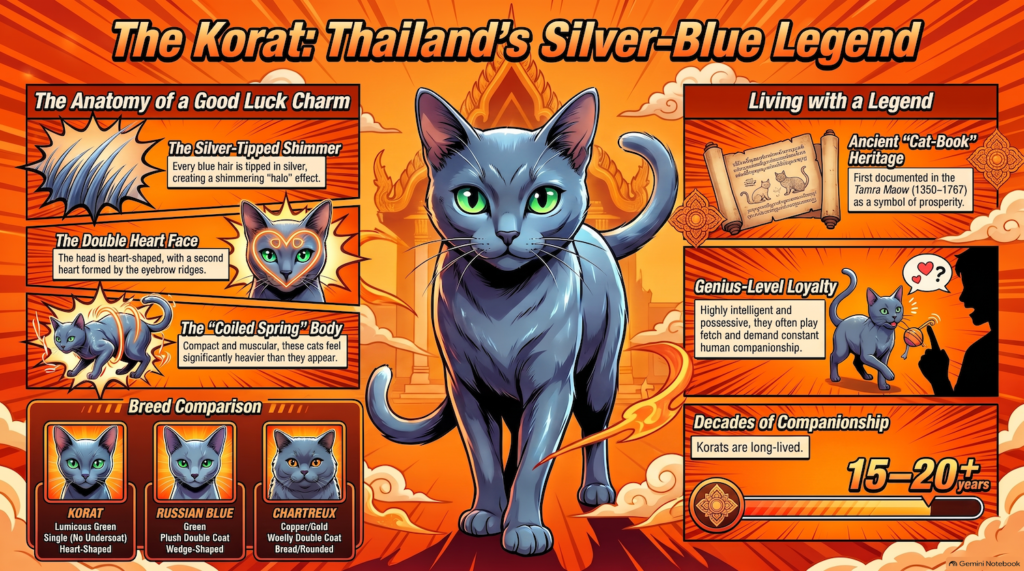
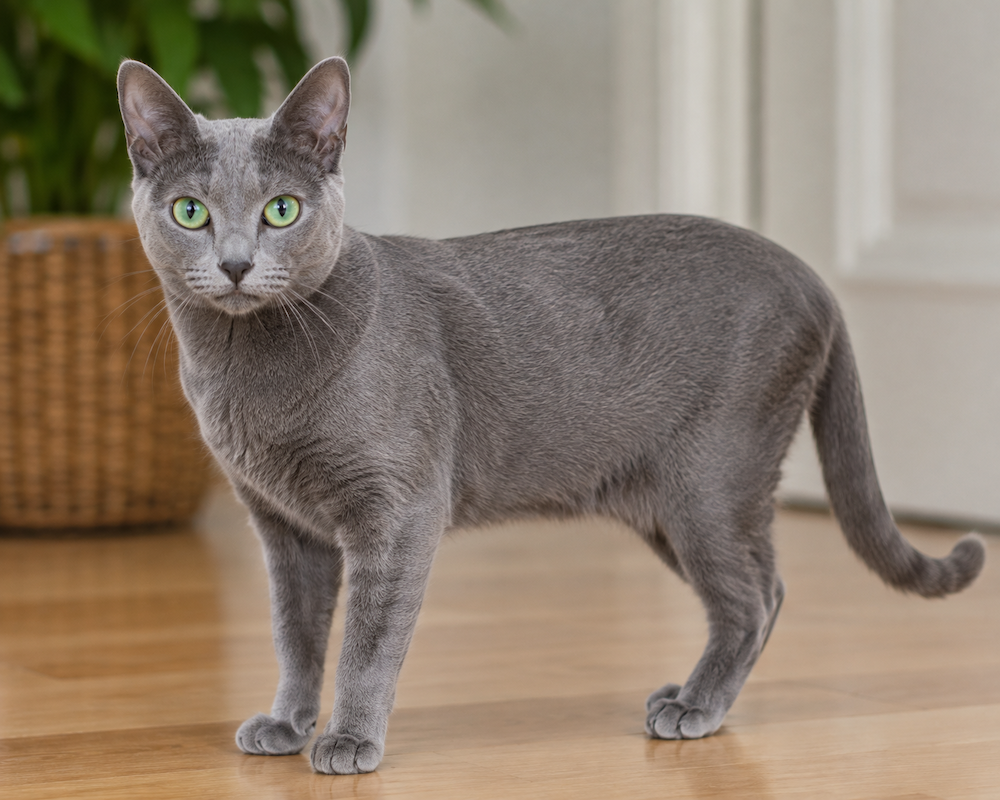
The Korat is an ancient natural breed from Thailand, instantly recognisable by its silver-tipped blue coat, luminous green eyes and characteristic heart-shaped head.
In Thailand, the breed is traditionally known as Si-Sawat, and it has been associated with prosperity, good fortune and happiness for centuries.
Unlike many modern pedigree breeds, the Korat wasn’t created by crossing other cats to achieve a particular appearance. Cats resembling today’s Korat appear in Thailand’s historic Tamra Maew, or Cat-Book Poems, demonstrating the breed’s remarkably long cultural history.
The Korat’s coat is particularly distinctive. Each blue-grey hair becomes lighter towards the tip, producing a silver sheen that can appear to shimmer as the cat moves.
Underneath that elegant exterior is a surprisingly muscular body. Korats often feel heavier than expected when picked up.
Personality is equally distinctive. They tend to be intelligent, playful, confident and extremely devoted to their people. Many want to know exactly what their humans are doing and aren’t shy about requesting attention.
The Korat remains comparatively uncommon internationally, partly because breeders have traditionally worked to preserve its natural Thai characteristics rather than radically altering its appearance.
✅ PROS & CONS
Pros
- Extremely affectionate and loyal
- Highly intelligent
- Easy-care short coat
- Excellent indoor companion
- Playful and interactive
- Fascinating ancient history
- Generally long-lived
Cons
- Can be demanding of attention
- May dislike being left alone for long periods
- Can be sensitive to noisy or chaotic environments
- Rare in many countries
- Serious inherited GM1 and GM2 gangliosidosis must be screened for
- Not hypoallergenic
Is a Korat a Good Family Cat?
Yes, the Korat can be an excellent family cat, particularly for households wanting a close relationship with their pet.
These cats often form exceptionally strong bonds with their humans. A Korat may follow family members from room to room, supervise household activities and actively seek interaction.
They can live happily with respectful children, especially children who enjoy playing with an intelligent, energetic cat rather than constantly carrying it.
Korats may also live successfully with compatible cats and cat-friendly dogs when introduced properly.
However, this isn’t always the most relaxed breed around constant chaos. Some Korats prefer predictable households and can be sensitive to excessive noise or disruption.
They may also dislike being ignored for long periods.
For families wanting a relatively independent cat that appears occasionally for dinner, the Korat may be too involved.
For people who want a cat that genuinely seems to consider itself part of the family decision-making process, it can be an outstanding companion.
Can a Korat Live Indoors or in an Apartment?
Yes, the Korat is very well suited to indoor and apartment living.
Its moderate size means an enormous property isn’t necessary, but environmental enrichment remains important.
Cat trees, scratching posts, shelves, tunnels, window perches and interactive toys can make relatively limited floor space much more interesting.
Korats are intelligent and observant, so puzzle feeders and toys requiring problem-solving can be particularly useful.
Secure indoor living also protects cats from traffic, fights, infectious diseases, poisoning and other outdoor dangers.
A secure cat enclosure can provide additional sensory stimulation where practical.
Apartment owners should consider the Korat’s strong attachment to people. A cat left completely alone for very long periods every day may become bored or unhappy.
The best apartment isn’t necessarily the biggest one.
For a Korat, a smaller home containing people, play and interesting things to investigate can be considerably better than a huge empty house.
How Much Exercise and Play Does a Korat Need?
The Korat has moderate-to-high exercise requirements and should have opportunities for active play every day.
Despite its refined appearance, this is a muscular and athletic cat.
Fishing-wand toys, balls, tunnels, climbing towers and chasing games can all provide useful physical exercise.
Several shorter sessions throughout the day generally work well.
Mental exercise is just as important.
Korats are intelligent cats that can enjoy puzzle feeders, clicker training, treat hunts, retrieving games and activities requiring them to solve simple problems.
Many remain playful well into adulthood.
Owners should also provide opportunities to climb and observe their surroundings from elevated positions.
Without enough interaction, an intelligent Korat can become bored.
And an intelligent bored cat rarely concludes that the best solution is simply to sit quietly and wait.
Is a Korat Easy to Train?
Yes, the Korat is generally highly intelligent and trainable.
Positive reinforcement using treats, toys, praise and clicker training tends to work extremely well.
Korats can learn to come when called, retrieve toys, enter a carrier voluntarily, use appropriate scratching areas and perform simple tricks.
Some can also learn harness walking.
Training provides mental stimulation as well as practical benefits.
Owners should introduce nail trimming, dental checks, carrier travel and gentle body handling during kittenhood.
Short and rewarding sessions work better than repetitive drills.
Punishment should be avoided because it can damage the close relationship these cats tend to develop with their humans.
There’s another consequence of Korat intelligence.
They learn routines extremely quickly.
You may teach your Korat to sit for a treat.
Your Korat may teach you that sitting beside the treat cupboard should produce exactly the same result.
Does a Korat Shed?
Yes, but the Korat is generally a relatively low-maintenance shedding breed.
One reason is its unusual coat structure.
The Korat typically has a single coat rather than a heavy double coat, so there is less undercoat to shed and maintain.
A gentle brushing approximately once a week is normally sufficient to remove loose hair and keep the coat glossy.
The coat should be short, close-lying and smooth.
Bathing is rarely necessary unless there is a specific reason.
Routine care should also include nail trimming, dental maintenance and regular checks of the ears, eyes, skin and body condition.
Despite sometimes shedding less noticeably than heavily coated cats, the Korat is not hypoallergenic.
Cat allergies are primarily caused by proteins produced in saliva and skin secretions rather than simply by fur.
For people wanting a straightforward coat to maintain, however, the Korat scores extremely well.
What Health Problems Are Common in a Korat?
The Korat is generally a robust natural breed, but there is one particularly important inherited health concern: gangliosidosis.
Korats can inherit GM1 or GM2 gangliosidosis, rare genetic disorders in which particular substances accumulate abnormally within cells, especially nerve cells.
Affected kittens can develop progressive neurological symptoms including tremors, loss of coordination, weakness and other serious problems.
These conditions are ultimately fatal.
Fortunately, genetic testing allows responsible breeders to identify carriers and plan matings so affected kittens are not produced.
This makes breeder health testing especially important when purchasing a Korat.
The breed can also experience health conditions affecting cats generally, including dental disease, kidney disease, urinary problems, obesity, arthritis and heart disease.
Because the international Korat population is relatively small, maintaining genetic diversity is also important.
With responsible breeding, appropriate nutrition, exercise and veterinary care, many Korats can live around 12–16 years or longer.
⭐ Is the Korat Really One of the World’s Oldest Cat Breeds?
The Korat is certainly one of the world’s oldest documented natural cat types.
Cats resembling the modern Korat appear in Thailand’s historic Tamra Maew, a collection commonly known in English as the Cat-Book Poems.
These manuscripts describe various Thai cats and the qualities traditionally associated with them.
The Korat’s ancestors were therefore being recognised as a distinctive type centuries before modern cat shows and pedigree registries existed.
That doesn’t mean today’s pedigree Korat has an uninterrupted written family tree extending back hundreds of years.
Rather, the traditional Thai cat population from which the breed developed has an exceptionally long documented history.
The distinction matters.
The Korat isn’t a modern cat designed to resemble something ancient.
It is a modern pedigree representation of a cat type that was already famous long before pedigree cats became fashionable.
⭐ Why Is the Korat Considered a Lucky Cat?
In Thailand, the Korat has traditionally been associated with good fortune, prosperity and abundance.
Its appearance may have helped inspire some of these associations.
The silver-blue coat has been compared with rain clouds, while the shimmering silver tips have been associated with wealth.
Its eye colour has also traditionally attracted poetic comparisons.
The breed’s connection with prosperity became strong enough that Korats were historically valued as meaningful gifts.
They were particularly associated with important occasions such as weddings.
This is where the Korat differs from simply owning an expensive cat.
Traditionally, its significance came partly from being given.
The animal represented a wish for happiness and prosperity in the recipient’s future.
That’s considerably more romantic than arriving at a wedding with another toaster.
⭐ Were Korats Traditionally Given as Wedding Gifts?
Yes. One of the most charming traditions associated with the Korat involves giving the cats to newly married couples as symbols of good fortune.
Pairs of Korats have been associated with wishes for a prosperous and happy marriage.
The tradition reflects the breed’s broader cultural status in Thailand as an auspicious animal.
This also helps explain why Korats were historically regarded differently from ordinary commodities.
A lucky cat received as a meaningful gift carries a different cultural significance from one simply purchased because its coat matches the furniture.
The association survives today as one of the most memorable pieces of Korat history.
Whether owning two highly intelligent cats actually guarantees a peaceful marriage is something the ancient manuscripts appear to have left unresolved.
⭐ Why Does the Korat Look Silver When Its Coat Is Actually Blue?
The Korat’s coat is technically described as blue, the feline term for a diluted grey colour.
But each hair has a lighter, silvery tip.
When thousands of these hairs catch the light together, the coat develops a distinctive silver halo or shimmering effect.
The effect can be especially noticeable around the face and legs.
Unlike breeds that occur in numerous colours and patterns, the Korat is defined by this characteristic silver-blue appearance.
The coat is also relatively close-lying, allowing the sheen to emphasise the cat’s muscular body.
It creates an interesting optical effect.
Standing still, the Korat may appear soft grey-blue.
When it moves through bright light, the same coat can suddenly seem almost metallic.
⭐ Why Does the Korat Have a Heart-Shaped Face?
A characteristic Korat head viewed from the front is often described as heart-shaped.
The broad forehead forms the upper part of the heart, while the facial structure narrows towards the chin.
Some breed enthusiasts even describe additional heart shapes created by features around the nose and chest.
Combined with enormous luminous green eyes, the head shape gives the Korat a particularly distinctive expression.
The heart symbolism also fits rather conveniently with a breed traditionally associated with weddings and good fortune.
Importantly, the head shouldn’t look artificially extreme.
The Korat developed as a natural breed, and preserving its traditional proportions is part of maintaining its identity.
⭐ Are Korat Kittens Born With Green Eyes?
Not usually.
One of the Korat’s most beautiful characteristics takes time to develop.
Kittens may initially have blue-toned eyes, as many kittens do. The eyes then typically transition through amber or yellowish shades before developing the brilliant green associated with mature Korats.
Full eye colour may take several years to reach its most intense expression.
This means a young Korat shouldn’t necessarily be judged by the same emerald eye colour expected from a mature adult.
The silver-blue coat and green eyes eventually create one of the most distinctive colour combinations in the cat world.
But nature doesn’t deliver the complete finished product on day one.
⭐ Is the Korat the Same as a Russian Blue?
No. The Korat and Russian Blue may both have blue-grey coats and green eyes, but they are separate breeds with very different histories and physical characteristics.
The Korat comes from Thailand and has a muscular, compact body, heart-shaped head and silver-tipped coat.
The Russian Blue is historically associated with Russia and generally has a more elongated, elegant body and a dense plush double coat.
Their coats also feel different.
The Korat has a close-lying single coat, whereas the Russian Blue’s dense double coat can feel remarkably plush.
The resemblance is strong enough that people unfamiliar with the breeds can easily confuse them.
But put good examples side by side and the differences become much clearer.
One is a silver-blue treasure from Thailand.
The other is a plush blue aristocrat associated with northern Europe.
⭐ Is the Korat Related to the Siamese and Khao Manee?
The Korat, Siamese and Khao Manee all belong to Thailand’s remarkable native feline heritage, but they represent distinct traditional cat types.
Thailand has one of the richest documented cat cultures in the world.
The traditional Siamese, known as the Wichien Maat, became internationally famous much earlier.
The Khao Manee is recognised for its brilliant white coat and often spectacular eye colours.
The Korat is the silver-blue lucky cat traditionally known as Si-Sawat.
Rather than viewing these as modern colour variations of one breed, it is better to think of them as different native Thai populations that people valued for their own appearances and cultural associations.
The popularity of the Siamese sometimes overshadows this broader history.
Thailand didn’t give the world just one extraordinary cat breed.
It gave us several.
⭐ Why Are Genuine Korats Still Relatively Rare?
The Korat has never been bred internationally on the enormous scale of cats such as the British Shorthair, Maine Coon or Ragdoll.
Breeders have also traditionally placed considerable emphasis on preserving the breed’s Thai identity and characteristic appearance.
Because the pedigree population is comparatively small, careful breeding and genetic diversity are important.
The breed’s appearance can create another problem.
An ordinary blue-grey domestic cat may superficially resemble a Korat.
Colour alone doesn’t make a cat a Korat.
A genuine pedigree Korat comes from documented Korat breeding lines and should display the characteristic combination of body type, head shape, coat structure, silver tipping and mature green eyes.
If someone simply finds a beautiful grey cat and declares it a Korat, the odds are strongly against it.
Sometimes pedigree is what separates an extremely rare Thai treasure from a perfectly lovely grey cat.