





Curly-coated, affectionate, and born from a completely spontaneous mutation — the LaPerm began with an unexpectedly bald kitten on an Oregon farm and developed into one of the cat world's most distinctive rex breeds, famous for its soft curls, people-loving personality, and remarkable variety of coats.
🧠 QUICK SNAPSHOT
- Temperament: Affectionate, intelligent, curious
- Energy Level: Moderate to High
- Size: Small to Medium
- Good With Families: Excellent
- Indoor Living: Excellent
- Trainability: High
- Grooming: Low to Moderate
- Best For: Families, apartment living, interactive households, owners wanting an affectionate companion
- Typical Lifespan: Around 12–16 years
📚 OVERVIEW
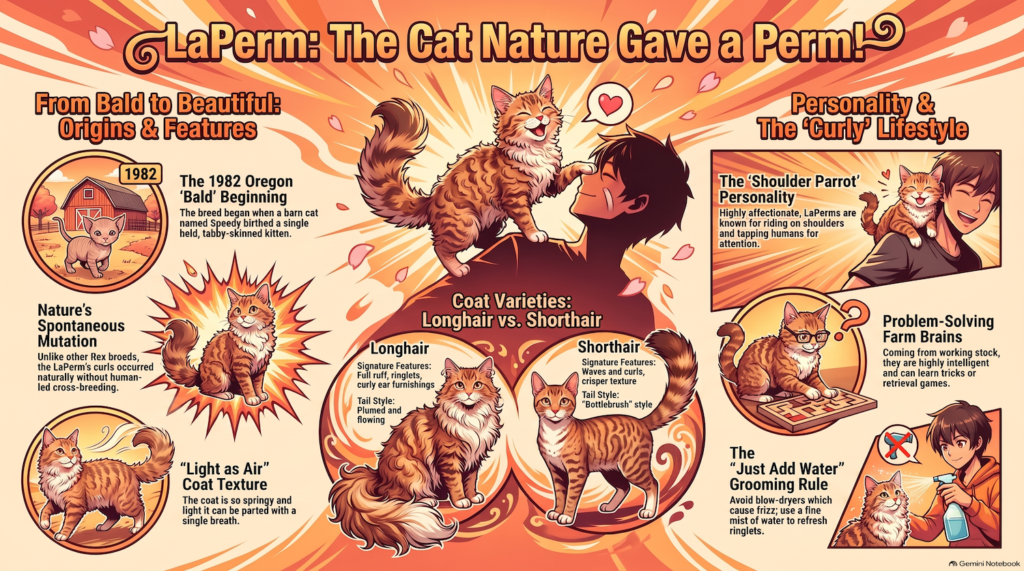
The LaPerm is one of the more remarkable modern cat breeds because its story began completely by accident.
In 1982, an apparently ordinary barn cat on a farm in Oregon, USA, gave birth to a litter that included an unusual female kitten. Unlike her siblings, the kitten was almost completely bald.
Her owners weren’t attempting to create a new breed.
Then something unexpected happened.
The kitten eventually grew a soft, curly coat.
She was appropriately named Curly.
Curly later produced kittens with the same unusual coat, demonstrating that the characteristic could be inherited. Over time, breeder Linda Koehl began developing these cats into what eventually became the LaPerm.
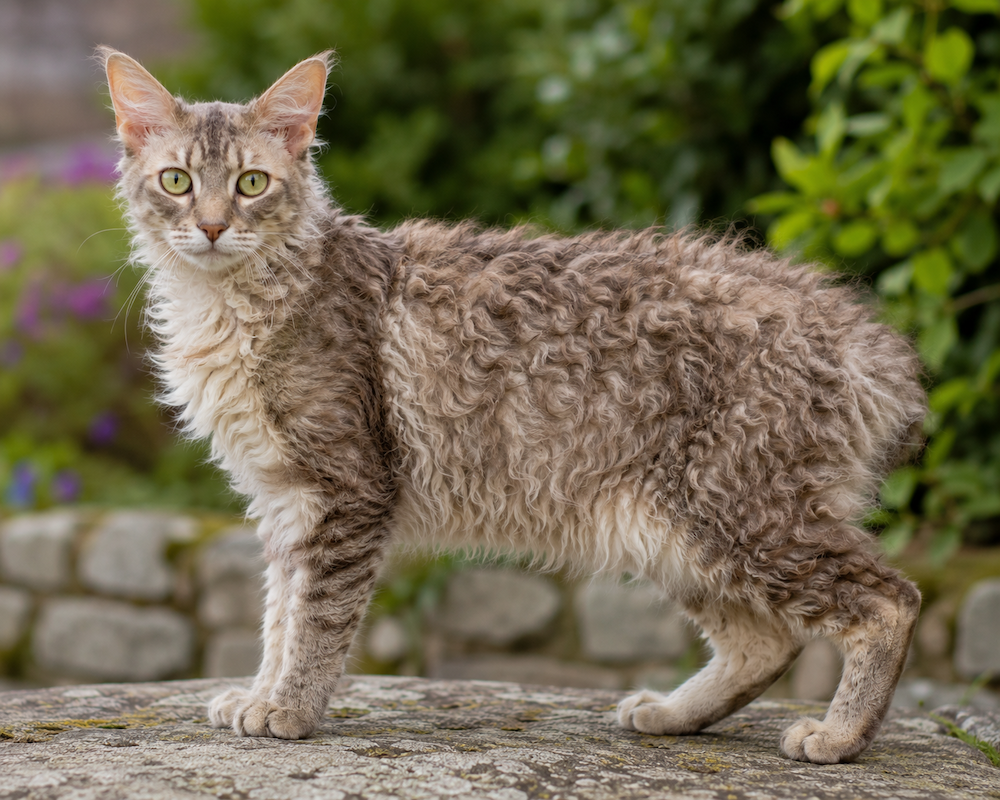
Modern LaPerms can have short or long coats and occur in numerous colours and patterns. Their curls can range from gentle waves to ringlets and corkscrew-like formations, particularly around the neck, ears and underside.
Personality is equally appealing. LaPerms tend to be affectionate, curious, intelligent and strongly people-oriented.
For such an unusual-looking cat, the LaPerm’s beginnings were surprisingly ordinary:
one farm, one unexpected kitten and one very interesting genetic mutation.
✅ PROS & CONS
Pros
- Exceptionally affectionate
- Intelligent and curious
- Playful without usually being hyperactive
- Excellent family companion
- Well suited to indoor living
- Unusual curly coat
- Grooming is easier than the coat may suggest
Cons
- Rare in many countries
- Coat texture can vary considerably
- Some cats experience significant moulting or coat changes
- Needs regular interaction and stimulation
- Not genuinely hypoallergenic
- Longer-coated individuals need additional grooming
Is a LaPerm a Good Family Cat?
Yes, the LaPerm is generally an excellent family cat, particularly for households wanting an affectionate and interactive companion.
LaPerms tend to be strongly people-oriented and often enjoy physical contact. Many happily sit on laps, climb onto shoulders or settle close to their favourite humans.
They can be good companions for respectful children, particularly children who enjoy interactive play.
The breed also tends to adapt well to other cats and cat-friendly dogs when introductions are handled appropriately.
Despite their affectionate nature, LaPerms are usually playful and curious rather than simply sedentary lap cats. They like exploring their surroundings and participating in household activities.
Individual personalities naturally vary, but the breed has developed a strong reputation for combining affection with intelligence.
For families wanting a cat that doesn’t simply live in the same house but actively wants to participate in family life, the LaPerm can be an excellent choice.
Can a LaPerm Live Indoors or in an Apartment?
Yes, the LaPerm is very well suited to indoor and apartment living.
It doesn’t require an enormous property, but it does need an interesting environment.
Cat trees, shelves, scratching posts, window perches, tunnels and interactive toys can provide plenty of exercise and exploration opportunities.
Puzzle feeders and rotating toys can also help satisfy the breed’s curiosity.
LaPerms tend to enjoy being close to people, so companionship is another important part of their environment.
Secure indoor living protects cats from traffic, fights, disease, poisoning and other outdoor hazards.
A secure cat enclosure can provide additional stimulation where practical.
Because LaPerms can be agile climbers, apartment owners should make good use of vertical space.
A relatively small home can feel enormous to a cat when the walls become part of its territory.
How Much Exercise and Play Does a LaPerm Need?
The LaPerm has moderate-to-high exercise requirements and benefits from daily interactive play.
Fishing-wand toys, balls, toy mice, tunnels and climbing structures can provide physical exercise.
Several shorter sessions throughout the day usually work well.
Their farm-cat ancestry also means many retain strong curiosity and hunting behaviours. Games involving stalking, chasing and pouncing can therefore be particularly satisfying.
Mental exercise is equally useful.
Puzzle feeders, hidden treats, scent games, clicker training and rotating toys can keep an intelligent LaPerm engaged.
Young cats can be particularly energetic, although many retain a playful personality throughout adulthood.
This is not generally an extreme high-energy breed.
But underneath all those curls is still a capable little hunter whose ancestors were expected to deal with rodents rather than spend the entire afternoon decorating a sofa.
Is a LaPerm Easy to Train?
Yes, the LaPerm is generally intelligent and receptive to training.
Positive reinforcement using treats, toys, praise and clicker training works particularly well.
LaPerms may learn to come when called, enter a carrier voluntarily, retrieve toys, use designated scratching areas and perform simple tricks.
Some can also learn to walk on a harness.
Training provides useful mental stimulation while strengthening the relationship between cat and owner.
Practical handling should begin during kittenhood. Grooming, nail trimming, dental checks, carrier travel and gentle body examination are much easier when introduced positively from an early age.
Short, enjoyable sessions are better than repetitive drills.
LaPerms are clever cats.
They can certainly learn what you want.
Whether they also learn that performing the behaviour is an extremely efficient method of extracting treats from you is another matter entirely.
Does a LaPerm Shed?
Yes. Despite some claims suggesting otherwise, the LaPerm does shed.
The amount varies considerably between individual cats, coat types and stages of life.
Both short-haired and long-haired LaPerms exist.
The curly coat can look as though it would require complicated maintenance, but grooming is usually relatively straightforward.
Gentle combing once or twice a week may be sufficient for many cats. Longer-coated individuals may need additional attention.
Excessive brushing can straighten or disrupt the curls, so gentle grooming is preferable.
Interestingly, some LaPerms undergo dramatic coat changes during their lives and may temporarily lose significant amounts of hair before growing a new curly coat.
The breed is sometimes marketed as hypoallergenic, but there is no reliably hypoallergenic cat breed.
Cat allergies are primarily caused by proteins such as Fel d 1 found in saliva and skin secretions rather than by curls themselves.
What Health Problems Are Common in a LaPerm?
The LaPerm is generally regarded as a healthy breed, but its relatively recent development means responsible breeding remains important.
There isn’t currently a long list of serious inherited disorders uniquely associated with the LaPerm.
However, that shouldn’t be interpreted as meaning the breed cannot develop genetic disease.
Responsible breeders should monitor their lines for heart disease and other inherited conditions and maintain sufficient genetic diversity.
Like all cats, LaPerms can develop dental disease, kidney disease, urinary disorders, obesity, arthritis and heart conditions.
Regular veterinary examinations, good dental care, appropriate nutrition and daily exercise remain important throughout life.
The coat and skin should also be monitored. Hair loss can sometimes be part of normal LaPerm coat development, but unexplained or persistent baldness should still be assessed by a veterinarian rather than automatically blamed on the breed.
With responsible breeding and appropriate lifelong care, many LaPerms live approximately 12–16 years, with some reaching older ages.
⭐ Was the First LaPerm Really Born Completely Bald?
Yes — and that’s where the breed’s extraordinary story begins.
In 1982, a brown tabby barn cat named Speedy gave birth to kittens on Linda and Richard Koehl’s cherry farm near The Dalles, Oregon.
One kitten looked dramatically different.
She was virtually hairless, with large ears and unusual markings on her skin.
Rather than remaining bald, however, she gradually developed a soft, curly coat.
The kitten became known as Curly.
At this point, the Koehls weren’t running an organised pedigree-cat breeding program. Curly was essentially another farm cat.
But when Curly later produced more curly-coated kittens, it became obvious that something genetically unusual was happening.
What eventually became an internationally recognised cat breed had started with a kitten that initially looked as though it had forgotten to grow fur.
⭐ Why Is the Breed Called LaPerm?
The name is a playful reference to the breed’s permed-looking curls.
The “La” was added as part of the distinctive breed name, producing LaPerm.
It’s particularly appropriate because the coat can look as though someone has deliberately curled the cat’s fur.
Nobody has.
The curls are completely natural.
Depending on the individual, they can form waves, loose curls or more pronounced ringlets.
The longest and most dramatic curls often appear around the neck, belly and base of the ears, particularly in long-haired cats.
Even the whiskers can be curly.
It’s one of those rare breed names that tells you almost everything you need to know before you’ve even seen the cat.
⭐ Are LaPerm Kittens Always Born Curly?
No — and this is one of the breed’s most fascinating characteristics.
LaPerm kittens can be born curly-coated, straight-haired or even nearly bald.
Their coats can also change dramatically as they mature.
A kitten that begins life with curls may lose much of its coat and then regrow it.
A sparsely coated kitten may later develop impressive waves or ringlets.
Hormonal changes can influence the coat as well, meaning adults may experience additional changes following maturity, pregnancy or desexing.
This can make predicting the final adult coat surprisingly difficult.
Buying a LaPerm kitten is therefore a little different from choosing a breed with an extremely predictable coat.
The cat you bring home may decide to change hairstyle several times before adulthood.
⭐ What Makes a LaPerm’s Fur Curly?
The LaPerm’s coat results from a naturally occurring genetic mutation affecting hair structure.
The mutation appeared spontaneously rather than being deliberately introduced from another curly-coated breed.
Importantly, the LaPerm’s curl is genetically distinct from the mutations behind several other rex breeds.
This means curly-coated cats have independently appeared in different places through different genetic changes.
The LaPerm arose in Oregon.
The Cornish Rex traces back to Cornwall.
The Devon Rex emerged in Devon.
The Selkirk Rex began with another spontaneous curly kitten in Montana.
Nature has therefore invented curly cats more than once.
Humans simply noticed the results and turned several of those mutations into breeds.
⭐ Is the LaPerm Related to the Cornish Rex or Devon Rex?
Not in the sense of sharing the same curly-coat mutation.
The LaPerm, Cornish Rex and Devon Rex all have unusual coats, but their distinctive fur arose from different genetic mutations and separate breed histories.
The Cornish Rex typically has an extremely short, tightly waved coat and a slender body.
The Devon Rex has its own coat mutation along with enormous ears and a distinctive pixie-like face.
The LaPerm generally retains a more conventional domestic-cat body shape and can have a considerably fuller coat containing loose waves, curls and ringlets.
This is a great example of convergent appearance.
Different genetic changes produced cats that humans grouped together because they all looked curly.
They arrived at a similar destination.
They just took completely different genetic roads to get there.
⭐ Is the LaPerm Hypoallergenic?
No cat breed can reliably be described as truly hypoallergenic, and the LaPerm is no exception.
The myth probably developed partly because of its unusual coat and sometimes reduced shedding.
But human cat allergies are primarily reactions to proteins such as Fel d 1, which are produced in the cat’s saliva and skin glands.
When a cat grooms itself, these allergens are transferred onto the coat and can then spread through the environment.
Having curly hair doesn’t switch off allergen production.
Some allergy sufferers may react less strongly to a particular LaPerm than to another individual cat, but the opposite can also happen.
Anyone with significant allergies should spend substantial time around the specific cat before bringing it home.
A curly cat can still make you sneeze.
It just looks particularly stylish while doing it.
⭐ Did the LaPerm Start as a Working Farm Cat?
Yes.
Long before LaPerms entered cat shows, the cats behind the breed were part of a working farm population.
The Koehl family’s Oregon property had ordinary farm cats that helped control rodents around barns and agricultural buildings.
Curly and her descendants weren’t initially isolated as precious pedigree animals.
They mixed with the local cat population, allowing the curly-coat gene to spread.
Over time, more curly kittens appeared.
It was only after years of seeing these distinctive cats reproduce that Linda Koehl began to realise she had something unusual enough to develop formally.
That history helps explain why the LaPerm has retained a relatively moderate, functional body.
The original cats weren’t designed around an extreme appearance.
They were working cats that happened to have spectacular hair.
⭐ Why Can Two LaPerms Look So Different?
The LaPerm has an unusually broad range of acceptable appearances compared with breeds defined by one very specific colour.
LaPerms can be short-haired or long-haired and occur in a huge variety of colours and patterns.
You may see solid cats, tabbies, tortoiseshells, colourpoints and many other combinations.
Curl intensity also varies.
One cat may have soft waves.
Another may have obvious corkscrew curls.
A third may have a comparatively sparse coat.
Even the same cat can look different at different stages of its life as the coat develops and changes.
What ties them together isn’t one particular colour.
It’s the characteristic curly coat, breed structure and ancestry.
The LaPerm is therefore less of a single “look” and more like an entire collection of feline hairstyles sharing the same genetic origin.
⭐ How Rare Is the LaPerm?
The LaPerm is recognised internationally but remains relatively uncommon compared with major pedigree breeds such as the Ragdoll, British Shorthair, Maine Coon or Siamese.
Its breeding population began with a relatively small group of cats in the United States and expanded gradually.
Dedicated breeders have since established LaPerm populations in other countries, but finding a kitten can still require patience.
Rarity also means prospective owners should verify pedigree documentation carefully.
A curly-coated mixed-breed cat isn’t automatically a LaPerm.
Spontaneous curly mutations can occur independently, and several established breeds already have curly coats.
A genuine LaPerm’s identity comes from its documented breeding lineage rather than curls alone.
Curly hair started the breed.
Pedigree is what defines it today.