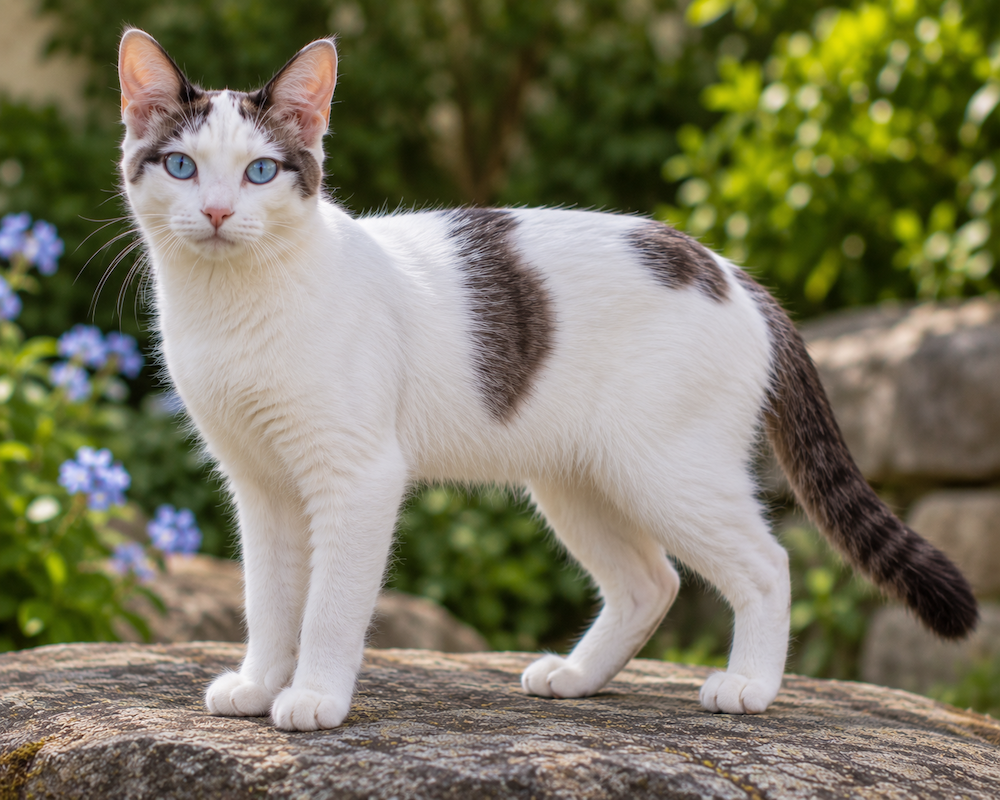






Deep blue eyes, a mysterious genetic history, and extraordinary rarity — the Ojos Azules was an American cat breed discovered through naturally occurring blue-eyed cats whose remarkable eye colour could appear without the white coat or colourpoint pattern normally associated with brilliant blue feline eyes.
🧠 QUICK SNAPSHOT
- Temperament: Affectionate, intelligent, active
- Energy Level: Moderate
- Size: Small to Medium
- Good With Families: Potentially Very Good
- Indoor Living: Excellent
- Trainability: Moderate to High
- Grooming: Low to Moderate
- Best For: Experienced cat enthusiasts and people fascinated by rare breeds
- Typical Lifespan: Not reliably established due to the breed’s extreme rarity
📚 OVERVIEW
The Ojos Azules has one of the most fascinating — and complicated — stories in the pedigree cat world.
Its name literally means “blue eyes” in Spanish, which tells you exactly what made these cats extraordinary.
Blue eyes aren’t particularly unusual in cats. They are commonly seen in white cats and colourpoint breeds such as the Siamese.
What made the Ojos Azules different was that intensely blue eyes could appear in cats with coat colours and patterns where they would normally be unexpected.
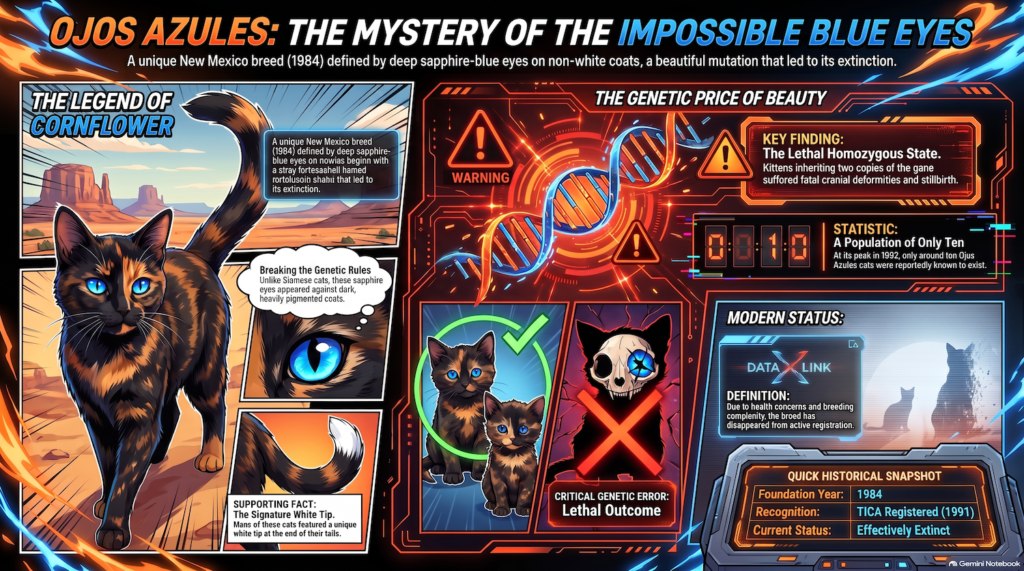
The story began in New Mexico in the 1980s, when a blue-eyed tortoiseshell female named Cornflower was discovered. When bred, she produced blue-eyed kittens, indicating that the remarkable trait could be inherited.
A breeding program followed, and Ojos Azules received recognition from The International Cat Association during the 1990s.
Then breeders discovered a serious problem.
Research into the unusual trait raised concerns that inheriting two copies of the gene responsible for the characteristic eyes could be associated with severe developmental abnormalities.
Breeding was consequently restricted, and the population remained extremely small.
Today, the Ojos Azules is best understood as an extraordinarily rare and historically significant experimental breed rather than a readily available modern pet breed.
✅ PROS & CONS
Pros
- Extraordinary deep-blue eyes
- Fascinating genetic history
- Blue eyes could occur with unusual coat colours
- Historically described as affectionate and active
- Short-haired individuals require little grooming
- One of the most unusual modern cat-breed stories
Cons
- Exceptionally rare and possibly functionally extinct as an organised breed
- Serious genetic concerns affected breeding programs
- Very limited modern health and temperament data
- Difficult to verify genuine pedigree examples
- Not widely available from established breeders
- Not hypoallergenic
Is an Ojos Azules a Good Family Cat?
Historically, Ojos Azules cats were described as affectionate, friendly and active, suggesting they could make good family companions.
However, this breed requires an important qualification that doesn’t apply to most EWL breed guides.
There are simply too few documented Ojos Azules cats to make strong claims about a consistent modern breed temperament.
The original breeding population came from domestic cats rather than a highly standardised behavioural line. Individual personality would therefore have played an enormous role.
Any genuine Ojos Azules should be assessed as an individual.
A well-socialised cat raised in a positive environment could potentially live very happily with adults, respectful children and compatible pets.
Prospective owners should nevertheless be extremely cautious about anyone advertising Ojos Azules kittens today without convincing pedigree documentation.
With a breed this rare, blue eyes alone are absolutely not proof that you’ve found one.
Can an Ojos Azules Live Indoors or in an Apartment?
Yes. Based on what is known about the breed, an Ojos Azules could be well suited to indoor and apartment living.
The cats weren’t unusually large and didn’t have extreme exercise requirements that would make apartment life impractical.
As with any active domestic cat, the home should provide climbing structures, scratching posts, window perches, toys and opportunities for interactive play.
Indoor living would also be particularly sensible for an extraordinarily rare pedigree animal, protecting it from traffic, infectious disease, fights and other outdoor hazards.
Secure cat enclosures can provide additional environmental stimulation.
Because reliable behavioural information about the Ojos Azules population is limited, owners shouldn’t assume every individual would have identical activity requirements.
The cat’s personality and background matter more than historical breed descriptions.
How Much Exercise and Play Does an Ojos Azules Need?
Historical descriptions suggest that the Ojos Azules was an active and playful cat, so daily exercise and mental stimulation would be important.
Interactive wand toys, balls, tunnels, climbing structures and chasing games can provide physical exercise.
Puzzle feeders, hidden treats and simple training activities can provide mental stimulation.
Several short play sessions throughout the day are usually more natural for cats than one extended exercise period.
Because the Ojos Azules never developed into a large, internationally established breed population, it is difficult to define a precise breed-specific exercise requirement.
These were still fundamentally domestic cats.
Their individual age, health, personality and background would influence activity needs more than their spectacular eye colour.
Is an Ojos Azules Easy to Train?
Ojos Azules cats were historically described as intelligent and interactive, so positive-reinforcement training should work well with motivated individuals.
Cats can learn considerably more than many owners realise.
Coming when called, entering a carrier voluntarily, using scratching posts, accepting nail trimming and even retrieving toys can all be taught using rewards.
Clicker training can provide useful mental enrichment.
For any rare breed, practical handling behaviours are especially valuable. A cat comfortable with veterinary examinations, carriers and routine body checks is considerably easier to care for.
There is not enough modern population data, however, to claim that the Ojos Azules possesses an unusually high level of trainability compared with other domestic cats.
Its eyes were exceptional.
That doesn’t automatically mean every other characteristic was.
Does an Ojos Azules Shed?
Yes. Ojos Azules cats had normal feline coats and therefore shed naturally.
Both short-haired and long-haired individuals were reported.
Short-haired cats would generally require minimal grooming, with weekly brushing usually sufficient to remove loose hairs.
Longer-coated cats would need more frequent grooming to prevent tangles.
Routine care should also include nail trimming, dental hygiene and examination of the ears, eyes and skin.
The Ojos Azules was not hypoallergenic.
Blue eyes have no meaningful connection with production of the major feline allergens found in saliva and skin secretions.
Anyone with cat allergies should therefore not assume that the breed’s unusual genetics would make it less likely to trigger a reaction.
What Health Problems Are Common in an Ojos Azules?
The major health concern surrounding the Ojos Azules was directly connected with the genetics responsible for its defining characteristic.
Early breeding suggested that the blue-eye trait behaved as a dominant characteristic.
More concerningly, breeding two blue-eyed Ojos Azules together produced evidence that inheriting two copies of the responsible mutation could cause severe developmental abnormalities.
Reported problems included cranial abnormalities, shortened or malformed tails and stillbirths.
This led to recommendations that blue-eyed cats should only be bred with cats without the Ojos Azules trait.
The situation dramatically complicated attempts to expand the breed.
Because the population remained tiny, there isn’t enough evidence to produce the type of comprehensive health profile available for established breeds.
This is an excellent example of why unusual physical characteristics must be investigated genetically rather than selected purely because humans find them attractive.
Sometimes the most visually spectacular trait carries information that can’t be seen from the outside.
⭐ What Does “Ojos Azules” Mean?
Ojos Azules means “blue eyes” in Spanish.
The pronunciation is approximately OH-hos ah-SOO-les.
The Spanish name makes particular sense because the foundation cats were discovered in New Mexico, a region with deep Spanish and Hispanic cultural history.
Unlike many breed names with complicated historical explanations, this one is refreshingly literal.
The defining feature was extraordinary blue eyes.
So breeders effectively named the breed:
Blue Eyes.
Considering how spectacular those eyes could be, there was probably little need to overthink it.
⭐ Who Was Cornflower — the Cat That Started the Breed?
The story of the Ojos Azules centres on an extraordinary female cat named Cornflower.
She was discovered in New Mexico in the 1980s.
What made Cornflower remarkable wasn’t simply that she had blue eyes.
She was a tortoiseshell cat with intensely blue eyes.
That combination was unusual because brilliant blue feline eyes are normally associated with particular genetic circumstances, especially white colouring or colourpoint patterns.
Cornflower didn’t fit the usual rules.
Even more importantly, when she produced kittens, some inherited her striking eyes.
That demonstrated that breeders weren’t simply looking at a random individual anomaly.
There was an inheritable genetic trait.
Cornflower therefore became the foundation of an attempt to create an entirely new breed.
One unusual stray cat had accidentally revealed a piece of feline genetics nobody had been deliberately looking for.
⭐ Why Were the Ojos Azules’ Blue Eyes So Unusual?
Most blue-eyed cats achieve their eye colour through genetics already familiar to breeders.
Colourpoint cats, including Siamese, characteristically have blue eyes.
White cats can also have blue eyes because genes affecting pigmentation can prevent normal pigment development within the iris.
The Ojos Azules was different.
Its blue-eye trait could appear independently of an all-white coat or Siamese-style colourpoint pattern.
That meant a dark tortoiseshell, tabby or other richly coloured cat could potentially have extraordinary deep-blue eyes.
This was what made Cornflower so remarkable.
The contrast between dark coat colours and intense blue eyes could be spectacular.
For breeders, it appeared initially to offer something extraordinary:
the possibility of producing blue-eyed cats in a huge variety of colours.
Unfortunately, the genetics turned out to be considerably more complicated than the appearance suggested.
⭐ Is the Ojos Azules Related to the Siamese?
No. The Ojos Azules’ blue eyes were not created by introducing Siamese colourpoint genetics.
That’s precisely why the breed attracted so much interest.
Siamese cats have blue eyes because of the temperature-sensitive form of albinism responsible for their colourpoint coat.
The Ojos Azules trait operated differently.
Cats could retain full pigmentation across their bodies while still developing deep-blue eyes.
This meant an Ojos Azules could look nothing like a Siamese.
The breeds therefore reached a visually similar feature — blue eyes — through entirely different genetic mechanisms.
It’s a useful reminder that appearance doesn’t necessarily reveal ancestry.
Two cats can have spectacular blue eyes for completely different biological reasons.
⭐ Could an Ojos Azules Have One Blue Eye and One Different-Coloured Eye?
Yes. Ojos Azules could reportedly display heterochromia, meaning the two eyes were different colours.
In odd-eyed individuals, one eye could show the characteristic deep blue while the other appeared green, gold or another shade.
Odd-eyed cats aren’t unique to the Ojos Azules.
Heterochromia occurs in other feline populations, particularly white cats.
What made the Ojos Azules remarkable was again the genetic context in which the blue eye appeared.
The cat didn’t necessarily need the white coat normally associated with many odd-eyed cats.
This could produce visually extraordinary combinations of dark coats and mismatched eyes.
⭐ Were Ojos Azules Cats Deaf Like Some Blue-Eyed White Cats?
The Ojos Azules blue-eye trait was not considered equivalent to the mechanism linking white coats, blue eyes and congenital deafness in some cats.
In white cats, the dominant-white genetic pathway can affect pigment-producing cells involved in development of the inner ear, which explains the increased risk of deafness.
The Ojos Azules trait was genetically different.
However, because the breed population was extremely small and its genetics presented other serious developmental concerns, it would be unwise to make sweeping claims that Ojos Azules cats could never experience hearing problems.
The important point is that blue eyes themselves don’t cause deafness.
It is the underlying genetics producing particular combinations of pigmentation and eye colour that determine associated risks.
⭐ Why Did Breeders Stop Mating Two Blue-Eyed Ojos Azules Together?
Because researchers discovered a potentially devastating genetic problem.
The characteristic blue-eye trait appeared to be dominant, meaning a cat only needed one copy to display it.
But kittens inheriting two copies appeared vulnerable to severe abnormalities.
This is known as a homozygous lethal or severely detrimental effect, depending on exactly how the mutation expresses itself.
Breeders therefore had to avoid blue-eyed-to-blue-eyed matings.
Instead, a blue-eyed cat would need to be bred with a cat that didn’t carry the trait.
That creates an obvious difficulty when trying to establish a breed whose defining characteristic is blue eyes.
Every breeding decision required careful management, and not every kitten would inherit the feature breeders were trying to preserve.
The very mutation that made the Ojos Azules fascinating also helped make the breed extraordinarily difficult to sustain.
⭐ Is the Ojos Azules Still an Existing Cat Breed Today?
This is where the Ojos Azules story becomes particularly unusual.
The breed became recognised by The International Cat Association (TICA) during the 1990s, but breeding remained extremely limited.
Concerns surrounding the genetics of the blue-eye trait resulted in restrictions and further investigation.
The breed never developed the large international population required to become a mainstream pedigree cat.
Today, genuine documented Ojos Azules appear to be extraordinarily rare, and the organised breed may effectively be inactive or functionally extinct.
That doesn’t mean cats with similar blue-eye mutations no longer appear naturally.
Unusual blue-eyed domestic cats continue to be discovered.
But discovering a dark-coated cat with blue eyes doesn’t automatically make it an Ojos Azules.
The historical pedigree breed and a naturally occurring blue-eyed cat are not necessarily the same thing.
⭐ Could Another Cat Like Cornflower Appear Naturally?
Yes — and that’s one reason the Ojos Azules story remains scientifically fascinating.
Genetic mutations occur naturally.
Cornflower herself wasn’t manufactured in a breeding laboratory. Her unusual appearance arose within an ordinary domestic-cat population.
Other unrelated blue-eyed cats with unusual coat colours have subsequently been reported around the world, and researchers have continued investigating the genetics behind different blue-eye phenotypes.
That doesn’t mean these cats are automatically Ojos Azules.
Similar appearances can arise through different mutations.
This distinction is becoming increasingly important as feline genetics advances.
What humans casually call “a blue-eyed gene” may actually represent several completely different biological mechanisms producing superficially similar results.
Cornflower showed breeders something extraordinary.
Nature may have invented similar blue-eyed cats more than once.
⭐ Why Is Buying an “Ojos Azules Kitten” Online Risky?
Because the historical breed is so exceptionally rare that any modern advertisement deserves serious scrutiny.
Blue eyes alone don’t establish breed identity.
A seller could potentially advertise an ordinary blue-eyed domestic kitten, a colourpoint cross, an odd-eyed cat or another naturally occurring blue-eyed phenotype as an Ojos Azules.
Prospective buyers should expect verifiable pedigree documentation, breeder records and an explanation of the breeding program and genetic testing involved.
Claims that a seller has numerous readily available “rare Ojos Azules kittens” should prompt questions rather than excitement.
This is especially important because responsible breeding of the original trait required careful genetic management.
For most people, the Ojos Azules is now more fascinating as a chapter in feline genetics and breed history than as a breed they can realistically expect to find.
And perhaps that’s what makes it so interesting.
The Ojos Azules isn’t merely rare.
It is a glimpse at how one extraordinary cat can almost become an entire breed — and how genetics can ultimately change the plan.