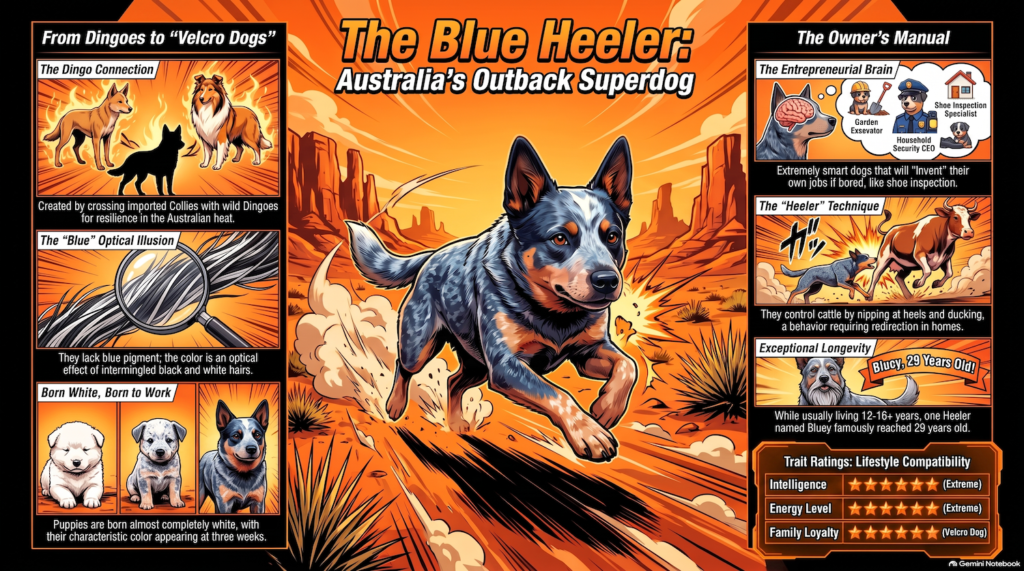
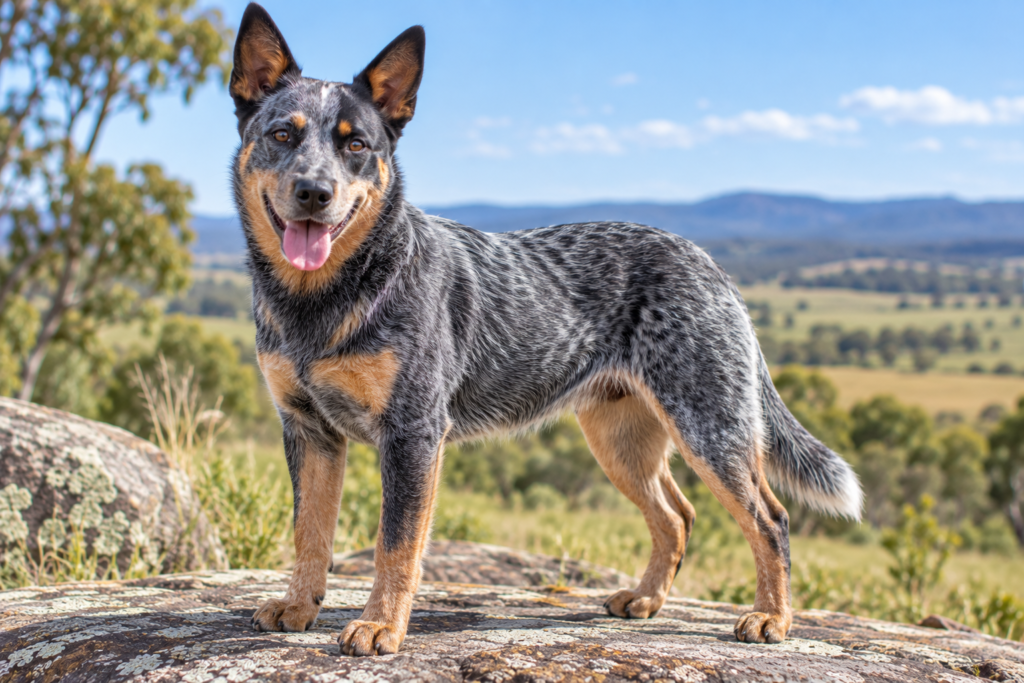






Tough, brilliant, and seemingly equipped with an unlimited supply of energy — the Blue Heeler was developed to move cattle across Australia's vast and unforgiving landscape, creating one of the world's most intelligent, hardworking and intensely loyal dogs.
🧠 QUICK SNAPSHOT
- Temperament: Intelligent, loyal, alert
- Energy Level: Very High
- Size: Medium
- Good With Families: Very Good with training and socialisation
- Apartment Living: Challenging
- Trainability: Very High
- Grooming: Low
- Best For: Active owners, rural properties, dog sports, experienced households
- Typical Lifespan: Around 12–16 years
📚 OVERVIEW
The Blue Heeler is better known officially as the Australian Cattle Dog, one of Australia’s great contributions to the working-dog world.
“Blue Heeler” generally refers to Australian Cattle Dogs with blue or blue-mottled colouring, while red-speckled examples are commonly called Red Heelers.
The “Heeler” part comes from exactly what you’d expect: these dogs were bred to control cattle partly by nipping at their heels.
The breed developed in Australia during the 19th century as cattle producers needed a dog tough enough to work livestock over enormous distances in heat, rough terrain and challenging conditions.
Its precise early breeding history contains disputed details, but Australia’s native Dingo played an important role, along with imported British herding dogs and other working lines.
The result was an extraordinary working animal.
Blue Heelers are intelligent, resilient, athletic and capable of making decisions independently. They often form extremely strong relationships with their owners and can be naturally protective.
But those qualities come with responsibilities.
This isn’t usually a dog satisfied with a leisurely stroll around the block and 23 hours on the sofa.
The Blue Heeler was built to have a job.
If you don’t provide one, don’t be surprised when it creates its own.
✅ PROS & CONS
Pros
- Exceptionally intelligent
- Extremely loyal
- Highly trainable
- Outstanding working ability
- Excellent endurance
- Low-maintenance coat
- Great for dog sports and active lifestyles
- Usually long-lived for a medium-sized dog
- Naturally alert and watchful
Cons
- Extremely high exercise requirements
- Can become destructive when bored
- Herding instinct can include heel-nipping
- May attempt to herd children or other animals
- Can be wary of strangers
- Needs substantial mental stimulation
- Strong personality can challenge inexperienced owners
- Heavy seasonal shedding despite short coat
- Some important inherited health conditions occur in the breed
Is a Blue Heeler a Good Family Dog?
Yes, a well-trained and properly socialised Blue Heeler can be an excellent family dog, particularly for an active household.
These dogs are famous for their loyalty and often develop an exceptionally strong bond with their family.
However, their herding instincts need to be understood.
A Blue Heeler may attempt to control running children by circling, chasing or even nipping towards their heels. This isn’t necessarily aggression — it’s a working behaviour that once had genuine value around cattle.
Early training is therefore essential.
Children should also learn how to interact appropriately with dogs and respect their space.
Blue Heelers tend to thrive in households that actively involve them in daily life. Hiking, training, running, dog sports and outdoor adventures are far more compatible with the breed than a sedentary lifestyle.
For the right family, they’re extraordinary companions.
For a family wanting an easy-going dog that doesn’t require much attention, there are considerably easier choices.
How Much Exercise Does a Blue Heeler Need?
A Blue Heeler needs a lot of daily exercise — typically around 1.5 to 2 hours for a healthy adult, with mental work on top of that.
Simply walking isn’t always enough.
Australian Cattle Dogs were developed to move livestock over long distances and work for extended periods. Their combination of stamina, intelligence and drive means they need activities that challenge both body and brain.
Running, hiking, retrieving, agility, obedience, scent work and herding activities can all be excellent options.
Mental exercise is particularly important.
Training sessions, puzzle toys and problem-solving games can sometimes tire an intelligent working dog more effectively than simply adding another kilometre to a walk.
Exercise should always be appropriate for the dog’s age and physical condition, particularly during puppyhood.
The aim isn’t to exhaust a Blue Heeler into submission.
With this breed, you may discover you become exhausted first.
Is a Blue Heeler Easy to Train?
Yes, the Blue Heeler is exceptionally intelligent and highly trainable, but that doesn’t necessarily make it an easy breed for beginners.
There’s an important difference between a dog being capable of learning and a dog automatically doing whatever you want.
Blue Heelers were bred to work independently and solve problems.
They learn quickly, notice inconsistencies and can become bored with repetitive training.
Positive reinforcement, clear boundaries and varied training generally produce the best results.
Early socialisation is particularly important because the breed can naturally be cautious around unfamiliar people and dogs.
Impulse control should also be taught from puppyhood.
Because heel-nipping is rooted in the breed’s original working behaviour, owners should redirect inappropriate herding behaviour rather than allowing it to become established.
A Blue Heeler can learn what you want remarkably quickly.
The real challenge is making sure you haven’t accidentally taught something else at the same time.
Does a Blue Heeler Shed?
Yes. Blue Heelers have a short coat, but they can shed considerably more than their appearance suggests.
The Australian Cattle Dog has a weather-resistant double coat consisting of a short outer coat and dense undercoat.
Routine weekly brushing can remove loose hair and keep the coat in good condition.
During heavier seasonal shedding, more frequent brushing may be necessary.
Bathing is generally required only when the dog becomes dirty or develops a noticeable odour.
Their coat was designed for practical working conditions rather than intensive grooming, making them relatively low maintenance overall.
Routine care should also include nail trimming, ear checks and dental hygiene.
The Blue Heeler isn’t hypoallergenic.
And despite its tidy-looking short coat, owners may discover that small blue-grey hairs possess an impressive ability to appear on furniture that the dog has never apparently touched.
What Health Problems Are Common in a Blue Heeler?
Blue Heelers are generally robust dogs, but several inherited conditions deserve attention.
One of the most important is congenital hereditary deafness. Deafness can affect one or both ears, and responsible breeders can use BAER hearing testing to identify affected dogs.
Progressive retinal atrophy (PRA) is another concern. This inherited eye disease progressively damages the retina and can eventually cause blindness. DNA testing is available for important forms affecting the breed.
Hip dysplasia can occur, as can elbow and other joint problems.
Other eye conditions may also appear within Australian Cattle Dog lines, making appropriate ophthalmic screening valuable.
Responsible breeders should use relevant health testing and provide prospective owners with clear results.
Despite these concerns, Australian Cattle Dogs are often impressively long-lived.
A combination of responsible breeding, healthy weight, appropriate exercise, dental care and routine veterinary attention gives a Blue Heeler an excellent chance of remaining active well into its senior years.
⭐ Is a Blue Heeler the Same as an Australian Cattle Dog?
Yes. Blue Heeler is a popular name for a blue-coloured Australian Cattle Dog.
The official breed name is Australian Cattle Dog.
Dogs with the characteristic blue colouring are commonly called Blue Heelers, while red-speckled Australian Cattle Dogs are often called Red Heelers.
They’re not separate breeds.
The nickname “Heeler” describes the dog’s traditional cattle-working technique.
These dogs would move stubborn cattle partly by nipping at or close to the animals’ heels before quickly avoiding the inevitable kick.
So “Blue Heeler” essentially means:
the blue Australian cattle dog that works at the heels.
It’s a nickname that describes the dog’s appearance, occupation and working technique all at once.
⭐ Why Are Blue Heeler Puppies Born White?
This is one of the breed’s most surprising characteristics.
Australian Cattle Dog puppies are generally born predominantly white, with any solid-coloured markings already visible.
Their characteristic blue mottling or red speckling develops as they grow.
The white background is associated with the ticking/roaning pattern that gradually becomes visible as pigmented hairs emerge through the puppy coat.
This can make newborn Blue Heelers look dramatically different from the adults they’ll eventually become.
Over the following weeks, the characteristic colour increasingly reveals itself.
A puppy that starts life looking mostly white can ultimately become the richly mottled blue dog everyone recognises.
The Blue Heeler’s famous coat is therefore something of a slow-development photograph.
⭐ Does the Blue Heeler Really Have Dingo Ancestry?
Yes. The Australian Cattle Dog’s development genuinely involved the Australian Dingo.
Early Australian cattle producers found that many imported British herding dogs weren’t ideally suited to the enormous distances, climate and challenging cattle conditions encountered in colonial Australia.
Working dogs were crossed with Dingoes as breeders attempted to develop tougher, quieter and more heat-resistant cattle dogs.
Exactly which dogs contributed at every stage of the breed’s early development has been debated, and some traditional accounts contain details that modern historians question.
But Dingo ancestry is an established part of the Australian Cattle Dog’s development.
The eventual working dog combined the trainability required by stockmen with extraordinary toughness and endurance.
The Blue Heeler doesn’t merely look like it could handle the Australian bush.
Its ancestors were specifically shaped by it.
⭐ Who Was Thomas Hall and What Was a Hall’s Heeler?
One of the most important names in Australian Cattle Dog history is Thomas Simpson Hall.
During the 19th century, the Hall family managed enormous cattle properties and needed dogs capable of moving livestock across demanding Australian terrain.
Thomas Hall developed working dogs by crossing imported herding dogs with Dingoes.
The resulting dogs became known as Hall’s Heelers.
For decades, these dogs were largely associated with Hall family properties rather than being widely available as a formal public breed.
After Hall’s death in 1870, the dogs became more widely distributed, and further development eventually contributed to what we now recognise as the Australian Cattle Dog.
That means the modern Blue Heeler wasn’t simply invented by a kennel club.
Its foundations came from a very practical problem:
How do you move difficult cattle enormous distances across Australia?
The Hall’s Heeler was part of the answer.
⭐ Is There Really Dalmatian in the Blue Heeler?
This is one of the most repeated stories in Australian Cattle Dog history — but it should be treated with caution.
Traditional accounts often claim that Dalmatian and Kelpie blood were introduced during later development of the breed.
The Dalmatian was supposedly used to improve the dogs’ relationship with horses and their loyalty to handlers.
However, modern breed historians have questioned parts of this traditional narrative, and documentation of some claimed crosses is weak.
The same applies to several colourful stories about exactly which breeds created the modern Australian Cattle Dog.
What is clear is that Hall’s Dingo-cross working dogs were central to the breed’s foundation.
The lesson here is useful whenever discussing an old working breed.
Breed histories often contain a mixture of documented fact, oral tradition and stories repeated so frequently that they eventually sound like documented fact.
⭐ What Is the Bentley Mark on a Blue Heeler?
Many Australian Cattle Dogs have a distinctive white patch on the forehead, sometimes called the Bentley Mark or Bentley Star.
According to breed tradition, the marking traces back to a particularly influential dog owned by breeder Tom Bentley.
The story became so embedded in Australian Cattle Dog folklore that a white forehead marking became popularly associated with his line.
Not every Blue Heeler has an obvious Bentley Mark, and a forehead patch doesn’t prove direct descent from one particular historical dog.
But the term remains widely used among breed enthusiasts.
It’s one of those wonderful pieces of breed culture where a tiny physical marking carries a story stretching back through generations of working dogs.
⭐ Why Do Blue Heelers Nip at People’s Heels?
Because heel-nipping is literally part of the job they were bred to perform.
Cattle can weigh hundreds of kilograms and aren’t always interested in following instructions.
Australian Cattle Dogs developed a working style involving approaching low, nipping at the heels of reluctant cattle and quickly moving clear.
That behaviour helped drive livestock forward.
In a modern home, however, the same instinct can become inappropriate.
Running children, cyclists, other dogs or even adults moving quickly through the house can trigger herding behaviour in some individuals.
Early training should teach the dog appropriate alternatives and strong impulse control.
Punishing the dog for having an instinct humans deliberately selected for generations isn’t particularly useful.
The goal is to channel it.
When your Blue Heeler tries to organise the household, remember:
management is part of its résumé.
⭐ How Smart Is a Blue Heeler?
The Blue Heeler is widely regarded as an exceptionally intelligent working breed.
But its most impressive intelligence isn’t simply the ability to memorise commands.
Australian Cattle Dogs were bred to solve practical problems while controlling animals far larger than themselves.
That required situational awareness, confidence, persistence and independent decision-making.
Modern Heelers can excel in obedience, agility, herding, scent work and complex trick training.
They also become very good at observing human routines.
Owners frequently discover that their dog knows what happens next based on tiny cues — a particular pair of shoes, car keys being picked up or the time of day.
That intelligence requires management.
A bored smart dog isn’t necessarily easier to live with than a bored less-intense dog.
Sometimes it’s simply more creative about being bored.
⭐ Is Bluey the Oldest Dog Ever Recorded?
A famous Australian Cattle Dog named Bluey was historically credited with living to an astonishing 29 years and 5 months.
According to the long-circulated record, Bluey lived in Victoria, Australia, from 1910 until 1939 and worked with cattle and sheep for much of his life.
For decades, Bluey was widely cited as the oldest dog ever reliably recorded.
Modern debates about canine longevity records have highlighted how difficult it can be to verify animals born more than a century ago to today’s evidentiary standards.
So Bluey’s extraordinary age should be understood in the context of a historical record rather than proof that Blue Heelers routinely live anywhere near 29 years.
They don’t.
Nevertheless, the story remains legendary.
A cattle dog reportedly living for nearly three decades is a fitting piece of folklore for a breed famous for refusing to quit.
⭐ Is the Dog From Bluey Actually a Blue Heeler?
Yes.
Bluey is a Blue Heeler, while her younger sister Bingo is depicted as a Red Heeler.
The enormously successful Australian animated series has introduced the breed to millions of children and families around the world.
The choice is particularly appropriate because the breed is so strongly associated with Australia.
Of course, the television version leaves out a few practical realities.
Real Blue Heelers need serious exercise, training and mental stimulation.
Parents whose children watch the show and announce that they now want a real Bluey should therefore investigate the breed rather than choosing one purely because of the character.
The cartoon may run for seven minutes.
The real Blue Heeler keeps going considerably longer.
⭐ How Long Can a Blue Heeler Work?
Australian Cattle Dogs were developed for extraordinary endurance rather than short bursts of activity.
Historic cattle drives could involve moving livestock across vast distances through difficult terrain.
The dogs needed enough stamina to repeatedly move around cattle, respond to handlers and remain mentally focused.
That heritage remains obvious in modern Blue Heelers.
A healthy adult can become an exceptional hiking, running or working companion when properly conditioned.
But this doesn’t mean owners should simply exercise the dog harder and harder.
Physical exercise alone can create an extremely fit dog that still needs mental stimulation.
Training, scent work, problem-solving and controlled working activities help satisfy the brain as well as the body.
The Blue Heeler wasn’t designed simply to run.
It was designed to run while thinking about what needed to happen next.
⭐ How Rare Is the Blue Heeler?
The Blue Heeler is not particularly rare, especially in Australia, where the Australian Cattle Dog remains one of the country’s best-known working breeds.
The breed has also developed a substantial following internationally.
Its combination of intelligence, durability and distinctive appearance has made it popular with farmers, active families and dog-sport enthusiasts.
Popularity does create one problem.
People can be attracted by the beautiful blue coat, Australian identity or Bluey connection without fully understanding the dog’s working temperament.
Finding an Australian Cattle Dog isn’t necessarily difficult.
Finding one from a responsible breeder who prioritises temperament, hearing, eye health, joint health and appropriate working structure deserves considerably more attention.
With this breed, the question shouldn’t only be:
“Where can I find a Blue Heeler?”
It should also be:
“Can I give a Blue Heeler enough to do?”