Lost Dog
How To Find Your lost Dog
Your dog is missing.
Maybe someone left the gate open. Perhaps they slipped through a door, escaped from the garden or bolted after something frightened them.
Your heart is racing and your first instinct is probably to run outside and search everywhere at once.
You need to act quickly — but you don’t need to panic.
Dogs are reunited with their families every day, and even dogs missing for long periods have made it home.
Right now, your dog needs you to turn that fear into a plan.
Start here and work through the steps in order.
🚨 Has Your Dog Just Gone Missing?
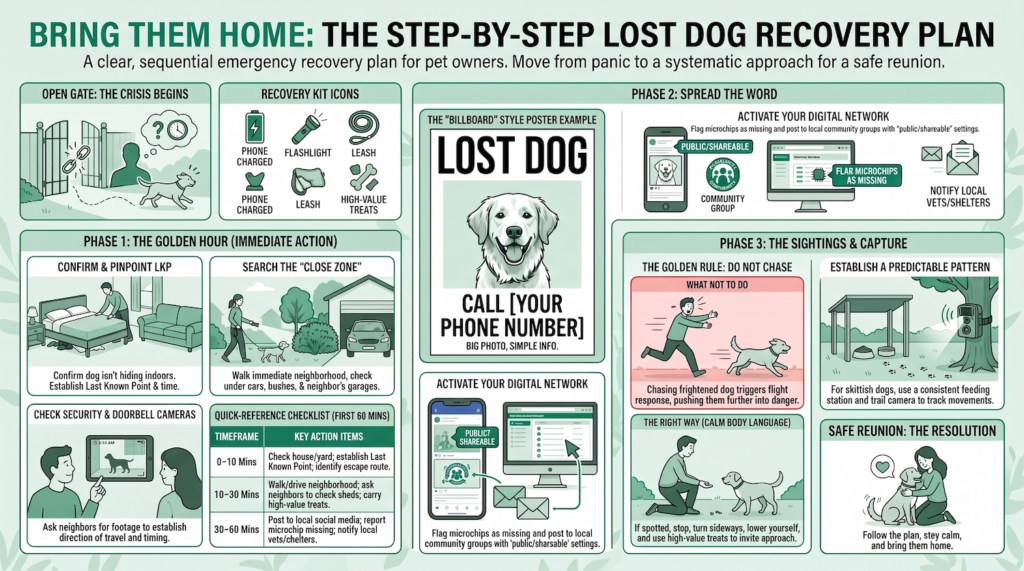
Don’t panic. We’ve created a free Lost Dog Emergency Action Plan you can save to your phone or print. It gives you the most important actions to take during the first 20 minutes, first hour and first 24 hours.
What Should You Do When Your Dog Goes Missing?
🚨 THE FIRST 20 MINUTES
- Search your own property first
Before assuming your dog is running through the neighbourhood, make absolutely sure they aren’t trapped or hiding somewhere nearby.
Quickly check:
- Every room.
- Under beds.
- Behind furniture.
- Garage.
- Shed.
- Under decks.
- Under the house.
- Behind garden structures.
- Vehicles.
- Pool area.
- Thick bushes.
Then work out two things:
Where was your dog last definitely seen?
What time was that?
That becomes the starting point of your search.
- Work out how they escaped
Look for the open gate, damaged fence or open door.
Was your dog frightened by thunder, fireworks or another animal?
Did they simply wander through an open gate?
This matters.
A confident dog out exploring may behave very differently from a terrified dog that has bolted in panic.
- Search the immediate neighbourhood NOW
Don’t spend your first half-hour designing a Facebook post.
Get someone outside searching.
Walk the nearby streets and check places a dog could hide:
- Under parked cars.
- Bushes and hedges.
- Parks.
- Laneways.
- Walking tracks.
- Under porches.
- Drains and culverts.
- Vacant blocks.
- Familiar walking routes.
Take:
A leash + favourite treats + favourite toy + your phone.
Use familiar words your dog loves:
“Treat!”
“Dinner!”
“Walk?”
“Want to go for a ride?”
Don’t just repeatedly scream their name.
- Get someone into the car
If you have another person available, have them slowly and safely drive nearby streets.
Your car is part of your dog’s normal world.
They may recognise its appearance, engine sound, doors or the familiar sound of your voice coming from it.
Keep the window down where safe.
Drive slowly enough to actually look beneath bushes, beside fences and between parked vehicles.
Don’t turn this into a high-speed search.
- Keep someone at home if possible
This is easily forgotten.
Imagine everyone spends two hours searching…
while your dog comes back to the front gate.
If you have enough people, leave someone at home to:
- Watch for your dog.
- Answer calls.
- Monitor cameras.
- Coordinate searchers.
Make sure a returning dog can safely be recognised and secured.
⏱️ THE FIRST HOUR
- Knock on doors
Your neighbours are now part of your search team.
But don’t simply ask:
“Have you seen my dog?”
Ask:
“Could you please check your backyard, garage and shed?”
Your dog could have wandered onto a property and become accidentally shut inside.
Also ask:
“Do you have a doorbell or security camera facing the street?”
A camera could tell you:
Which direction your dog went — and exactly when.
That information can transform the search.
- Divide the jobs
If family or friends are helping, don’t have everyone doing the same thing.
Try:
Person 1: Search on foot.
Person 2: Search by car.
Person 3: Stay at home and coordinate.
Person 4: Start online alerts and make phone calls.
Organisation beats panic.
- Put your dog online
Now create your lost-dog alert.
Post in:
- Local lost-pet groups.
- Community Facebook groups.
- Neighbourhood apps.
- Local rescue groups.
- Local community pages.
- Lost-and-found pet databases available in your country.
Use a clear, recent photograph showing your dog’s appearance.
Include:
LOST DOG
Dog’s name.
Breed/type.
Colour and size.
Distinctive markings.
Where they disappeared.
When they disappeared.
Your contact number.
And whether they’re frightened.
If your dog is scared or running from people, make this extremely prominent:
DO NOT CHASE — CALL/TEXT SIGHTINGS
- Check the microchip
If your dog is microchipped, contact the appropriate registry.
Report them missing where that service is available.
Then check:
- Your phone number.
- Email.
- Address.
- Secondary contact.
Don’t assume they’re correct.
A microchip can only help reunite you if the registration leads back to you.
What If You See Your Lost Dog?
⚠️ THIS COULD BE THE MOST IMPORTANT THING YOU READ
You’ve been searching for an hour.
Suddenly you see your dog.
Your instinct screams:
RUN TO THEM!
But look at your dog’s behaviour first.
If your dog is frightened and moving away:
DON’T CHASE THEM.
A scared lost dog can behave very differently from the dog curled up beside you at home.
They may even run from you.
That doesn’t necessarily mean they’ve forgotten you.
Fear can change behaviour.
If they’re frightened:
- Stop pursuing.
- Stay calm.
- Turn partly sideways.
- Avoid looming over them.
- Avoid intense eye contact.
- Lower yourself if safe.
- Use familiar food.
- Speak calmly.
- Give them an opportunity to approach.
Most importantly, tell other people:
Don’t chase. Don’t surround. Don’t create a crowd.
You want to turn a sighting into a reunion — not another escape.
🕐 THE FIRST 2–4 HOURS
- Contact the organisations most likely to receive your dog
Depending on where you live, contact:
- Local animal shelters.
- Animal control or local authority.
- Rescue organisations.
- Nearby veterinary clinics.
- Emergency veterinary hospitals.
Send them a photograph.
Give them your contact details and the location your dog disappeared from.
Don’t assume they’ll automatically connect every found dog with every missing report.
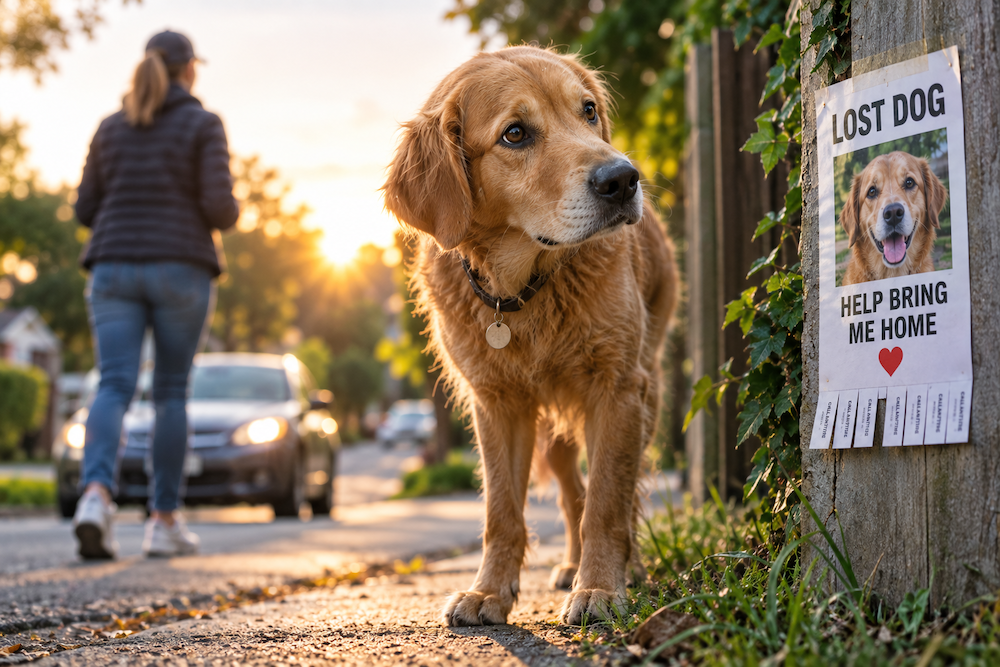
- Start making posters
Social media is powerful.
But the person who sees your dog walking down the street may never see your Facebook post.
They might see your poster.
And your poster should not look like an essay.
Think:
LOST DOG
BIG PHOTO
PHONE NUMBER
If appropriate:
DO NOT CHASE — CALL WITH SIGHTINGS
That’s it.
Someone driving past has seconds to understand it.
Use large lettering and high-visibility paper or backing.
Put signs where legally permitted around:
- Main intersections.
- Neighbourhood entrances.
- Parks.
- Walking tracks.
- Shopping areas.
- Last-known location.
Test your poster from a distance.
If you can’t immediately read LOST DOG and the phone number, neither can a passing driver.
- Start recording every sighting
Open the notes app on your phone or grab a notebook.
For every credible sighting record:
TIME — LOCATION — DIRECTION — BEHAVIOUR — WITNESS — PHONE NUMBER
Don’t trust yourself to remember everything.
You’re stressed.
Write it down.
🌙 THE FIRST NIGHT
Your dog still isn’t home.
This is frightening.
But the search is not over.
Do not interpret one unsuccessful day as evidence that you’re not going to find your dog.
Now you need to become more systematic.
- Look at the sightings, not your assumptions
Put confirmed sightings on a map.
You may begin to see a pattern.
Perhaps your dog was seen:
4:15 pm — Oak Street.
5:10 pm — park entrance.
6:20 pm — creek path.
Now you have something much more useful than:
“My dog could be anywhere.”
You have a possible route.
- Search during quieter periods
A frightened dog may be less visible while roads, parks and streets are busy.
Quiet evening and early-morning periods can be useful times to search.
Take a torch.
Listen as well as look.
But don’t put yourself in danger searching railway lines, highways, private property or other hazardous locations.
- Change your voicemail
This is a brilliant little step people often forget.
Your voicemail could say:
“If you’re calling about our missing dog, please leave the exact location, time and direction they were travelling. If you can still see the dog, please say so and leave your number.”
Then:
Answer unknown numbers.
For the next few days, that unknown caller could be standing 50 metres from your dog.
And keep your phone charged.
🌅 THE FIRST 24 HOURS
- Now distribute flyers door-to-door
A roadside poster and a letterbox flyer have different jobs.
Your flyer can contain more detail:
- Several photographs.
- Breed/type.
- Colour.
- Size.
- Sex.
- Collar.
- Distinguishing markings.
- Last-seen location.
- Contact numbers.
- Whether the dog is frightened.
When speaking with residents, ask two specific questions:
“Could you check your garage, shed and backyard?”
and:
“Could you check your security cameras from around this time?”
That’s much more useful than simply saying:
“Please keep an eye out.”
- Think about people who travel through your area all day
Tell:
- Postal workers.
- Delivery drivers.
- Dog walkers.
- Joggers.
- Gardeners.
- Council/local authority workers.
- Waste collection crews.
- Security staff.
- Local businesses.
- School communities.
- Pet shops.
- Groomers.
You can’t watch every street.
But you can put hundreds of extra eyes on them.
- Check shelters again
Don’t think:
“I’ve already called.”
Check again.
A dog may arrive hours or days after your first call.
Descriptions can also be wrong.
Your dog might be recorded as a different breed, colour or age.
Where possible, check found-dog listings and shelters regularly yourself.
📍 ONCE YOU START GETTING SIGHTINGS
This is where your strategy may need to change completely.
If your frightened dog keeps appearing around the same area:
Stop sending crowds after them.
You have achieved something important.
You know where your dog is.
Now your objective is to keep them in that area long enough to recover them safely.
- Create a controlled feeding point
Where safe and appropriate, place:
- Strong-smelling food.
- Water.
Use the same location consistently.
You are trying to establish a pattern.
Don’t randomly scatter food all over the neighbourhood.
- Add a motion camera
A motion-activated or trail camera can tell you:
- Whether your dog is actually visiting.
- What time they arrive.
- Which direction they come from.
- Whether they’re alone.
- How regularly they’re returning.
Suddenly you aren’t guessing anymore.
You have information.
- Consider professional recovery help
If your frightened dog is repeatedly visiting the same location but refuses to approach people, contact:
- Experienced lost-dog recovery volunteers.
- Animal control.
- Rescue organisations.
- Lost-pet recovery professionals.
A properly selected and monitored humane trap may sometimes be appropriate once a reliable pattern has been established.
This isn’t something to improvise casually.
The objective is a controlled recovery, not another chase.
📅 AFTER 48 HOURS
Your dog still isn’t home.
Keep going.
Now review everything.
Refresh your plan:
☐ Re-check shelters.
☐ Re-contact veterinary clinics.
☐ Refresh damaged posters.
☐ Expand flyers around confirmed sightings.
☐ Update social posts.
☐ Check security footage.
☐ Map every credible sighting.
☐ Search new areas suggested by actual evidence.
☐ Keep your phone charged and answer unknown callers.
☐ Keep checking lost-and-found listings.
Don’t simply expand the search farther and farther because time has passed.
Let evidence guide you.
🚨 BEWARE OF LOST-DOG SCAMS
Unfortunately, frightened owners can become targets.
Someone contacts you:
“I’ve got your dog.”
Then they demand money.
Don’t panic and immediately pay.
Ask for:
- A current photograph.
- Video.
- Where the dog was found.
- Description of a distinguishing feature.
It can even be useful to leave one small, non-obvious identifying feature out of public posts so you have something a genuine finder can describe.
Be especially suspicious of someone demanding money before providing evidence they have your dog.
❤️ WHEN YOU FINALLY SEE YOUR DOG
This could be the moment you’ve been waiting for.
Don’t let excitement create one final escape.
If your dog appears frightened:
Don’t sprint towards them.
Stay calm.
Give them time.
Use food.
Let them recognise the situation.
When they reach you, secure them before celebrating.
Attach the leash properly.
Check the collar or harness.
Get them somewhere enclosed and safe.
Then you can cry.
Then you can hug them.
Then you can make the phone call everyone has been waiting for:
“We’ve got them.”
Once your dog is safely home
Check them carefully for:
- Injuries.
- Cuts.
- Sore paws.
- Limping.
- Dehydration.
- Exhaustion.
- Pain.
- Unusual behaviour.
If they’ve been missing for a significant period, appear injured or seem unwell, contact your veterinarian.
Then find out how they escaped.
Repair the fence.
Fix the gate.
Replace the faulty latch.
Check the collar.
Update the microchip.
Update the ID tag.
Because after everything you’ve just been through…
you don’t want to do this twice.
And Please Don’t Give Up
There may come a point when you’ve driven every street.
You’ve checked every shelter.
Your posters are everywhere.
Your phone isn’t ringing.
And you start thinking:
“What if we’re not going to find them?”
Keep going.
Lost dogs have been reunited with their families after months and even years.
A quiet phone doesn’t mean nobody will see your dog tomorrow.
No sighting today doesn’t mean there won’t be one tonight.
You don’t need to search the entire world.
You need the right person to see the right dog in the right place.
So take a breath.
Charge your phone.
Look at your map.
And work the next step.
Your dog is missing.
Your job is to make it as easy as possible for them to be found — and as easy as possible for whoever finds them to find you.