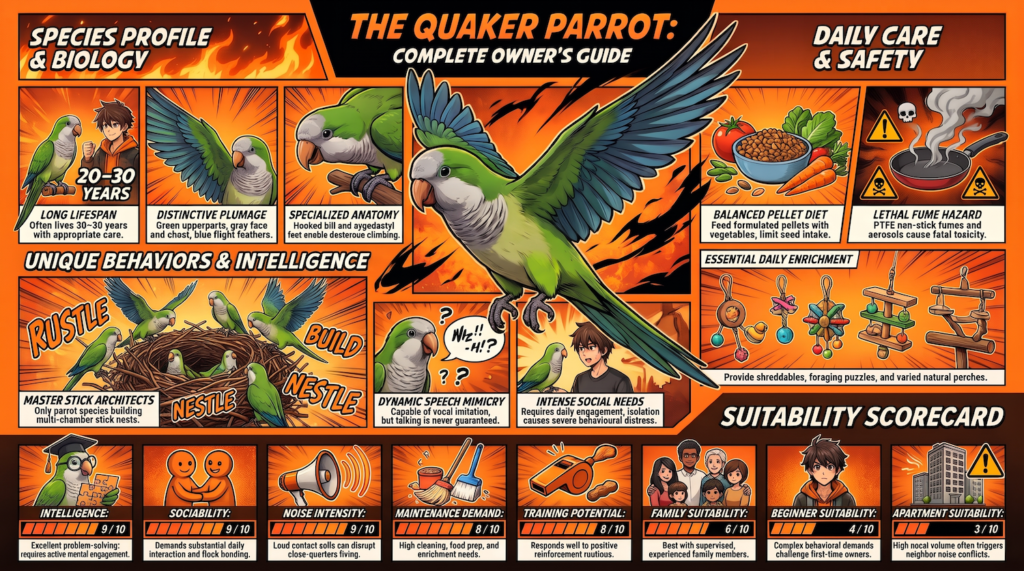
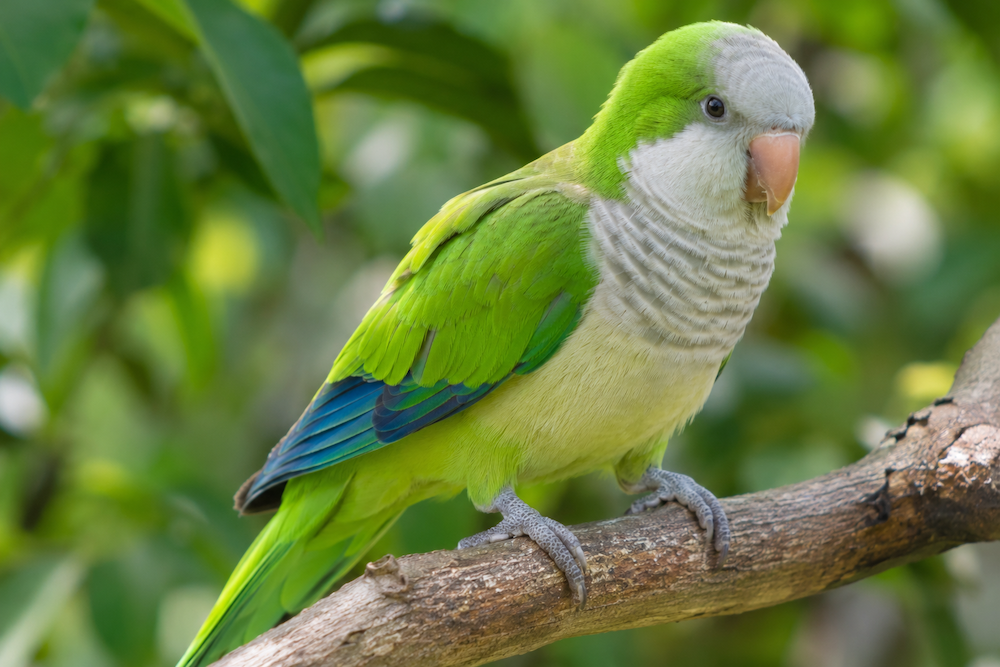







Intelligent, talkative and bursting with personality, the Quaker Parrot is a fascinating small parrot famous for its remarkable talking abilities, extraordinary nest-building skills, affectionate nature and wonderfully mischievous behaviour.
🧠 QUICK SNAPSHOT
Trait | Quaker Parrot |
|---|---|
Scientific Name | Myiopsitta monachus |
Other Names | Monk Parakeet, Quaker Parakeet, Monk Parrot |
Pet Type | Companion Bird / Small Parrot |
Natural Origin | South America, particularly Argentina, Brazil, Bolivia, Paraguay and Uruguay |
Typical Lifespan | Approximately 20–30 years in captivity |
Adult Size | Approximately 28–30 cm, including tail |
Adult Weight | Approximately 90–150 g |
Feather Type | Smooth, dense plumage |
Natural Colours | Green body, grey face and chest, blue flight feathers |
Captive Colour Varieties | Blue, yellow, white, cinnamon and other mutations |
Diet | Primarily herbivorous / Omnivorous |
Activity | Diurnal |
Temperament | Intelligent, playful, social, vocal and sometimes territorial |
Noise Level | Moderate to high |
Social Needs | Very high; requires extensive interaction and enrichment |
Housing | Spacious, secure bird enclosure with supervised flight opportunities |
Grooming | Regular bathing opportunities and nail monitoring |
Exercise Needs | High; daily flight and climbing opportunities |
Talking Ability | Excellent for a relatively small parrot |
Training Ability | High; responds well to positive reinforcement |
Beginner Friendly? | Possible, but demanding for inexperienced owners |
Famous Feature | The only parrot species known for routinely constructing large communal stick nests |
📚 OVERVIEW
The Quaker Parrot, also known as the Monk Parakeet, is a small, highly intelligent parrot native to South America. Its bright green plumage, grey face and chest, and long tapered tail create a distinctive appearance that has made it popular among bird enthusiasts.
Quaker Parrots are particularly famous for their intelligence, talking abilities and strong social personalities. Many learn to imitate human words, household sounds and familiar phrases. They can also develop close relationships with caregivers, although their independent nature means they may occasionally display stubborn or territorial behaviour.
One of their most extraordinary characteristics is their nest-building ability. Unlike most parrots, which nest in tree cavities or similar sheltered spaces, Quaker Parrots construct elaborate stick nests. Wild colonies may build enormous communal structures containing separate nesting chambers for multiple pairs.
Their care requires a spacious enclosure, daily exercise, a balanced diet, substantial mental stimulation, regular social interaction and access to an avian veterinarian. Quaker Parrots can be rewarding companions, but their vocal behaviour, intelligence and long lifespan make them a significant commitment.
✅ PROS & CONS
👍 Pros
Highly intelligent and entertaining
Excellent talking and mimicry abilities
Often affectionate with familiar caregivers
Fascinating natural nest-building behaviour
Responds well to positive reinforcement training
Playful, curious and energetic
Beautiful natural and captive-bred colours
Long-lived companion with appropriate care
👎 Cons
Can be loud and demanding
Requires substantial daily attention
May develop territorial behaviour
Can bite when frightened or frustrated
Needs extensive mental stimulation
May chew furniture and household objects
Long lifespan requires decades of commitment
Ownership is restricted or prohibited in some countries or regions
Are Quaker Parrots Good Pets?
Yes. Quaker Parrots can make excellent companions for experienced or well-prepared bird owners.
They’re intelligent, entertaining and often develop close relationships with familiar people.
However, their demanding social needs, vocal behaviour and long lifespan require careful consideration.
Are Quaker Parrots Good for Beginners?
Quaker Parrots can be suitable for dedicated beginners who thoroughly research their care.
However, they’re generally more demanding than many smaller companion birds.
Their intelligence, territorial tendencies and need for daily interaction can be challenging for inexperienced owners.
How Long Do Quaker Parrots Live?
Quaker Parrots commonly live approximately 20–30 years in captivity.
Some individuals may live longer with excellent care.
Their lifespan depends on genetics, nutrition, exercise, veterinary attention and environmental conditions.
How Big Do Quaker Parrots Get?
Adult Quaker Parrots typically measure approximately 28–30 cm from head to tail.
They generally weigh around 90–150 grams.
Although relatively small, they have sturdy bodies and surprisingly powerful beaks.
What Colours Do Quaker Parrots Come In?
Wild Quaker Parrots are primarily green with grey faces and chests.
Their flight feathers may display attractive blue colouring.
Selective breeding has produced additional colour mutations, including blue, yellow, white and cinnamon varieties.
Are Quaker Parrots Friendly?
Many Quaker Parrots are friendly and sociable when properly raised and socialised.
They often enjoy interacting with familiar caregivers and participating in household activities.
However, individual temperament varies, and some birds become protective of their cages or favourite objects.
Are Quaker Parrots Affectionate?
Yes.
Some Quaker Parrots enjoy gentle head scratches, sitting near caregivers and engaging in interactive play.
They may develop strong social bonds with familiar people.
However, affection should always occur on the bird’s terms, and unwanted handling should be avoided.
Do Quaker Parrots Bond With One Person?
Quaker Parrots can develop particularly strong relationships with individual caregivers.
However, they can also form positive relationships with multiple household members.
Regular, gentle interaction with different people may help reduce excessive attachment and territorial behaviour.
Can Quaker Parrots Talk?
Yes.
Quaker Parrots are widely recognised as talented vocal mimics.
Many learn words, phrases, whistles and household sounds.
Their talking ability varies considerably between individuals, and not every Quaker Parrot will learn to speak.
How Many Words Can a Quaker Parrot Learn?
Some Quaker Parrots develop vocabularies containing dozens of words or phrases.
Exceptionally talented individuals may learn considerably more.
However, there is no guaranteed vocabulary size, and speech development depends on individual ability, experience and interaction.
Are Quaker Parrots Intelligent?
Yes.
Quaker Parrots demonstrate impressive learning, problem-solving and social abilities.
They can learn routines, respond to training cues and manipulate objects.
Their extraordinary communal nest-building behaviour also reflects complex behavioural adaptations.
Can Quaker Parrots Learn Tricks?
Yes.
Quaker Parrots respond well to reward-based training.
They may learn to step onto a hand, turn around, retrieve objects and perform other simple behaviours.
Short, enjoyable training sessions are particularly effective.
Are Quaker Parrots Noisy?
Yes.
Quaker Parrots can be quite vocal, producing loud calls, chatter, whistles and repeated sounds.
Their noise level may be unsuitable for some apartments or noise-sensitive households.
Providing enrichment and social interaction helps reduce boredom-related calling, although normal vocalisation cannot be eliminated.
Why Do Quaker Parrots Scream?
Screaming may occur during excitement, alarm, social communication or attempts to attract attention.
Excessive calling can also result from boredom, stress or inadequate sleep.
Understanding the cause is important before attempting behavioural modification.
Are Quaker Parrots Aggressive?
Quaker Parrots aren’t inherently aggressive, but some individuals can become territorial.
They may defend cages, food bowls, nesting materials or favourite locations.
Positive reinforcement, appropriate socialisation and respecting body language can help manage defensive behaviour.
Do Quaker Parrots Bite?
Yes.
Like all parrots, Quakers may bite when frightened, frustrated, overstimulated or defending something important.
Their beaks are strong enough to cause painful injuries.
Learning to recognise warning signals and avoiding forced handling reduces the risk.
Are Quaker Parrots Good With Children?
Quaker Parrots can live successfully in households with children when interactions are carefully supervised.
However, they may bite if handled roughly or unexpectedly.
Children should be taught to respect the bird’s personal space and avoid placing fingers near its beak.
Do Quaker Parrots Need Companions?
Quaker Parrots are highly social birds.
They benefit from extensive daily interaction and may also enjoy compatible avian companionship.
However, introducing another bird requires careful planning, quarantine and gradual introductions.
Human interaction alone may not meet every bird’s social needs.
Can Two Quaker Parrots Live Together?
Yes.
Compatible Quaker Parrots may form strong social bonds and live together successfully.
However, territorial disputes can occur, particularly around nesting areas.
Introductions should be gradual, and birds should initially have separate accommodation.
Can Quaker Parrots Live With Other Birds?
Some Quaker Parrots coexist peacefully with other bird species.
However, their territorial behaviour and strong beaks can create risks.
Different species should generally have separate enclosures unless compatibility has been carefully established under expert guidance.
What Size Cage Does a Quaker Parrot Need?
Quaker Parrots require spacious accommodation that allows climbing, wing stretching and active movement.
A cage measuring approximately 90 × 60 × 90 cm is a useful minimum starting point for one bird, although larger accommodation is strongly preferred.
Daily supervised flight or exercise outside the cage is also important.
Do Quaker Parrots Need Daily Exercise?
Yes.
Quaker Parrots are active birds that require regular movement, climbing and opportunities for flight.
Daily supervised exercise in a safe environment supports physical and mental wellbeing.
An appropriately sized aviary can provide additional opportunities for natural movement.
What Toys Do Quaker Parrots Like?
Quaker Parrots often enjoy chewable toys, foraging puzzles, climbing ropes and bird-safe wooden objects.
Many also enjoy manipulating small objects and carrying nesting materials.
Toys should be inspected regularly for damage, loose fibres and potential entanglement hazards.
Why Do Quaker Parrots Collect Sticks?
Collecting and arranging sticks reflects their natural nest-building instincts.
Wild Quaker Parrots construct elaborate nests using twigs and branches.
Captive birds may display similar behaviour by collecting toys, paper or other available materials.
What Do Quaker Parrots Eat?
Quaker Parrots require a balanced diet.
A suitable diet generally includes high-quality formulated parrot pellets, fresh vegetables, appropriate leafy greens and limited fruit.
Seeds and nuts may be offered in controlled quantities, particularly as training rewards.
Fresh drinking water must always be available.
What Foods Are Dangerous for Quaker Parrots?
Several common household foods are dangerous to parrots.
These include avocado, chocolate, caffeine, alcohol and foods containing excessive salt.
Onion and garlic should also be avoided.
Birds should never be offered foods known to be toxic or nutritionally inappropriate.
Do Quaker Parrots Need Baths?
Yes.
Quaker Parrots benefit from regular opportunities to bathe or shower.
Some enjoy shallow dishes of clean water, while others prefer gentle misting.
Bathing helps maintain healthy feathers and supports natural grooming behaviour.
How Much Sleep Do Quaker Parrots Need?
Quaker Parrots generally benefit from approximately 10–12 hours of uninterrupted sleep each night.
A quiet, dark and secure sleeping environment is important.
Inadequate sleep may contribute to stress and behavioural difficulties.
What Health Problems Are Common in Quaker Parrots?
Potential concerns include obesity, nutritional deficiencies, feather-damaging behaviour, respiratory disease and reproductive problems.
Quaker Parrots may also be affected by infectious diseases such as psittacosis and psittacine beak and feather disease.
A balanced diet, appropriate exercise and regular avian veterinary examinations help support long-term health.
Are Quaker Parrots Legal to Keep as Pets?
Quaker Parrots are legal companion birds in some countries, but some countries or regions restrict or prohibit their ownership, breeding or importation.
These restrictions are often related to concerns about escaped birds establishing wild populations, agricultural damage and environmental impacts.
In Australia, Quaker Parrots are exotic birds, and possession or trade is subject to applicable Commonwealth and state or territory regulations. Requirements vary, so prospective owners must confirm the current rules with the relevant authorities before obtaining one.
What Makes the Quaker Parrot Unique?
Imagine a small green parrot capable of learning human words, solving puzzles, building an elaborate home from sticks and living in a bustling neighbourhood of other parrots.
That’s the extraordinary Quaker Parrot.
These fascinating birds possess one of the most unusual nesting behaviours in the entire parrot family.
While most parrots nest in tree cavities, Quaker Parrots construct their own elaborate stick nests.
And these aren’t ordinary bird nests.
Wild Quaker Parrots may build enormous communal structures containing multiple separate nesting chambers.
Some nests become so substantial that they can remain in use for years, with generations of birds adding new material and maintaining existing sections.
These structures are often built high in trees, although introduced populations sometimes use utility poles and other human-made structures.
Their unusual nesting habits have helped Quaker Parrots establish wild populations outside their native South American range.
Another remarkable characteristic is their intelligence.
Quaker Parrots are talented learners and can develop impressive abilities to imitate human speech.
Some individuals learn words and phrases in appropriate contexts, although imitation doesn’t necessarily mean they understand language as humans do.
Their social behaviour is equally fascinating.
Wild Quaker Parrots live in groups and communicate through a variety of calls.
Research has revealed that their vocal communication is more complex than simple repetitive squawking.
They can also recognise familiar social companions and respond to changes within their groups.
Their natural appearance is distinctive.
Wild Quaker Parrots have bright green bodies, grey faces and chests, and attractive blue flight feathers.
Their long, tapered tails give them an elegant appearance in flight.
Selective breeding has produced striking colour mutations, including beautiful blue and yellow varieties.
Another surprising characteristic is their remarkable adaptability.
Quaker Parrots have established introduced populations in several parts of the world, including regions with climates considerably different from their native habitats.
Their communal nests may provide sheltered spaces that help them cope with environmental conditions.
However, this adaptability also creates conservation and agricultural concerns in areas where they’re not native.
And despite their relatively small size, Quaker Parrots possess enormous personalities.
They may enthusiastically rearrange toys, collect objects, imitate household sounds and investigate almost anything within reach.
Their combination of intelligence, curiosity and vocal ability makes them fascinating companions for dedicated bird enthusiasts.
The Quaker Parrot isn’t simply a colourful talking bird — it’s an extraordinary architect, intelligent problem-solver and highly social parrot with one of the most remarkable nesting behaviours in the bird world.