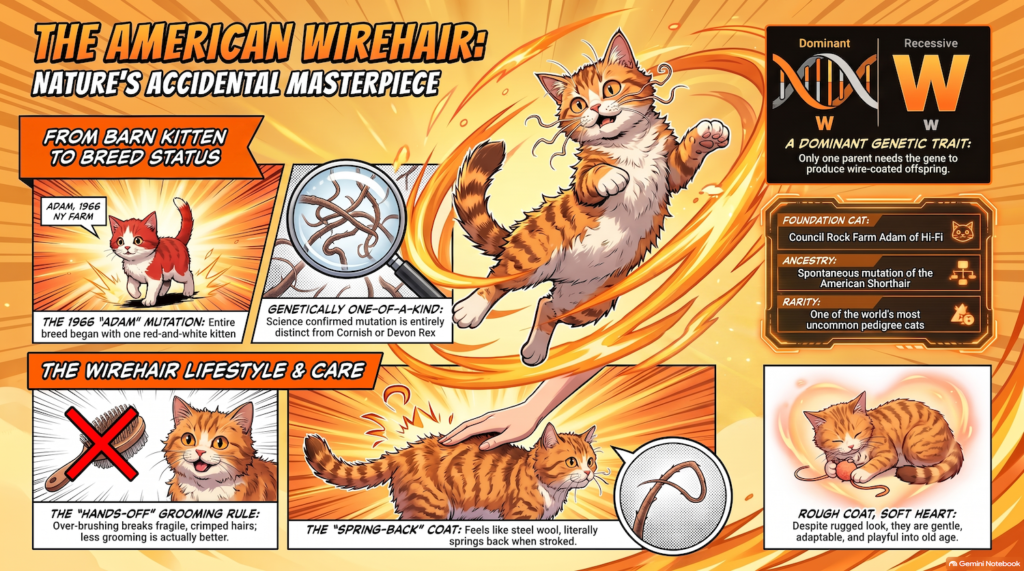





Curly-whiskered, affectionate, and uniquely American — the American Wirehair is a rare cat famous for its springy, crimped coat, easygoing personality, and an extraordinary origin story that began with a single farm kitten in New York.
🧠 QUICK SNAPSHOT
- Temperament: Affectionate, easygoing, playful
- Energy Level: Moderate
- Size: Medium to Large
- Good With Families: Excellent
- Indoor Living: Excellent
- Trainability: High
- Grooming: Low to Moderate
- Best For: Families, apartment dwellers, multi-pet homes, people wanting a relatively relaxed companion
- Typical Lifespan: Around 12–16 years
📚 OVERVIEW
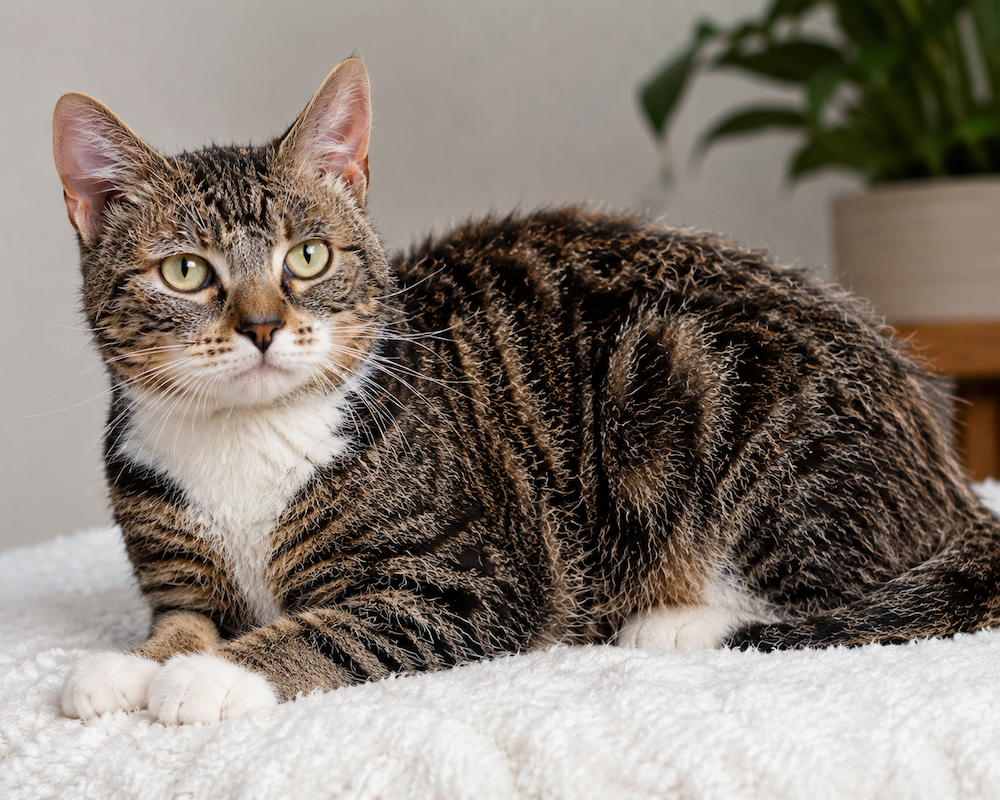
The American Wirehair is one of the more unusual naturally occurring cat breeds. Its defining feature is an extraordinary wiry, springy coat, with individual hairs bent, hooked, or crimped rather than lying smooth against the body. Even the whiskers may appear curled.
The entire breed traces back to a spontaneous genetic mutation that appeared in upstate New York in 1966.
A litter of farm kittens included an unusual red-and-white male with a coat unlike that of his littermates. The kitten, later named Council Rock Farm Adam of Hi-Fi, attracted the attention of breeder Joan O’Shea, who recognised that his distinctive fur could form the foundation of a new breed.
American Shorthairs subsequently played an important role in developing the American Wirehair, which helps explain the breed’s sturdy build and familiar, rounded appearance.
Unlike some highly active pedigree cats, American Wirehairs tend to have a balanced temperament. They are typically playful and curious without being relentlessly demanding, affectionate without always insisting on constant attention.
The unusual coat attracts attention.
The adaptable personality is what makes many people want to live with one.
✅ PROS & CONS
Pros
- Affectionate and easygoing
- Usually excellent with families
- Moderate, manageable activity level
- Adapts well to indoor and apartment living
- Often good with other pets
- Distinctive coat without extreme grooming demands
Cons
- Extremely rare in many countries
- Wire coat requires gentle grooming
- Can develop oily skin in some individuals
- Doesn’t necessarily enjoy constant handling
- Not hypoallergenic
- Finding an experienced breeder may be difficult
Is an American Wirehair a Good Family Cat?
Yes, the American Wirehair is generally an excellent family cat. Its combination of affection, playfulness, adaptability, and relative calm makes it suitable for many different households.
These cats tend to enjoy human company without necessarily demanding attention every minute of the day. Many are happy playing with family members and then settling nearby while everyone gets on with other activities.
American Wirehairs can live successfully with respectful children, particularly when children understand that cats should be allowed to decide when interactions end.
They can also coexist with other cats and cat-friendly dogs after appropriate introductions.
The breed retains the hunting instincts common to domestic cats, so smaller prey animals such as pet rodents and birds should always be securely protected.
For owners who want a friendly cat that sits somewhere between an extremely independent breed and an intensely demanding one, the American Wirehair offers a particularly appealing balance.
Can an American Wirehair Live Indoors or in an Apartment?
Yes, the American Wirehair is very well suited to indoor and apartment living.
Its moderate energy level means it doesn’t require enormous amounts of space, provided its home includes appropriate opportunities for climbing, scratching, playing, and exploring.
A sturdy cat tree, scratching posts, window perches, tunnels, puzzle feeders, and a selection of interactive toys can create an excellent indoor environment.
Daily play remains important. Apartment-friendly shouldn’t be interpreted as inactive.
Secure indoor living protects cats from traffic, fights, infectious diseases, poisoning, predators, and other hazards. A secure cat enclosure can provide additional stimulation where practical.
American Wirehairs are typically adaptable enough to fit into different lifestyles, but they still need companionship and environmental enrichment.
A smaller home filled with interesting things to do can be considerably better for a cat than a large property offering little stimulation.
How Much Exercise and Play Does an American Wirehair Need?
The American Wirehair has moderate exercise requirements and should receive interactive play every day.
Several shorter play sessions generally work well. Fishing-wand toys, balls, tunnels, toy mice, climbing structures, and chasing games allow the cat to express natural stalking, pouncing, and hunting behaviours.
Puzzle feeders and treat hunts can provide additional mental stimulation.
American Wirehairs often retain a playful side into adulthood but generally aren’t as relentlessly active as breeds such as the Abyssinian, Somali, or Oriental Shorthair.
This can make them easier companions for people wanting an interactive cat without having to provide near-constant entertainment.
Regular activity remains important for weight management, particularly as the cat ages.
A healthy American Wirehair should be sturdy and muscular rather than overweight, and combining appropriate portions with daily exercise helps maintain that condition.
Is an American Wirehair Easy to Train?
Yes, the American Wirehair is generally quite trainable. These cats tend to be intelligent, curious, and responsive to positive interaction.
Using treats, toys, praise, and clicker training, owners can teach useful behaviours such as coming when called, entering a carrier voluntarily, using designated scratching areas, and accepting routine handling.
Some individuals can also learn simple tricks, retrieve toys, or become comfortable walking on a harness.
Practical training is particularly worthwhile. Teaching acceptance of nail trimming, dental checks, coat inspection, and carrier travel during kittenhood can make routine care considerably easier later.
Sessions should remain short and rewarding. Punishment should be avoided because it can create anxiety without explaining what the cat should do instead.
The American Wirehair may not always display the relentless problem-solving enthusiasm of some highly active breeds, but it is perfectly capable of learning household routines — especially those involving dinner.
Does an American Wirehair Shed?
Yes, the American Wirehair does shed, although the amount varies between individual cats.
Its coat is unusual because the hairs can be crimped, bent, or hooked, producing the characteristic springy texture. The degree of wiriness also varies considerably between cats.
Despite appearances, aggressive brushing isn’t desirable. Excessive grooming can damage the distinctive hairs and affect the coat’s texture.
A gentle weekly grooming session is usually sufficient, although some cats require even less frequent brushing. Loose hairs can often be removed carefully by hand or with an appropriate soft grooming tool.
Some American Wirehairs can develop oily skin and may occasionally benefit from bathing under appropriate guidance.
The breed is not hypoallergenic. The unusual coat doesn’t prevent the production of feline allergens, which originate primarily in saliva and skin secretions.
Those extraordinary hairs are different.
The cat underneath them is still very much a cat.
What Health Problems Are Common in an American Wirehair?
The American Wirehair is generally considered a healthy, robust breed, but responsible breeding and routine veterinary care remain important.
Because American Shorthairs contributed significantly to the breed’s development, breeders should remain aware of health conditions occurring within related lines.
Hypertrophic cardiomyopathy (HCM) is one potential concern. This condition causes abnormal thickening of the heart muscle and can affect cats across many breeds and mixed populations.
Some American Wirehairs may also experience skin or coat problems, including excessive oiliness or irritation, making regular inspection useful.
Beyond this, they can develop common feline conditions including dental disease, obesity, kidney disease, arthritis, and urinary problems as they age.
The breed’s rarity means there is less extensive breed-specific health data than exists for many more common cats. Claims that it is completely free of inherited disease should therefore be treated cautiously.
Regular veterinary care, dental maintenance, appropriate nutrition, exercise, and weight control can help an American Wirehair achieve a lifespan commonly around 12–16 years or potentially longer.
⭐ Why Does the American Wirehair Have Such Strange Fur?
The American Wirehair’s coat exists because of a spontaneous genetic mutation that appeared completely unexpectedly.
In 1966, a litter of kittens was born on a farm in Verona, New York. One surviving male kitten had an extraordinary red-and-white coat that felt wiry and springy rather than conventionally smooth.
He became known as Adam.
Breeder Joan O’Shea acquired Adam and began investigating whether his unusual coat could be inherited.
It could.
The mutation responsible for the American Wirehair coat is generally described as dominant, meaning only one copy of the relevant variant is needed for the characteristic coat to appear.
The mutation affects individual hairs, producing bends, hooks, and crimps. Even the whiskers can be affected.
From one accidental farm kitten came an entirely new pedigree breed.
Nature supplied the mutation.
Humans simply decided it was too interesting to lose.
⭐ Is the American Wirehair the Cat Version of a Wirehaired Dog?
Not really.
The word “wirehair” makes comparison with breeds such as Wire Fox Terriers or German Wirehaired Pointers almost inevitable, but the coats aren’t genetically equivalent.
Wirehaired dogs were developed through their own canine coat genetics and selective breeding histories.
The American Wirehair’s coat arose from an independent feline mutation.
Even the texture can be surprising. People sometimes imagine a harsh, bristly cat, but American Wirehair coats vary considerably. Some feel relatively soft and springy, while others have a more pronounced coarse or wiry texture.
The strongest crimping is often found on areas such as the back, hips, head, and tail.
So “wirehair” describes the unusual appearance and texture rather than implying any biological relationship with wire-coated dogs.
This is very much a cat-specific experiment performed by genetics.
⭐ Is Every American Wirehair’s Coat the Same?
No — and this is one of the fascinating things about the breed.
The amount of crimping can vary significantly from one American Wirehair to another.
In strongly coated cats, all three major types of hair — guard, awn, and down hairs — can be affected by the mutation. The hairs may bend, hook, twist, or form tight crimps, creating a dense, resilient texture.
Other cats can display a much milder effect.
Whiskers may also curl or kink rather than extending straight from the face.
Coat texture can even change as kittens mature, meaning the final adult coat isn’t always obvious immediately after birth.
The ideal isn’t simply to produce the roughest possible cat. Responsible breeding needs to balance coat characteristics with healthy skin, good structure, genetic diversity, and temperament.
After all, the unusual fur gets people’s attention.
A healthy, friendly cat is what actually matters.
⭐ How Rare Is the American Wirehair?
Very rare.
Despite having been recognised for decades, the American Wirehair has never achieved the worldwide popularity of breeds such as the Maine Coon, Ragdoll, British Shorthair, or Siamese.
Its breeding population remains relatively small, and the breed can be especially difficult to find outside North America.
That rarity produces an interesting contradiction.
The American Wirehair wasn’t created through decades of complicated experimentation. It began with a naturally occurring mutation in an ordinary farm-cat population.
Yet the resulting breed is now considerably harder to encounter than many cats with much more elaborate histories.
Someone can therefore spend years around cats without ever meeting a genuine American Wirehair.
And the entire worldwide breed ultimately traces its defining characteristic back to one unusually fuzzy kitten born on a New York farm in 1966.