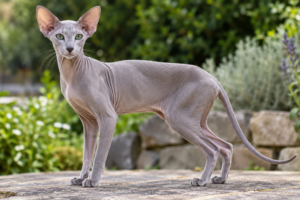
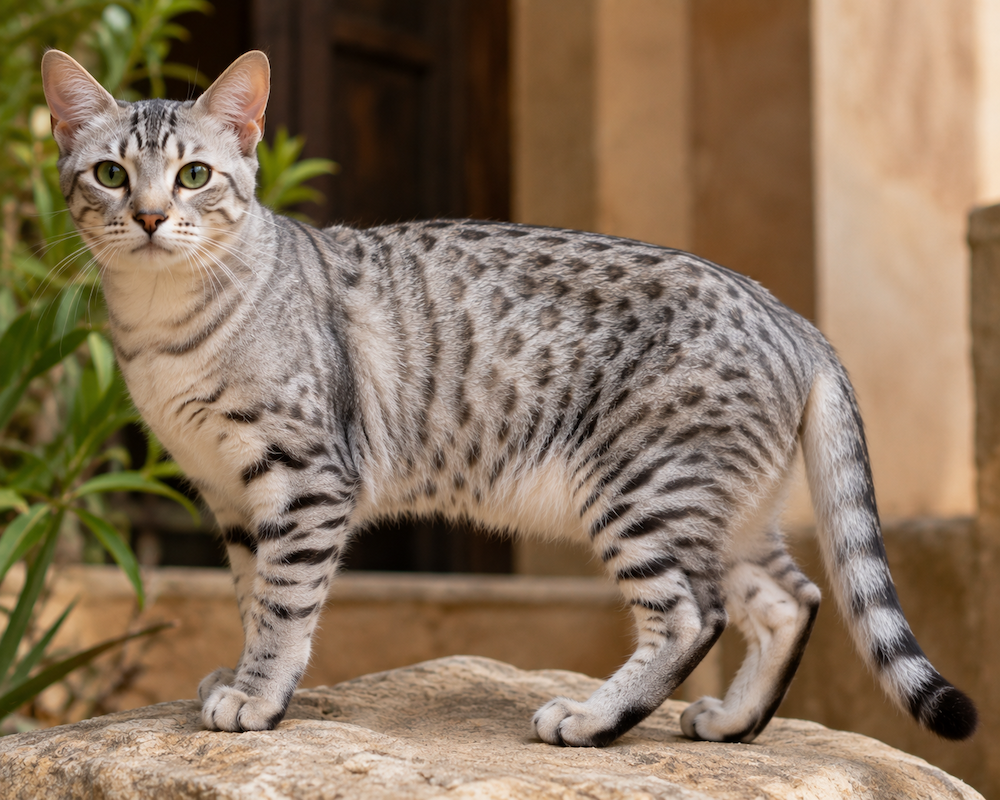






Athletic, intelligent, and shaped by life in one of the hottest regions on Earth — the Arabian Mau is a naturally developed cat from the Arabian Peninsula, combining impressive survival instincts with an affectionate, energetic personality that can adapt remarkably well to family life.
🧠 QUICK SNAPSHOT
- Temperament: Affectionate, intelligent, energetic
- Energy Level: High
- Size: Medium
- Good With Families: Very Good
- Indoor Living: Very Good with sufficient enrichment
- Trainability: High
- Grooming: Low
- Best For: Active families, interactive owners, warm climates, homes offering plenty of enrichment
- Typical Lifespan: Around 12–15 years
📚 OVERVIEW
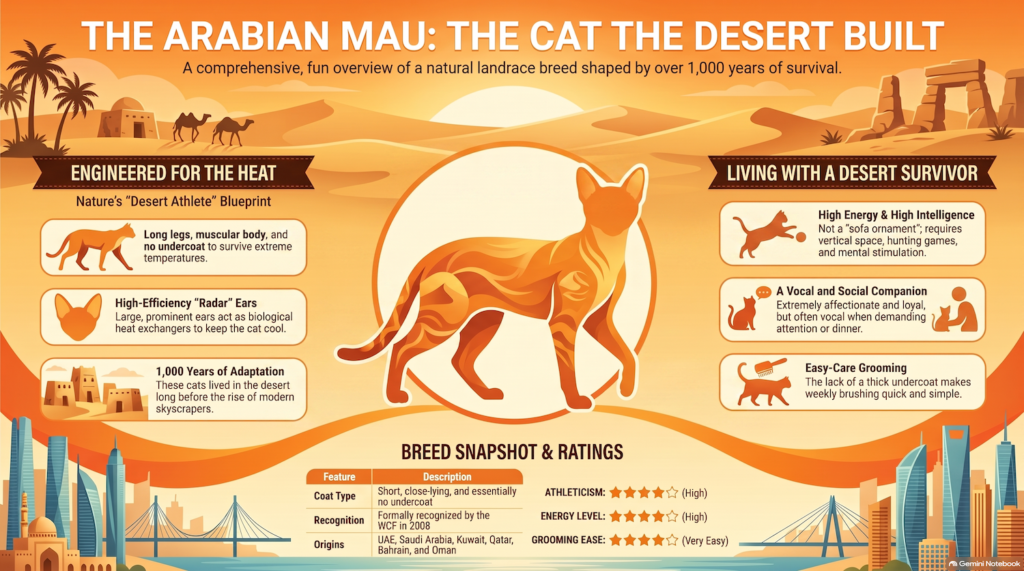
The Arabian Mau is quite different from many modern pedigree cats. Rather than being deliberately created by breeders to achieve a particular appearance, it developed naturally from cats that lived for generations across the Arabian Peninsula.
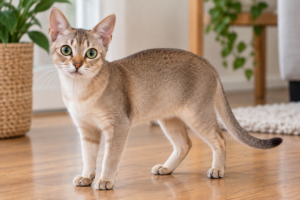
Cats surviving in this environment had to cope with extreme heat, limited resources, and demanding conditions. Over time, a naturally athletic, adaptable cat emerged with a short coat, relatively long legs, strong body, and large ears.
Arabian Maus occur in numerous colours and patterns rather than having one highly restricted signature coat. Their overall appearance reflects a functional natural cat rather than an exaggerated show breed.
The breed became formally recognised in the modern cat fancy after efforts to document and standardise these indigenous cats. However, countless cats throughout the Arabian Peninsula may resemble the Arabian Mau without necessarily having a registered pedigree.
At home, Arabian Maus are typically active, intelligent, curious, and affectionate. They can form strong relationships with their families while retaining the independence and confidence you might expect from a cat shaped by generations of natural survival.
✅ PROS & CONS
Pros
- Affectionate and loyal with family
- Highly intelligent and alert
- Athletic and playful
- Extremely easy-care short coat
- Generally robust natural body type
- Well suited to active households
Cons
- High exercise requirements
- Needs substantial environmental enrichment
- Can become bored when under-stimulated
- Strong hunting instincts
- May be independent and strong-willed
- Pedigree Arabian Maus can be difficult to find outside their home region
Is an Arabian Mau a Good Family Cat?
Yes, the Arabian Mau can be a very good family cat, particularly for an active household that appreciates an intelligent and energetic companion.
These cats can develop strong bonds with their owners and often enjoy being involved in everyday household life. Many are affectionate without necessarily wanting to spend every moment being carried or sitting on someone’s lap.
Arabian Maus can live successfully with respectful children, particularly when children understand feline body language and interact through games rather than forced handling.
They may also live successfully with other cats and cat-friendly dogs when introduced gradually. Individual temperament and early socialisation are important, particularly because naturally developed cats can retain considerable confidence and independence.
Their hunting instincts may make homes containing small prey animals more complicated, and secure separation may be necessary.
For the right household, the Arabian Mau offers an appealing combination of affection, intelligence, athleticism, and independence.
Can an Arabian Mau Live Indoors or in an Apartment?
Yes, an Arabian Mau can live successfully indoors or in an apartment, but owners need to accommodate its high activity level.
This is an athletic cat that benefits greatly from vertical territory. Tall cat trees, shelves, climbing structures, window perches, scratching towers, and other elevated areas dramatically increase the usable space inside a home.
Daily interactive play is essential, while puzzle feeders, treat hunts, tunnels, and rotating toys provide additional mental stimulation.
Secure indoor living can protect cats from traffic, infectious diseases, poisoning, fights, and other hazards. A secure outdoor enclosure can provide additional enrichment.
The Arabian Mau’s history as a free-ranging natural cat means an empty apartment offering little stimulation isn’t an ideal environment.
However, apartment size alone doesn’t determine quality of life. A thoughtfully designed smaller home filled with climbing opportunities, play, interesting activities, and human interaction can work extremely well.
How Much Exercise and Play Does an Arabian Mau Need?
The Arabian Mau is a high-energy cat requiring substantial daily exercise and mental stimulation.
Several interactive play sessions spread throughout the day are preferable to one occasional burst of activity. Fishing-wand toys, balls, tunnels, climbing structures, chasing games, and toys encouraging stalking and pouncing are particularly appropriate.
These cats are naturally athletic and can be excellent jumpers, so providing vertical exercise is important.
Mental challenges matter too. Puzzle feeders, scent games, hidden treats, clicker training, and frequently rotated toys can help keep an intelligent Arabian Mau occupied.
Its background also helps explain its strong hunting behaviour. Games that allow the cat to stalk, chase, capture, and finally receive a small food reward can provide a satisfying approximation of the natural hunting sequence.
An under-stimulated Arabian Mau may create its own activities.
Given the breed’s intelligence and athletic ability, its definition of entertainment may be considerably more adventurous than yours.
Is an Arabian Mau Easy to Train?
Yes, the Arabian Mau is generally intelligent and capable of learning quickly, although its independent nature means training works best when the cat sees a reason to participate.
Positive reinforcement using treats, toys, praise, and play is the most effective approach.
Arabian Maus can potentially learn to come when called, enter a carrier voluntarily, use designated scratching areas, retrieve toys, perform simple tricks, and walk on a harness.
Clicker training provides excellent mental stimulation while strengthening communication between cat and owner.
Practical training is equally useful. Teaching comfortable nail handling, dental checks, carrier use, and veterinary-style examinations can make routine care significantly easier.
Punishment should be avoided because it can damage trust without teaching the desired behaviour.
The Arabian Mau’s intelligence developed in a context where solving problems could have genuine survival value. Modern owners can put that brain to much more constructive use through games, training, and enrichment.
Does an Arabian Mau Shed?
Yes, but the Arabian Mau’s short coat is extremely easy to maintain.
Its coat developed in a very hot environment and typically lies close to the body without the heavy insulation associated with cats originating in cold climates.
A gentle brushing approximately once a week is normally sufficient to remove loose hair, distribute natural skin oils, and keep the coat in good condition. More frequent brushing may be useful during periods of increased shedding.
Bathing is rarely required unless there is a particular reason.
Routine maintenance should also include nail trimming, dental care, and checks of the ears, eyes, skin, and overall body condition.
The Arabian Mau is not hypoallergenic. Short fur and straightforward grooming don’t prevent the production of the proteins in feline saliva and skin secretions responsible for most cat allergies.
For owners wanting a low-maintenance cat from a grooming perspective, however, the Arabian Mau is an excellent candidate.
What Health Problems Are Common in an Arabian Mau?
The Arabian Mau is a naturally developed breed and isn’t currently associated with the extensive list of breed-specific inherited disorders seen in some heavily selected pedigree populations.
That does not mean Arabian Maus are immune to disease.
They can still develop common feline health problems including dental disease, obesity, kidney disease, urinary tract disorders, heart disease, parasites, and infectious illnesses.
Because the formal pedigree population is comparatively small and the breed is relatively uncommon internationally, there is also less extensive breed-specific health research available than exists for many established pedigree breeds. Claims that the Arabian Mau has “no genetic health problems” should therefore be treated cautiously.
Responsible breeders should maintain genetic diversity, understand the health histories of their cats, and use veterinary screening where appropriate.
Regular veterinary examinations, vaccination and parasite control appropriate to the cat’s location, dental care, balanced nutrition, weight management, and early investigation of health changes provide the best foundation for a long life.
Many Arabian Maus can live around 12–15 years or potentially longer with appropriate care.
⭐ Did the Arabian Mau Really Develop in the Desert?
Essentially, yes — although it’s more accurate to describe it as a cat naturally shaped by the hot, arid environments and human settlements of the Arabian Peninsula rather than imagining generations of cats living alone among endless sand dunes.
Free-ranging cats have lived around settlements across the region for a very long time. Animals capable of coping with extreme temperatures and scarce resources had an obvious survival advantage.
Several features of the Arabian Mau make sense in that environment.
Its coat is short and relatively close-fitting rather than thick and heavily insulating.
The body is athletic and functional.
And then there are those large ears.
Large ears provide excellent hearing, but their relatively large surface area may also assist with heat dissipation — a characteristic seen in numerous animals from hot environments.
Unlike breeds deliberately designed according to a human aesthetic, much of the Arabian Mau’s appearance was shaped by a much tougher judge:
survival.
⭐ Why Does the Arabian Mau Have Such Large Ears?
The Arabian Mau’s impressive ears are one of its most characteristic features.
Their obvious purpose is hearing. Cats are exceptional at detecting high-frequency sounds, and independently rotating ears help them locate subtle noises — extremely useful for an animal hunting small prey.
But large ears can offer another potential advantage in a hot environment.
Blood flowing close to the surface of the ear can release heat into the surrounding air, helping with thermoregulation. This principle appears repeatedly among animals adapted to hot climates.
The Arabian Mau’s large ears therefore fit beautifully with its origins in the Arabian Peninsula.
That doesn’t mean its ears function as miniature air conditioners capable of protecting a cat from dangerous heat. Arabian Maus still require access to shade, water, and safe temperatures like any domestic cat.
But those ears are more than an attractive breed characteristic.
They are part of the Arabian Mau’s wonderfully functional appearance.
⭐ Is the Arabian Mau an Ancient Pedigree Breed?
This depends on what we mean by “breed.”
Cats resembling the Arabian Mau have existed across the Arabian Peninsula for generations, giving the population a history much older than its formal recognition by cat organisations.
However, the pedigree Arabian Mau is a relatively modern formalisation of this naturally occurring cat population.
Breeder Petra Müller played an important role in documenting cats from the region and establishing a breeding program. The World Cat Federation subsequently recognised the Arabian Mau in the late 2000s.
This distinction is important.
Humans didn’t suddenly invent the Arabian Mau when the breed standard was written. They documented and standardised a type of cat that already existed naturally in the region.
That’s very different from deliberately crossing established breeds to create something like a Toyger or Snowshoe.
In the Arabian Mau’s case, nature did most of the original breeding program.
Humans arrived much later with pedigrees and paperwork.
⭐ Is Every Street Cat in Dubai an Arabian Mau?
No.
This is an important distinction because the Arabian Mau is strongly associated with the Gulf region and visually resembles many free-ranging cats seen in places such as Dubai and Abu Dhabi.
A street cat living in the Arabian Peninsula may share ancestry, physical characteristics, and adaptations with the broader native cat population from which the Arabian Mau was formalised.
But that doesn’t automatically make every local cat a pedigree Arabian Mau.
Pedigree status requires documented ancestry and registration according to the requirements of the relevant feline organisation.
There’s also substantial variation among free-ranging domestic cats, particularly around cities where animals from many different backgrounds can interbreed.
So you may encounter a street cat that looks remarkably like an Arabian Mau — large ears, athletic body, long legs, short coat and all.
It may represent the same fascinating regional cat heritage.
It just doesn’t necessarily have the paperwork.