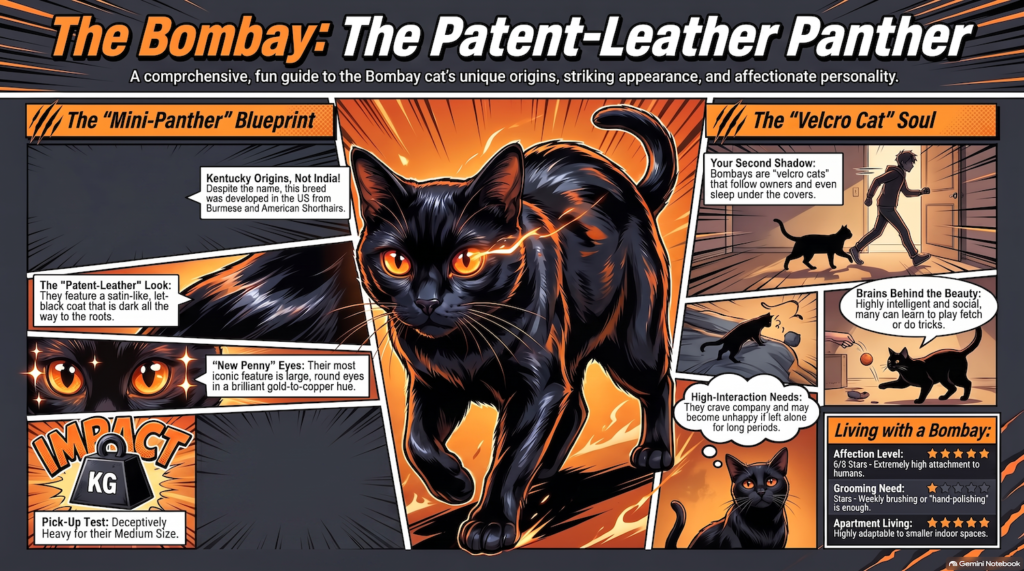
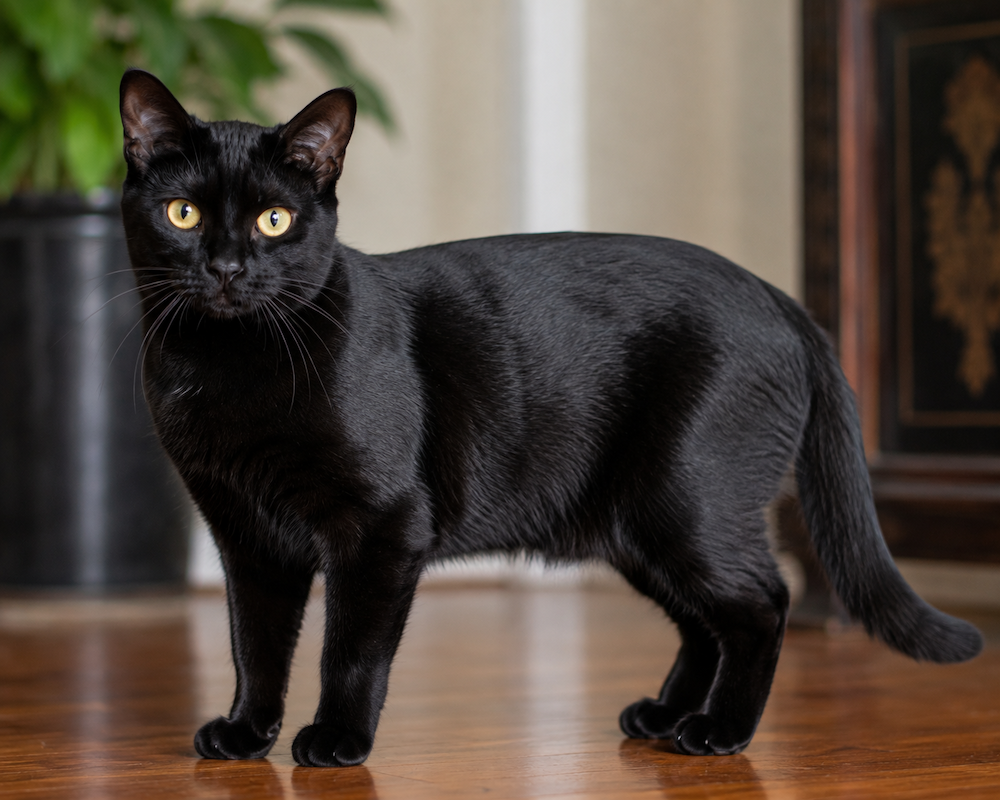






Sleek, affectionate, and often described as a miniature panther — the Bombay is a striking black cat with brilliant copper or gold eyes, a playful personality, and an enormous appetite for human companionship.
🧠 QUICK SNAPSHOT
- Temperament: Affectionate, sociable, playful
- Energy Level: Moderate to High
- Size: Medium
- Good With Families: Excellent
- Indoor Living: Excellent
- Trainability: High
- Grooming: Low
- Best For: Families, apartment dwellers, multi-pet homes, people wanting an affectionate companion
- Typical Lifespan: Around 12–16 years
📚 OVERVIEW
The Bombay is one of the cat world’s most convincing examples of appearance not matching ancestry. With its glossy jet-black coat, muscular body, rounded head, and striking copper or gold eyes, it was deliberately developed to resemble a miniature black panther. There is, however, no panther or other wild cat hiding in its pedigree.
The American Bombay was developed during the 20th century by American breeder Nikki Horner, who crossed black American Shorthairs with sable Burmese cats. Her objective was a domestic cat with the sleek black appearance of a small wild panther combined with an affectionate companion temperament.
The result is a cat that looks dramatic but is typically anything but wild in personality.
Bombays tend to be affectionate, confident, intelligent, and extremely interested in their humans. Many follow their owners around the house, seek out laps, sleep close to family members, and investigate whatever is happening.
Their short coat is exceptionally easy to maintain, while their moderate-to-high activity level makes them playful without necessarily requiring the almost constant activity of some highly athletic breeds.
✅ PROS & CONS
Pros
- Extremely affectionate and people-oriented
- Usually excellent with families
- Highly adaptable to indoor and apartment living
- Intelligent and playful
- Very low-maintenance coat
- Often gets along well with other social pets
Cons
- Doesn’t enjoy being routinely left alone for long periods
- Can be demanding of attention
- May become bored without interaction
- Some individuals can be quite vocal
- Weight gain can become a problem without appropriate diet and activity
- Genuine pedigree Bombays can be difficult to find in some countries
Is a Bombay a Good Family Cat?
Yes, the Bombay is generally an excellent family cat thanks to its affectionate, confident, and sociable personality. These cats tend to enjoy human company and frequently want to participate in everyday household activities rather than disappearing for hours on their own.
Bombays can be excellent companions for respectful children. Their playful nature makes interactive games enjoyable, while their affectionate temperament means many are equally happy settling onto a lap when playtime finishes.
They can also live successfully with other cats and cat-friendly dogs when introduced gradually. Individual personalities vary, and owners should never rush introductions simply because the breed has a reputation for sociability.
The bigger consideration is companionship. Many Bombays dislike spending extended periods alone and may be happier in households where someone is regularly home or where another compatible pet provides company.
For families wanting an interactive cat that combines playfulness with plenty of affection, the Bombay can be an outstanding choice.
Can a Bombay Live Indoors or in an Apartment?
Yes, the Bombay is particularly well suited to indoor and apartment living. It doesn’t require an enormous property, provided its home offers opportunities for play, climbing, exploration, scratching, and interaction.
Tall cat trees, window perches, scratching posts, shelves, tunnels, and comfortable elevated resting areas help create a stimulating three-dimensional environment even within a relatively small apartment.
Bombays also tend to appreciate warmth. Don’t be surprised to discover one occupying a sunny window, burrowing under a blanket, or selecting the warmest available human as its preferred sleeping location.
Daily interactive play remains essential. Apartment-friendly doesn’t mean exercise-free.
Secure indoor living also protects cats from traffic, fights, infectious disease, poisoning, predators, and other outdoor hazards. A secure cat enclosure can provide additional stimulation where practical.
For the Bombay, the availability of companionship and enrichment is generally much more important than the number of square metres in the home.
How Much Exercise and Play Does a Bombay Need?
The Bombay has a moderate-to-high activity level and should receive daily interactive play, climbing opportunities, and mental stimulation.
Several short play sessions distributed throughout the day work particularly well. Fishing-wand toys, balls, toy mice, tunnels, climbing structures, and games involving stalking and chasing allow the cat to express natural feline hunting behaviours.
Bombays are also intelligent, so mental challenges are valuable. Puzzle feeders, treat hunts, clicker training, rotating toys, and learning simple tricks can prevent boredom.
Some individuals enjoy retrieving toys and can develop games that seem surprisingly dog-like.
Regular activity is also important for weight management. The Bombay’s solid, muscular construction shouldn’t be confused with excess body weight, and owners should monitor body condition as their cat matures.
A well-exercised Bombay will still enjoy plenty of relaxation — preferably somewhere warm and conveniently close to its favourite person.
Is a Bombay Easy to Train?
Yes, the Bombay is generally easy to train for a cat because it is intelligent, curious, food-motivated, and interested in interacting with people.
Using positive reinforcement, owners can potentially teach behaviours such as coming when called, sitting, retrieving a toy, giving a paw, entering a carrier voluntarily, and walking on a harness.
Clicker training can be particularly useful because it turns learning into a game and gives the cat immediate feedback when it performs the desired behaviour.
Practical training is equally valuable. Teaching comfortable nail handling, carrier use, dental checks, and gentle body examination can make routine care considerably less stressful.
Training sessions should remain short and rewarding, and punishment should be avoided.
Bombays are also excellent observers. They quickly learn household routines, where food is stored, and which behaviours reliably result in human attention.
You may occasionally discover that your Bombay has been conducting a training program of its own — with you as the student.
Does a Bombay Shed?
Yes, the Bombay sheds, but its short, close-lying coat is extremely easy to maintain. Shedding is usually light to moderate and requires considerably less grooming than long-haired or densely undercoated breeds.
A gentle brushing approximately once a week is generally sufficient to remove loose hair and maintain the coat’s characteristic glossy appearance. Rubbing the coat gently with a soft grooming cloth can further enhance its distinctive shine.
Bathing is rarely necessary unless there is a particular reason.
Routine maintenance should include nail trimming, dental care, and checks of the ears, eyes, skin, and overall body condition.
The Bombay is sometimes suggested as suitable for allergy sufferers because of its short coat, but it is not considered hypoallergenic. Major cat allergens are produced in saliva and skin glands rather than simply being a consequence of visible shedding.
For owners primarily concerned about grooming workload, however, the Bombay is unquestionably a relatively low-maintenance cat.
What Health Problems Are Common in a Bombay?
The Bombay is generally a healthy breed, but its Burmese ancestry means responsible breeders should be aware of health conditions occurring within related breeding populations.
One concern associated with some Burmese lines is a congenital skull and facial abnormality sometimes referred to as the Burmese head defect. Genetic knowledge and responsible breeding are particularly important in managing inherited conditions.
Hypertrophic cardiomyopathy (HCM), involving abnormal thickening of the heart muscle, is another health concern that can affect cats and should be discussed with breeders and veterinarians.
Bombays may also develop more general feline health problems including dental disease, obesity, kidney disease, and urinary tract conditions as they age.
Prospective owners should choose responsible breeders who are transparent about the health of related cats and perform appropriate screening.
Regular veterinary examinations, good dental care, balanced nutrition, weight management, and early investigation of changes in appetite, thirst, breathing, toileting, weight, or behaviour can help a Bombay enjoy a lifespan of approximately 12–16 years or longer.
⭐ Is a Bombay Really a Miniature Panther?
Only in appearance.
The Bombay was deliberately developed to create a domestic cat resembling a small black panther, but no wild panthers were involved in creating the breed.
American breeder Nikki Horner began working towards this appearance during the 20th century, using sable Burmese and black American Shorthair cats.
The objective was remarkably specific: a completely black cat with a sleek, glossy coat, muscular body, rounded features, and dramatic copper-coloured eyes.
The result can be incredibly convincing.
A Bombay walking through a dimly lit room can genuinely resemble a tiny black panther — right up until it climbs onto someone’s lap and demands attention.
The breed’s personality is thoroughly domestic. Rather than behaving like a solitary wild predator, Bombays tend to be highly social and strongly attached to people.
So you get much of the visual drama of a panther without actually attempting to share your sofa with one.
⭐ Are Bombay Cats Always Black?
Yes — black is fundamental to the Bombay breed standard.
A pedigree Bombay should have a short, glossy black coat extending right down towards the roots rather than a coat that is merely dark on the surface. Even the nose leather and paw pads are expected to complement the cat’s dramatic dark appearance.
The contrast comes from the eyes.
Depending on the breed standard and individual cat, Bombay eyes range through shades of gold to rich copper, producing the famous combination of a jet-black coat and glowing eyes.
However, genetics can occasionally produce sable-coloured kittens in some Bombay breeding programs because of the breed’s Burmese ancestry. How these cats are registered or used in breeding depends upon the registry involved.
It’s also worth remembering that not every black cat is a Bombay.
Black coat colour occurs throughout the domestic cat population. A genuine Bombay is defined by pedigree, breed type, temperament, and breeding history — not simply by being black.
Your black rescue cat may look like a tiny panther too, but that doesn’t automatically make it a Bombay.
⭐ Why Does a Bombay’s Coat Look So Shiny?
A well-conditioned Bombay can have such an intensely glossy coat that it almost appears polished.
Part of this comes from the structure of its short, fine, close-lying fur. Without a long or shaggy coat disrupting the surface, light reflects beautifully from the smooth black hairs.
Selective breeding also emphasised this sleek appearance because the original objective was to create the visual impression of a miniature panther.
Good health plays an important role too. Balanced nutrition, healthy skin, normal grooming behaviour, and appropriate weight all contribute to coat condition.
Owners don’t need complicated grooming routines to produce the effect. Gentle weekly brushing and normal feline self-grooming are generally enough.
The result is one of the Bombay’s defining characteristics: a coat that doesn’t simply look black.
In the right light, it can look like shimmering black satin.