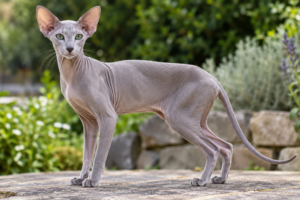
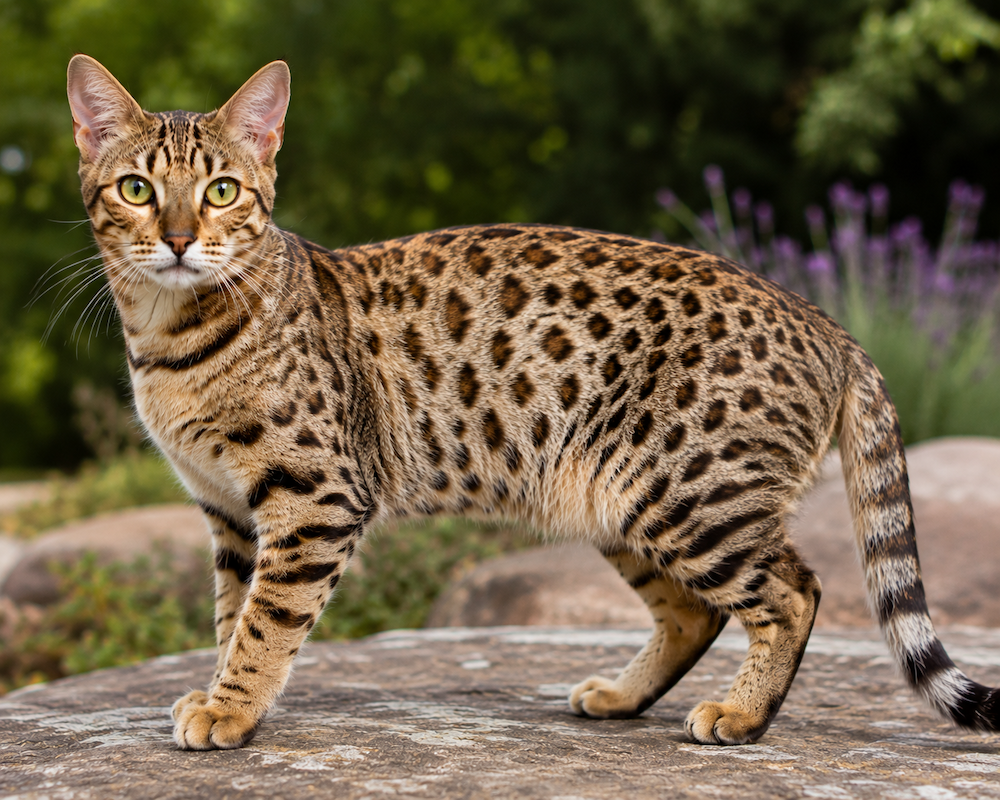






Designed to resemble a miniature leopard but created entirely as a domestic companion — the California Spangled is an exceptionally rare American cat with a fascinating conservation-inspired history, athletic build, dramatic spotted coat, and affectionate personality.
🧠 QUICK SNAPSHOT
- Temperament: Affectionate, intelligent, energetic
- Energy Level: High
- Size: Medium to Large
- Good With Families: Very Good
- Indoor Living: Very Good with sufficient enrichment
- Trainability: High
- Grooming: Low
- Best For: Active families, interactive owners, experienced cat households
- Typical Lifespan: Around 12–15 years
📚 OVERVIEW
The California Spangled is one of the most fascinating — and now one of the rarest — modern cat breeds.
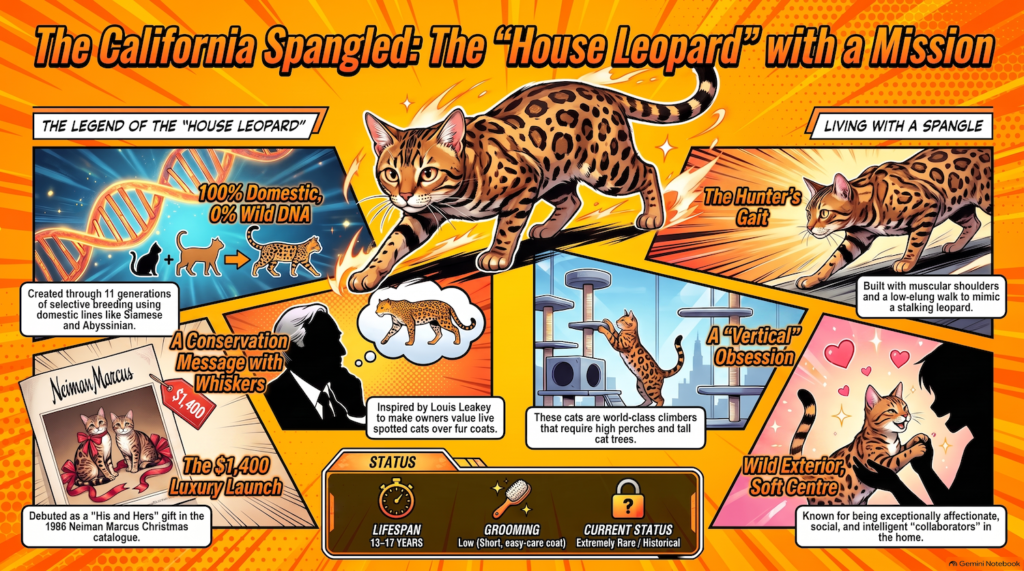
Its dramatic spotted coat was deliberately developed to resemble wild cats such as leopards and ocelots. Yet despite its exotic appearance, the California Spangled was created using domestic cats rather than direct wild-cat hybridisation.
The breed was developed by American writer and conservationist Paul Casey, beginning in the 1970s. Casey wanted to create a domestic cat that reminded people of endangered spotted wild cats and, in theory, encouraged greater concern for their conservation.
Developing the desired appearance took many generations. A variety of domestic cats contributed to the breeding program as Casey worked towards a muscular, athletic cat with prominent spots and a distinctly wild appearance.
The California Spangled finally attracted major public attention during the 1980s, including a famously unconventional appearance in a Neiman Marcus Christmas catalogue.
Unfortunately, the breed arrived at roughly the same time that other exotic-looking cats, particularly the Bengal and Ocicat, were becoming established. It never achieved comparable popularity.
Today, genuine California Spangled cats are exceptionally uncommon.
That makes this more than an unusual breed.
It is almost a piece of living feline history.
✅ PROS & CONS
Pros
- Affectionate without usually
- Affectionate and people-oriented
- Intelligent and highly interactive
- Athletic and playful
- Spectacular wild-looking coat
- Very easy grooming requirements
- No direct wild-cat ancestr
Cons
- Extremely rare
- High exercise and enrichment requirements
- Can become bored without sufficient stimulation
- Strong hunting and chasing instincts
- Difficult to find from established breeders
- Not hypoallergenic
Is a California Spangled a Good Family Cat?
Yes, the California Spangled can be a very good family cat, particularly in an active household that wants an intelligent and interactive companion.
Despite its miniature-leopard appearance, the breed was developed specifically as a domestic cat. California Spangled cats are generally described as affectionate, sociable, curious, and strongly interested in their humans.
They can interact well with respectful children, particularly when children use toys and games rather than forcing physical contact.
They may also live successfully with other cats and cat-friendly dogs when introduced gradually. Their hunting instincts mean appropriate caution is required around small prey animals such as birds or rodents.
This isn’t generally a cat that wants to spend its entire life sitting quietly in the background.
California Spangled cats tend to enjoy participating in household activities, exploring their environment, and interacting with their owners.
The biggest challenge for a prospective family isn’t necessarily temperament.
It’s actually finding one.
Can a California Spangled Live Indoors or in an Apartment?
Yes, a California Spangled can live successfully indoors or in an apartment, but its athleticism means environmental enrichment is essential.
Tall cat trees, climbing shelves, sturdy scratching towers, window perches, tunnels, and secure elevated platforms allow the cat to use vertical territory rather than relying entirely on floor space.
Interactive toys and puzzle feeders should also be provided.
Because California Spangled cats were developed with an athletic, wild-looking body, they tend to benefit from opportunities to climb, leap, chase, stalk, and explore.
Secure indoor living protects cats from traffic, infectious diseases, fights, poisoning, theft, and other hazards. For an exceptionally rare pedigree breed, the risk of theft can be another reason to avoid unsupervised roaming.
A secure cat enclosure can provide additional stimulation, and harness training may be possible for receptive individuals.
Apartment living can work very well.
An empty apartment with nothing interesting to do cannot.
How Much Exercise and Play Does a California Spangled Need?
The California Spangled is a high-energy, athletic cat and should receive several opportunities for active play every day.
Fishing-wand toys, balls, tunnels, toy mice, climbing structures, and games encouraging stalking, chasing, and pouncing are excellent choices.
Vertical exercise is particularly valuable. These cats were deliberately bred for an athletic appearance and can be powerful jumpers.
Mental exercise matters just as much.
Puzzle feeders, treat hunts, clicker training, rotating toys, and problem-solving games help keep an intelligent cat occupied.
Play that mimics the hunting sequence — searching, stalking, chasing, pouncing, and capturing — can be particularly satisfying.
Owners should vary activities rather than leaving the same collection of toys permanently on the floor.
The California Spangled may resemble a miniature leopard.
Fortunately, keeping one entertained doesn’t require releasing antelope into your living room.
A good fishing-wand toy is considerably more practical.
Is a California Spangled Easy to Train?
Yes, the California Spangled is generally considered intelligent and trainable.
Positive reinforcement using treats, toys, praise, and play can be used to teach useful behaviours such as coming when called, entering a carrier voluntarily, using designated scratching areas, and accepting routine handling.
Some may also learn tricks, retrieve toys, or become comfortable walking on a harness.
Clicker training can provide valuable mental stimulation for an intelligent, active cat.
Practical training deserves equal attention. Teaching acceptance of nail trimming, dental checks, carrier travel, and veterinary-style body examination can reduce stress throughout the cat’s life.
Training sessions should remain short, positive, and interesting. Punishment should be avoided.
The same intelligence that makes training enjoyable can also create problems when the cat is bored.
Cupboards, shelves, containers, and household objects can all become puzzles.
Giving a California Spangled legitimate problems to solve is generally preferable to discovering which ones it has selected independently.
Does a California Spangled Shed?
Yes, but the California Spangled’s short coat is relatively low maintenance.
A gentle brushing approximately once a week is generally enough to remove loose hair, distribute natural skin oils, and keep the coat looking its best.
More frequent brushing may be useful during periods of increased shedding.
Bathing is rarely required unless there is a particular reason.
Routine care should also include nail trimming, dental maintenance, and regular checks of the ears, eyes, skin, and overall body condition.
The California Spangled is not considered hypoallergenic. Like other cats, it produces allergens primarily through proteins found in saliva and skin secretions, so a short coat doesn’t guarantee compatibility with allergy sufferers.
From a grooming perspective, however, the breed is remarkably straightforward.
That dramatic leopard-style coat looks exotic.
Maintaining it isn’t.
What Health Problems Are Common in a California Spangled?
This is an area where some caution is necessary.
The California Spangled is now extremely rare, and there is relatively little comprehensive modern breed-specific health data compared with popular breeds such as the Maine Coon, Persian, or Siamese.
There isn’t a well-established list of major inherited diseases uniquely associated with the California Spangled.
However, that should not be interpreted as proof that the breed has no genetic health risks.
A very small breeding population can itself create concerns if genetic diversity isn’t carefully maintained.
California Spangled cats can also develop general feline conditions including dental disease, obesity, kidney disease, urinary disorders, arthritis, and heart disease.
Anyone fortunate enough to locate a breeder should ask detailed questions about genetic diversity, longevity, veterinary screening, and health problems within the breeding lines.
Regular veterinary examinations, balanced nutrition, dental care, appropriate exercise, and maintaining a healthy body weight remain essential.
A lifespan of approximately 12–15 years is commonly cited, although reliable large-scale longevity data for such a rare breed is limited.
⭐ Is the California Spangled Part Leopard?
No.
Despite its appearance, the California Spangled was created using domestic cat breeding rather than crossing domestic cats directly with leopards or other wild feline species.
That distinction was central to the concept.
Paul Casey wanted a domestic cat that visually reminded people of endangered spotted wild cats.
The spots, muscular body, facial structure, and distinctive movement were therefore developed through selective breeding.
A variety of domestic cats contributed to the project over multiple generations as breeders worked towards the desired appearance.
The result demonstrates just how dramatically domestic-cat appearance can be altered through selective breeding.
Look at a California Spangled from across the room and your brain may briefly say:
Leopard.
Genetically, however, what you’re looking at is a domestic cat.
Which is fortunate when it decides to sleep at the end of your bed.
⭐ Was the California Spangled Really Created to Help Save Leopards?
Conservation awareness was genuinely an important part of Paul Casey’s vision for the breed.
The idea reportedly developed after Casey travelled in Africa and became increasingly concerned about the killing of wild cats and the fur trade.
His concept was provocative.
If people could form an emotional relationship with a domestic cat resembling a miniature leopard, perhaps they would become less comfortable with the idea of wild spotted cats being killed for their skins.
In other words, instead of wearing a leopard-style coat:
love the animal wearing it.
Whether creating a pedigree cat could materially influence wild-cat conservation is debatable, but it certainly gave the California Spangled a very different origin story from breeds created primarily for appearance.
Its wild look wasn’t intended merely to make the cat fashionable.
It was supposed to make people think about the real animals that appearance represented.
⭐ Was the California Spangled Really Sold in a Christmas Catalogue?
Yes — and it became one of the strangest chapters in the breed’s history.
In the 1980s, the California Spangled gained enormous publicity when it appeared in the prestigious Neiman Marcus Christmas Book, famous for extravagant and unusual gifts.
A rare designer cat that looked like a miniature leopard certainly attracted attention.
The publicity was enormous, but it also generated controversy.
A breed supposedly intended to encourage respect for endangered wild cats was simultaneously being marketed as an expensive luxury item.
That contradiction didn’t go unnoticed.
Nevertheless, the catalogue appearance transformed the California Spangled from an obscure breeding project into a cat people suddenly knew about.
For a brief period, it looked as though the breed might become the next major exotic-looking pedigree cat.
But something else was happening at almost exactly the same time.
The Bengal was arriving.
⭐ Why Did the California Spangled Become So Rare?
Timing played a major role.
The California Spangled entered public awareness during a period when interest in exotic-looking domestic cats was growing rapidly.
Unfortunately for the breed, the Bengal became enormously successful, offering consumers an even more dramatic wild-cat appearance. The Ocicat also occupied part of the market for spotted domestic cats.
Compared with those breeds, the California Spangled never developed a large international breeder network.
Maintaining a breed requires more than producing beautiful cats. It needs enough breeders, genetically diverse breeding animals, registry support, public demand, and new enthusiasts willing to continue the program.
Without that infrastructure, numbers can decline surprisingly quickly.
Today, the California Spangled is often described as extremely rare and may be difficult or effectively impossible to find in many countries.
Ironically, a cat created partly to remind people about endangered animals eventually became something of a rarity itself.
⭐ California Spangled vs Bengal vs Ocicat — What’s the Difference?
All three can deliver a spectacular wild-cat appearance, but their histories are very different.
The California Spangled was selectively developed from domestic cats to resemble spotted wild felines and promote conservation awareness.
The Ocicat also has no direct wild-cat ancestry. It arose from domestic breeds including Siamese and Abyssinian lines and was developed for its striking spotted appearance.
The Bengal, however, has genuine historical hybrid ancestry involving the domestic cat and the Asian leopard cat. Modern pedigree Bengals are generations removed from those original crosses, but the wild ancestor genuinely exists within the breed’s developmental history.
Their modern temperaments and physical characteristics also differ, and there is considerable variation between individual cats.
But the simplest historical distinction is:
California Spangled — domestic-created wild look.
Ocicat — domestic-created wild look.
Bengal — wild look with historical wild-cat ancestry.
Three attempts at bringing a little visual wilderness into the home — achieved through very different routes.