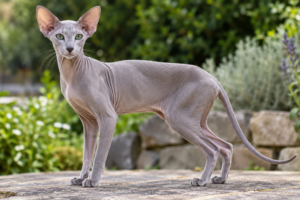
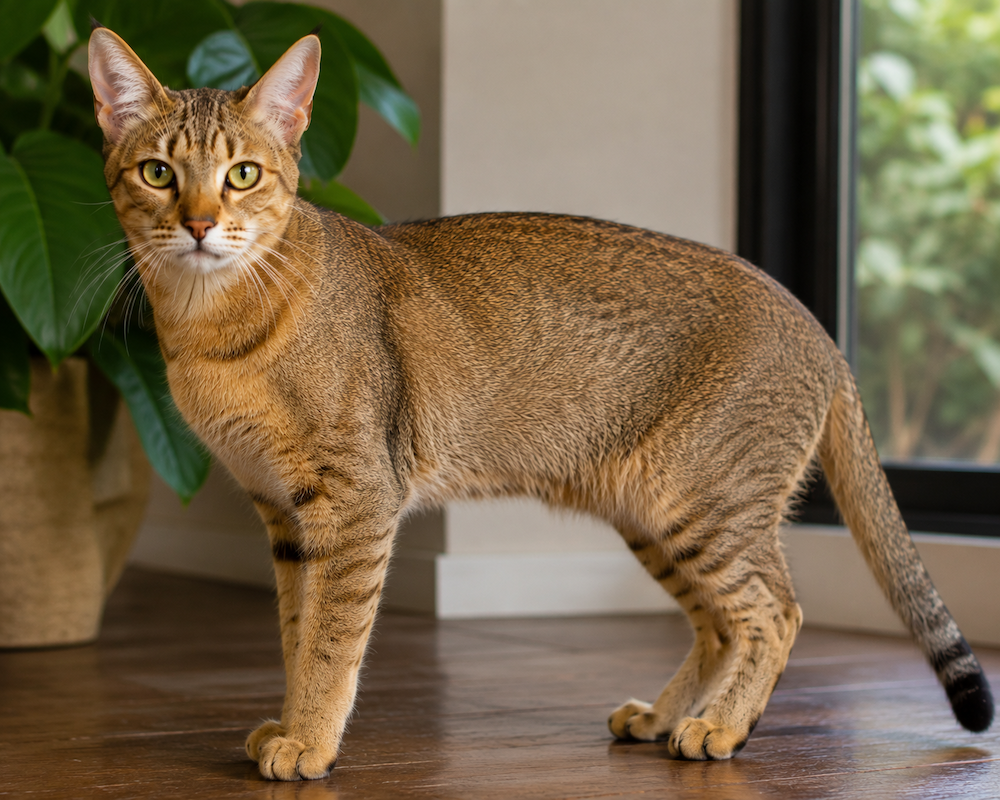






Tall, athletic, and genuinely descended from a wild cat — the Chausie combines the striking appearance of the jungle cat with generations of domestic breeding, creating an exceptionally intelligent, energetic companion that is fascinating but definitely not suited to every household.
🧠 QUICK SNAPSHOT
- Temperament: Intelligent, energetic, affectionate
- Energy Level: Very High
- Size: Medium to Large
- Good With Families: Good for experienced households
- Indoor Living: Good with substantial space and enrichment
- Trainability: Very High
- Grooming: Low
- Best For: Experienced cat owners, active households, highly interactive homes
- Typical Lifespan: Around 12–15 years
📚 OVERVIEW
The Chausie is one of the more unusual modern cat breeds because it has genuine wild-cat ancestry.
The breed was developed using the jungle cat (Felis chaus), a wild feline found across parts of Africa, the Middle East, and Asia, together with domestic cats. The name Chausie comes directly from the jungle cat’s scientific name.
Although natural matings between jungle cats and domestic cats have occurred historically, organised Chausie breeding began much more recently, particularly in the United States during the late 20th century.
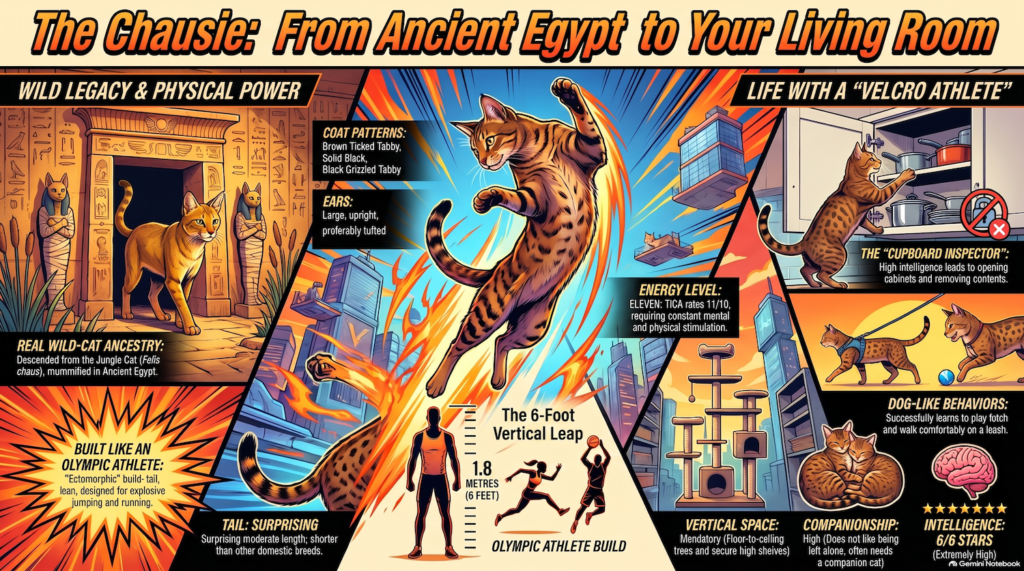
Modern pedigree Chausies are bred towards a domestic temperament while preserving some of the jungle cat’s distinctive physical characteristics. They tend to be tall, long-legged, lean, muscular, and extraordinarily athletic, with relatively large ears and a short coat.
The breed’s personality is equally striking. Chausies are typically intelligent, active, inquisitive, and strongly attached to their humans.
This is not usually a sedentary cat.
A Chausie needs significant exercise, environmental enrichment, climbing opportunities, training, and companionship. For an experienced owner prepared for that commitment, however, it can be an extraordinary companion.
✅ PROS & CONS
Pros
- Exceptionally intelligent
- Strong bonds with its humans
- Highly athletic and playful
- Very trainable
- Easy-care short coat
- Spectacular wild appearance
Cons
- Extremely high exercise requirements
- Needs substantial space and enrichment
- Strong prey drive can complicate small-pet households
- Can become destructive when bored
- Not ideal for inexperienced cat owners
- Ownership restrictions may apply in some locations
Is a Chausie a Good Family Cat?
A Chausie can be a very good family cat in the right household, but it isn’t an ideal choice for every family.
Later-generation Chausies bred specifically as companions can be affectionate, sociable, and deeply attached to their humans. Many enjoy participating in virtually everything happening around the home.
Their combination of size, strength, and energy makes supervision particularly important around very young children. Older children who understand respectful feline interaction and enjoy training or playing with an active cat may find a Chausie fascinating.
Chausies can also live successfully with compatible cats and cat-friendly dogs, particularly when raised together and introduced appropriately.
Small prey animals are another matter. The breed can have a powerful hunting instinct, making homes with freely accessible birds, rodents, or similar pets potentially unsuitable.
Prospective owners should also investigate local regulations because hybrid-cat ownership rules can vary.
For an experienced, active household prepared to provide substantial enrichment, a well-socialised Chausie can become an intensely rewarding family companion.
Can a Chausie Live Indoors or in an Apartment?
A Chausie can live indoors, but apartment living can be challenging unless the environment is exceptionally well designed.
These are large, athletic cats capable of impressive jumping and climbing. Vertical territory is therefore essential. Extra-tall cat trees, reinforced shelves, secure climbing systems, scratching towers, and elevated walkways can help provide the physical environment a Chausie needs.
Daily interactive exercise is equally important.
Puzzle feeders, scent games, training sessions, rotating toys, tunnels, and opportunities to explore new objects can help satisfy its intelligence.
A secure outdoor cat enclosure can be particularly valuable, while some Chausies can learn to enjoy harness walks.
Owners should also Chausie-proof the home. An intelligent, powerful cat may reach shelves, open cupboards, investigate doors, and explore spaces ordinary cats ignore.
A Chausie doesn’t necessarily require a rural property.
But expecting one to thrive in a small, unstimulating apartment while sleeping for most of the day is unrealistic.
How Much Exercise and Play Does a Chausie Need?
The Chausie has very high exercise requirements and is among the more physically demanding domestic cat breeds.
Owners should provide multiple active play sessions every day alongside opportunities for independent climbing and exploration.
Fishing-wand toys, retrieving games, tunnels, climbing structures, running games, puzzle feeders, and activities involving stalking and pouncing are excellent choices.
Many Chausies enjoy playing fetch, and some can become enthusiastic harness walkers.
Mental exercise is equally important. Clicker training, food puzzles, scent searches, hidden treats, and learning increasingly complicated behaviours help challenge an exceptionally intelligent cat.
The Chausie’s athletic ability shouldn’t be underestimated. These cats can jump remarkably high and may regard the top of cupboards, doors, or shelving as perfectly reasonable destinations.
Without sufficient stimulation, all that intelligence and athletic ability can be redirected towards household destruction or escape attempts.
With a Chausie, exercise isn’t an optional extra.
It is a fundamental part of responsible ownership.
Is a Chausie Easy to Train?
Yes, the Chausie is exceptionally intelligent and highly trainable, although intelligence doesn’t necessarily mean easy ownership.
Positive reinforcement using treats, toys, praise, and clicker training can produce impressive results.
Chausies may learn to come when called, sit, retrieve objects, enter a carrier voluntarily, walk on a harness, and perform more complicated tricks.
Training is particularly valuable because it provides mental exercise as well as improving everyday behaviour.
Owners should also teach practical skills such as accepting nail trimming, veterinary handling, carrier travel, and boundaries around doors.
Punishment should be avoided. It can damage trust and may be particularly counterproductive with a confident, intelligent animal.
There is also another side to owning such a clever cat.
A Chausie can independently learn how cupboards, doors, handles, containers, and household routines work.
Training a Chausie is therefore partly about teaching the cat what you want.
The rest involves staying one step ahead of what the cat is teaching itself.
Does a Chausie Shed?
Yes, the Chausie sheds, but its short coat is relatively easy to maintain.
A gentle brushing approximately once a week is usually enough to remove loose hair and keep the coat in good condition. Some individuals may shed more heavily during seasonal changes and benefit from additional grooming.
The coat is generally short and close-lying, reflecting the athletic outline that breeders seek to preserve.
Bathing is rarely necessary unless there is a specific reason.
Routine care should also include nail trimming, dental maintenance, and regular checks of the ears, eyes, skin, and body condition.
The Chausie is not considered hypoallergenic. A short coat doesn’t prevent production of feline allergens found primarily in saliva and skin secretions.
From a grooming perspective, the Chausie is remarkably straightforward.
Most of the work involved in owning one isn’t keeping its coat tidy.
It’s keeping its brain and body occupied.
What Health Problems Are Common in a Chausie?
The Chausie can be a healthy, athletic cat, but its hybrid ancestry creates several important considerations.
One historically recognised issue in earlier-generation Chausies involves digestive sensitivity and intestinal differences inherited from jungle cat ancestry. Some individuals may have difficulty tolerating particular ingredients or diets, although claims that every Chausie requires an exotic or raw diet are not justified. Diet should be discussed with a veterinarian familiar with the individual cat.
Another consideration in early hybrid generations is male sterility, a phenomenon that occurs in several hybrid animal populations. Later-generation breeding helps establish greater reproductive stability.
Responsible breeders should also monitor general feline concerns such as heart disease and maintain genetic diversity within their breeding programs.
Like other cats, Chausies can develop dental disease, kidney disease, urinary problems, obesity, and age-related disorders.
Because hybrid generations and breeding lines can differ significantly, prospective owners should discuss ancestry and health testing carefully with the breeder.
With responsible breeding, appropriate veterinary care, nutrition, exercise, and weight management, many Chausies can live approximately 12–15 years or longer.
⭐ Is the Chausie Really Part Wild Cat?
Yes.
Unlike breeds such as the Ocicat or California Spangled, which were selectively bred to look wild without direct wild-cat ancestry, the Chausie genuinely descends from the jungle cat (Felis chaus).
The jungle cat is a medium-sized wild feline found across a broad region stretching from parts of Africa and the Middle East through southern and southeastern Asia.
Despite its name, it isn’t primarily a rainforest animal. Jungle cats are commonly associated with wetlands, reed beds, grasslands, and areas close to water.
Domestic cats and jungle cats have occasionally hybridised naturally, but the modern Chausie resulted from deliberate breeding programs designed to establish a domestic companion retaining aspects of the wild species’ appearance.
Modern Chausies can be many generations removed from the original wild ancestor.
That distinction matters enormously.
A carefully bred later-generation Chausie is very different from keeping an actual jungle cat in your home.
⭐ How Big Can a Chausie Get?
The Chausie can look surprisingly large, but part of that impression comes from its unusual proportions.
Rather than being extremely heavy like some Maine Coons, Chausies tend to be tall, long-legged, lean, and muscular.
Adult weight varies according to sex, breeding line, and hybrid generation, but many fall roughly within the 7–11 kg (15–25 lb) range, with females often smaller and individual cats falling outside these figures.
Their long legs and deep chest can make them appear larger than the scales suggest.
The breed was developed to retain something of the jungle cat’s athletic silhouette rather than becoming a heavily built giant.
This matters when setting up the home.
A lightweight cat tree designed for a small domestic cat may not survive repeated launches from a muscular adult Chausie.
Think less “big fluffy cat.”
Think feline athlete built on unusually long suspension.
⭐ Why Can a Chausie Jump So High?
Everything about the Chausie’s body suggests athleticism.
The breed has long legs, powerful hindquarters, a lean body, and considerable muscular strength, allowing many individuals to make impressive vertical leaps.
This physical ability reflects both the jungle cat ancestry behind the breed and generations of selection for an athletic, wild-looking body.
For owners, this changes the definition of “out of reach.”
A shelf that seems safely high may simply look like the next stage of a climbing course to a Chausie.
Providing legitimate vertical territory is therefore essential.
Tall cat trees, securely mounted wall shelves, elevated walkways, and stable perches allow the cat to use its natural abilities without repeatedly launching itself onto unsuitable furniture.
Owners should also secure fragile objects accordingly.
With an ordinary cat, putting something on the highest shelf may protect it.
With a Chausie, you may simply have made the object more interesting.
⭐ Do Chausies Really Like Water?
Many Chausies appear to have an unusual fascination with water, although individual preferences vary.
The connection is particularly interesting because jungle cats frequently inhabit areas associated with wetlands, marshes, rivers, and reed beds and are capable swimmers.
Some domestic Chausies may investigate running taps, play in shallow water, splash drinking bowls, or show considerably less hesitation around water than the stereotypical domestic cat.
This doesn’t mean every Chausie wants to swim.
Cats should never be forced into water based on breed reputation.
For individuals that genuinely enjoy it, however, supervised water play or a drinking fountain can provide additional enrichment.
Just remember that there’s a significant difference between a cat enjoying water and a cat understanding that water is supposed to remain inside the container.
⭐ Why Are Some Chausies More “Domestic” Than Others?
The answer largely involves generations.
Hybrid breeds are often described according to how many generations separate an individual from its wild ancestor.
An F1 cat has a wild parent. Subsequent generations — F2, F3 and onwards — are progressively further removed from the original wild cross.
Modern Chausie breeding programs generally focus on later-generation cats suitable for domestic life. Over generations, breeders select for stable temperament, health, appearance, fertility, and predictable companion behaviour.
This is one reason prospective owners shouldn’t treat every animal labelled “Chausie” as equivalent.
Generation, breeding quality, early socialisation, individual temperament, and local laws can all matter.
A responsible breeder isn’t simply trying to produce the wildest-looking kitten possible.
The objective should be a physically impressive cat that can actually thrive as a domestic companion.
⭐ Are Chausies Legal Everywhere?
No. Hybrid-cat regulations vary considerably between countries, states, provinces, and local jurisdictions.
Some regions allow later-generation Chausies without special restrictions but regulate or prohibit earlier generations that are closer to the jungle cat ancestor.
Other jurisdictions may impose licensing, enclosure, importation, or ownership requirements.
Rules can also change, and legislation may classify hybrids according to generation rather than breed name alone.
This makes checking the applicable regulations before obtaining a Chausie particularly important.
Prospective owners should also investigate insurance, rental or strata rules, and veterinary availability. Not every veterinarian routinely works with early-generation hybrid cats.
The legal question therefore isn’t simply:
“Are Chausies legal?”
It is:
“Is this particular generation of Chausie legal where I live?”
That is something worth establishing before falling in love with the kitten.