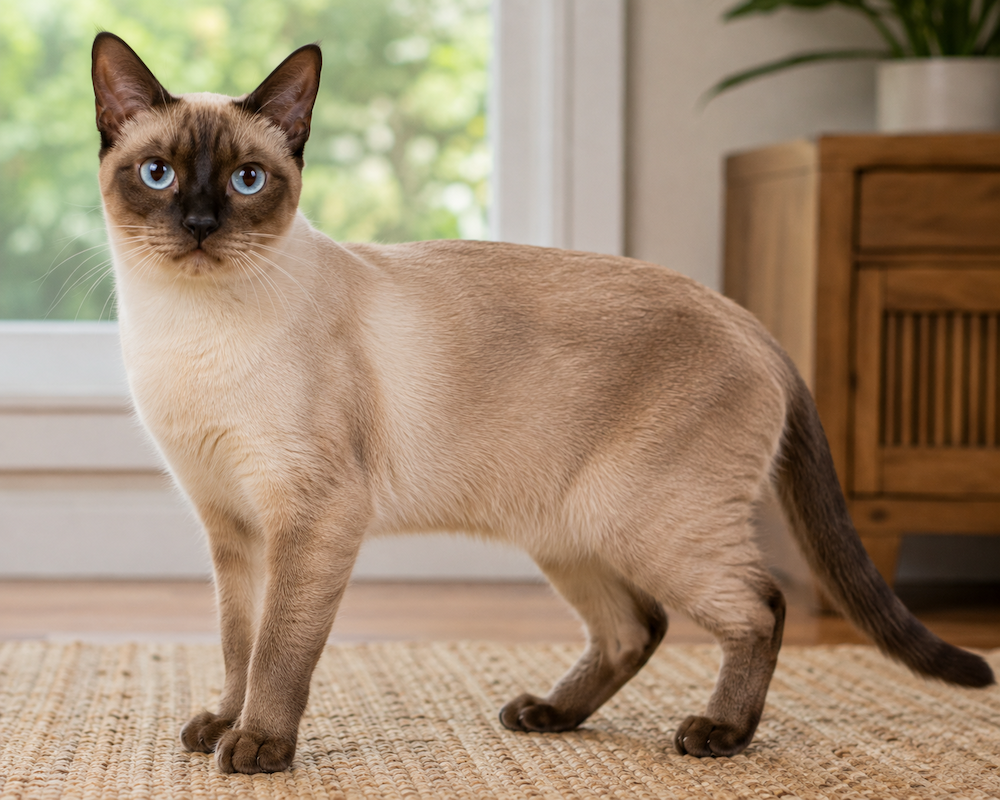






Elegant, intelligent, and never short of an opinion — the Colorpoint Shorthair is a close relative of the Siamese, created to bring a much wider palette of colours to that famous sleek body, blue-eyed expression, and wonderfully talkative personality.
🧠 QUICK SNAPSHOT
- Temperament: Affectionate, vocal, intelligent
- Energy Level: High
- Size: Medium
- Good With Families: Excellent
- Indoor Living: Excellent with sufficient enrichment
- Trainability: Very High
- Grooming: Low
- Best For: Interactive families, apartment living, multi-pet homes, people wanting a highly social cat
- Typical Lifespan: Around 12–16 years
📚 OVERVIEW
The Colorpoint Shorthair is essentially a close cousin of the Siamese, sharing its elegant body, wedge-shaped head, large ears, brilliant blue eyes, intelligence, and famously people-oriented personality.
The major difference is colour.
Traditional Siamese breeding centred on a relatively limited range of point colours. During the 1940s and 1950s, breeders in the United States and Britain began working to create Siamese-type cats in additional colours, particularly red points and other variations not traditionally accepted as Siamese.
Siamese cats were crossed with other short-haired cats carrying the desired colours, followed by generations of selective breeding back towards Siamese type.
The resulting cats became known as Colorpoint Shorthairs in some registries, although classification varies internationally. Some organisations regard these colour varieties simply as Siamese rather than recognising the Colorpoint Shorthair as a separate breed.
Whatever the paperwork says, the personality is unmistakably Siamese-like.
Colorpoints are typically energetic, affectionate, curious, highly intelligent, and extremely communicative. They don’t simply live in your home.
They tend to become involved in everything happening inside it.
✅ PROS & CONS
Pros
- Exceptionally affectionate and people-oriented
- Highly intelligent and trainable
- Usually excellent with families
- Very easy-care coat
- Well suited to indoor and apartment living
- Often enjoys other social pets
Cons
- Can be extremely vocal
- Doesn’t usually cope well with prolonged isolation
- Needs substantial interaction and enrichment
- Can become mischievous when bored
- May demand considerable attention
- Not hypoallergenic
Is a Colorpoint Shorthair a Good Family Cat?
Yes, the Colorpoint Shorthair is generally an excellent family cat, particularly for households wanting an affectionate and highly interactive companion.
These cats tend to form strong relationships with their humans and often want to participate in everyday activities. A Colorpoint may follow family members from room to room, supervise household jobs, sleep beside its favourite person, and enthusiastically contribute its opinion whenever something interesting happens.
They can be wonderful companions for respectful children, particularly children who enjoy interactive play and teaching tricks.
Colorpoints can also thrive with other sociable cats and cat-friendly dogs after appropriate introductions. In fact, a compatible animal companion can be particularly beneficial in homes where humans are absent during parts of the day.
The breed’s intense sociability is also its biggest consideration. This isn’t usually the best choice for someone wanting a highly independent cat.
If you want a cat that genuinely becomes another member of the family, however, the Colorpoint Shorthair is difficult to overlook.
Can a Colorpoint Shorthair Live Indoors or in an Apartment?
Yes, the Colorpoint Shorthair is very well suited to indoor and apartment living, provided it receives enough exercise, mental stimulation, and companionship.
These cats are athletic and enjoy vertical territory, so tall cat trees, shelves, scratching towers, and window perches can dramatically increase the usable space within a smaller home.
Puzzle feeders, tunnels, interactive toys, and rotating enrichment activities help keep their intelligent minds occupied.
Daily human interaction is especially important. A Colorpoint may find an empty apartment extremely boring regardless of how comfortable the furniture is.
One consideration for apartment dwellers is noise. Like its Siamese relatives, the Colorpoint can be highly vocal. Individual cats vary, but prospective owners should be comfortable living with a cat that may enthusiastically “talk” to them.
For someone who enjoys that interaction, apartment size isn’t necessarily a problem.
Your neighbours may simply become aware that you own a cat with opinions.
How Much Exercise and Play Does a Colorpoint Shorthair Need?
The Colorpoint Shorthair is a high-energy cat requiring substantial daily play and mental stimulation.
Several interactive sessions throughout the day are ideal. Fishing-wand toys, balls, tunnels, climbing structures, toy mice, and games involving stalking, chasing, and pouncing provide excellent physical activity.
Many Colorpoints enjoy retrieving toys and can become enthusiastic participants in games of fetch.
Mental exercise is equally important. Puzzle feeders, clicker training, treat hunts, rotating toys, and problem-solving activities help challenge their considerable intelligence.
Vertical exercise should also form part of the environment. These elegant cats are athletic jumpers and often enjoy observing their household from elevated positions.
Without sufficient activity, a bored Colorpoint can become vocal, demanding, or mischievous.
The solution isn’t simply more toys.
It is a combination of physical exercise, intellectual challenges, environmental variety, and genuine interaction with people.
Is a Colorpoint Shorthair Easy to Train?
Yes, the Colorpoint Shorthair is one of the more trainable cat breeds. Its combination of intelligence, curiosity, energy, and strong interest in humans makes positive-reinforcement training particularly effective.
Treats, toys, praise, and clicker training can be used to teach behaviours such as coming when called, sitting, giving a paw, retrieving toys, entering a carrier voluntarily, and walking on a harness.
Training is also an excellent form of mental enrichment.
Practical behaviours deserve attention too. Teaching comfortable nail trimming, dental checks, carrier travel, and gentle veterinary-style handling can make routine care significantly easier.
Sessions should be short, interesting, and rewarding. Punishment should be avoided because it can damage trust without teaching the desired alternative.
There’s one warning about living with an intelligent Colorpoint:
Training doesn’t stop when you put the clicker away.
These cats observe routines exceptionally well and may quickly learn how cupboards, doors, food containers — and their humans — operate.
Does a Colorpoint Shorthair Shed?
Yes, the Colorpoint Shorthair sheds, but its short, fine coat is exceptionally easy to maintain.
A gentle brushing approximately once a week is normally enough to remove loose hair, distribute natural skin oils, and maintain the coat’s sleek appearance. Some cats may need slightly more frequent grooming during seasonal shedding.
Bathing is rarely necessary unless there is a specific reason.
Routine care should also include nail trimming, dental maintenance, and regular checks of the ears, eyes, skin, and body condition.
The Colorpoint Shorthair is not considered hypoallergenic. Short fur doesn’t prevent a cat from producing allergens, particularly the Fel d 1 protein associated with saliva and skin secretions.
The coat itself is one of the breed’s easiest characteristics to manage.
Considering how much attention a Colorpoint may demand in other areas of life, owners can at least be grateful that grooming usually isn’t one of them.
What Health Problems Are Common in a Colorpoint Shorthair?
Because the Colorpoint Shorthair is so closely related to the Siamese, health conditions occurring in Siamese-related populations are particularly relevant.
Progressive retinal atrophy (PRA) is an inherited eye disorder that can progressively damage vision and eventually cause blindness. Genetic testing is available for relevant forms.
Some Siamese-related cats can also be predisposed to amyloidosis, where abnormal proteins accumulate within organs and can interfere with their function.
Heart disease, including hypertrophic cardiomyopathy (HCM), should also be considered.
Dental disease can be an issue across the feline population, while some Siamese-related lines have experienced additional inherited or congenital conditions.
Responsible breeders should understand the health history of their lines and use appropriate genetic testing and veterinary screening.
Regular veterinary examinations, dental care, balanced nutrition, weight management, and early investigation of changes in appetite, weight, thirst, breathing, behaviour, or activity can help a Colorpoint Shorthair achieve its typical 12–16 year lifespan, with some cats living longer.
⭐ Is the Colorpoint Shorthair Just a Different-Coloured Siamese?
Depending on which cat registry you ask, the answer can effectively be yes.
The Colorpoint Shorthair was developed to produce Siamese-style cats in colours beyond the traditional Siamese point colours accepted by certain registries.
Physically and temperamentally, the relationship is extremely close.
Colorpoints share the long, elegant body, wedge-shaped head, large ears, blue eyes, short coat, intelligence, sociability, and vocal personality associated with modern Siamese cats.
The complication comes from classification.
Some cat organisations recognise the Colorpoint Shorthair as a distinct breed, while others classify comparable cats as Siamese colour varieties.
This means two cats with very similar ancestry and appearance could potentially be described differently depending on the registry involved.
For prospective owners, the practical lesson is simpler.
If you love the modern Siamese personality but want a broader range of coat colours, the Colorpoint Shorthair delivers exactly that.
⭐ Why Are Colorpoint Shorthair Kittens Born Almost White?
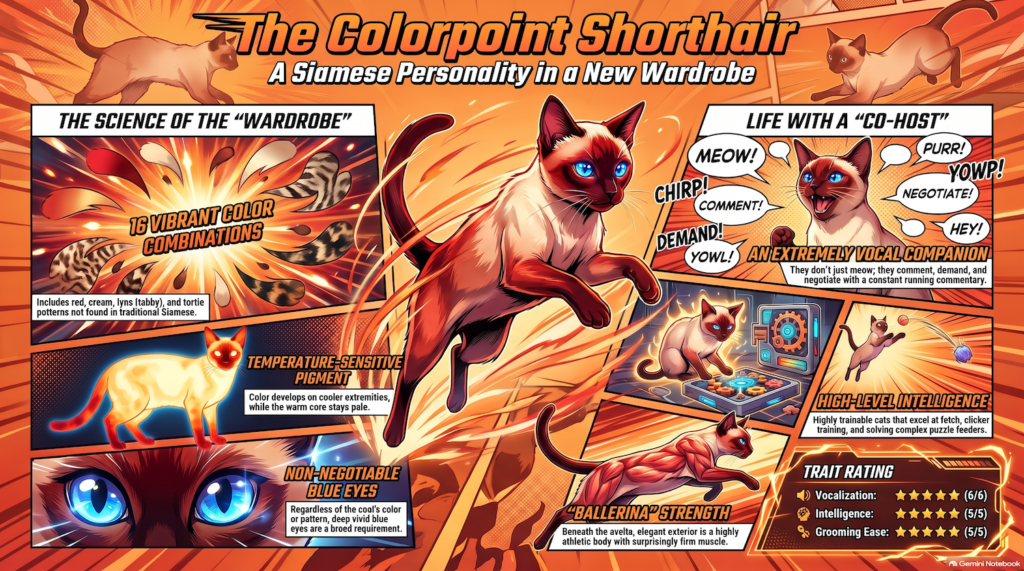
Colorpoint Shorthair kittens are born very pale because the gene responsible for their pointed colouring is temperature-sensitive.
Pigment production is reduced in warmer parts of the body.
Inside the mother’s womb, kittens are surrounded by a relatively uniform warm temperature, so relatively little dark pigment develops before birth.
After delivery, something fascinating happens.
The extremities — particularly the ears, face, paws, legs, and tail — are slightly cooler than the core of the body.
Pigment-producing enzymes work more effectively in these cooler areas, causing the points to gradually darken.
This is why newborn Colorpoint kittens can look dramatically different from the adults they eventually become.
Their colouring continues developing as they grow and can change throughout life.
The cat’s famous pattern is therefore not merely genetic.
It is genetics interacting directly with temperature.
⭐ Can a Colorpoint Shorthair’s Colour Change With Temperature?
Yes — and this is one of the most fascinating things about colourpoint cats.
The pigment-producing enzyme involved in their characteristic colouring functions differently according to temperature. Cooler areas tend to become darker, while warmer areas remain lighter.
This can produce some intriguing effects.
Colorpoint cats living in cooler environments may develop somewhat darker body colouring than comparable cats living in warmer conditions.
Age can also influence appearance because circulation, metabolism, and body temperature patterns change over time.
Even shaved fur can occasionally regrow temporarily darker if the exposed skin has been cooler while the new hair develops.
The underlying genetics haven’t suddenly changed.
The environment has influenced how strongly the pigmentation is expressed.
It’s a remarkable biological trick hidden inside one of the world’s most recognisable feline coat patterns.
⭐ Why Does the Colorpoint Shorthair Have Blue Eyes?
Those brilliant blue eyes are directly connected with the same genetic system responsible for the cat’s colourpoint coat.
The colourpoint form of the TYR gene affects melanin production.
Melanin isn’t only responsible for colour in fur. It also contributes to pigmentation within the iris.
Reduced pigmentation means Colorpoint Shorthairs develop their characteristic blue eyes rather than green, copper, yellow, or brown eyes.
The exact intensity can vary between individuals, but deep, vivid blue is highly desirable within breed standards.
This creates one of the most dramatic combinations in the domestic cat world:
A pale body.
Dark contrasting points.
And intensely blue eyes.
Humans deliberately expanded the Colorpoint Shorthair’s coat palette.
But those extraordinary blue eyes remained part of the package.
⭐ Why Are Colorpoint Shorthairs So Talkative?
Their Siamese ancestry has a lot to answer for.
Siamese-type cats are famous for being among the most vocal domestic cats, and Colorpoint Shorthairs generally inherited that enthusiasm for conversation.
They may vocalise when greeting owners, asking for food, requesting play, looking for companionship, objecting to a closed door, or apparently simply deciding that the silence has continued long enough.
Their voices can also be surprisingly powerful.
But vocalisation shouldn’t automatically be interpreted as meaningless noise.
Cats learn extremely quickly which sounds produce responses from humans. Over time, a Colorpoint and its owner can develop something resembling a private communication system involving different vocalisations, gestures, routines, and responses.
Some people absolutely adore this.
Others discover that they would prefer a cat with fewer opinions.
If silence is important to you, choose another breed.
If you enjoy coming home to someone who apparently wants to hear about your day and then tell you about theirs, the Colorpoint can be wonderful.
⭐ What Colours Can a Colorpoint Shorthair Be?
This is precisely where the breed becomes interesting.
The Colorpoint Shorthair was developed specifically to extend Siamese-type cats beyond the traditional point colours accepted by particular registries.
Depending on the registry, recognised varieties can include red point, cream point, lynx points, and tortie points, along with numerous colour combinations within those patterns.
“Lynx point” describes tabby-style markings within the darker points, producing stripes around areas such as the face, legs, and tail.
Tortie points combine colourpoint patterning with tortoiseshell-type patches.
The exact terminology and accepted colours vary between feline organisations, which is another reason researching Colorpoint Shorthairs can sometimes become confusing.
But that diversity is really the reason the breed exists.
Breeders essentially looked at the elegant Siamese and thought:
What if we kept the cat but dramatically expanded the colour chart?
The Colorpoint Shorthair was the answer.