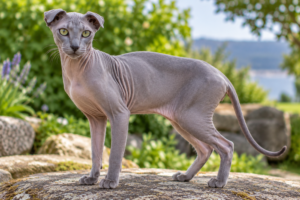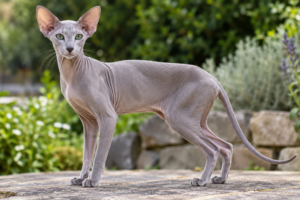
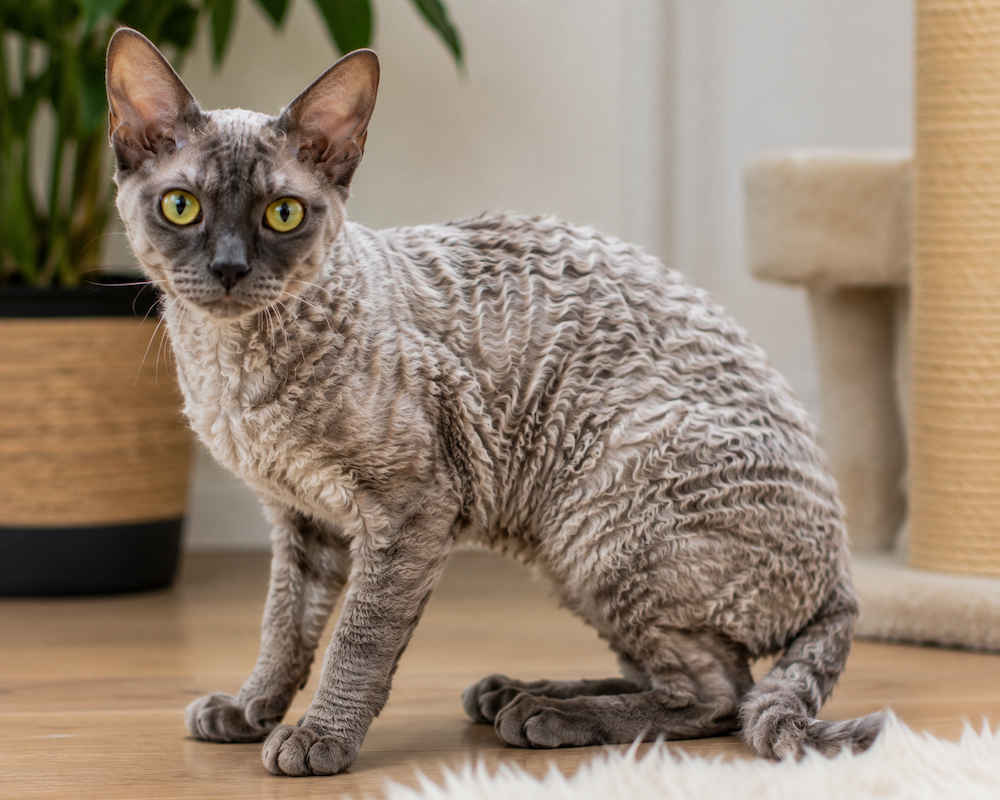






Soft, curly-coated, and exceptionally rare — the German Rex is one of Europe's original rex cat breeds, combining a distinctive wavy coat with an affectionate, intelligent personality and a remarkable history that began with naturally occurring curly-haired cats in Germany.
🧠 QUICK SNAPSHOT
- Temperament: Affectionate, intelligent, playful
- Energy Level: Moderate to High
- Size: Medium
- Good With Families: Excellent
- Indoor Living: Excellent
- Trainability: High
- Grooming: Low to Moderate
- Best For: Families, apartment dwellers, interactive owners, people wanting an unusual companion
- Typical Lifespan: Around 12–15 years
📚 OVERVIEW
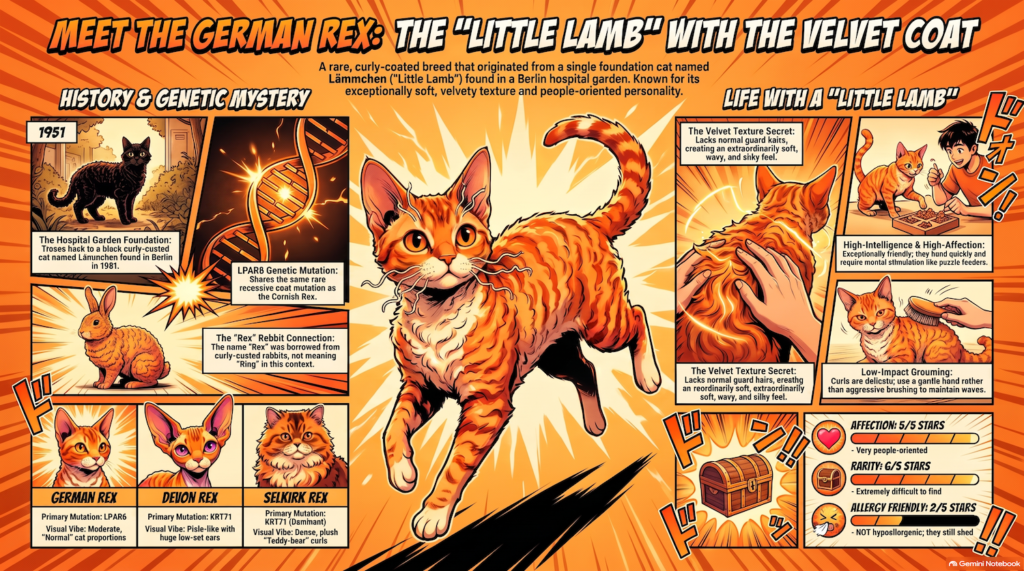
The German Rex is an exceptionally rare European cat best known for its soft, short, curly or wavy coat.
Although it can resemble other rex breeds, particularly the Cornish Rex, the German Rex developed from a separate naturally occurring curly-coat mutation discovered in Germany.
The cat most closely associated with the foundation of the modern breed was a black curly-coated female named Lämmchen, meaning “little lamb”, who lived in Berlin during the years following the Second World War.
Her unusual coat was eventually recognised as an inherited characteristic, and breeding demonstrated that the rex trait could be passed to her kittens.
German Rex cats have a medium-sized, muscular but elegant body, rounded head, prominent cheekbones, and expressive eyes. Their most remarkable feature is the coat, which lacks the conventional straight appearance of most domestic-cat fur and instead forms soft waves or curls.
Temperamentally, the German Rex is generally affectionate, intelligent, sociable, and playful. Many enjoy close contact with their families and retain a lively curiosity throughout adulthood.
Despite its historical importance, the German Rex remains extremely uncommon — even within its native Europe.
✅ PROS & CONS
Pros
- Affectionate and people-oriented
- Intelligent and playful
- Unusual soft, curly coat
- Excellent indoor companion
- Generally good with families
- Relatively straightforward grooming
Cons
- Extremely rare
- Can become lonely if routinely left alone
- Coat and skin may require gentle care
- May feel the cold more than heavily coated cats
- Not truly hypoallergenic
- Genuine pedigree kittens can be very difficult to find
Is a German Rex a Good Family Cat?
Yes, the German Rex is generally an excellent family cat, particularly for households wanting an affectionate and interactive companion.
These cats tend to enjoy human company and often develop strong relationships with their owners. Many prefer being involved in household life rather than spending long periods completely alone.
Their playful personality can make them good companions for respectful children. Interactive toys provide an excellent way for children and cats to play together without excessive handling.
German Rex cats can also live successfully with other compatible cats and cat-friendly dogs when introductions are gradual.
Because the breed tends to be sociable, another friendly pet can provide useful companionship in homes where humans are absent during parts of the day.
Individual temperament always varies, particularly in such a rare breed with a relatively small population.
Overall, however, the German Rex combines many qualities people look for in a family cat: affection, intelligence, playfulness, and a strong desire to be part of everyday life.
Can a German Rex Live Indoors or in an Apartment?
Yes, the German Rex is very well suited to indoor and apartment living.
It doesn’t need an enormous property, but it does need an interesting environment.
Cat trees, scratching posts, window perches, tunnels, shelves, puzzle feeders, and interactive toys provide opportunities for climbing, exploring, and playing.
The unusual coat provides another reason indoor living can suit the breed particularly well. German Rex cats don’t have the same heavy protective coat as many conventional cats and may be less comfortable in very cold conditions.
Warm sleeping areas are therefore appreciated.
Secure indoor living also protects cats from traffic, fights, infectious diseases, poisoning, theft, and other outdoor hazards.
A secure cat enclosure can provide additional stimulation where practical.
Apartment owners should focus less on floor area and more on creating usable vertical space and daily interaction.
A German Rex with places to climb, things to investigate, and people to engage with can thrive perfectly well in a smaller home.
How Much Exercise and Play Does a German Rex Need?
The German Rex has moderate-to-high exercise requirements and benefits from interactive play every day.
Fishing-wand toys, balls, tunnels, toy mice, climbing towers, and chasing games provide useful physical exercise.
Several shorter play sessions spread throughout the day are generally more effective than expecting the cat to entertain itself continuously.
Mental stimulation is equally important.
Puzzle feeders, treat hunts, rotating toys, clicker training, and simple problem-solving games can help satisfy the German Rex’s intelligent and curious personality.
Young cats may be especially energetic, although many remain playful well into adulthood.
Climbing opportunities should also be available because physical exercise helps maintain lean muscle and healthy body condition.
The German Rex may look like a delicate little lamb because of its curly coat.
Underneath it is still a cat perfectly capable of racing through the house because something invisible apparently required immediate pursuit.
Is a German Rex Easy to Train?
Yes, the German Rex is generally intelligent and receptive to training, particularly when positive reinforcement is used.
Treats, toys, praise, and clicker training can teach useful behaviours such as coming when called, entering a carrier voluntarily, using designated scratching areas, retrieving toys, or performing simple tricks.
Training also provides valuable mental stimulation.
Practical handling should begin early. Teaching a kitten to accept nail trimming, dental checks, coat care, carrier travel, and gentle body examination can make lifelong care significantly easier.
Short, enjoyable training sessions work best.
Punishment should be avoided because it can damage trust and doesn’t clearly teach the desired alternative behaviour.
Like many intelligent cats, the German Rex is also capable of studying its humans.
Meal times, treat locations, bedtime routines, and the sound of a cupboard containing cat food tend to be learned with remarkable efficiency.
Does a German Rex Shed?
Yes, but the German Rex generally sheds less noticeably than many conventionally coated cats.
Its distinctive coat is short, soft, and wavy or curly. The whiskers may also appear curled or crimped.
Grooming should be gentle.
Aggressive or excessive brushing can damage the delicate hairs and disrupt the characteristic curls. Light grooming with the hands or a very soft grooming tool is often sufficient.
Some individuals may develop oily skin or ears and need additional attention, although unnecessary bathing should be avoided.
The German Rex is sometimes promoted as suitable for allergy sufferers, but it is not truly hypoallergenic.
Cat allergies are primarily triggered by proteins such as Fel d 1 produced in saliva and skin secretions rather than by fur itself.
Reduced or unusual shedding may help some individuals tolerate a particular cat better, but there are no guarantees.
Anyone with significant allergies should spend time with the individual cat before committing to ownership.
What Health Problems Are Common in a German Rex?
The German Rex is so rare that large-scale breed-specific health information is limited.
There is no extensive catalogue of inherited disorders uniquely associated with the breed, but this should not be interpreted as evidence that German Rex cats are genetically problem-free.
A small breeding population creates its own challenge because maintaining sufficient genetic diversity becomes extremely important.
Responsible breeders should carefully monitor pedigrees, avoid excessive inbreeding, and maintain transparent records of health and longevity.
The coat may also require attention. Some rex-coated cats can experience skin sensitivity, excessive oil accumulation, or coat abnormalities.
Like all domestic cats, German Rex cats can develop common conditions including dental disease, kidney disease, urinary disorders, obesity, arthritis, and heart disease.
Regular veterinary examinations, dental care, appropriate nutrition, exercise, and weight management remain important.
With responsible breeding and good lifelong care, a German Rex can potentially live around 12–15 years or longer, although robust breed-specific longevity statistics are limited.
⭐ Was the German Rex the World’s First Curly-Haired Cat?
The answer is more complicated than it first appears.
Curly-haired cats have probably appeared spontaneously in domestic-cat populations many times throughout history.
One particularly important German example was a curly-coated cat called Munk, reportedly born in Königsberg — now Kaliningrad — during the 1930s.
However, Munk wasn’t developed into a sustained pedigree breeding program.
The modern German Rex is instead most closely associated with Lämmchen, a curly-coated female discovered in post-war Berlin.
That means Germany had documented curly cats extremely early in the history of modern rex breeds.
But declaring one particular cat the world’s first curly-haired domestic cat would go considerably beyond the evidence.
Genetic mutations don’t wait for pedigree registries.
They can appear anywhere.
Humans simply have to notice them.
⭐ Who Was Lämmchen — the Cat Behind the German Rex?
The foundation story of the German Rex revolves around an extraordinary little cat named Lämmchen.
Her name translates roughly as “little lamb” — an extremely appropriate description for a cat covered in soft curls.
Lämmchen was found around the grounds of a hospital in Berlin after the Second World War and was taken in by Dr Rose Scheuer-Karpin.
Her unusual coat initially made her an interesting pet rather than the founder of a new breed.
Eventually, however, breeding revealed that her curly coat was inherited.
Lämmchen subsequently became central to the establishment of the German Rex breeding population.
It’s an extraordinary transformation.
A stray-looking curly cat living around a hospital became the genetic foundation of an internationally recognised pedigree breed.
Many famous breeds began in carefully planned breeding programs.
The German Rex effectively began because someone looked at one unusual cat and realised:
there was something genetically special beneath those curls.
⭐ Is the German Rex Related to the Cornish Rex?
The German Rex and Cornish Rex have separate historical origins, but their genetics produced an intriguing discovery.
The Cornish Rex originated in Cornwall, England, after a curly-coated kitten named Kallibunker was born in 1950.
The German Rex developed from curly-coated cats in Germany.
At first glance, these appeared to be independent mutations.
However, breeding experiments demonstrated that the German Rex and Cornish Rex mutations affect the same genetic locus or are genetically compatible in producing the rex coat.
That distinguishes them from some other curly-coated breeds whose curls result from different mutations.
Despite this genetic relationship, the breeds developed different appearances.
The Cornish Rex is typically extremely slender and fine-boned with a tightly waved coat.
The German Rex usually has a more moderate, substantial body and a softer, less extreme overall appearance.
Nature effectively discovered a similar curly-coat solution in two different European cat populations.
⭐ Why Is Curly Cat Fur Called “Rex”?
The word Rex wasn’t originally a cat term at all.
Its use for curly-coated animals has historical connections with Rex rabbits, which are famous for their unusual plush coats.
When curly-coated cats began appearing and being developed into pedigree breeds, breeders adopted the same terminology.
Today, “Rex” has become almost feline shorthand for unusual curly or wavy fur.
That’s why we have breeds such as:
- German Rex
- Cornish Rex
- Devon Rex
- Selkirk Rex
But there’s an important catch.
These cats don’t all share exactly the same curly-coat mutation.
Similar-looking curls can emerge through different genetic pathways.
So “Rex” describes the unusual coat appearance rather than proving that all rex breeds belong to one curly-haired family.
⭐ Is the German Rex the Same as a Devon Rex?
No. Despite both having curly coats and “Rex” in their names, the German Rex and Devon Rex are distinct breeds with different genetic histories.
The Devon Rex originated in Devon, England, from a curly-coated kitten named Kirlee.
Its mutation is genetically different from the one associated with the German and Cornish Rex.
Their appearances are also quite different.
The Devon Rex is famous for its enormous ears, short muzzle, prominent cheekbones, and almost pixie-like expression.
The German Rex generally has a more conventional rounded head, moderate ears, and a sturdier body.
The difference illustrates something fascinating about genetics.
Humans didn’t create one curly-haired cat and spread it around the world.
Curly-coat mutations appeared independently in different cat populations.
Nature apparently likes experimenting with feline hairstyles.
⭐ Why Is the German Rex So Rare?
Despite being historically important, the German Rex never achieved the enormous international popularity of breeds such as the British Shorthair, Ragdoll, Maine Coon, or even its curly-coated relative the Devon Rex.
The breeding population remained comparatively small.
Wars and political upheaval in 20th-century Europe also created difficult conditions for establishing and maintaining emerging pedigree populations.
Later, other rex breeds gained stronger international breeder networks and greater public recognition.
The result is that genuine German Rex cats remain exceptionally uncommon, particularly outside Europe.
Rarity creates another responsibility.
Breeders need to preserve the breed without narrowing its gene pool excessively, which can require carefully managed breeding strategies.
For prospective owners, this also means caution is appropriate when encountering kittens advertised as German Rex.
A curly coat alone doesn’t establish breed identity.
Pedigree documentation matters.
The German Rex may not be the world’s most famous curly cat.
But historically, it is one of the most fascinating.