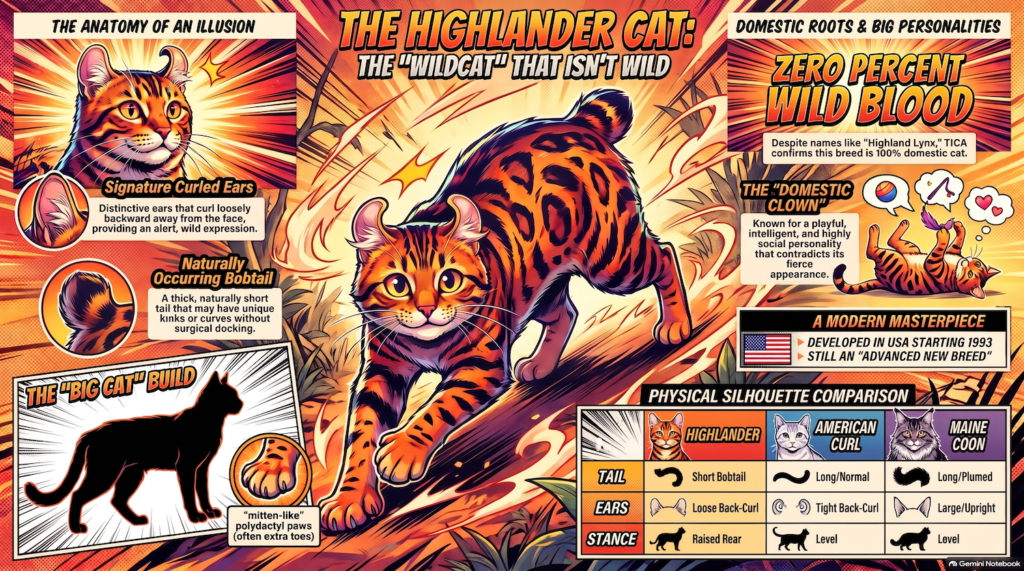
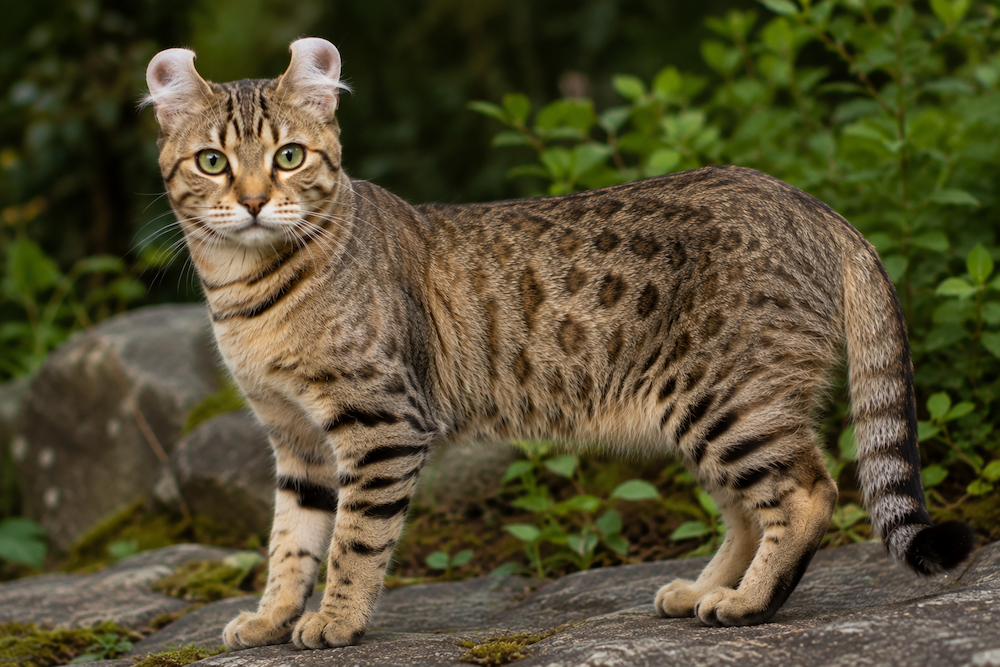






Curled ears, a powerful athletic body, and a surprisingly playful personality — the Highlander is a modern domestic cat developed to look wild while remaining people-friendly, energetic, and highly interactive.
🧠 QUICK SNAPSHOT
- Temperament: Playful, affectionate, confident
- Energy Level: High
- Size: Medium to Large
- Good With Families: Very Good
- Indoor Living: Very Good with enrichment
- Trainability: High
- Grooming: Low to Moderate
- Best For: Active households, families, experienced cat owners
- Typical Lifespan: Around 10–15 years
📚 OVERVIEW
The Highlander is a relatively modern cat breed created in the United States and deliberately developed to have an unusual, somewhat wild appearance while maintaining a domestic temperament.
Its most striking features are usually the backward-curled ears, substantial muscular body, broad head, and short or naturally bobbed tail found in many individuals.
Despite that exotic appearance, the Highlander was not developed from a recent wild-cat hybrid program in the way breeds such as the Chausie or early Bengal were.
The breed’s development traces back to cats known as the Highland Lynx, which were later selectively bred towards a more standardised pedigree type.
Highlanders are generally confident, energetic, curious, and strongly interested in people. Many enjoy interactive games, climbing, exploring, and learning new behaviours.
They can be affectionate without necessarily being sedentary lap cats.
This is a breed for owners who want personality as much as appearance.
A Highlander may look as though it belongs in a forest.
In reality, it is much more likely to be found investigating a cupboard, chasing a toy, or following its owner from room to room.
✅ PROS & CONS
Pros
- Affectionate and sociable
- Very playful and entertaining
- Highly intelligent
- Athletic and interactive
- Distinctive appearance
- Generally easy coat maintenance
Cons
- High exercise requirements
- Can become destructive if bored
- Rare in many countries
- Ear shape requires regular checking
- Breed type is still relatively modern
- Not hypoallergenic
Is a Highlander a Good Family Cat?
Yes, the Highlander can be a very good family cat, particularly in an active household.
These cats tend to be confident, affectionate, and highly interactive. Many enjoy being involved in family activities rather than spending most of the day hidden away.
Highlanders can do well with respectful children, especially children who enjoy playing with toys or teaching simple tricks.
Their relatively sturdy build may make them less fragile than some fine-boned breeds, but children should still be taught gentle handling.
They can also live successfully with other cats and cat-friendly dogs when introductions are handled gradually.
One important consideration is energy level.
The Highlander is not usually a passive companion. It needs opportunities to climb, chase, explore, and interact every day.
Families wanting a playful cat with a big personality may find that ideal.
Families wanting a very quiet, low-activity cat may be happier with another breed.
Can a Highlander Live Indoors or in an Apartment?
Yes, a Highlander can live successfully indoors or in an apartment, provided the environment is sufficiently stimulating.
Vertical territory is particularly important.
Tall cat trees, wall-mounted shelves, climbing structures, scratching towers, tunnels, and secure elevated resting areas can make a smaller home far more interesting.
Interactive toys, puzzle feeders, and rotating enrichment activities are also useful.
Because Highlanders tend to be athletic and inquisitive, owners may need to cat-proof parts of the home more carefully than they would for a less active breed.
Secure indoor living protects cats from traffic, fights, disease, poisoning, and other outdoor hazards.
A secure cat enclosure can also be valuable for providing additional exercise and sensory stimulation.
An apartment can work extremely well.
But a Highlander should not be expected to thrive in a home where its main activity is watching the furniture remain exactly where it was yesterday.
How Much Exercise and Play Does a Highlander Need?
The Highlander has high exercise requirements and benefits from several active play sessions each day.
Fishing-wand toys, balls, tunnels, climbing towers, toy mice, and games involving stalking and pouncing are excellent choices.
Many Highlanders enjoy retrieving toys and may even develop a reputation for playing fetch.
Mental exercise is equally important.
Puzzle feeders, clicker training, hidden treats, scent games, and problem-solving toys can help challenge an intelligent cat.
Vertical exercise should also form a major part of the environment.
A Highlander may be surprisingly powerful and capable of reaching places an owner assumed were inaccessible.
This makes sturdy climbing equipment important.
A bored Highlander is likely to create its own entertainment.
And unlike the entertainment you provide, its version may involve shelves, drawers, cupboards, and objects you considered decorative.
Is a Highlander Easy to Train?
Yes, the Highlander is generally intelligent and quite trainable.
Positive reinforcement works best.
Treats, toys, praise, and clicker training can be used to teach behaviours such as coming when called, sitting, retrieving toys, walking on a harness, and entering a carrier voluntarily.
Training is particularly valuable because it provides mental stimulation as well as practical benefits.
Owners should also teach comfortable nail trimming, carrier travel, body handling, and dental checks.
Short, enjoyable sessions tend to work better than repetitive drills.
Punishment should be avoided because it can damage trust and rarely improves learning.
One of the most enjoyable things about Highlanders is their curiosity.
They often approach training as another form of play.
That makes them engaging students.
It also means they are quite capable of learning things you never intended to teach them.
Does a Highlander Shed?
Yes, Highlanders shed, although coat maintenance is generally low to moderate.
The breed can occur in short-haired and longer-haired forms depending on breeding line and registry classification.
Short-haired Highlanders usually require brushing approximately once a week.
Longer-coated individuals may need grooming several times a week to prevent tangles and remove loose undercoat.
Seasonal shedding may increase grooming requirements temporarily.
The ears also deserve attention.
Because the Highlander’s curled ears have an unusual shape, owners should inspect them regularly for wax, debris, irritation, or infection.
Cleaning should be gentle and only performed when necessary.
Routine care should also include nail trimming and dental maintenance.
The Highlander is not hypoallergenic. Coat length does not remove the allergens found in feline saliva and skin secretions.
What Health Problems Are Common in a Highlander?
The Highlander is a relatively modern and uncommon breed, so there is less extensive published long-term health data than exists for more established breeds.
The unusual ear shape deserves particular attention.
Backward-curled ears result from inherited cartilage characteristics, and responsible breeders should prioritise healthy ear structure and avoid extreme exaggeration.
Owners should regularly check the ears for irritation, wax accumulation, or infection.
The breed’s bobbed or shortened tail may also vary considerably between individuals. Any breeding program involving structural mutations should place health above appearance.
Because the Highlander has a broad and evolving breeding history, responsible breeders should maintain genetic diversity and be transparent about health screening.
Like all cats, Highlanders can also develop common conditions such as dental disease, obesity, kidney disease, urinary disorders, arthritis, and heart disease.
Prospective owners should ask detailed questions about health testing and the longevity of breeding lines.
With appropriate breeding, nutrition, exercise, and veterinary care, Highlanders can often live approximately 10–15 years.
⭐ Is the Highlander Part Wild Cat?
Despite its appearance, the Highlander is generally regarded as a domestic cat breed rather than a recent wild-cat hybrid.
That is an important distinction.
The breed was deliberately created to look exotic, with features such as curled ears, a muscular body, and often a shortened tail.
Its early development involved cats marketed under names such as Highland Lynx, but the goal was a domestic companion with a wild-looking appearance.
This differs from breeds such as the Chausie, which genuinely descends from the jungle cat, or the Bengal, which has historical Asian leopard cat ancestry.
The Highlander’s “wildness” is therefore mostly visual.
It may look like something that has just walked out of a forest.
Its actual priorities are more likely to include food, play, attention, and finding the best sleeping spot in the house.
⭐ Why Does the Highlander Have Curled Ears?
The Highlander’s distinctive ears curve backwards because of an inherited cartilage trait.
The curl can vary considerably between individuals.
Some cats have a gentle backward curve, while others may display a more dramatic shape.
This characteristic became one of the breed’s signature features because it contributes strongly to the exotic appearance breeders were trying to achieve.
However, unusual physical traits always create a responsibility to breed conservatively.
Extreme ear shapes should never be prioritised over comfort, health, and normal function.
Owners should also resist excessive cleaning or bending of the ears.
They may look unusual, but they still contain delicate structures.
For most Highlanders, the ears are simply an eye-catching inherited feature.
And they certainly make the breed difficult to mistake for an ordinary domestic shorthair.
⭐ Why Do Some Highlanders Have Bobtails?
Many Highlanders have naturally shortened or bobbed tails, although tail length can vary.
The bobtail contributes to the breed’s wild, lynx-like appearance.
It is important to understand that a shortened tail is caused by inherited skeletal development rather than having the tail removed.
Some cats may have only a small bob, while others have a longer partial tail.
The exact appearance depends on genetics and breeding line.
As with any structural trait, responsible breeding should focus on ensuring that shortened tails do not interfere with spinal health, mobility, or quality of life.
A bobtail may make the Highlander look exotic.
But health should always matter more than producing the most dramatic silhouette possible.
⭐ Was the Highlander Originally Called the Highland Lynx?
Yes.
The breed’s history is closely connected to cats known as the Highland Lynx, which were developed in the United States during the 1990s.
Those cats were bred for an exotic combination of features including curled ears, bobbed tails, muscular bodies, and sometimes polydactyl feet.
Later breeding programs worked towards a more standardised pedigree cat under the name Highlander.
The name change also helped distinguish the developing breed from marketing claims and from actual lynx species.
A genuine Highlander isn’t a lynx hybrid.
The resemblance is intentional, but the breed itself is domestic.
This is a recurring theme in the pedigree cat world.
Humans love creating cats that look as though they belong in the wilderness.
Then we give them heated beds and serve dinner from ceramic bowls.
⭐ Can Highlander Cats Have Extra Toes?
Some Highlanders may be polydactyl, meaning they have more toes than the usual number.
This trait appeared in some of the early Highland Lynx breeding lines.
Polydactyl cats can have extra digits on the front paws, rear paws, or occasionally both.
The result can give the feet a broad, almost mitten-like appearance.
Extra toes are not unique to Highlanders and occur naturally in various domestic cat populations.
In many cats, polydactyly causes no major problems, although nails on extra digits should be checked carefully because some may not wear down normally.
Not every Highlander is polydactyl, and acceptance of the trait can vary depending on the registry or breed standard.
So if you see a Highlander with enormous-looking paws, you may not be imagining things.
There may genuinely be more cat attached to each foot.
⭐ Why Is the Highlander Still Relatively Rare?
The Highlander is a young breed compared with cats such as the Siamese, Persian, or British Shorthair.
It has a smaller breeder population and is not recognised in exactly the same way by every international feline organisation.
That limits availability.
Its unusual physical characteristics also mean responsible development takes time.
Breeders need to maintain stable temperament, healthy structure, and adequate genetic diversity while preserving the breed’s distinctive appearance.
This is particularly important when traits such as curled ears and shortened tails are involved.
As a result, genuine pedigree Highlanders remain uncommon in many countries.
For prospective buyers, rarity creates another challenge.
Unusual-looking mixed-breed cats may sometimes be advertised under fashionable breed names without proper documentation.
Pedigree records and breeder transparency are therefore important.
The Highlander may look wild.
Finding a genuine one can be something of a wild-goose chase in its own right.