How Do Cats See the World?
Human Vision vs Cat Vision
Have you ever wondered what your home looks like through your cat’s eyes?
Your bright red sofa, green garden and colourful collection of cat toys may look surprisingly different to your feline companion.
But colour is only part of the story.
Cats have evolved as extraordinarily effective hunters, and their vision reflects that. They sacrifice some of the sharpness and rich colour humans enjoy in exchange for abilities that matter much more when you’re trying to detect a tiny animal moving through the shadows.
Cats can see remarkably well in low light. They’re highly sensitive to movement. Their enormous pupils can transform as lighting conditions change. Yet something sitting directly beneath their nose may actually be harder for them to see clearly than you might imagine.
So rather than thinking of feline eyesight as better or worse than ours, it makes more sense to think of it as built for a completely different job.
What Colours Can Cats See?
One of the biggest myths about cats is that they see the world entirely in black and white.
They don’t.
Cats can perceive colour, but their experience of it is different from ours.
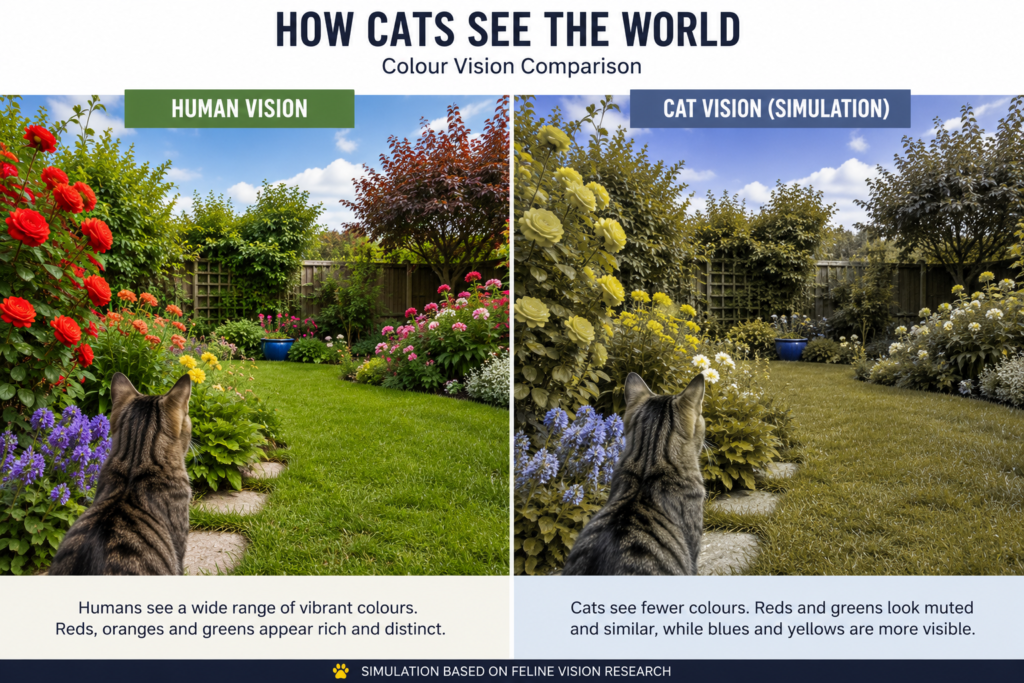
Your cat’s world probably looks less colourful
Colour vision begins in the retina with specialised photoreceptor cells called cones.
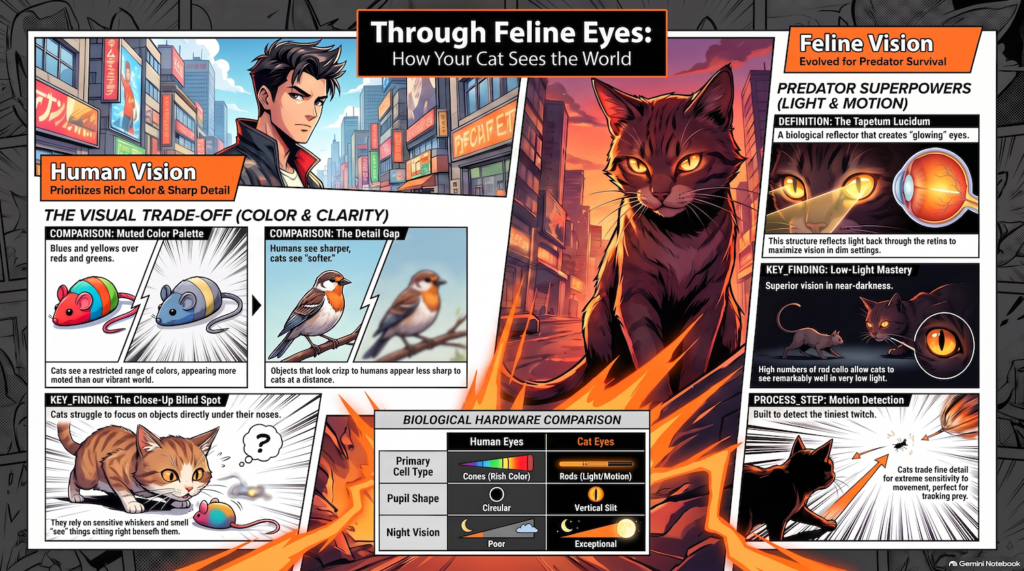
Humans have extremely rich colour perception, while cats have far fewer cones. This means colours probably don’t appear as varied or intensely saturated to a cat as they do to us.
Researchers are still investigating precisely how cats experience different colours, but veterinary sources suggest blue and grey are readily perceived, with yellow also thought to be visible.
Reds, oranges and some greens are likely to be much less distinctive.
So your cat isn’t living inside an old black-and-white movie.
Their world is probably better imagined as having a more restricted, muted colour palette.
Your bright red cat toy might not look very bright
Here’s where feline vision becomes useful for owners.
Imagine putting a bright red toy against green surroundings.
To you, the contrast can be obvious.
To your cat, those colours may not stand apart nearly as dramatically.
A blue or yellow toy may provide stronger visual contrast.
Of course, cats don’t rely exclusively on colour. Movement, sound, scent and texture are all important parts of how they experience their surroundings.
And movement is where feline vision becomes particularly impressive.
Cats traded colour for something arguably more useful
Humans are extraordinarily good at seeing detailed, colourful scenes.
But imagine being a small predator hunting around dawn and dusk.
Would you rather admire subtle differences between red and orange…
or detect the tiny movement of potential prey in poor light?
Evolution appears to have given cats a very practical answer.
Can Cats See in the Dark?
Cats have a reputation for being able to see in complete darkness.
That isn’t quite true.
Cats still need some light to see.
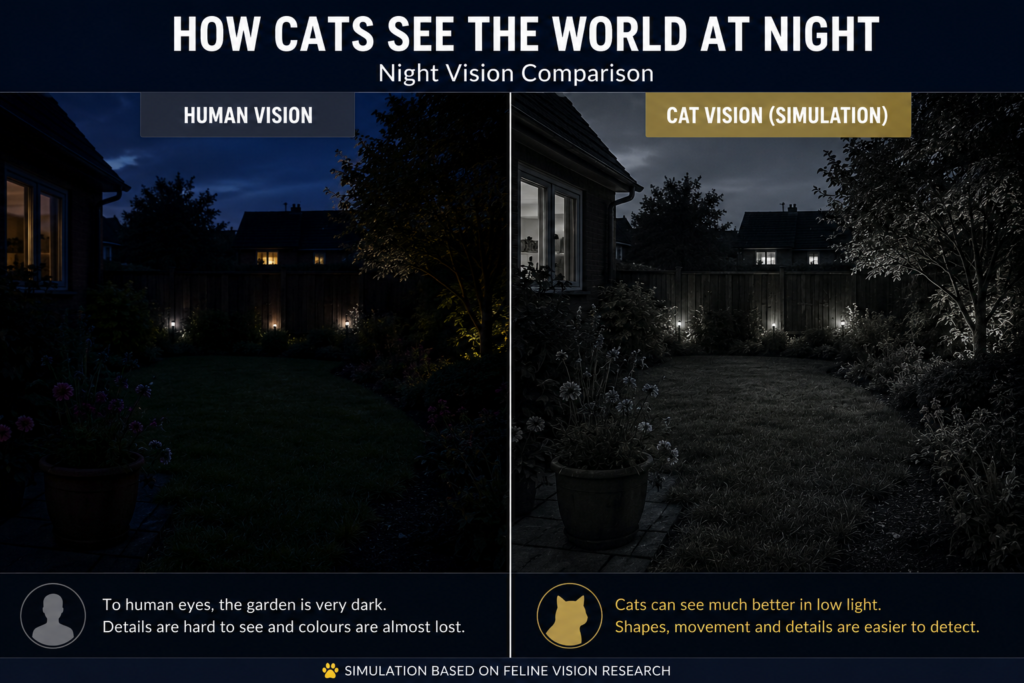
But give them just a small amount of available light and their visual system becomes remarkably effective.
Cats can see far better than humans in dim light
The feline retina contains large numbers of rod cells.
Rods are particularly important for detecting:
- Low levels of light.
- Changes in brightness.
This gives cats a major advantage when lighting conditions become poor.
Their pupils can also dilate enormously, allowing more light into the eye.
That familiar narrow vertical slit you see during a bright day can expand dramatically in darkness.
Cats have a built-in biological reflector
Behind the retina sits one of the coolest structures in the feline eye:
the tapetum lucidum.
Think of it somewhat like a biological reflector.
Light that passes through the retina can be reflected back, giving the light-sensitive cells another opportunity to respond.
This helps cats make better use of limited available light.
It also explains something every cat owner has probably experienced.
You’re walking through a dark room.
You turn on a light.
And suddenly…
two glowing eyes are staring back at you.
That eerie green, blue or yellowish shine isn’t your cat revealing their supernatural powers.
It’s light reflecting from structures within their eyes.
Your cat still can’t see in absolute darkness
This distinction matters.
Superior night vision does not mean cats can see when there is literally no light.
They still require some illumination.
In truly dark conditions, other extraordinary feline senses become even more important.
Their hearing, sense of smell and whiskers all contribute information about their surroundings.
Why are cats so good at seeing at dusk?
Domestic cats retain the sensory equipment of hunters.
Low-light vision is particularly valuable around dawn, dusk and other poorly illuminated conditions when prey animals may be active.
That helps explain why your cat can suddenly become extremely interested in something moving outside when you can barely see anything at all.
How Is a Cat’s Vision Different From Human Vision?
If you could borrow your cat’s eyes for a few minutes, the biggest surprise might not be colour.
The whole visual experience would be different.
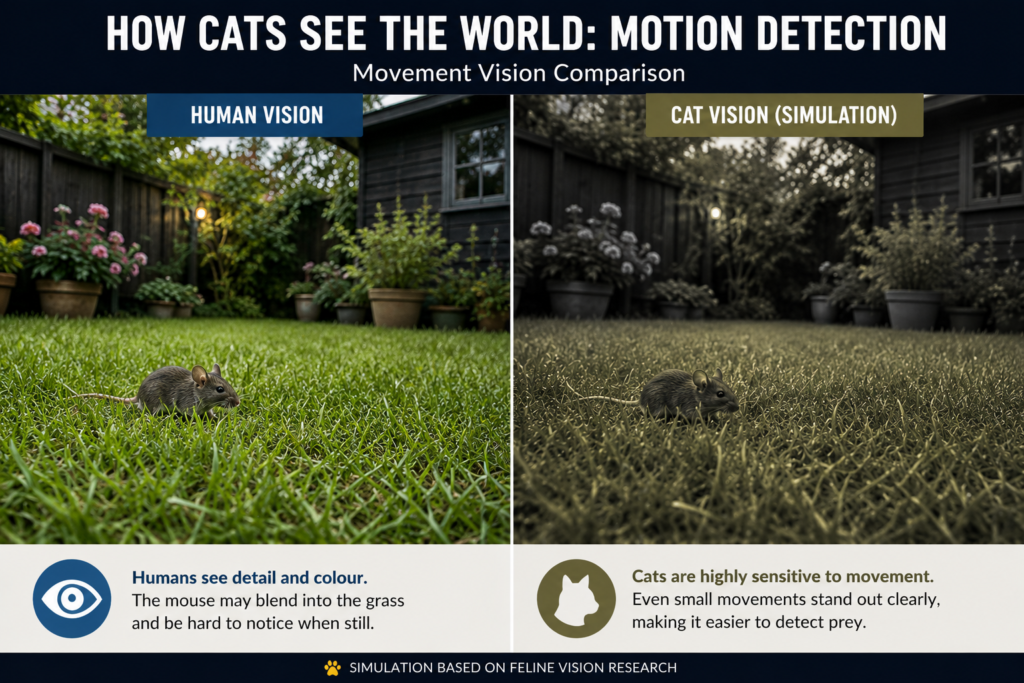
Cats are better at detecting movement
Cats have visual adaptations that make them particularly sensitive to motion.
For a predator, that’s enormously valuable.
A tiny movement in grass or a quick flick across the floor may immediately attract your cat’s attention.
It’s one reason interactive toys become much more exciting when they move like prey.
Drag a toy slowly behind furniture.
Pause.
Make it twitch.
Allow it to disappear.
Suddenly the cat that ignored a motionless toy for ten minutes becomes a miniature tiger.
Humans generally see finer detail
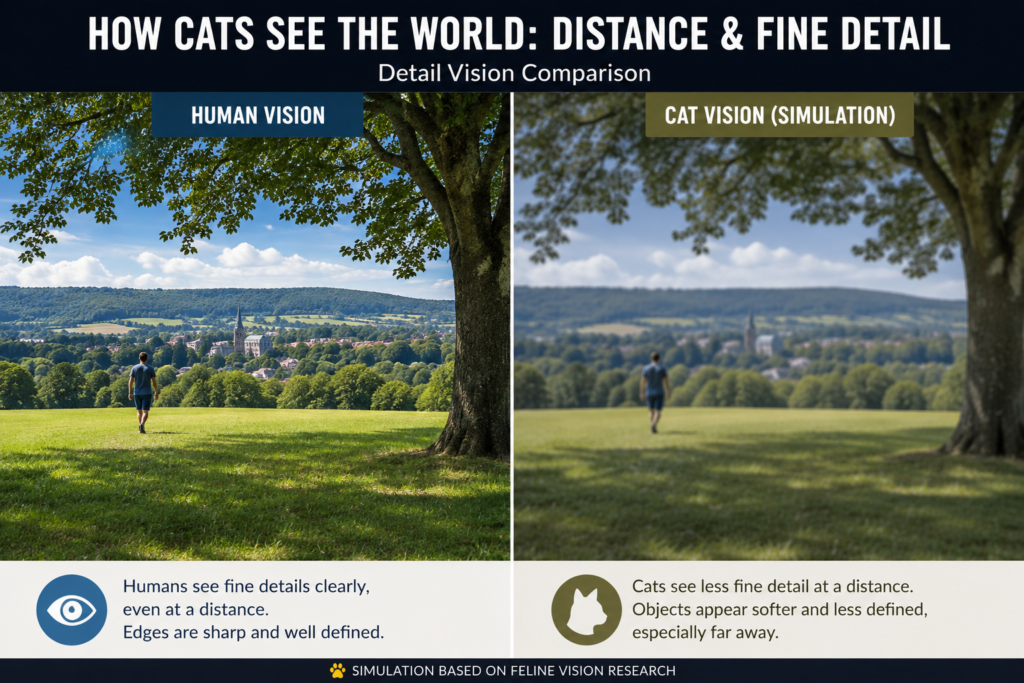
Cats gain low-light and motion advantages, but there are trade-offs.
Human daylight vision is generally sharper.
An object that looks crisp and detailed to you at a distance may appear considerably less sharp to your cat.
This is another reason we shouldn’t describe cat vision simply as “better”.
It’s specialised.
We excel at some visual tasks.
Cats excel at others.
Cats can struggle with things extremely close to their face
Here’s one of the most surprising facts.
Cats aren’t necessarily brilliant at focusing on something sitting immediately underneath their nose.
That’s where another feline superpower becomes useful:
whiskers.
Whiskers are extraordinarily sensitive structures that help cats gather information about objects and spaces very close to their bodies.
So when your cat appears unable to see a treat you’ve placed directly beneath their nose, they haven’t necessarily lost interest—or intelligence.
Their visual system simply isn’t optimised for that particular job.
Their nose and whiskers can take over.
Cats have useful binocular vision
Their forward-facing eyes create overlapping visual fields, giving cats binocular vision that helps with judging distance and movement.
That’s extremely important when you’re about to leap onto something.
Watch a cat preparing to jump onto a shelf.
They look.
They calculate.
Their body lowers.
The hind legs prepare.
Then they launch.
Accurately judging where that surface is matters enormously.
Those vertical pupils have a purpose
One of the most visually distinctive things about cats is the vertical pupil.
In bright light it can contract into an incredibly narrow slit.
As light levels fall, it expands dramatically.
That gives the feline eye enormous flexibility in controlling the amount of light reaching the retina.
It also produces one of the most dramatic visual changes we can recreate for the video.
So What Does the World Actually Look Like to Your Cat?
Imagine standing in a garden at dusk.
To you, the flowers and surroundings still contain a rich range of colours, but details are becoming harder to distinguish as the light fades.
Your cat’s experience would be very different.
The colours would probably appear less rich and varied.
Fine distant detail would be softer.
But that tiny movement underneath a bush?
Your cat may notice it immediately.
As darkness increases, your vision rapidly becomes less useful.
Your cat’s specialised low-light system keeps working remarkably well.
And if something is extremely close to their face, vision may become less important as whiskers, smell and hearing contribute to the picture.
That’s the fascinating thing about asking how cats see the world.
Cats don’t simply experience a poorer version of human vision.
They experience a world prioritised differently.
Less colour. Less fine detail. Far better low-light performance. Exceptional sensitivity to movement.
For an animal whose ancestors survived by detecting, stalking and capturing small moving prey, that makes perfect sense.
Your cat may spend most of today sleeping on your sofa rather than hunting for dinner.
But behind those beautiful eyes is still an extraordinary visual system built for a predator.