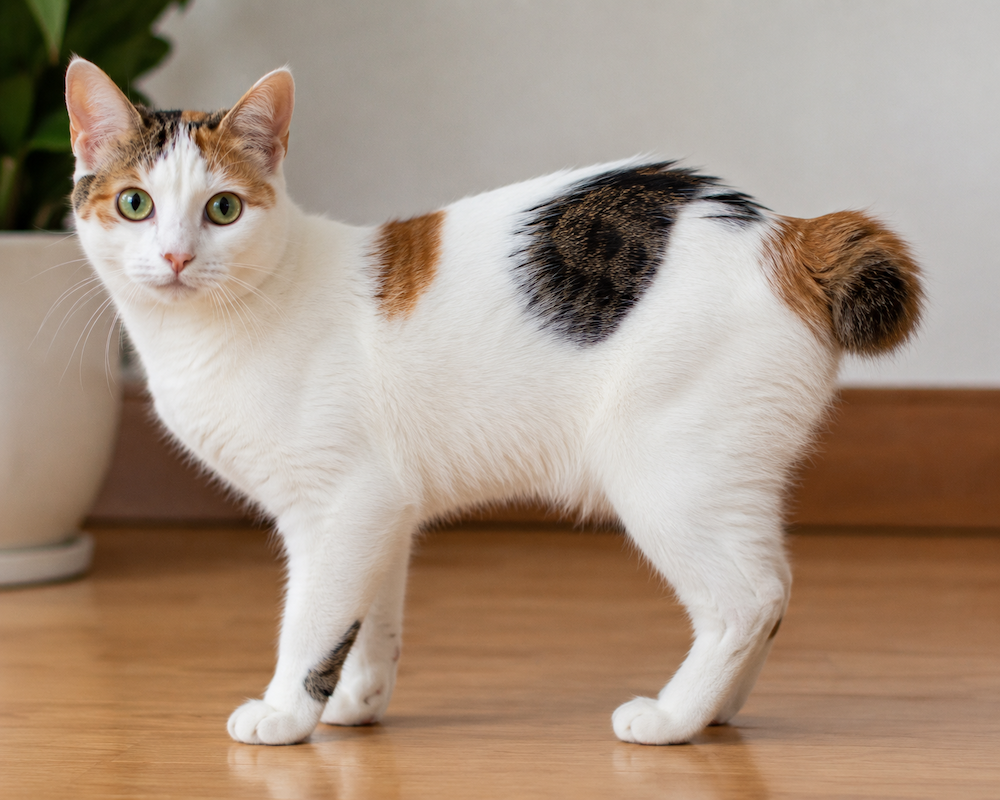






Famous for its pom-pom tail, lively personality, and centuries of Japanese history — the Japanese Bobtail is an athletic, intelligent cat closely associated with good fortune and the iconic beckoning Maneki-neko seen throughout Japan.
🧠 QUICK SNAPSHOT
- Temperament: Affectionate, intelligent, outgoing
- Energy Level: High
- Size: Small to Medium
- Good With Families: Excellent
- Indoor Living: Excellent with enrichment
- Trainability: Very High
- Grooming: Low to Moderate
- Best For: Families, apartment living, multi-pet households, interactive owners
- Typical Lifespan: Around 12–16 years
📚 OVERVIEW
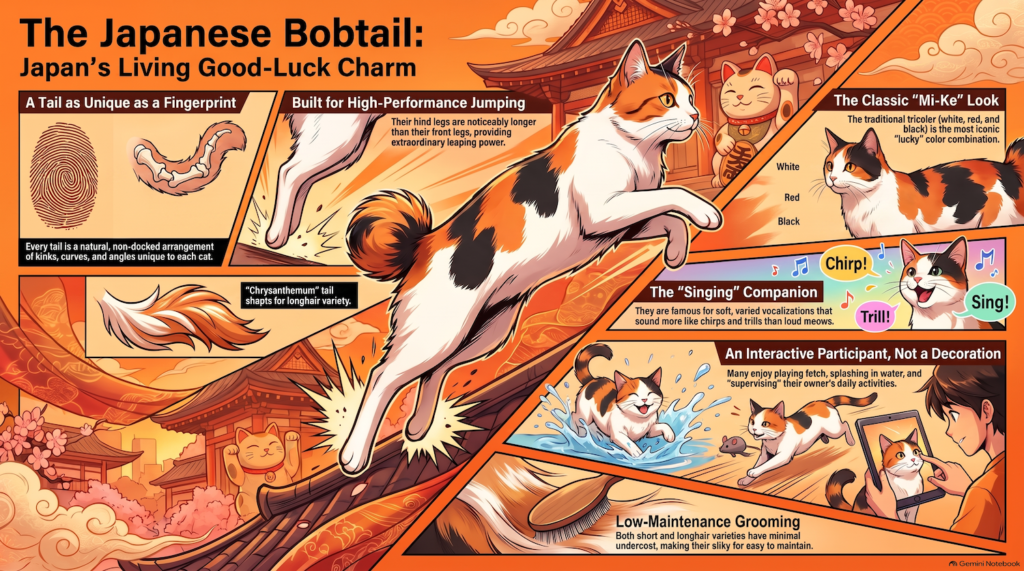
The Japanese Bobtail is an ancient natural cat breed famous for its extraordinary short, pom-pom-like tail and long association with Japanese culture.
Cats with short tails have been depicted in Japanese art and written records for centuries. While the breed’s deeper ancestry probably involves cats introduced to Japan from elsewhere in Asia, bobtailed cats eventually became a distinctive and familiar part of Japanese life.
The tail is caused by an inherited mutation and is naturally short — it is not docked. Each tail has its own combination of curves, kinks and bends, making it almost like a feline fingerprint.
Japanese Bobtails have lean, muscular bodies, long legs and a surprisingly athletic build. Both short-haired and long-haired varieties exist.
One of the most famous colour patterns is mi-ke, meaning three-fur or three-coloured — typically white with red and black patches. These tricoloured cats have traditionally been associated with good fortune.
Personality is equally memorable.
Japanese Bobtails are typically active, sociable, curious, playful and highly intelligent. Many are remarkably vocal and produce a wide range of soft chirps and conversational sounds.
This is a cat with an unusual combination of ancient history and thoroughly modern confidence.
✅ PROS & CONS
Pros
- Affectionate and highly sociable
- Intelligent and trainable
- Excellent with families
- Playful and athletic
- Usually adapts well to other pets
- Fascinating cultural history
- Distinctive naturally short tail
Cons
- Needs plenty of play and interaction
- Can be very vocal
- May become bored if left alone frequently
- Strong personality may not suit someone wanting a very quiet cat
- Rare in some countries
- Not hypoallergenic
Is a Japanese Bobtail a Good Family Cat?
Yes, the Japanese Bobtail is generally an excellent family cat.
These cats tend to be outgoing, affectionate and strongly interested in their humans. Many enjoy being involved in everyday household activities rather than disappearing to sleep alone for most of the day.
Their playful nature can make them particularly good companions for respectful children. Interactive games such as retrieving toys or chasing a fishing-wand provide excellent ways for children and cats to engage safely.
Japanese Bobtails can also live successfully with other cats and cat-friendly dogs when introductions are handled appropriately.
They are often confident enough to adapt well to a busy household, although every individual cat has its own temperament.
Their sociability means they may dislike spending very long periods completely alone. A compatible animal companion can help in households where humans are regularly absent.
For families wanting an intelligent cat that behaves more like an active participant than a household ornament, the Japanese Bobtail can be an outstanding choice.
Can a Japanese Bobtail Live Indoors or in an Apartment?
Yes, the Japanese Bobtail can live very successfully indoors or in an apartment, provided it receives sufficient enrichment.
Floor space is less important than making the environment interesting.
Tall cat trees, shelves, window perches, scratching posts, tunnels and climbing structures allow these athletic cats to use vertical space.
Interactive toys and puzzle feeders should also be available.
Japanese Bobtails are curious and intelligent, so rotating toys and introducing new activities can help prevent boredom.
Secure indoor living protects cats from traffic, fights, poisoning, infectious diseases and other outdoor hazards. A secure cat enclosure can provide additional sensory stimulation where practical.
One consideration for apartment dwellers is vocalisation.
Japanese Bobtails are known for being communicative. They may chirp, trill and “talk” to their owners rather than simply meowing occasionally.
Fortunately, many owners find the sounds charming rather than excessively loud.
Expect a roommate that sometimes feels entitled to comment on what you’re doing.
How Much Exercise and Play Does a Japanese Bobtail Need?
The Japanese Bobtail has high exercise and play requirements.
These are athletic cats with strong hind legs and an enthusiasm for running, jumping, climbing and chasing.
They benefit from several interactive play sessions throughout the day.
Fishing-wand toys, balls, toy mice, tunnels and climbing structures are all excellent choices.
Japanese Bobtails are also particularly famous for enjoying fetch. Some individuals will repeatedly retrieve a favourite toy and bring it back for another throw.
Mental stimulation matters just as much as physical exercise.
Puzzle feeders, clicker training, scent games, treat hunts and learning tricks can help challenge their intelligence.
Because they are naturally curious, environmental variety is valuable.
A Japanese Bobtail isn’t necessarily going to sit patiently waiting for you to make life interesting.
If you don’t provide enough entertainment, it may start conducting its own research into cupboards, bags, shelves and whatever you accidentally left on the table.
Is a Japanese Bobtail Easy to Train?
Yes, the Japanese Bobtail is generally very intelligent and highly trainable.
Positive reinforcement using treats, toys, praise and clicker training works particularly well.
Many Japanese Bobtails can learn to come when called, retrieve toys, sit, enter a carrier voluntarily, walk on a harness and perform simple tricks.
Their natural interest in people often makes training particularly enjoyable.
Practical training should also include nail trimming, dental checks, grooming, carrier travel and gentle body handling.
Short sessions are usually best because training should remain interesting rather than becoming repetitive.
Punishment should be avoided because it can damage trust and doesn’t clearly teach the desired alternative behaviour.
Their intelligence does create an amusing problem.
A Japanese Bobtail can learn the rules very quickly.
It can also learn exactly when you aren’t watching.
That’s not a training failure.
That’s a clever cat performing a risk assessment.
Does a Japanese Bobtail Shed?
Yes, the Japanese Bobtail sheds, but coat maintenance is generally low to moderate.
The breed occurs in both short-haired and long-haired varieties.
Short-haired Japanese Bobtails typically need brushing about once a week to remove loose hair and maintain coat condition.
Long-haired cats may benefit from brushing several times a week, particularly around areas where the fur is more likely to tangle.
Interestingly, the coat generally has relatively little undercoat compared with many heavily coated breeds, which can make grooming easier than its appearance suggests.
Seasonal shedding may still occur.
Routine care should also include nail trimming, dental maintenance and checks of the ears, eyes, skin and body condition.
The Japanese Bobtail is not considered hypoallergenic. Allergens are primarily associated with proteins in feline saliva and skin secretions rather than simply the amount of visible hair being shed.
What Health Problems Are Common in a Japanese Bobtail?
The Japanese Bobtail is generally regarded as a healthy and robust natural breed, and its distinctive tail mutation has not been associated with the same level of spinal problems seen in some other tailless breeds.
This is an important distinction.
The Japanese Bobtail’s shortened tail results from a different genetic mechanism from the mutation responsible for taillessness in the Manx and Cymric.
That doesn’t mean Japanese Bobtails are immune to illness.
Like all cats, they can develop dental disease, kidney disease, urinary disorders, obesity, arthritis and heart conditions.
Because the breed has historically developed from a relatively broad natural population, it hasn’t become strongly associated with a long list of breed-specific inherited disorders.
Responsible breeding remains important, particularly as pedigree populations outside Japan may be considerably smaller.
Maintaining healthy body weight, providing regular exercise, arranging veterinary examinations and practising good dental care can all contribute to longevity.
Many Japanese Bobtails can live approximately 12–16 years, with well-cared-for individuals potentially living longer.
⭐ Is the Japanese Bobtail’s Tail Really Natural?
Yes. The Japanese Bobtail is born with its short tail.
It is not surgically docked.
The unusual appearance results from an inherited genetic mutation affecting tail development.
What makes the breed particularly interesting is that no two tails are exactly alike.
A tail may contain curves, angles, kinks or twists, with the fur spreading around it to create the famous pom-pom appearance.
Some tails are relatively flexible while others are more rigid.
The underlying tail is also longer than it may initially appear because its bends and curves compress its overall visible length.
Breed enthusiasts sometimes compare each cat’s tail to a fingerprint because the shape is so individual.
For a cat famous for having hardly any tail, there is an extraordinary amount of variation packed into those few centimetres.
⭐ Is the Japanese Bobtail the Cat Behind the Maneki-neko?
The Japanese Bobtail is strongly associated with the Maneki-neko, Japan’s famous beckoning cat.
You’ve almost certainly seen one.
The Maneki-neko is the seated cat figurine with one paw raised, commonly displayed in shops, restaurants and businesses as a symbol of good fortune and prosperity.
Its exact historical origins are surrounded by several competing legends, but the traditional cat is frequently portrayed with characteristics associated with Japanese bobtailed cats.
One particularly famous colour is the mi-ke tricolour pattern — white with black and reddish patches.
Tricoloured bobtailed cats have long been considered particularly lucky.
This has helped make the Japanese Bobtail much more than simply another pedigree breed.
Its silhouette became embedded in one of the world’s most recognisable pieces of Japanese popular culture.
Millions of people who have never heard the words “Japanese Bobtail” may already recognise its most famous relative.
⭐ Why Were Japanese Bobtails Once Put to Work Protecting Silk?
One of the most fascinating chapters in the breed’s history involves silkworms.
Silk production was enormously important in Japan, but rodents could cause devastating damage by eating silkworms and their food.
Cats were valuable pest controllers.
During the early 17th century, cats were reportedly released from confinement in parts of Japan so they could help control rodent populations threatening the silk industry.
Bobtailed cats were among the feline population that became increasingly familiar around farms, villages and streets.
This helps explain why Japanese Bobtails aren’t simply ornamental cats associated with palaces and artwork.
Their ancestors were practical working animals.
Long before modern owners were buying puzzle feeders to exercise their hunting instincts, Japanese cats were helping protect an economically important industry.
That’s a fairly impressive entry on a cat’s résumé.
⭐ Why Is the Mi-ke Japanese Bobtail Considered Especially Lucky?
The mi-ke Japanese Bobtail is a tricoloured cat, usually displaying white fur with patches of black and red or orange.
The name essentially refers to three-coloured fur.
These cats became strongly associated with luck and prosperity in Japanese culture.
There is also an interesting genetic reason why most tricoloured cats are female.
The genes responsible for orange and black coat colour are carried on the X chromosome.
Females normally have two X chromosomes, allowing different cells to express different colour variants and creating the familiar patchwork of black and orange.
Males normally have only one X chromosome, making true male calico or tricolour cats extremely rare.
So a male mi-ke Japanese Bobtail combines cultural rarity with genetic rarity.
No wonder people found these cats extraordinary.
⭐ Do Japanese Bobtails Really “Sing”?
Japanese Bobtails have developed a reputation for having unusually musical voices.
Rather than relying on a single conventional meow, many produce an assortment of chirps, trills, squeaks and softly modulated sounds.
Owners often describe them as “singing.”
The cat isn’t literally producing melodies in the human sense, of course.
But its varied vocal repertoire combined with a highly social personality can create the impression of an ongoing conversation.
Some individuals appear to respond vocally when spoken to, making them particularly entertaining companions for people who enjoy communicative cats.
This doesn’t necessarily mean they are as relentlessly loud as some Siamese-type breeds.
It’s often the variety of noises rather than sheer volume that attracts attention.
You talk.
The Japanese Bobtail answers.
Whether the two of you are discussing the same subject is considerably less certain.
⭐ Is the Japanese Bobtail Actually From Japan?
The breed has been associated with Japan for many centuries, but the deeper story is more complicated.
Domestic cats did not originally evolve in Japan.
Cats were introduced into East Asia through ancient trade and cultural movement, and historical accounts suggest cats may have reached Japan from mainland Asia many centuries ago.
Short-tailed cats eventually became particularly prominent within Japanese populations.
Artwork, prints and written records show bobtailed cats living alongside Japanese people long before the modern pedigree-cat era.
Therefore, describing the Japanese Bobtail as a Japanese breed is entirely reasonable.
But that doesn’t mean its earliest ancestors spontaneously appeared on the Japanese islands.
Like many ancient breeds, its identity was created through a combination of migration, natural genetic mutation, isolation and centuries of living within a particular human culture.
⭐ Is the Japanese Bobtail Related to the Manx?
Not closely in terms of the mutation responsible for their tails.
The Japanese Bobtail and Manx may both have shortened tails, but they are genetically and physically very different breeds.
The Manx originated on the Isle of Man and carries a mutation that can dramatically affect development of the spine and tail. In some cats, this can contribute to serious health problems collectively known as Manx syndrome.
The Japanese Bobtail’s mutation works differently and generally produces a shortened, kinked tail without the same characteristic spinal syndrome.
Their body shapes also differ.
The Manx is typically rounded and powerful, with especially prominent hindquarters.
The Japanese Bobtail is leaner, longer-legged and more elegant.
This is a perfect example of two breeds arriving at superficially similar appearances through different genetic routes.
Short tail.
Completely different story.
⭐ How Long Have Japanese Bobtails Appeared in Japanese Art?
Bobtailed cats have appeared in Japanese paintings, woodblock prints and other artworks for centuries.
One reason this matters is that artwork provides valuable evidence that these cats weren’t simply invented by modern pedigree breeders.
They were already recognisable members of Japanese domestic life.
Cats appear in traditional scenes as companions, mousers, street animals and occasionally humorous characters.
Over time, the bobtail became so visually familiar that it helped shape the classic Japanese image of the domestic cat.
This historical continuity is one of the breed’s greatest attractions.
A modern Japanese Bobtail isn’t merely a cat designed to resemble an animal from an old painting.
Its ancestors helped inspire the paintings in the first place.