





Partly hairless, intensely curious, and famous for looking like a tiny werewolf — the Lykoi is one of the world's most unusual modern cat breeds, created from a naturally occurring mutation found in ordinary domestic cats rather than from Sphynx ancestry.
🧠 QUICK SNAPSHOT
- Temperament: Intelligent, affectionate, curious
- Energy Level: High
- Size: Small to Medium
- Good With Families: Very Good
- Indoor Living: Excellent with enrichment
- Trainability: High
- Grooming: Moderate
- Best For: Interactive households, experienced cat owners, families wanting an active and unusual companion
- Typical Lifespan: Around 12–15 years
📚 OVERVIEW
Few cats make a first impression quite like the Lykoi.
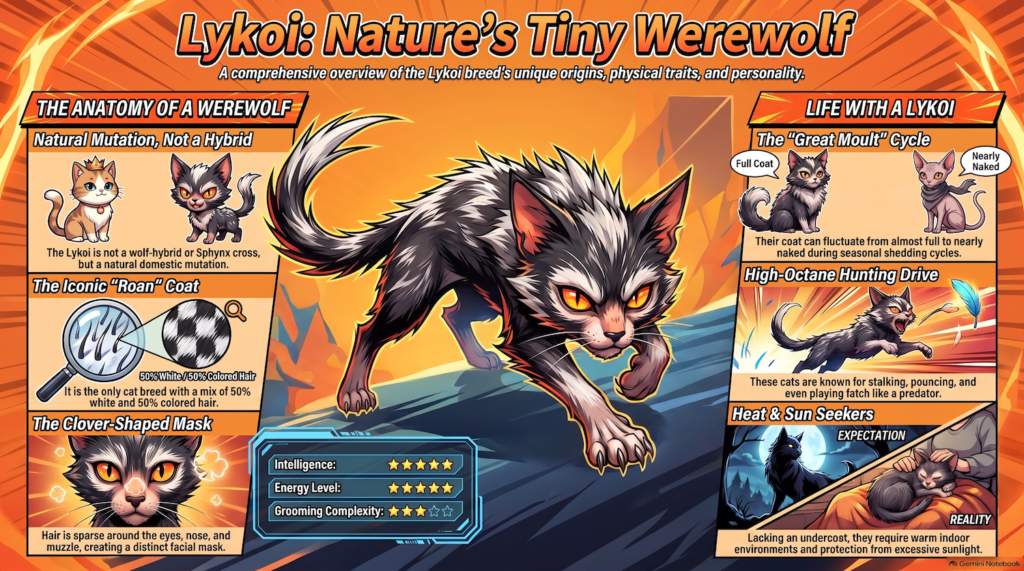
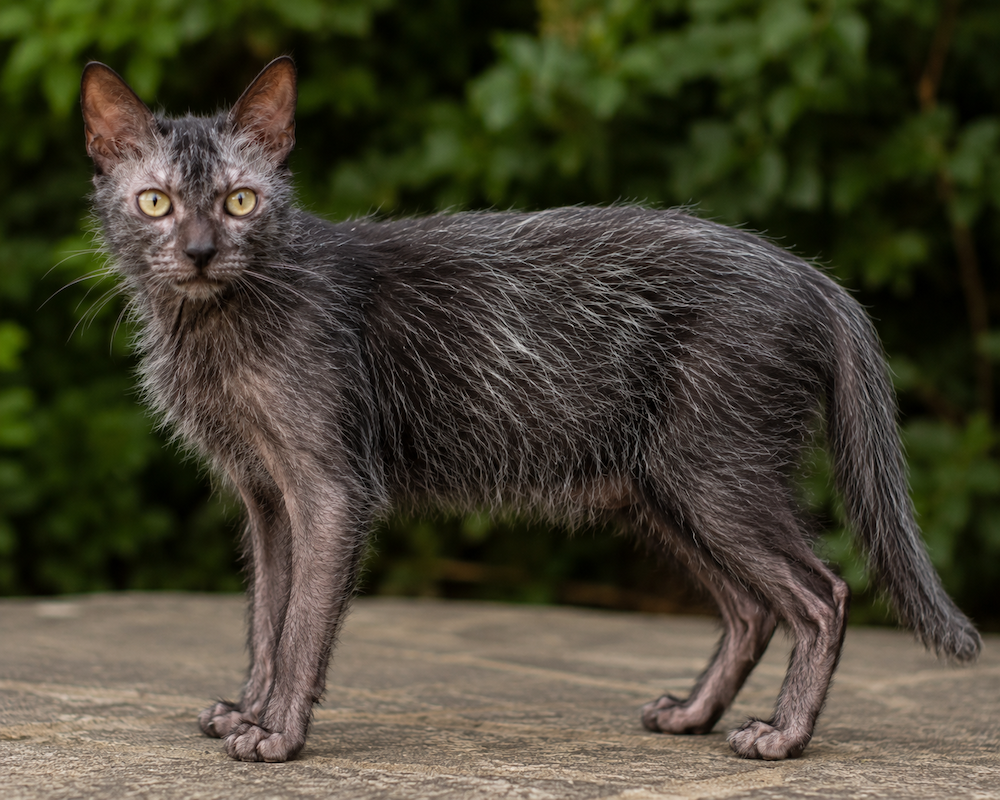
Its sparse coat, largely hairless face, prominent eyes and unusual roan colouring give it an appearance frequently compared with a miniature werewolf.
Remarkably, breeders didn’t deliberately create that appearance by crossing established hairless breeds.
The Lykoi developed from a naturally occurring genetic mutation discovered independently in domestic cats.
During the early 2010s, breeders Johnny and Brittney Gobble became involved with unusual partially hairless cats found in the United States. Veterinary examinations and genetic investigation helped establish that the appearance wasn’t simply the result of disease and wasn’t the same mutation responsible for breeds such as the Sphynx or Devon Rex.
A breeding program was subsequently established.
The Lykoi’s unusual coat lacks much of the normal undercoat and often combines coloured and white hairs, producing a distinctive roan appearance. Hair is particularly sparse around the eyes, muzzle and nose.
Some individuals periodically lose substantial amounts of their coat before regrowing it.
Despite looking like something that might appear during a full moon, the Lykoi is completely domestic.
They are generally intelligent, playful, energetic and affectionate cats with strong hunting instincts and an enormous amount of curiosity.
✅ PROS & CONS
Pros
- Extremely distinctive appearance
- Intelligent and interactive
- Affectionate with their families
- Playful and athletic
- Fascinating natural genetic history
- Strong hunting and problem-solving instincts
- Generally manageable coat care
Cons
- Very rare in many countries
- Skin requires additional monitoring
- Can undergo dramatic periods of moulting
- Needs plenty of activity and enrichment
- May be sensitive to temperature extremes
- Strong prey drive
- Not hypoallergenic
Is a Lykoi a Good Family Cat?
Yes, the Lykoi can be an excellent family cat for households prepared for an energetic, intelligent and highly curious companion.
Although their appearance can seem slightly intimidating, their personalities generally aren’t.
Lykoi tend to form strong relationships with their humans and can be affectionate without necessarily wanting to spend every moment sitting still on someone’s lap.
They often enjoy interactive play and can be excellent companions for respectful children.
Many can also live successfully with compatible cats and cat-friendly dogs when properly introduced.
Their hunting instincts deserve consideration around smaller animals. Rodents, birds and other small pets should be kept securely separated.
This is also a breed that benefits from participation.
A Lykoi wants things to investigate, games to play and preferably humans willing to provide both.
They may look like miniature werewolves.
Fortunately, their preferred family activities are generally playing, exploring and stealing your seat rather than howling at the moon.
Can a Lykoi Live Indoors or in an Apartment?
Yes, the Lykoi can live very successfully indoors or in an apartment, and protected indoor living can actually offer some advantages for this unusual breed.
Because the coat is sparse and lacks the insulation of a conventional double coat, Lykoi may be more vulnerable to temperature extremes.
Their exposed skin can also require protection from excessive sunlight.
Indoor living makes these environmental factors easier to control.
The trade-off is enrichment.
Lykoi are active, intelligent cats, so owners should provide climbing structures, scratching areas, window perches, puzzle feeders and plenty of interactive toys.
Vertical territory can make even a relatively small apartment much more stimulating.
Secure cat enclosures can provide controlled outdoor experiences where climate conditions are appropriate.
The Lykoi doesn’t necessarily need a huge home.
It needs a home containing enough interesting things to prevent it inventing its own entertainment.
How Much Exercise and Play Does a Lykoi Need?
The Lykoi is an active cat with relatively high exercise and enrichment requirements.
Its domestic-cat ancestry includes strong hunting behaviours, and many Lykoi appear particularly enthusiastic about stalking, chasing and investigating.
Interactive fishing-wand toys, balls, tunnels, climbing towers and toys that imitate prey can provide excellent exercise.
Puzzle feeders and treat hunts can challenge the cat mentally.
Several shorter play sessions spread throughout the day are generally preferable to one long session.
Many Lykoi remain highly playful as adults.
Their curiosity also means simply providing a pile of static toys may not be enough. Rotating toys and introducing new challenges helps keep the environment interesting.
This is a cat that tends to investigate first and ask questions later.
Owners quickly discover that a closed cupboard isn’t necessarily boring.
To a Lykoi, it may simply represent an unsolved mystery.
Is a Lykoi Easy to Train?
Yes, the Lykoi is generally intelligent and responsive to positive training.
Food rewards, toys, praise and clicker training can all work effectively.
Lykoi may learn to come when called, retrieve toys, enter their carrier voluntarily, use appropriate scratching areas and perform simple tricks.
Some individuals can also learn harness walking.
Training is particularly valuable because it provides mental stimulation for a naturally curious breed.
Practical handling should also begin early.
Owners should teach kittens to accept nail trimming, dental checks, skin examination, bathing when necessary and veterinary handling.
Short, enjoyable training sessions are preferable to repetitive exercises.
The Lykoi’s intelligence has another consequence: they can be very good at learning behaviours you didn’t intend to teach.
If opening a particular drawer results in a favourite toy appearing, don’t be surprised if your Lykoi starts investigating how the drawer works.
Does a Lykoi Shed?
Yes — and sometimes far more dramatically than people expect.
The Lykoi’s unusual coat can periodically undergo significant moulting.
Some individuals may temporarily lose so much hair that they become almost completely bald before the coat grows back.
This can be perfectly normal for the breed.
Coat density can also change with age, hormones, seasons and individual genetics.
When hair is present, grooming is relatively straightforward. Gentle brushing can remove loose hairs, but care should be taken because exposed skin can be delicate.
Like other cats with sparse coats, Lykoi may accumulate skin oils that would normally be distributed through a fuller coat. Some individuals therefore need occasional bathing or gentle cleaning.
The ears and nails may also require attention.
Despite its reduced coat, the Lykoi is not hypoallergenic. Cat allergens are produced primarily through saliva and skin secretions rather than simply by the amount of hair a cat possesses.
What Health Problems Are Common in a Lykoi?
The Lykoi is a very young and relatively rare breed, which means long-term breed-specific health data is still more limited than for established breeds.
One reassuring aspect of its development is that the original unusual cats underwent veterinary investigation to determine whether their sparse coats were caused by disease.
Research found structural differences within their hair follicles that explained why some follicles couldn’t produce hair normally and why others produced hair that could be lost.
The breed isn’t simply suffering from a skin disease.
Nevertheless, the unusual coat means owners should monitor skin condition, oil accumulation, sun exposure and temperature regulation.
As with all cats, Lykoi can also develop dental disease, urinary disorders, kidney disease, heart conditions, obesity and other common feline illnesses.
Responsible breeders should monitor inherited disease within their lines and maintain genetic diversity.
Because the breed remains relatively new, claims that the Lykoi is completely free from genetic health problems should be treated cautiously.
⭐ Why Is the Lykoi Called the “Werewolf Cat”?
Take one look at its face and the nickname makes sense.
The Lykoi’s sparse facial hair, prominent eyes, unusual coat and roan colouring can create an appearance remarkably reminiscent of the classic Hollywood werewolf.
Its official name embraces the connection.
Lykoi derives from the Greek word associated with wolves.
Rather than trying to disguise the cat’s unconventional appearance, breeders made it central to the breed’s identity.
Interestingly, the werewolf effect isn’t produced by cosmetic grooming.
Hair naturally grows sparsely around areas such as the eyes, nose and muzzle.
Combined with the roan body coat, the result can be startling.
Fortunately, transformation during a full moon has not been included in any recognised breed standard.
⭐ Is the Lykoi Part Sphynx?
No.
This is one of the biggest misconceptions surrounding the breed.
Because the Lykoi has areas of exposed skin, many people assume breeders crossed domestic cats with the Sphynx.
They didn’t.
Genetic investigation during the breed’s early development helped establish that the Lykoi’s unusual coat was caused by a different mutation from that responsible for Sphynx hairlessness.
The founding cats appeared naturally among domestic-cat populations.
Additional cats displaying similar characteristics were subsequently discovered independently.
This was important for establishing that the unusual appearance wasn’t simply one isolated kitten.
The Lykoi is therefore not a designer Sphynx cross.
Its werewolf appearance is the result of nature producing another unusual feline coat mutation entirely independently.
⭐ Did the Lykoi Mutation Appear More Than Once?
Yes — and this is one of the most fascinating aspects of the breed.
Unusual cats displaying the Lykoi phenotype were discovered independently in different domestic-cat populations.
That gave breeders opportunities to introduce additional naturally occurring lines rather than relying entirely upon one founding family.
It also demonstrated that the mutation wasn’t simply a one-off curiosity restricted to a single litter.
Cats carrying similar traits have subsequently been identified in different locations.
This makes the Lykoi story particularly interesting from a genetics perspective.
Humans didn’t decide they wanted to create a werewolf-looking cat and start crossing breeds until something worked.
Nature produced the look first.
Humans noticed it, investigated it and developed a breed around it.
⭐ Why Does the Lykoi Have Such a Strange Coat?
The Lykoi’s unusual appearance comes from differences in its hair follicles.
Not every follicle is able to produce hair normally, contributing to the sparse coat.
Hair-producing follicles may also lack some of the components necessary to maintain hair consistently, helping explain why Lykoi can undergo dramatic moulting.
Another distinctive feature is the absence or reduction of a conventional undercoat.
The combination creates the characteristic thin, slightly rough-looking coat.
Then there is the colour.
The classic Lykoi has a roan pattern, meaning coloured hairs are interspersed with white hairs.
Roaning is extremely unusual in cats and contributes enormously to the breed’s wolf-like appearance.
What looks almost scruffy at first glance is therefore the product of some fascinating feline genetics.
⭐ Can a Lykoi Really Go Bald and Then Grow Its Fur Back?
Yes.
Some Lykoi undergo periods of extreme moulting, during which they can lose most or occasionally almost all of their visible coat.
Then the hair grows back.
The amount of hair present on the same cat can therefore vary dramatically over time.
Temperature, hormonal changes, age and seasonal factors may influence coat density.
This makes photographs of the breed potentially confusing.
Two pictures showing very different-looking cats may actually represent perfectly normal Lykoi coat variation.
Even photographs of the same cat taken months apart can look surprisingly different.
For owners, this means the Lykoi comes with something few other breeds can offer:
a naturally occurring wardrobe change.
⭐ Is the Lykoi’s Roan Coat Unusual Among Cats?
Extremely.
Roan colouring involves an intermingling of coloured and white hairs, rather than white patches appearing as clearly defined areas.
The pattern is familiar in some horses, cattle and dogs but is considerably less common in domestic cats.
In the classic black Lykoi, white hairs mixed throughout black fur create a silvery, weathered appearance.
Combined with sparse facial hair, it dramatically enhances the werewolf effect.
Although other colours can occur within Lykoi breeding populations, the black roan appearance has become particularly associated with the breed.
It is one of those rare situations where the individual features aren’t necessarily extraordinary on their own.
Put the roaning, sparse hair, exposed face and large eyes together, however, and the result is unmistakable.
⭐ Are Lykoi Cats Actually Unhealthy Because They Look Partly Hairless?
No. Sparse hair by itself doesn’t mean a Lykoi is sick.
This question was important during the breed’s development.
When the original cats were examined, veterinarians investigated whether parasites, infections, nutritional deficiencies or other skin diseases might explain their unusual appearance.
The coat characteristics were eventually linked to their follicular structure and inherited genetics.
That said, appearance should never be used as an excuse to ignore genuine symptoms.
Persistent skin inflammation, sores, excessive itching or unexpected hair loss should still be assessed by a veterinarian.
A Lykoi can have naturally sparse hair and develop an unrelated skin problem.
Knowing what is normal for the individual cat makes unusual changes easier to recognise.
⭐ Does a Lykoi Need Sunscreen or Special Skin Care?
The Lykoi’s exposed skin means sun and temperature management deserve more attention than they would with a heavily coated cat.
Areas with little hair have less natural protection from ultraviolet radiation.
The safest approach is generally to limit prolonged exposure to intense direct sunlight rather than routinely applying human sunscreen, as some sunscreen ingredients can be unsafe for cats.
A veterinarian can advise on cat-safe products if additional protection is genuinely required.
Cold weather can also be uncomfortable because the sparse coat provides relatively little insulation.
Owners should provide warm sleeping areas and a comfortable indoor environment.
Skin oils can accumulate more noticeably than they would beneath a conventional coat, so occasional bathing may be necessary for some cats.
In other words, owning a werewolf cat doesn’t require supernatural care.
But it does require paying attention to the skin that other cats normally keep hidden beneath their fur.
⭐ How Rare Is the Lykoi?
The Lykoi remains a very rare breed, particularly outside countries with established specialist breeders.
Its history only stretches back to the early 2010s as an organised breed, making it extraordinarily young compared with ancient natural breeds such as the Korat or traditional Siamese.
The limited population means prospective owners may encounter waiting lists and potentially significant prices.
It also makes pedigree verification particularly important.
A cat suffering from hair loss isn’t a Lykoi.
Neither is every naturally sparse-coated kitten.
A genuine Lykoi should come from documented breeding lines with appropriate health records.
The breed’s rarity and extraordinary appearance unfortunately create opportunities for misleading advertising.
When buying one of the world’s strangest-looking cats, the paperwork should be considerably less mysterious than the cat.