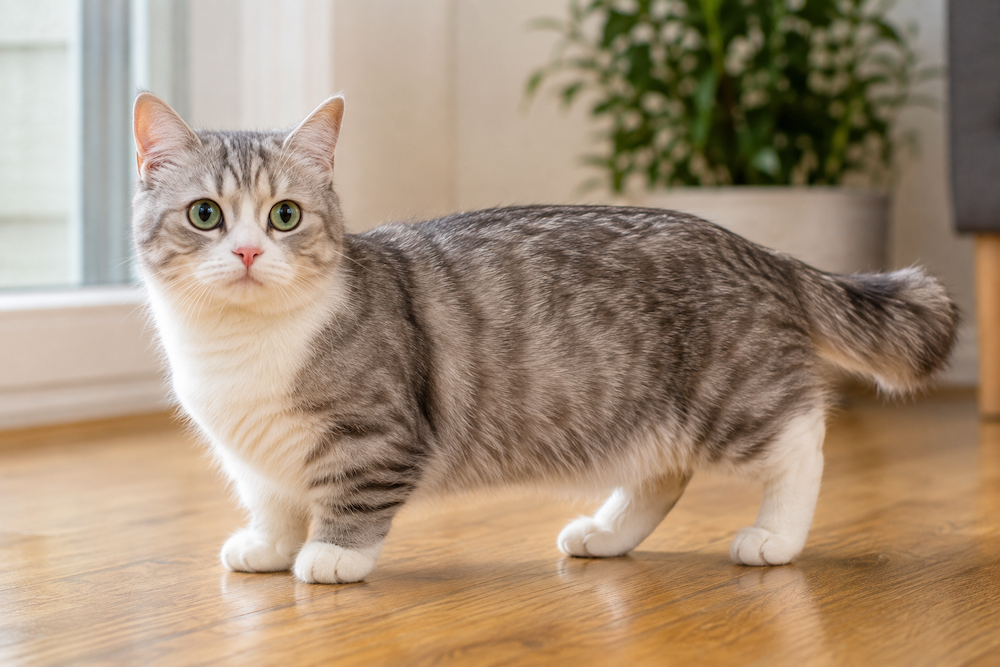





Short-legged, round-faced, and irresistibly expressive — the Minuet combines Persian-family looks with Munchkin ancestry to create a small, affectionate companion famous for its teddy-bear appearance, gentle personality, and surprisingly playful nature.
🧠 QUICK SNAPSHOT
- Temperament: Affectionate, gentle, playful
- Energy Level: Moderate
- Size: Small to Medium
- Good With Families: Excellent
- Indoor Living: Excellent
- Trainability: Moderate to High
- Grooming: Moderate to High
- Best For: Families, apartment living, interactive households, owners wanting an affectionate indoor companion
- Typical Lifespan: Around 12–15 years
📚 OVERVIEW
The Minuet is a relatively modern cat breed developed by combining Munchkin cats with Persian-family breeds, particularly Persians, Exotic Shorthairs and Himalayans.
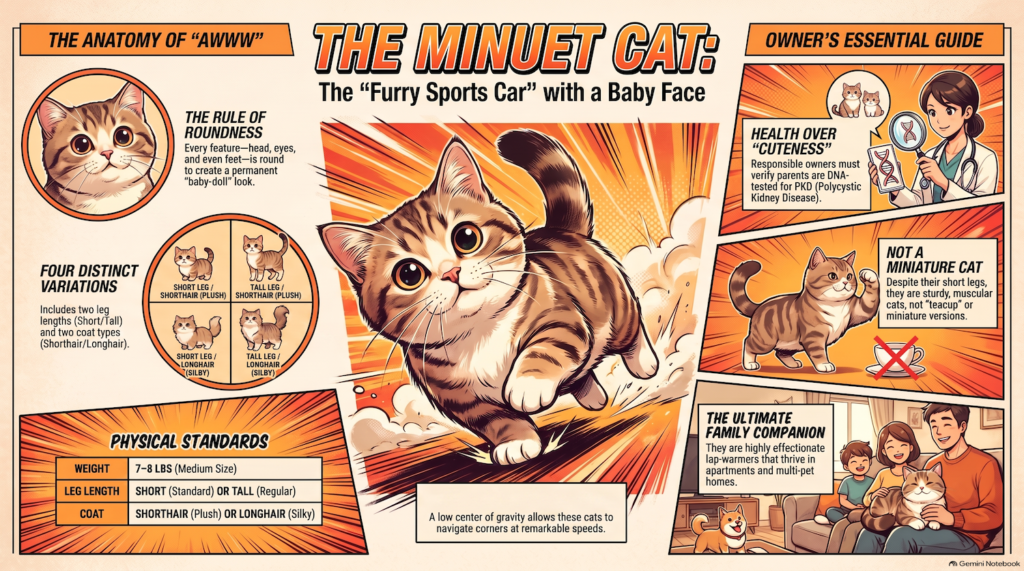
The result is one of the cat world’s most distinctive combinations: the rounded head, large expressive eyes and substantial coat associated with Persian-type cats paired with the shortened legs inherited from the Munchkin.
Originally known as the Napoleon, the breed was developed in the United States during the 1990s by Joe Smith, a Basset Hound breeder who became fascinated by Munchkin cats.
His goal wasn’t simply to create another short-legged cat. Smith wanted a distinctive breed that combined the Munchkin’s stature with the attractive facial features and coat of Persian-related cats.
Modern Minuets can be long-haired or short-haired.
Importantly, not every Minuet has short legs. Standard Minuets have the characteristic shortened limbs, while non-standard Minuets can inherit normal-length legs while still belonging to Minuet breeding lines.
They are typically affectionate, gentle and playful cats that enjoy human companionship.
Their unusual structure, however, means prospective owners should consider health and responsible breeding just as seriously as that undeniably cute appearance.
✅ PROS & CONS
Pros
- Extremely affectionate and people-oriented
- Excellent indoor companion
- Usually gentle with families
- Playful and curious
- Adaptable to apartment living
- Available in short- and long-haired varieties
- Distinctive teddy-bear appearance
Cons
- Short legs may limit some physical abilities
- Long-haired cats require regular grooming
- Persian ancestry can introduce inherited health concerns
- Responsible breeding is particularly important
- Rare in many countries
- Not recognised by every major cat registry
- Not hypoallergenic
Is a Minuet a Good Family Cat?
Yes, the Minuet is generally considered an excellent family companion thanks to its affectionate, gentle and sociable temperament.
These cats often enjoy being close to their humans and can develop strong bonds with multiple family members.
They tend to combine the calmer qualities associated with Persian-type cats with some of the playful curiosity found in Munchkins.
Many Minuets live happily with respectful children and can adapt to compatible cats and cat-friendly dogs when properly introduced.
Their physical structure does require consideration, particularly with short-legged individuals. Children should never encourage a Minuet to jump from excessive heights or handle the cat roughly.
The breed generally prefers being involved in family life rather than spending long periods isolated.
For households wanting a relatively small indoor cat with an affectionate personality, the Minuet can be a charming companion.
Just remember that the teddy-bear appearance belongs to a real animal with genuine physical and emotional needs — not a stuffed toy designed to tolerate unlimited cuddling.
Can a Minuet Live Indoors or in an Apartment?
Yes, the Minuet is very well suited to indoor and apartment living.
Its moderate exercise requirements and people-oriented temperament mean a huge property isn’t necessary.
The home should still provide climbing opportunities, scratching posts, comfortable resting areas, puzzle feeders and interactive toys.
For short-legged Minuets, accessibility deserves extra thought.
Rather than expecting the cat to make enormous vertical leaps, owners can use lower platforms, ramps or closely spaced climbing levels to create accessible vertical territory.
Secure indoor living also reduces exposure to traffic, predators, fights, infectious diseases and other outdoor hazards.
A secure cat enclosure can provide additional enrichment where practical.
Minuets generally appreciate companionship, so owners who spend substantial amounts of time away from home should make sure the cat receives enough interaction and stimulation.
A Minuet may have short legs.
That doesn’t mean it wants a short list of things to do.
How Much Exercise and Play Does a Minuet Need?
The Minuet generally has moderate exercise requirements, but it can be surprisingly playful and energetic.
Daily interactive play is important for maintaining muscle condition, controlling weight and providing mental stimulation.
Fishing-wand toys, balls, tunnels, puzzle feeders and ground-level chasing games are excellent options.
Short-legged Minuets can still run remarkably quickly.
What they may not do as easily as conventionally proportioned cats is make very high jumps in a single movement.
The home environment should therefore encourage safe activity rather than treating the cat as physically fragile.
Maintaining a healthy body weight is especially important. Extra weight places unnecessary stress on joints and the musculoskeletal system.
Several short play sessions throughout the day can provide plenty of exercise without forcing repetitive high-impact movements.
Don’t underestimate those little legs.
A determined Minuet can still move remarkably quickly when it hears a treat packet being opened.
Is a Minuet Easy to Train?
Yes, Minuets are generally intelligent and responsive to positive reinforcement, although individual motivation varies.
Treats, toys, praise and clicker training can be used to teach practical behaviours and simple tricks.
Many cats can learn to come when called, enter a carrier voluntarily, use designated scratching areas and tolerate grooming and nail trimming.
Training is especially valuable for long-haired Minuets because regular coat care will form part of everyday life.
Kittens should become comfortable with brushing, facial cleaning, dental checks, nail care and general handling from an early age.
Short, rewarding sessions work better than punishment or repetitive drilling.
Puzzle feeders and treat-searching games also provide valuable mental exercise.
The Minuet’s cute expression can occasionally create another training problem.
Owners need to remember that giving a treat every time those enormous eyes look disappointed is technically the cat training the human.
Does a Minuet Shed?
Yes. Minuets shed, and grooming requirements depend heavily on whether the cat has a short or long coat.
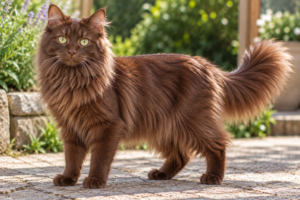
Long-haired Minuets can develop a substantial, soft coat influenced by their Persian ancestry.
They usually require brushing several times a week, potentially daily for particularly dense coats, to prevent tangles and mats.
Short-haired Minuets are easier to maintain but still benefit from regular brushing to remove loose hair.
Seasonal shedding can increase grooming requirements.
The breed’s facial structure also deserves attention. Cats with shorter faces may experience increased tear staining or discharge around the eyes and may need gentle cleaning.
Routine care should include nail trimming, dental hygiene and ear checks.
The Minuet is not hypoallergenic. Allergic reactions to cats are primarily triggered by proteins found in saliva and skin secretions rather than simply by the length or amount of fur.
What Health Problems Are Common in a Minuet?
The Minuet’s health deserves particularly careful consideration because the breed combines Munchkin dwarfism with Persian-family ancestry.
The shortened legs result from an inherited skeletal mutation. Although many short-legged cats remain active and mobile, responsible breeders should select for sound structure and avoid exaggerating physical characteristics simply for appearance.
Persian ancestry can also introduce inherited conditions including polycystic kidney disease (PKD). DNA testing makes screening for the relevant PKD mutation possible and should form part of responsible breeding programs where applicable.
Some Persian-derived lines may also carry increased risk of heart disease and other inherited disorders.
Facial structure matters as well. Responsible Minuet breeding should avoid excessively flattened faces that interfere with normal breathing, tear drainage or dental structure.
Weight management is particularly important for a short-legged cat because obesity increases mechanical stress on the body.
Prospective owners should ask breeders specifically about PKD testing, cardiac health, skeletal soundness and family health history.
Cute should never outrank healthy.
⭐ Why Was the Minuet Originally Called the Napoleon Cat?
The breed was originally named the Napoleon, an obvious reference to the famously short-statured French emperor Napoleon Bonaparte.
The name played on the breed’s characteristic short legs.
As the breed became more formally established, however, the name was eventually changed to Minuet.
The International Cat Association (TICA) adopted the newer name during the 2010s.
“Minuet” gives the breed a more elegant identity while retaining a subtle connection with French culture through the historic European dance and musical form.
You may still encounter older websites, breeders or records referring to Napoleon cats.
They aren’t necessarily describing a different breed.
In most cases, Napoleon is simply the Minuet’s former name.
⭐ Who Created the Minuet?
The Minuet’s development is particularly unusual because its founder wasn’t originally best known for breeding cats.
American breeder Joe Smith was involved with Basset Hounds.
After learning about Munchkin cats during the 1990s, he became fascinated by their short-legged appearance.
Smith reportedly felt that long-legged kittens produced within Munchkin breeding could look much like ordinary domestic cats, so he set out to develop a more consistently distinctive breed.
He introduced Persian-family cats to establish the rounded head, large eyes, substantial coat and characteristic expression that would distinguish his new breed.
The combination eventually became the Napoleon and later the Minuet.
So one of the cat world’s most teddy-bear-like breeds owes part of its existence to a man whose earlier experience involved another famously short-legged animal entirely.
⭐ Why Does the Minuet Have Such Short Legs?
The Minuet’s short legs come from its Munchkin ancestry.
Munchkin cats carry a naturally occurring genetic variant affecting limb development, producing shortened long bones in the legs.
The body itself remains relatively conventionally sized.
This gives the Minuet its characteristic low-to-the-ground appearance.
Importantly, responsible breeding doesn’t mean continually selecting for the shortest legs imaginable.
Sound movement, comfort and overall health should remain the priority.
The shortened-leg gene also explains something surprising about Minuet litters:
not every kitten will necessarily be short-legged.
That brings us to one of the breed’s most confusing features.
⭐ Can a Minuet Have Normal-Length Legs?
Yes.
Minuets can be born with normal-length legs, and these cats are commonly described as non-standard Minuets.
Short-legged cats are generally called standard Minuets.
The difference occurs because kittens don’t all inherit the short-legged trait.
A non-standard Minuet can still inherit the characteristic Persian-influenced head, coat, body and personality while standing on conventionally proportioned legs.
This sometimes surprises buyers who assume that short legs alone define the breed.
They don’t.
Breed identity comes from ancestry and the overall breeding program, not simply leg length.
A long-legged kitten from documented Minuet parents doesn’t suddenly become an ordinary domestic cat because its legs grew normally.
It is essentially a Minuet that received the tall option.
⭐ Are Minuets Actually Persian-Munchkin Crosses?
The breed originated through crosses involving Munchkins and Persian-family cats, but calling every modern Minuet simply a Persian-Munchkin cross is an oversimplification.
Once a breed becomes established, breeders work within documented lines to produce animals conforming to a defined breed standard.
Persian-related breeds used in the Minuet’s development include the Persian, Himalayan and Exotic Shorthair.
Their influence explains the Minuet’s round head, large eyes, substantial coat and sweet expression.
The Munchkin contributed the characteristic short-legged trait.
The eventual goal was not to produce random hybrid kittens but a recognisable population combining these characteristics predictably.
That’s an important distinction whenever someone advertises a rare breed.
Crossing any Persian with any Munchkin doesn’t automatically produce a responsibly bred pedigree Minuet.
⭐ Is the Minuet the Same as a Munchkin?
No.
Although the Minuet inherited its short legs from the Munchkin, the two breeds have different breed standards and overall appearances.
The Munchkin generally retains a more conventional domestic-cat head and body type.
The Minuet was specifically developed to incorporate features from Persian-family cats.
As a result, Minuets typically have rounder heads, large round eyes, smaller ears and a more substantial, teddy-bear-like expression.
Their coats can also be particularly plush, especially in long-haired individuals.
Think of the Munchkin as providing the short-legged foundation.
The Minuet then adds a considerable dose of Persian-family appearance.
From the neck down, a stranger might notice the legs first.
From the neck up, the family connection becomes much more Persian.
⭐ Can Minuet Cats Jump?
Yes. Short-legged Minuets can jump, climb, run and play, although their mechanics differ from those of conventionally proportioned cats.
Their shortened limbs can reduce the height they can comfortably clear in a single leap.
That doesn’t mean they should be treated as incapable of climbing.
A determined cat can use furniture, intermediate surfaces and climbing structures surprisingly effectively.
Owners can make the home easier to navigate by providing steps, ramps or closely spaced platforms to favourite elevated areas.
This is particularly useful as the cat gets older.
The goal shouldn’t be to prevent normal activity.
Appropriate movement helps maintain muscle condition and healthy body weight.
The important point is to design the environment around the individual cat’s abilities rather than expecting it to perform like a long-legged feline athlete.
⭐ Why Does the Minuet Look Like a Teddy Bear?
The effect comes from an unusual combination of physical characteristics inherited through its Persian-family ancestry.
Minuets typically have large round eyes, a rounded head, relatively small ears and a soft, substantial coat.
Add shortened legs and a compact-looking body, and the result can resemble a walking stuffed toy.
Long-haired Minuets exaggerate the effect even further because their coats create a rounded silhouette.
But responsible breeding should maintain moderation.
A dramatically flattened face isn’t necessary to produce the characteristic Minuet expression and can create unnecessary health concerns.
The ideal isn’t to make the cat increasingly cartoon-like.
It’s to retain the appealing round expression while preserving normal breathing, vision, movement and quality of life.
The best teddy bear is still very clearly a functional cat.
⭐ Is Breeding Short-Legged Minuets Controversial?
Yes. Like the Munchkin, the Minuet is part of an ongoing debate about breeding cats specifically for inherited dwarfism.
Supporters point out that many well-bred short-legged cats are active, playful and capable of living normal lives.
Critics argue that deliberately perpetuating a skeletal mutation for appearance raises animal-welfare concerns, particularly when long-term health evidence is limited or physical traits become exaggerated.
This disagreement is reflected in the pedigree-cat world.
The Minuet is recognised by some feline organisations but not universally accepted by all major registries.
For prospective owners, the most useful response isn’t to ignore the controversy.
It’s to choose breeders who prioritise health, moderate structure, genetic screening and long-term follow-up over producing the most extreme-looking kittens possible.
An unusual appearance should never require compromising a cat’s welfare.
⭐ How Rare Is the Minuet?
The Minuet remains a relatively rare breed, particularly outside countries with established Munchkin and Minuet breeding communities.
Its modern history is short compared with traditional breeds, and not every feline registry recognises it.
The existence of both standard and non-standard kittens can make identification even more confusing.
A short-legged fluffy kitten advertised online isn’t automatically a Minuet.
Neither is every Persian-Munchkin cross necessarily representative of an established pedigree line.
Prospective owners should ask for pedigree documentation, health-testing information and details about the breeder’s breeding program.
The rarity and exceptionally cute appearance of Minuets can make them expensive.
That makes careful research even more important.
When a kitten’s appearance is unusual enough to command a premium price, health records and pedigree documentation should be equally impressive.