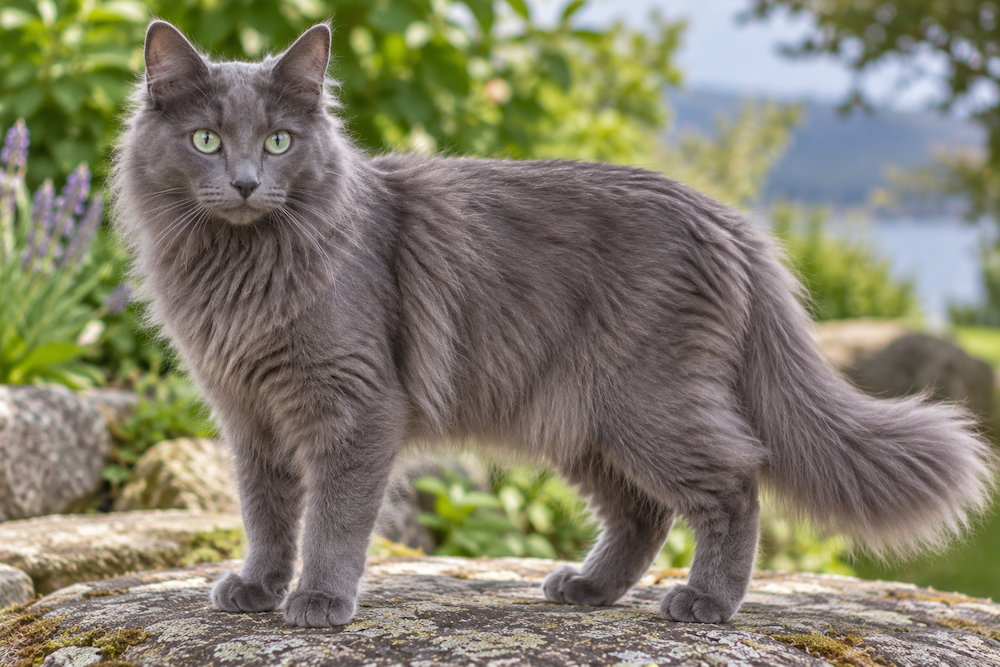






Silvery-blue, luxuriously long-haired, and almost ghostlike in appearance — the Nebelung is a rare modern breed combining the elegant look of the Russian Blue with a flowing coat, brilliant green eyes, quiet intelligence, and an intensely loyal personality.
🧠 QUICK SNAPSHOT
- Temperament: Gentle, intelligent, loyal
- Energy Level: Moderate
- Size: Medium
- Good With Families: Very Good
- Indoor Living: Excellent
- Trainability: High
- Grooming: Moderate
- Best For: Quieter families, apartment living, patient owners, people wanting a strongly bonded companion
- Typical Lifespan: Around 13–18 years
📚 OVERVIEW
The Nebelung looks like an ancient cat that might have wandered out of a European fairy tale, but the recognised breed is surprisingly modern.
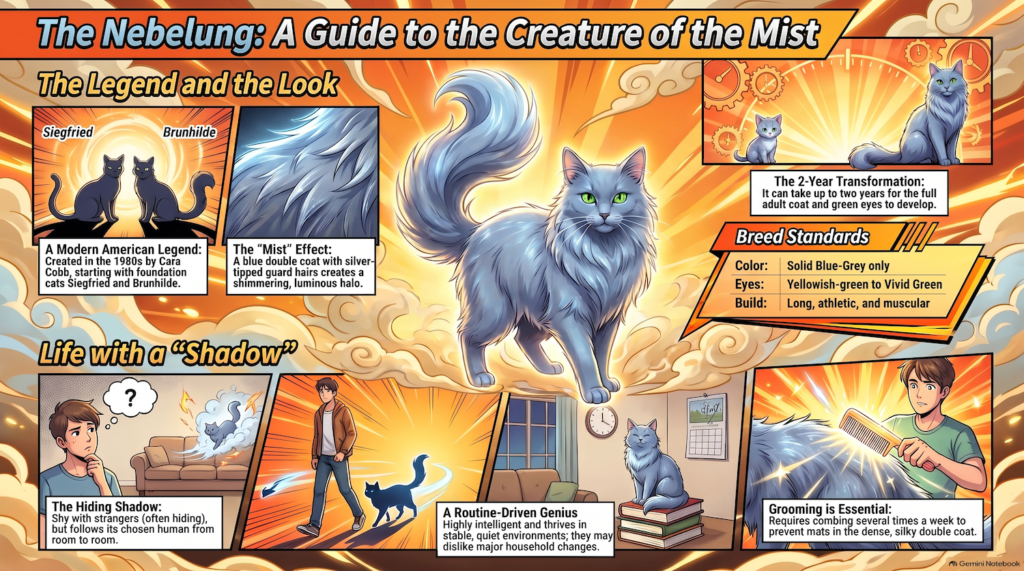
Its story began in the United States during the 1980s with breeder Cora Cobb and two unusual blue-grey cats named Siegfried and Brunhilde.
Their beautiful semi-long blue coats reminded Cobb of what a long-haired Russian Blue might look like, and they became the foundation of the new breed.
The Russian Blue subsequently played an important role in developing the Nebelung and establishing its characteristic appearance.
Modern Nebelungs are elegant, medium-sized cats with long bodies, fine but strong bone structure, vivid green eyes and distinctive blue coats tipped with silver.
The name Nebelung comes from the German word Nebel, meaning “mist” or “fog”, while also deliberately echoing the Germanic epic Nibelungenlied connected with the names Siegfried and Brunhilde.
Personality is generally quieter than appearance might suggest.
Nebelungs tend to be intelligent, sensitive and deeply devoted to their families. They can be reserved around strangers and may take time to adjust to unfamiliar environments.
Once they trust someone, however, they can become remarkably affectionate companions.
✅ PROS & CONS
Pros
- Extremely loyal and affectionate
- Beautiful silver-blue coat
- Intelligent and trainable
- Excellent indoor companion
- Generally quiet and gentle
- Often long-lived
- Moderate exercise requirements
Cons
- Can be shy around strangers
- May dislike noisy or chaotic households
- Doesn’t always adapt quickly to change
- Semi-long coat requires regular grooming
- Can become strongly attached to particular people
- Rare in many countries
- Not hypoallergenic
Is a Nebelung a Good Family Cat?
Yes, the Nebelung can be an excellent family cat, particularly in a relatively calm and predictable household.
These cats tend to form deep relationships with their humans. Some become particularly attached to one person while remaining affectionate towards other members of the family.
They can live successfully with respectful children, although a household filled with constant noise and rough play may overwhelm a sensitive individual.
Nebelungs may also live happily with compatible cats and calm, cat-friendly dogs when introductions are gradual.
They aren’t typically the type of cat that immediately climbs onto every visitor.
A Nebelung may initially disappear when unfamiliar people arrive and observe proceedings from somewhere safe before deciding whether introductions are appropriate.
That reserve shouldn’t be mistaken for lack of affection.
With trusted family members, the same cat can become an extremely devoted companion that follows people around the house and quietly settles beside them.
Can a Nebelung Live Indoors or in an Apartment?
Yes, the Nebelung is very well suited to indoor and apartment living.
Its moderate energy level means a huge property isn’t necessary, provided the cat receives sufficient exercise and enrichment.
Cat trees, shelves, scratching posts, window perches and interactive toys provide opportunities to climb, observe and play.
Nebelungs often appreciate having quiet retreats where they can escape household activity.
This is particularly useful in apartments where cats can’t simply move to another distant part of the property when visitors arrive.
They generally appreciate routine and may be happier in a stable environment than one involving constant disruption.
Secure indoor living also protects cats from traffic, fights, disease and other outdoor dangers.
A secure cat enclosure can provide additional stimulation where practical.
For the Nebelung, the quality of the home environment generally matters much more than its square metres.
How Much Exercise and Play Does a Nebelung Need?
The Nebelung has moderate exercise requirements and should receive interactive play every day.
These cats may appear serene, but they retain the agility and hunting instincts of domestic cats.
Fishing-wand toys, balls, tunnels, climbing structures and games involving stalking and pouncing can provide excellent physical exercise.
Several shorter play sessions throughout the day generally work well.
Mental enrichment is also important.
Puzzle feeders, hidden treats and training games can challenge an intelligent Nebelung without overwhelming it.
Young cats can be surprisingly energetic, while adults often settle into a more measured routine.
Keeping the cat active also helps prevent obesity, which is particularly important with a fluffy breed because weight gain can be harder to notice beneath the coat.
A Nebelung may look like an elegant cloud drifting around the house.
There is still a capable feline athlete somewhere inside the fog.
Is a Nebelung Easy to Train?
Yes, the Nebelung is generally intelligent and capable of learning quickly, particularly when training is calm and reward-based.
Treats, toys, praise and clicker training can all be effective.
A Nebelung can learn to come when called, use designated scratching areas, enter a carrier voluntarily and perform simple tricks.
Some may also enjoy retrieving or harness walking.
Because the breed can be sensitive, harsh corrections are particularly inappropriate.
Training should build confidence rather than create anxiety.
Early positive exposure to grooming, nail trimming, dental checks, carrier travel and visitors can be extremely valuable.
Nebelungs are also good at learning household routines.
They may know precisely when meals should appear, which cupboard contains treats and what time their favourite human normally comes home.
If you’re late, don’t assume the cat hasn’t noticed.
Does a Nebelung Shed?
Yes. The Nebelung has a semi-long double coat and does shed, particularly during seasonal coat changes.
The coat is one of the breed’s defining features.
It should feel soft and silky, with a dense undercoat and longer guard hairs creating a luxurious appearance.
Regular brushing approximately two or three times a week can remove loose hair and reduce tangles.
More frequent grooming may be useful during periods of heavier shedding.
Particular attention should be paid around the hindquarters, chest and other areas where longer fur can become tangled.
The coat can take considerable time to reach full maturity, particularly in younger cats.
Routine care should also include nail trimming, dental hygiene and checks of the ears, eyes and skin.
Despite occasional claims surrounding blue-coated breeds, the Nebelung is not hypoallergenic.
The beautiful coat may look magical.
Unfortunately, it hasn’t found a magical way to eliminate cat allergens.
What Health Problems Are Common in a Nebelung?
The Nebelung is generally considered a relatively healthy breed, although its rarity means there is less large-scale breed-specific health research than for more common cats.
Its close relationship with the Russian Blue means responsible breeders should maintain careful health records and avoid excessive narrowing of the gene pool.
No single serious disorder defines the Nebelung in the way that certain inherited diseases affect some other pedigree breeds.
However, Nebelungs can still develop common feline conditions including dental disease, kidney disease, urinary disorders, heart disease, arthritis and obesity.
Weight deserves particular attention.
A thick coat can disguise changes in body condition, so owners should physically assess their cat rather than relying entirely on appearance.
Responsible breeders should monitor their lines for inherited disease and prioritise genetic diversity.
With good breeding, appropriate nutrition, exercise, dental care and veterinary attention, Nebelungs can be relatively long-lived, with many reaching their mid-to-late teens.
⭐ Is the Nebelung Just a Long-Haired Russian Blue?
The simplest description of a Nebelung is often “a long-haired Russian Blue”, and visually that comparison makes considerable sense.
The relationship is real.
Russian Blues were important in developing and standardising the Nebelung, and the breeds share several characteristics including their blue colouring, green eyes, elegant structure and somewhat reserved personality.
But the Nebelung is recognised as a distinct breed by organisations that accept it.
Its semi-long coat fundamentally changes its appearance, creating the flowing, misty silhouette that inspired its name.
The breed also has its own modern foundation history beginning with Siegfried and Brunhilde in the United States.
So calling it a long-haired Russian Blue is useful shorthand.
It just doesn’t tell the entire story.
⭐ Who Were Siegfried and Brunhilde?
The Nebelung’s story revolves around two cats with names borrowed from Germanic legend.
The first was a long-haired blue male named Siegfried, born in the early 1980s.
A later litter produced a similarly beautiful blue female, who was named Brunhilde.
Their owner, Cora Cobb, recognised that these cats possessed a combination of features she wanted to preserve.
Siegfried and Brunhilde eventually became the foundation pair behind the development of the Nebelung.
Their names weren’t chosen randomly.
Siegfried and Brünnhilde are famous figures associated with the Germanic heroic tradition and Wagner’s Ring cycle.
That literary connection would eventually influence the name of the breed itself.
Very few modern cat breeds can trace their identity so neatly back to two individual cats with appropriately epic names.
⭐ What Does “Nebelung” Mean?
The name Nebelung is a clever piece of wordplay.
The German word Nebel means “mist” or “fog”.
That perfectly describes the cat’s shimmering silver-blue coat, which can give the animal a soft, almost hazy appearance.
But the name also deliberately echoes the Nibelungenlied, the medieval German epic featuring the legendary hero Siegfried.
Given that the breed’s foundation cats were named Siegfried and Brunhilde, the connection is unmistakable.
The name therefore manages to reference both the cat’s physical appearance and the story behind its development.
“Mist cat” would already have been a pretty good description.
Giving it an additional connection to medieval Germanic legend makes it considerably better.
⭐ Why Does the Nebelung’s Coat Look Silver?
The Nebelung is genetically a blue cat, with “blue” being the feline term for diluted black.
However, the ends of the hairs can appear lighter or silvery.
When light strikes these hairs, the entire coat can develop a shimmering silver effect.
The longer fur amplifies this appearance compared with the short coat of a Russian Blue.
As the cat moves, individual hairs catch the light differently, creating the impression of a soft halo surrounding the body.
This is particularly dramatic in bright natural light.
The combination of blue-grey fur, silver tipping and vivid green eyes gives the Nebelung its characteristic ethereal appearance.
It isn’t difficult to understand why “mist” became part of the breed’s name.
⭐ Are Nebelung Kittens Born With Green Eyes?
Not with the fully developed vivid green eyes expected of mature adults.
Like other kittens, their eye colour changes as they grow.
Nebelung kittens may pass through yellowish or yellow-green stages before the mature green colour becomes established.
Development can be gradual.
This means a young kitten shouldn’t necessarily be judged by the intense green eye colour seen in photographs of mature show cats.
The same patience applies to the coat.
A Nebelung’s full adult coat may take up to around two years or longer to develop its most impressive length and texture.
The breed is something of a slow reveal.
The kitten gives you an indication.
The adult eventually delivers the complete special effects.
⭐ Why Are Nebelungs Often Shy Around Strangers?
Nebelungs tend to have a reputation for being reserved and cautious with unfamiliar people.
This doesn’t necessarily mean they are fearful cats.
Many simply prefer to observe someone before deciding whether that person deserves access to the inner circle.
Early socialisation can make a significant difference.
Kittens positively exposed to different people, sounds, environments and handling are more likely to become confident adults.
Even well-socialised Nebelungs, however, may remain more selective than highly outgoing breeds.
This trait is part of what makes their affection towards trusted humans feel particularly strong.
A Nebelung may not consider everybody its best friend.
Once you’re chosen, though, you may discover that personal space has quietly been removed from the household rules.
⭐ Do Nebelungs Really Choose One Favourite Person?
Many Nebelungs are reported to develop an especially strong attachment to one particular person, although this isn’t universal.
They can certainly love an entire family.
But their combination of sensitivity, loyalty and selective social behaviour can result in one relationship becoming particularly intense.
The favourite person may acquire a quiet grey shadow that follows them from room to room, sleeps nearby and waits outside closed doors.
This doesn’t mean a Nebelung should be deliberately encouraged to depend entirely on one human.
Positive relationships with multiple household members can help create a more confident, adaptable cat.
But if you live with several people and your Nebelung consistently ignores everyone else to sit beside you, congratulations.
The election has apparently been held.
⭐ Is the Nebelung an Ancient European Breed?
Surprisingly, no.
Everything about the Nebelung looks ancient.
The German name, silver-blue coat and connection with legendary characters make it easy to imagine these cats wandering through medieval European castles.
The recognised breed actually began in the United States during the 1980s.
Its European atmosphere comes largely from its appearance, Russian Blue influence and deliberately Germanic naming.
This is a useful distinction between the history of a breed and the ancestry behind its appearance.
The Russian Blue has much older roots.
The Nebelung as an organised pedigree breed does not.
It is essentially a modern American breed that somehow managed to arrive looking as though it had spent the previous thousand years hiding in a German forest.
⭐ How Rare Is the Nebelung?
The Nebelung remains quite rare internationally.
It has never reached the enormous popularity of breeds such as the Maine Coon, Ragdoll, British Shorthair or Russian Blue.
Breeder numbers are limited in many countries, so finding a genuine kitten may involve waiting or travelling.
The breed’s appearance also creates frequent cases of mistaken identity.
Long-haired blue-grey domestic cats can look remarkably similar to Nebelungs.
Some may even have green eyes and the same elegant appearance.
That doesn’t make them pedigree Nebelungs.
A genuine Nebelung comes from documented breeding lines.
This distinction doesn’t make an unidentified blue-grey cat any less beautiful.
It simply means that looking like a breed and actually belonging to that breed are two different things.