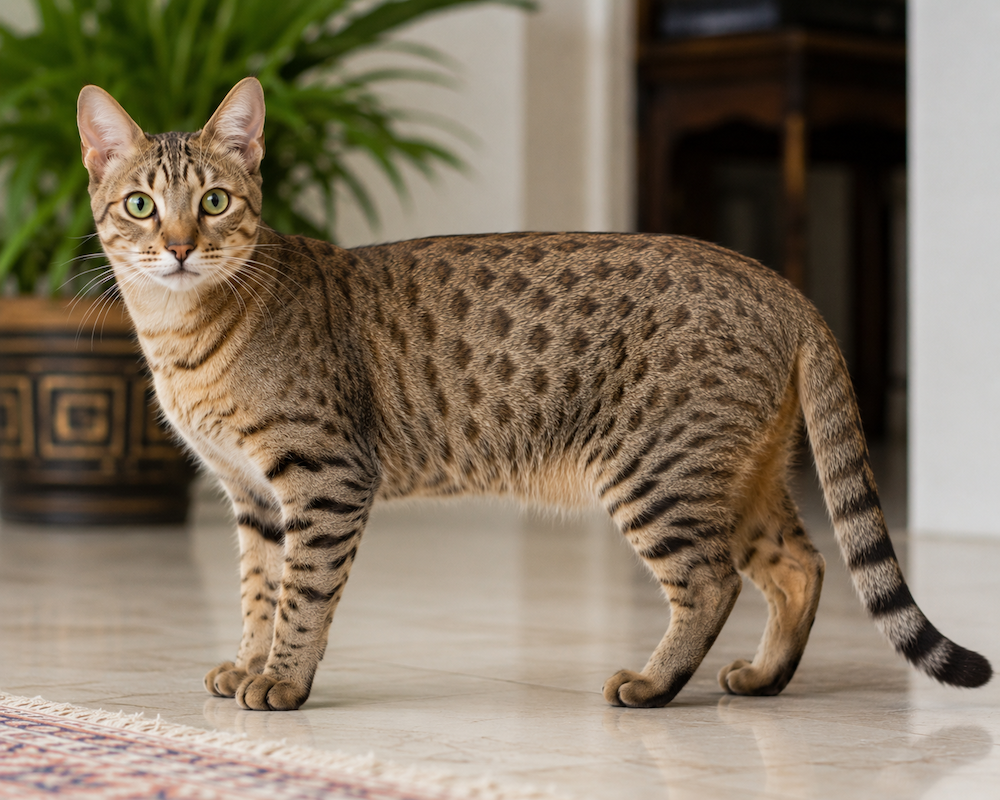






Wild-looking but completely domestic — the Ocicat combines spectacular leopard-like spots with an outgoing, intelligent, and surprisingly dog-like personality that loves people, games, and being involved in family life.
🧠 QUICK SNAPSHOT
- Temperament: Outgoing, affectionate, intelligent
- Energy Level: High
- Size: Medium to Large
- Good With Families: Excellent
- Indoor Living: Excellent with sufficient enrichment
- Trainability: Very High
- Grooming: Low
- Best For: Active families, interactive owners, multi-pet households
- Typical Lifespan: Around 12–15 years
📚 OVERVIEW
The Ocicat looks like a small wild cat that has somehow wandered into the living room, but its exotic appearance is deceptive. There is no wild cat ancestry in the Ocicat.
Instead, the breed began almost accidentally in the United States during the 1960s.
Breeder Virginia Daly was attempting to produce an Abyssinian-pointed Siamese when one of her litters included an unexpected ivory kitten covered in golden spots. The kitten, named Tonga, looked so much like a tiny ocelot that Daly’s daughter suggested the name “Ocicat.”
Although Tonga himself didn’t establish the breed, his appearance inspired further breeding. Siamese and Abyssinian ancestry formed the foundation, with American Shorthair later contributing additional size, substance, and colour.
The modern Ocicat is muscular, athletic, and covered in distinctive thumbprint-shaped spots. Underneath that wild appearance, however, is a highly social domestic cat.
Ocicats tend to be confident, affectionate, intelligent, and strongly interested in people. Many greet visitors rather than hiding and actively seek opportunities to play, learn, and participate in household life.
✅ PROS & CONS
Pros
- Highly affectionate and sociable
- Extremely intelligent and trainable
- Excellent family companion
- Often good with other pets
- Spectacular wild-looking spotted coat
- Very low-maintenance grooming
Cons
- Needs substantial daily interaction
- Can become bored or mischievous without enrichment
- Doesn’t usually enjoy prolonged isolation
- High activity level
- Can be vocal when it wants attention
- May be too demanding for someone wanting an independent cat
Is an Ocicat a Good Family Cat?
Yes, the Ocicat is generally an excellent family cat, especially for an interactive household wanting a confident, affectionate companion. Despite its wild appearance, the breed was developed entirely from domestic cats and is known for being strongly people-oriented.
Ocicats often enjoy respectful children, particularly those willing to play games and interact with them. Their sturdy, muscular build also makes them less physically delicate than some finely built breeds, although gentle handling remains essential.
They can be excellent candidates for multi-pet homes. Many enjoy the companionship of another cat and can live successfully with cat-friendly dogs after gradual introductions.
Unlike naturally reserved breeds, an Ocicat may also be surprisingly confident around visitors. Some enthusiastically investigate anyone arriving at the house.
Their sociability does mean they aren’t ideal for households where the cat will routinely spend very long periods alone.
For families wanting a cat that actively participates in household life, the Ocicat can be a particularly rewarding companion.
Can an Ocicat Live Indoors or in an Apartment?
Yes, an Ocicat can live very successfully indoors or in an apartment, provided owners create a stimulating environment that accommodates its intelligence and athletic ability.
Ocicats love vertical territory. Tall cat trees, climbing shelves, window perches, scratching towers, and secure elevated platforms allow them to jump, climb, and observe their surroundings.
Puzzle feeders, tunnels, interactive toys, and regular training sessions can help make indoor life interesting.
The breed’s confidence and intelligence also mean owners should think carefully about security. Doors, screens, balconies, and windows should be properly secured, particularly in high-rise apartments.
A secure outdoor enclosure can provide additional enrichment, and many Ocicats can be trained to walk on a harness.
The Ocicat doesn’t necessarily need a huge house. It needs things to climb, games to play, problems to solve, and people to interact with.
Provide those and it can adapt extremely well to indoor living.
How Much Exercise and Play Does an Ocicat Need?
The Ocicat is a high-energy, athletic cat requiring substantial daily play and mental stimulation. Several interactive play sessions spread throughout the day are ideal.
Fishing-wand toys, balls, tunnels, climbing structures, chasing games, and toys that encourage stalking and pouncing provide excellent physical activity.
Many Ocicats enjoy retrieving toys and can become enthusiastic participants in games of fetch. Their intelligence also makes puzzle feeders, treat hunts, clicker training, and learning tricks particularly valuable.
Climbing should form an important part of the home environment. These muscular cats are powerful jumpers and may simply create their own climbing routes if appropriate ones aren’t provided.
Mental exercise can sometimes tire an intelligent cat just as effectively as physical play. Rotating toys and introducing new challenges prevents activities from becoming predictable.
An under-stimulated Ocicat is unlikely to simply accept boredom quietly. It may instead start investigating cupboards, opening doors, moving objects, or inventing entirely new household games.
Is an Ocicat Easy to Train?
Yes, the Ocicat is one of the more trainable cat breeds thanks to its intelligence, confidence, curiosity, and strong interest in interacting with humans.
Positive-reinforcement training can teach an Ocicat to come when called, sit, give a paw, retrieve toys, enter a carrier voluntarily, and walk on a harness.
Many individuals particularly enjoy fetch, contributing to the breed’s reputation for occasionally behaving more like a dog than a conventional cat.
Clicker training can be extremely effective. It provides a clear signal when the cat performs the desired behaviour and turns learning into an engaging mental game.
Training practical behaviours is worthwhile too. Comfortable nail handling, carrier use, dental checks, and veterinary-style examinations can make routine care considerably less stressful.
Punishment should be avoided. Rewarding desirable behaviour produces better results while preserving trust.
Owners should also remember that intelligent cats learn continuously. Your Ocicat may discover how to open a cupboard without you ever intending to teach that particular trick.
Does an Ocicat Shed?
Yes, the Ocicat sheds, but its short, sleek coat requires very little maintenance. Shedding is generally light to moderate and far easier to manage than the coat of a long-haired or densely undercoated breed.
Brushing approximately once a week with a soft brush or grooming mitt is normally sufficient to remove loose hair and maintain the coat’s characteristic shine.
Many owners gently polish the coat with a grooming cloth or chamois to emphasise its smooth appearance and spectacular spotted pattern.
Bathing is rarely required unless the cat becomes unusually dirty.
Routine maintenance should include nail trimming, dental care, and checks of the ears, eyes, skin, and overall body condition.
The Ocicat is not considered hypoallergenic. A short coat and relatively low grooming requirements don’t prevent the production of feline allergens, which are primarily associated with proteins in saliva and skin secretions.
For owners wanting an exotic-looking cat without exotic grooming requirements, however, the Ocicat is remarkably easy to maintain.
What Health Problems Are Common in an Ocicat?
The Ocicat is generally considered a healthy breed, but its Abyssinian and Siamese ancestry means several inherited conditions deserve attention.
Progressive retinal atrophy (PRA) can occur and may eventually cause blindness. Genetic testing can help responsible breeders manage relevant inherited forms.
Pyruvate kinase deficiency (PK deficiency), an inherited condition affecting red blood cells and potentially causing anaemia, is another disorder for which genetic testing is available.
Renal amyloidosis, involving abnormal protein deposits that can damage the kidneys, has occurred within related breed populations and is another condition responsible breeders should understand.
Heart disease, including hypertrophic cardiomyopathy (HCM), should also be considered, while dental disease can affect cats of any breed.
Prospective owners should seek breeders who undertake appropriate health screening and understand the medical history of their lines.
Regular veterinary examinations, balanced nutrition, dental care, weight management, and early investigation of unusual symptoms can help an Ocicat achieve its typical lifespan of around 12–15 years or longer.
⭐ Is the Ocicat Part Ocelot?
No — not even a little bit.
The resemblance is deliberate, but the Ocicat contains no ocelot or other wild feline ancestry.
The breed’s story began unexpectedly in 1964 when American breeder Virginia Daly was working with Abyssinian and Siamese cats. One kitten emerged with an extraordinary pattern of golden spots.
His name was Tonga.
Daly’s daughter reportedly remarked that the kitten looked like an ocelot and suggested calling him an Ocicat.
Tonga wasn’t initially regarded as the foundation of an entirely new breed, but interest in his appearance encouraged breeders to recreate and develop the spotted look.
American Shorthairs were later incorporated into breeding programs, adding greater size and substance.
The result is a cat that looks impressively wild while being genetically domestic.
So if you want something that resembles a miniature jungle cat but behaves like an affectionate family companion, the Ocicat delivers the illusion remarkably well.
⭐ Why Does an Ocicat Have Spots?
The Ocicat’s dramatic markings come entirely from domestic cat genetics.
The breed’s spotted appearance is essentially produced through modifications of tabby patterning. Each individual spot should be clearly visible against the lighter background colour, creating the characteristic wild-cat effect.
Interestingly, the underlying pattern becomes easier to understand when you look closely at the cat.
The face retains classic tabby-style markings, including the familiar “M” shape on the forehead, while the legs and tail may display bars and rings. Across the body, however, the pattern breaks into distinct spots.
The hairs within the coat also display agouti banding, inherited through the breed’s Abyssinian ancestry, adding additional richness and depth to the colour.
Ocicats occur in numerous recognised colours, but regardless of shade, the spots should stand out clearly.
What looks like a wild-cat camouflage pattern is therefore the result of selectively combining and refining coat genetics already present within domestic cats.
⭐ Why Are Ocicats Sometimes Called Dog-Like Cats?
Calling a cat “dog-like” is often overused, but the Ocicat does display several behaviours that explain the comparison.
Many Ocicats enjoy playing fetch.
They can learn to come when called.
Some happily walk on a harness.
They frequently greet their owners at the door and may enthusiastically investigate visitors rather than disappearing when the doorbell rings.
Most importantly, they tend to be highly interactive. An Ocicat often wants to know where its humans are and what they’re doing.
That doesn’t mean it behaves exactly like a dog. It remains thoroughly feline, complete with climbing, stalking, scratching, independent decision-making, and the occasional refusal to participate simply because it has changed its mind.
Perhaps the better description is a cat with an unusually strong enthusiasm for social interaction and cooperative games.
And unlike a dog, you probably won’t need to take your Ocicat outside at 6:00 am in the rain.