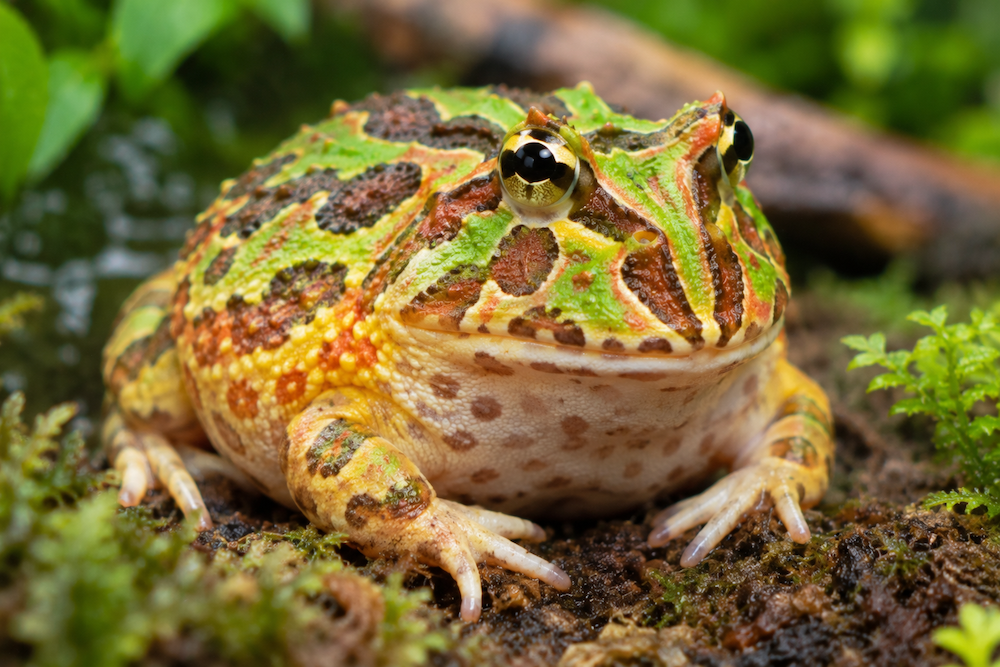







Round, colourful and equipped with an enormous appetite, the Pacman Frog is a fascinating amphibian famous for its oversized mouth, remarkable camouflage, powerful feeding response and wonderfully unusual appearance.
🧠 QUICK SNAPSHOT
Trait | Pacman Frog |
|---|---|
Scientific Classification | Ceratophrys species |
Other Names | Horned Frog, South American Horned Frog, Argentine Horned Frog |
Pet Type | Amphibian / Terrestrial Frog |
Natural Origin | South America |
Typical Lifespan | Approximately 6–10 years; some live longer |
Adult Size | Approximately 8–17 cm, depending on species and sex |
Adult Weight | Commonly 100–500 g; large females may exceed this |
Skin Type | Moist, textured skin with distinctive markings |
Colours | Green, brown, yellow, orange, red, cream and patterned |
Diet | Carnivore |
Activity | Primarily nocturnal and crepuscular |
Temperament | Solitary, sedentary and defensive when threatened |
Noise Level | Usually quiet; males may vocalise |
Social Needs | Solitary; should be housed individually |
Housing | Secure terrestrial amphibian enclosure |
Temperature | Generally 24–28°C, with species-appropriate variation |
Humidity | Commonly 60–80%, with moist substrate |
Substrate | Moist, amphibian-safe material suitable for burrowing |
Grooming | No grooming required |
Exercise Needs | Low; primarily an ambush predator |
Handling | Minimal; observation preferred |
Beginner Friendly? | Suitable for prepared beginners with appropriate husbandry |
Famous Feature | Enormous mouth, round body and powerful ambush-feeding behaviour |
📚 OVERVIEW
The Pacman Frog is a popular name for several species of South American horned frogs belonging to the genus Ceratophrys. These extraordinary amphibians are instantly recognisable by their enormous mouths, rounded bodies, short legs and distinctive camouflage patterns.
Popular captive species include the Argentine Horned Frog (Ceratophrys ornata) and Cranwell’s Horned Frog (Ceratophrys cranwelli). Selective breeding has produced numerous striking colour varieties, particularly among Cranwell’s Horned Frogs, including albino, apricot and other brightly coloured forms.
Unlike highly active tree frogs, Pacman Frogs spend much of their lives partially buried in soft substrate. They are ambush predators, remaining almost motionless until suitable prey approaches. Their powerful jaws and rapid feeding response make them fascinating animals to observe.
Their care requires appropriate temperature and humidity, deep moist substrate, clean dechlorinated water, carefully managed feeding and minimal handling. Pacman Frogs are solitary animals and should not be housed together because of their territorial behaviour and potential for cannibalism.
✅ PROS & CONS
👍 Pros
Extraordinary appearance and impressive colours
Fascinating ambush-predator behaviour
Relatively modest enclosure requirements
Generally quiet and unobtrusive
Suitable for observation-focused keepers
Many attractive captive-bred colour varieties
Low physical activity requirements
Long-lived with appropriate care
👎 Cons
Unsuitable for frequent handling
Require carefully controlled environmental conditions
Can bite when threatened or confused by movement
Must be housed individually
May remain buried for extended periods
Require live or appropriately prepared animal-based foods
Vulnerable to dehydration and poor water quality
Ownership is restricted or prohibited in some countries or regions
Are Pacman Frogs Good Pets?
Yes. Pacman Frogs can make excellent pets for people who enjoy observing unusual amphibians.
Their distinctive appearance and dramatic feeding behaviour make them fascinating enclosure animals.
However, they are better suited to observation than physical interaction.
Are Pacman Frogs Good for Beginners?
Yes, with appropriate preparation.
Pacman Frogs are often considered among the more manageable amphibians for beginners because they don’t require enormous enclosures.
However, correct humidity, temperature, nutrition and water quality are essential.
How Long Do Pacman Frogs Live?
Pacman Frogs commonly live approximately 6–10 years in captivity.
Some individuals may live considerably longer with excellent care.
Lifespan depends on species, genetics, nutrition and environmental conditions.
How Big Do Pacman Frogs Get?
Adult Pacman Frogs generally measure approximately 8–17 cm in body length.
Females are usually considerably larger than males.
Their broad, rounded bodies make them appear particularly substantial compared with many other frog species.
How Much Do Pacman Frogs Weigh?
Adult weight varies according to species, sex and body condition.
Many weigh approximately 100–500 g, although particularly large females can exceed this range.
Maintaining appropriate body condition is important because obesity can contribute to health problems.
What Are the Different Types of Pacman Frogs?
Popular and recognised species include:
Argentine Horned Frog — Ceratophrys ornata, famous for its bold green and brown markings
Cranwell’s Horned Frog — Ceratophrys cranwelli, widely kept and available in numerous colour varieties
Surinam Horned Frog — Ceratophrys cornuta, known for prominent horn-like projections above its eyes
Brazilian Horned Frog — Ceratophrys aurita, a large species native to Brazil
Care requirements and availability vary between species.
Why Are They Called Pacman Frogs?
Their nickname comes from their enormous mouths and rounded bodies.
When viewed from above, they resemble the famous video game character Pac-Man.
Their ability to swallow surprisingly large prey reinforces the comparison.
Are Pacman Frogs Friendly?
Pacman Frogs aren’t social animals in the way mammals can be.
They may become accustomed to familiar routines and nearby human activity.
However, they don’t generally seek affection or enjoy being handled.
Do Pacman Frogs Recognise Their Owners?
Pacman Frogs can become familiar with regular feeding routines and environmental cues.
Some appear to respond to movement associated with food.
However, there is limited evidence that they recognise individual owners in the same way as many mammals.
Are Pacman Frogs Aggressive?
Pacman Frogs can display defensive behaviour when disturbed.
They may inflate their bodies, vocalise or attempt to bite.
Their powerful feeding response can also cause them to mistake moving fingers for prey.
Do Pacman Frogs Bite?
Yes.
Pacman Frogs possess strong jaws and can deliver painful bites.
Their teeth-like structures and powerful grip help them capture prey.
Feeding tongs and minimal handling reduce the risk of accidental bites.
Are Pacman Frogs Poisonous?
Pacman Frogs aren’t generally considered dangerously poisonous to humans.
However, amphibian skin secretions can irritate sensitive tissues, and frogs may carry microorganisms such as Salmonella.
Hands should be washed thoroughly after contact with their enclosure or equipment.
Can You Hold a Pacman Frog?
Handling should be kept to an absolute minimum.
Their delicate, permeable skin can absorb substances from human hands, including soap residues, oils and chemicals.
When handling is unavoidable, clean, powder-free gloves moistened with dechlorinated water are often recommended.
Can Pacman Frogs Live Together?
No.
Pacman Frogs should generally be housed individually.
They are solitary predators and may attack or consume smaller frogs, including members of their own species.
Even similarly sized individuals can injure one another.
Are Pacman Frogs Active?
Pacman Frogs are relatively sedentary.
They spend much of their time buried in substrate, waiting for prey.
Activity often increases during feeding periods and at night.
Why Does My Pacman Frog Bury Itself?
Burrowing is completely natural.
Pacman Frogs bury themselves to remain concealed, conserve moisture and ambush prey.
However, prolonged inactivity accompanied by weight loss, abnormal skin or other concerning symptoms may indicate unsuitable conditions or illness.
Do Pacman Frogs Hibernate?
Some Pacman Frog species can enter a period of dormancy known as aestivation during unfavourable environmental conditions.
This may involve reduced activity and the formation of protective skin layers.
Captive owners should not deliberately induce dormancy without species-specific veterinary guidance.
What Size Tank Does a Pacman Frog Need?
A single adult Pacman Frog generally benefits from a terrestrial enclosure with a floor area of approximately 60 × 45 cm or larger.
Larger individuals may require more space.
Floor area and deep substrate are more important than excessive enclosure height.
What Substrate Is Best for Pacman Frogs?
Pacman Frogs require soft, moisture-retaining substrate that allows natural burrowing.
Suitable options may include amphibian-safe soil-based mixtures and appropriate coconut fibre products.
Substrate should remain moist but not waterlogged.
Avoid sharp gravel, coarse particles and materials that could cause injury or intestinal obstruction.
What Temperature Do Pacman Frogs Need?
Many captive Pacman Frogs thrive at approximately 24–28°C.
A slightly cooler area allows the frog to regulate its temperature.
Exact requirements vary by species and life stage, and overheating must be avoided.
What Humidity Do Pacman Frogs Need?
Pacman Frogs generally require moderate to high humidity.
Approximately 60–80% relative humidity is commonly recommended, although species and enclosure conditions influence the ideal range.
Moist substrate, ventilation and regular monitoring help maintain suitable conditions.
Do Pacman Frogs Need Water?
Yes.
Pacman Frogs require access to clean, shallow, dechlorinated water.
The dish should allow the frog to enter and exit safely without the risk of drowning.
Water should be changed regularly because amphibians are particularly sensitive to contamination.
Do Pacman Frogs Need UVB Lighting?
Low-level UVB lighting can be beneficial when correctly provided.
Appropriate UVB exposure supports vitamin D metabolism and calcium regulation.
Lighting must be selected carefully for the species, enclosure height and available shaded retreats.
What Do Pacman Frogs Eat?
Pacman Frogs are carnivores.
Their captive diet may include appropriately sized earthworms, crickets, roaches and other suitable invertebrates.
Larger individuals may occasionally receive other appropriately selected prey under expert guidance.
A varied diet with suitable calcium and vitamin supplementation is important.
How Often Should You Feed a Pacman Frog?
Young Pacman Frogs generally require feeding more frequently than adults.
Juveniles may be offered suitable food several times weekly, while many healthy adults are fed approximately once or twice weekly.
Feeding frequency should reflect body condition, prey size, age and veterinary advice.
Can Pacman Frogs Eat Mice?
Large Pacman Frogs are physically capable of consuming small vertebrate prey.
However, mice are not necessary as a routine captive food and may contribute to excessive calorie intake or digestive problems.
Appropriately sized invertebrates are generally preferable as the foundation of their diet.
How Do Pacman Frogs Breed?
Pacman Frogs reproduce by laying eggs in water.
During breeding, males grasp females in a position known as amplexus.
Females may deposit large numbers of eggs, which develop into aquatic tadpoles.
Captive breeding requires specialised conditions and careful management.
What Health Problems Are Common in Pacman Frogs?
Potential concerns include metabolic bone disease, obesity, dehydration, bacterial infections, intestinal obstruction and nutritional deficiencies.
Improper substrate, poor water quality and unsuitable temperatures can contribute to serious health problems.
A veterinarian experienced with amphibians should assess persistent refusal to eat, abnormal posture, severe swelling or unusual skin changes.
Are Pacman Frogs Legal to Keep as Pets?
Pacman Frogs are legal pets in some countries, but some countries or regions restrict or prohibit their ownership, sale or importation.
In Australia, private ownership of exotic amphibians such as South American Pacman Frogs is generally prohibited under strict biosecurity and wildlife regulations.
Prospective owners should verify current national, state and local requirements before attempting to obtain one.
What Makes the Pacman Frog Unique?
Imagine a frog shaped almost like a tennis ball, with an enormous mouth, tiny legs and a feeding response so powerful that it can capture prey approaching from almost any direction.
That’s the extraordinary Pacman Frog.
These remarkable amphibians are among the most unusual predators in South America’s grasslands, wetlands and forest environments.
Their famous nickname comes from their resemblance to Pac-Man, the circular video game character with an enormous mouth.
But their appearance serves a serious evolutionary purpose.
Pacman Frogs are specialised ambush predators.
Instead of chasing prey over long distances, they bury themselves in soft soil or vegetation and wait for unsuspecting animals to approach.
Their broad heads and powerful jaws allow them to capture a surprisingly wide variety of prey.
In the wild, some species consume insects, worms, other frogs and occasionally small vertebrates.
Their appetite has earned them a reputation as opportunistic predators.
Another extraordinary feature is their camouflage.
Wild Pacman Frogs often display green, brown and yellow patterns that help them blend into leaf litter, soil and surrounding vegetation.
Their bodies are so rounded that their mouths can occupy a remarkable proportion of their head width.
Some species also possess pointed projections above their eyes.
These horn-like structures help disrupt the outline of the frog’s head, making it harder for predators and prey to distinguish the animal from its surroundings.
Their survival abilities are equally fascinating.
Certain Pacman Frogs can survive unfavourable dry periods by burrowing underground and entering aestivation, a state of greatly reduced activity.
During this process, layers of shed skin may help form a protective covering that reduces water loss.
Their reproduction is another remarkable aspect of their biology.
Like many amphibians, Pacman Frogs undergo a dramatic transformation from aquatic tadpoles into terrestrial adults.
However, their tadpoles can be unusually predatory, and cannibalism may occur in some species.
Scientists have also studied the extraordinary biting performance of horned frogs, finding that their powerful jaws are capable of generating impressive forces relative to body size.
And despite their fearsome appearance, Pacman Frogs spend much of their lives doing almost nothing at all.
Their strategy is simple: remain hidden, conserve energy and strike when an opportunity appears.
The Pacman Frog isn’t simply a round, colourful amphibian — it’s a remarkable ambush predator with powerful jaws, extraordinary camouflage and some of the most fascinating survival adaptations in the frog world.