




Elegant, affectionate, and sometimes almost completely hairless — the Peterbald is a rare Russian breed with an extraordinary range of coat types, a sleek Oriental-style body, enormous ears, remarkable intelligence, and a famously people-loving personality.
🧠 QUICK SNAPSHOT
- Temperament: Affectionate, intelligent, sociable
- Energy Level: High
- Size: Medium
- Good With Families: Excellent
- Indoor Living: Excellent
- Trainability: Very High
- Grooming: Moderate
- Best For: Interactive families, apartment living, multi-pet households, owners wanting a highly social companion
- Typical Lifespan: Around 12–15 years
📚 OVERVIEW
The Peterbald is one of the cat world’s most unusual hairless breeds, but don’t assume it is simply a Russian version of the Sphynx.
Its story began in St Petersburg, Russia, during the 1990s, when breeder Olga Mironova crossed a Don Sphynx — now generally known as the Donskoy — with an Oriental Shorthair.
The resulting kittens combined an unusual hair-loss trait with the elegant physique of Oriental-type cats.
The Peterbald was born.
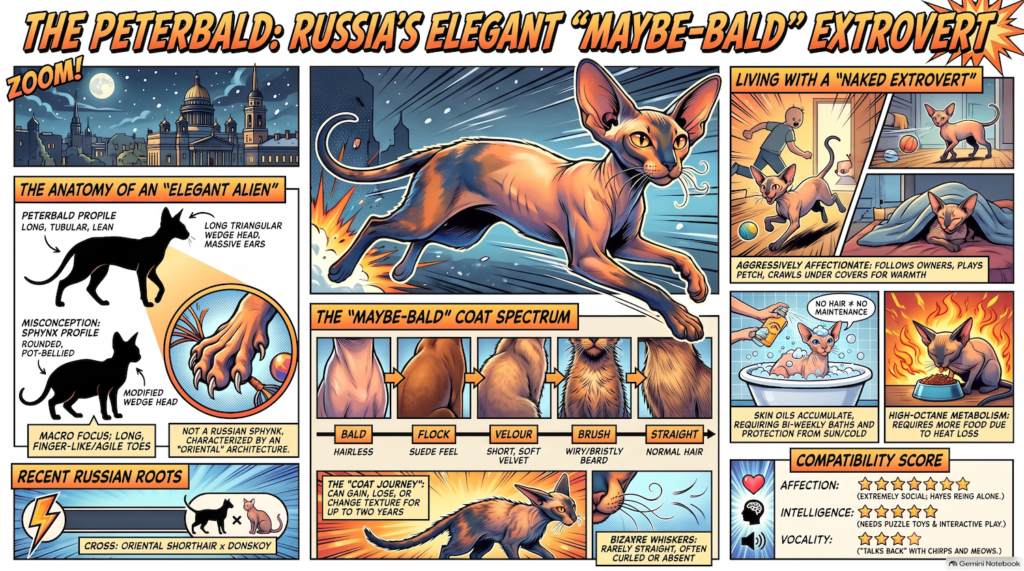
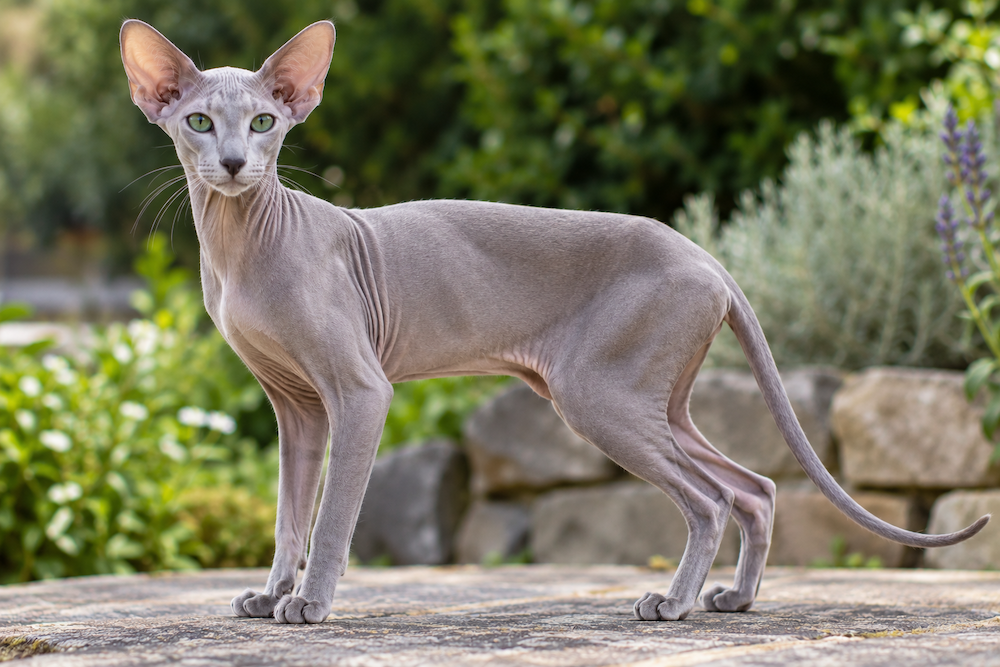
Modern Peterbalds are characterised by long, graceful bodies, slender legs, wedge-shaped heads and impressively large ears. But the feature attracting the most attention is naturally the coat — or sometimes the lack of one.
Peterbalds can range from completely naked to cats with unusual textures commonly described as flock, velour or brush. Some can even have relatively conventional coats.
Even more surprisingly, a Peterbald’s coat can change as it grows.
Personality is another major attraction. Peterbalds tend to be intelligent, energetic, vocal, affectionate and intensely social.
Many want to be directly involved with whatever their humans are doing.
This isn’t usually a cat that considers you the person who happens to own the house.
The Peterbald is more likely to consider you part of its social group — and therefore available for interaction whenever required.
✅ PROS & CONS
Pros
- Extremely affectionate and people-oriented
- Highly intelligent and trainable
- Playful and interactive
- Excellent indoor companion
- Often good with other compatible pets
- Extraordinary range of coat types
- Very distinctive appearance
Cons
- Requires considerable companionship
- Hairless individuals need specialised skin care
- Sensitive to cold and excessive sun exposure
- Can be vocal
- High energy and enrichment needs
- Rare in many countries
- Not truly hypoallergenic
Is a Peterbald a Good Family Cat?
Yes, the Peterbald is generally an excellent family cat, particularly for households wanting a highly interactive companion.
Peterbalds tend to be extremely social and affectionate. Many actively seek physical contact, follow their humans around the home and want to participate in everyday activities.
They can be wonderful companions for respectful children who understand gentle handling.
Many also live successfully with compatible cats and cat-friendly dogs, particularly when introduced carefully.
In fact, companionship can be particularly important for this breed. Peterbalds may not appreciate spending very long periods completely alone every day.
Their Oriental ancestry also contributes to a tendency towards communication. Some Peterbalds are enthusiastic conversationalists and aren’t shy about announcing their opinions.
If you want an independent cat that quietly appears twice a day for food, there are probably better choices.
The Peterbald tends to prefer full membership of the family rather than an occasional guest appearance.
Can a Peterbald Live Indoors or in an Apartment?
Yes, the Peterbald is very well suited to indoor and apartment living, provided it receives sufficient exercise and mental stimulation.
Indoor living is particularly sensible for cats with little or no coat.
Hairless skin offers limited protection against cold weather, intense sunlight, scratches and other environmental hazards.
The home should provide climbing structures, scratching areas, warm sleeping locations, window perches, puzzle feeders and interactive toys.
Because Peterbalds are athletic cats, vertical territory is especially valuable in smaller homes.
They can also be intensely social.
Owners who spend long periods away may need to consider whether another compatible pet can provide companionship.
A secure cat enclosure can offer outdoor enrichment where temperatures and sun exposure can be safely managed.
The Peterbald doesn’t need a mansion.
But it does need warmth, entertainment and preferably somebody interesting to supervise.
How Much Exercise and Play Does a Peterbald Need?
The Peterbald has high exercise and enrichment requirements.
Its Oriental Shorthair ancestry is obvious not only in appearance but also in its athleticism and curiosity.
Daily interactive play is essential.
Fishing-wand toys, balls, tunnels, climbing towers and chasing games can provide useful physical activity.
Several shorter play sessions throughout the day generally work well.
Mental exercise is equally important.
Puzzle feeders, treat hunts, clicker training and problem-solving games can keep an intelligent Peterbald occupied.
These cats often enjoy climbing and exploring elevated areas, so sturdy cat trees and wall-mounted platforms can be excellent additions.
A bored Peterbald may invent its own activities.
Given enough intelligence and free time, the definition of “toy” can rapidly expand to include cupboards, toilet rolls, paperwork and anything you specifically asked the cat not to touch.
Is a Peterbald Easy to Train?
Yes, Peterbalds are generally highly intelligent and very trainable.
Positive reinforcement using food, toys, praise and clicker training can produce excellent results.
Many can learn to come when called, retrieve toys, perform simple tricks, enter a carrier voluntarily and walk on a harness.
Training also provides valuable mental stimulation.
Practical handling is particularly important for this breed.
Kittens should become comfortable with bathing or skin cleaning, nail trimming, ear care, dental checks and general body handling from an early age.
Because Peterbalds often enjoy interaction with humans, training can become another form of social activity.
Their intelligence does have a downside.
A Peterbald doesn’t only learn the behaviours you’re intentionally teaching.
It can also become remarkably good at discovering which behaviours make its human immediately get up and pay attention.
Does a Peterbald Shed?
It depends enormously on the individual Peterbald’s coat type.
Completely hairless cats obviously produce little conventional shedding.
Flock, velour and brush-coated Peterbalds may shed varying amounts, while cats retaining more conventional hair can shed more normally.
Interestingly, Peterbald coats can change over time.
A kitten born with hair may lose some or most of it as it matures.
Hairless Peterbalds require different grooming from ordinary cats. Without enough hair to absorb and distribute natural skin oils, oils can accumulate on the skin.
Some cats therefore need regular wiping or occasional bathing.
Ears and nail beds can also accumulate oils and require cleaning.
The Peterbald is not reliably hypoallergenic. Major cat allergens are produced through saliva and skin secretions, so removing most of the hair doesn’t automatically remove the proteins that trigger allergic reactions.
What Health Problems Are Common in a Peterbald?
The Peterbald is a relatively young breed, so long-term breed-specific health information is more limited than for many established cats.
Responsible breeding is particularly important because the breed combines hairlessness with Oriental-type ancestry.
Dental health deserves attention. Cats with unusual hairlessness genes can sometimes have associated dental abnormalities, although the extent of this issue within different Peterbald lines requires careful breeder assessment rather than broad assumptions.
The breed’s sparse or absent coat creates practical health considerations as well.
Hairless individuals are more vulnerable to temperature extremes, sunburn, scratches and skin irritation.
Regular skin monitoring is important.
Peterbalds can also develop common feline conditions including dental disease, kidney disease, urinary disorders and heart disease.
Responsible breeders should maintain genetic diversity and monitor the health history of their lines.
A reputable breeder should be happy to discuss both the advantages and limitations of current health knowledge rather than claiming the breed has no genetic problems.
⭐ Where Does the Peterbald Come From?
The Peterbald originated in St Petersburg, Russia, in 1994.
Russian breeder Olga Mironova crossed a male Donskoy — then often called a Don Sphynx — named Afinogen Myth with an Oriental Shorthair female named Radma von Jagerhov.
Several kittens from these early litters became the foundation of the new breed.
Mironova was essentially combining two very different characteristics.
From the Donskoy came the unusual hair-loss trait.
From Oriental-type cats came the elegant body, wedge-shaped head, enormous ears and outgoing personality.
The breed’s name is a straightforward combination of its birthplace and its defining characteristic:
Petersburg + bald = Peterbald.
Sometimes breed naming really doesn’t need to be complicated.
⭐ Is the Peterbald the Same as a Sphynx?
No. Although both can be hairless, the Peterbald and Sphynx are distinct breeds with different genetic histories.
The familiar Sphynx developed primarily from naturally occurring hairless cats in North America.
The Peterbald’s hairlessness entered through the Russian Donskoy.
The two breeds also look noticeably different.
Sphynx cats tend to have more substantial bodies, rounded contours and characteristic wrinkled skin.
Peterbalds generally have the elegant Oriental body type: long, slender bodies, wedge-shaped heads and enormous ears.
Even their hairlessness isn’t necessarily identical.
Peterbalds can display an extraordinary spectrum of coat types and may change coat during their lives.
Calling every hairless cat a Sphynx is rather like calling every short-legged dog a Dachshund.
The missing hair is simply the first thing people notice.
⭐ Can a Peterbald Actually Have Fur?
Absolutely.
Despite the name, not every Peterbald is bald.
Different coat descriptions used within the breed include naked, flock, velour and brush, along with cats retaining more conventional coats.
A naked Peterbald may have virtually no visible hair.
A flock-coated cat can feel as though its skin has been covered with an incredibly fine layer of peach fuzz.
Velour cats have a slightly more noticeable soft covering.
Brush-coated Peterbalds can possess wiry, irregular or curly-feeling hair.
Coat terminology and classification can vary between registries and breeding communities.
The important point is that Peterbald isn’t synonymous with completely hairless.
Sometimes the Peterbald is bald.
Sometimes it merely appears to have made a very unconventional decision at the hairdresser.
⭐ Can a Peterbald Lose Its Hair as It Gets Older?
Yes — and this is one of the breed’s most fascinating characteristics.
A Peterbald kitten’s coat doesn’t necessarily predict exactly how the adult will look.
Some kittens are born with noticeable hair and gradually lose much of it as they mature.
Others retain their coat.
The texture can also change.
This means photographs taken months apart can show surprisingly different appearances in the same cat.
The phenomenon is very different from ordinary seasonal shedding.
It is connected with how the Peterbald’s inherited coat trait expresses itself as the cat develops.
Owners therefore shouldn’t assume that the furry Peterbald kitten they choose will necessarily remain equally furry throughout adulthood.
With this breed, the final hairstyle can remain something of a work in progress.
⭐ Is the Peterbald Related to the Donskoy?
Yes. The Donskoy played a fundamental role in creating the Peterbald.
The original breeding program used a Donskoy male crossed with an Oriental Shorthair female.
However, the resulting Peterbald was developed into a distinctly different breed.
The Donskoy generally has a more substantial body and its own breed standard.
The Peterbald was deliberately shaped around the elegant Oriental type.
This makes the breeds close historical relatives rather than interchangeable names for the same cat.
The distinction also matters when discussing genetics.
Hairlessness in the Donskoy/Peterbald lineage developed independently from the mutation responsible for the North American Sphynx.
Nature has produced hairless cats on more than one occasion and through different genetic pathways.
⭐ Why Does the Peterbald Have Such Huge Ears?
The enormous ears are primarily connected with the breed’s Oriental Shorthair ancestry.
The Peterbald standard emphasises a long, wedge-shaped head topped by very large, widely based ears.
Combined with almond-shaped eyes and a slender body, they create the distinctive Oriental silhouette.
Hairlessness makes the ears look even larger because there is no surrounding coat to visually soften their outline.
Those ears aren’t merely decorative from an owner’s perspective.
Hairless and sparsely coated cats can accumulate visible oils and debris within their ears more readily than heavily coated cats.
Routine inspection and gentle cleaning when necessary are therefore important.
No, the ears don’t give the Peterbald supernatural hearing.
They simply make it look as though nothing happening anywhere in the house could possibly remain confidential.
⭐ Do Peterbalds Really Have Webbed Feet?
Peterbalds are often described as having long toes with noticeable webbing, sometimes leading to claims that they have unusually webbed feet.
All cats naturally have some tissue connecting their toes.
In Peterbalds, the long, mobile-looking toes and sparse hair can make this anatomy particularly visible.
Breed descriptions also emphasise their oval paws and long toes, which can give the feet an almost hand-like appearance.
Some Peterbalds are remarkably dexterous when manipulating toys or objects.
It’s better not to exaggerate this into claims that they possess aquatic feet or some unique swimming adaptation.
They remain cats.
They just happen to have feet that can look surprisingly unusual when there isn’t much fur hiding them.
⭐ Is the Peterbald Hypoallergenic Because It Has No Hair?
No. Hairlessness doesn’t make the Peterbald reliably hypoallergenic.
The misunderstanding comes from assuming that people are allergic to cat hair itself.
Most cat allergies involve proteins such as Fel d 1, produced primarily in saliva and sebaceous glands.
Cats spread these proteins onto their bodies when grooming.
A hairless Peterbald therefore still produces potential allergens.
The absence of a conventional coat may alter how allergens spread around a particular home, but it doesn’t guarantee that an allergic person won’t react.
Individual cats and individual humans vary considerably.
Anyone with significant allergies should spend time around the specific cat before making a commitment.
A bald cat can still make you sneeze.
It simply can’t leave quite as much fur on your black trousers afterwards.
⭐ Does a Hairless Peterbald Feel Cold?
Yes. Peterbalds with little or no coat can lose body heat more readily than fully coated cats.
They frequently seek warm places, including sunny windows, blankets, heated beds and — very conveniently — human laps.
A comfortable indoor temperature is important during colder weather.
Some owners use cat clothing, although garments must fit safely, allow normal movement and never be used as a substitute for an appropriately heated environment.
Their lack of insulating fur can also make Peterbalds feel unusually warm to the touch.
Their body temperature isn’t necessarily dramatically higher than that of other cats.
You’re simply feeling their skin directly instead of touching them through layers of fur.
In winter, this arrangement can be mutually beneficial.
The Peterbald wants your body heat.
You get a small feline hot-water bottle that occasionally demands dinner.
⭐ How Rare Is the Peterbald?
The Peterbald remains a rare breed internationally, particularly outside Russia, Europe and specialist breeding communities.
Its unusual appearance attracts considerable attention, but the breeding population remains much smaller than those of mainstream breeds such as the Ragdoll, Maine Coon or British Shorthair.
Rarity makes responsible breeder selection particularly important.
Prospective owners should ask about pedigree documentation, health testing, genetic diversity, skin care and the health history of breeding lines.
A hairless or sparsely coated kitten isn’t automatically a Peterbald.
Several feline breeds possess unusual coats, and spontaneous hairlessness can occasionally appear elsewhere.
A genuine Peterbald is defined by documented ancestry and breed type, not simply by the absence of fur.
The Peterbald may look like a cat that has misplaced its coat.
Its pedigree shouldn’t be equally difficult to find.