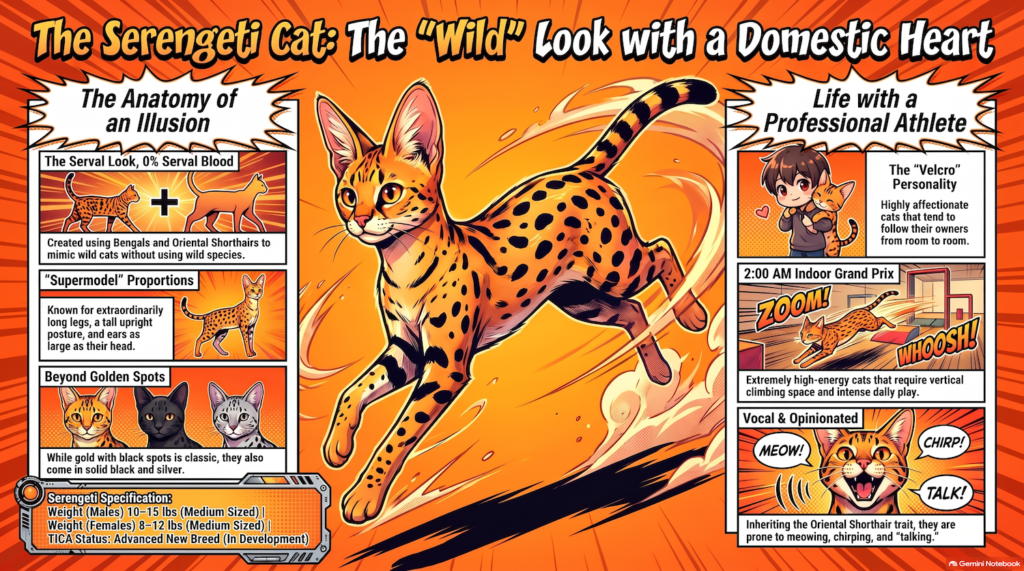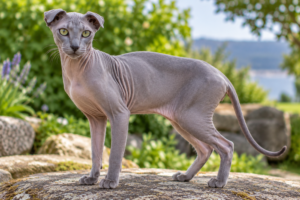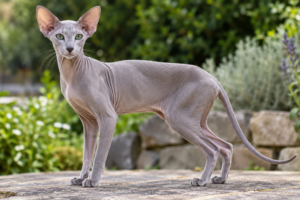
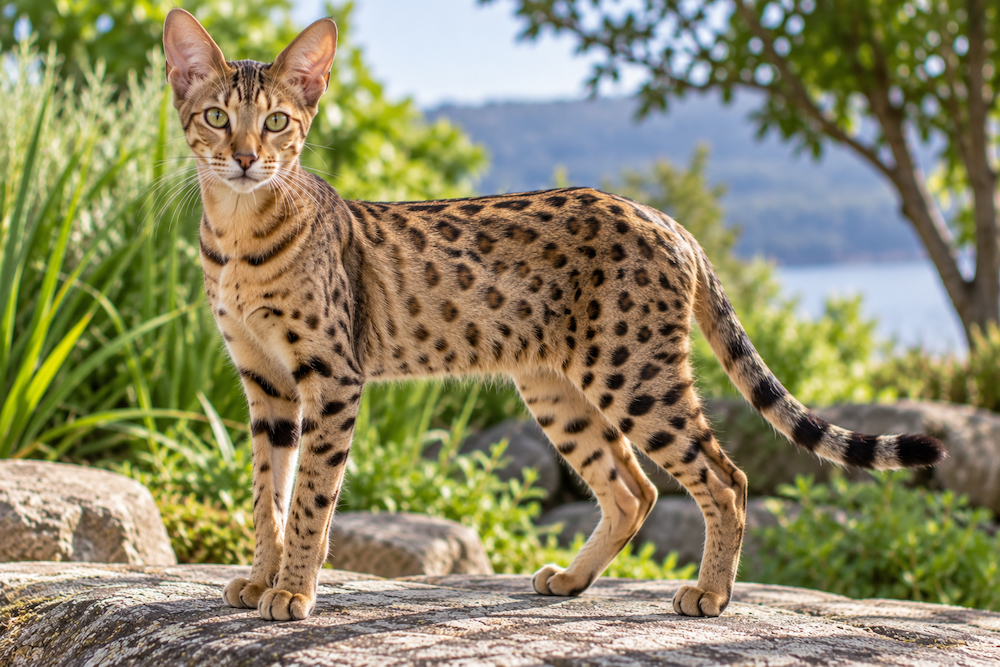






Long-legged, boldly spotted, and deliberately created to resemble a wild African cat — the Serengeti combines the striking appearance of the serval with completely domestic ancestry, producing an athletic, intelligent and extraordinarily energetic companion without deliberately introducing wild-cat blood.
🧠 QUICK SNAPSHOT
- Temperament: Confident, intelligent, affectionate
- Energy Level: Very High
- Size: Medium
- Good With Families: Very Good
- Indoor Living: Very Good with substantial enrichment
- Trainability: High
- Grooming: Low
- Best For: Active households, experienced owners, families wanting an interactive and athletic cat
- Typical Lifespan: Around 12–15 years
📚 OVERVIEW
The Serengeti looks like it should have an exotic wild-cat ancestor hiding somewhere in its family tree.
That appearance is completely intentional.
The breed was developed in the United States during the 1990s by conservation biologist Karen Sausman, who wanted to create a domestic cat resembling the African serval without deliberately crossing domestic cats with servals.
The original breeding program primarily combined Bengal and Oriental Shorthair ancestry.
That creates an interesting twist.
Although the Serengeti wasn’t created through direct serval hybridisation, the Bengal itself historically derives from domestic cats crossed with the Asian leopard cat. The Serengeti can therefore have distant wild ancestry through Bengal lines, but no serval ancestry is required to create its serval-like appearance.
The resulting cat is tall, slender and muscular, with exceptionally long legs, a long neck, enormous upright ears and a boldly spotted coat.
Serengetis are also highly active.
They tend to enjoy running, jumping, climbing and investigating everything around them.
Many are confident and affectionate with their families, although some can initially be cautious in unfamiliar environments.
This is a spectacular cat for the right household.
But anyone attracted purely by the miniature-serval appearance needs to understand that those long legs contain a considerable amount of energy.
✅ PROS & CONS
Pros
- Spectacular wild-looking appearance
- Highly intelligent
- Athletic and playful
- Affectionate with its family
- Very trainable
- Easy-care short coat
- No direct serval hybridisation required
Cons
- Extremely high activity requirements
- Needs substantial vertical territory
- Can be vocal
- Strong hunting instincts
- May become destructive when bored
- Rare in many countries
- Not ideal for owners wanting a quiet lap cat
- Not hypoallergenic
Is a Serengeti a Good Family Cat?
Yes, the Serengeti can be a very good family cat for an active household prepared to provide plenty of interaction and enrichment.
These cats tend to be affectionate, intelligent and strongly interested in what their humans are doing.
Many enjoy interactive games and can be excellent companions for respectful children.
They may also live successfully with compatible cats and cat-friendly dogs when properly introduced.
Their activity level is the main consideration.
A Serengeti isn’t generally a cat that spends the entire day sleeping peacefully on the sofa. It needs opportunities to climb, chase, investigate and play.
Its hunting instincts also mean caution is appropriate around birds, rodents and other small pets.
For an energetic family wanting a cat that becomes actively involved in household life, the Serengeti can be enormously entertaining.
For someone looking for an ornamental miniature serval that quietly decorates the living room, the reality may come as something of a surprise.
Can a Serengeti Live Indoors or in an Apartment?
Yes, a Serengeti can live indoors or in an apartment, but the environment must compensate for limited floor space.
Vertical territory is particularly important.
These cats have extremely long legs and impressive jumping ability, so tall cat trees, wall-mounted shelves, climbing systems and elevated resting areas can dramatically improve their environment.
Daily interactive play is essential.
Puzzle feeders, tunnels, rotating toys and training sessions provide additional mental stimulation.
A secure outdoor enclosure can be an excellent addition where practical.
Apartment owners should also consider vocalisation. Oriental ancestry means some Serengetis can be talkative.
A small apartment with excellent enrichment can work better than a large but boring house.
The question isn’t simply whether there is enough room for the cat to stand.
It’s whether there is enough usable feline territory for a highly athletic animal to actually behave like one.
How Much Exercise and Play Does a Serengeti Need?
The Serengeti has very high exercise requirements and is one of those breeds for which daily interactive activity is essential rather than optional.
Running, jumping and climbing should all form part of its environment.
Fishing-wand toys, balls, tunnels, retrieving games and toys that imitate prey can provide excellent physical exercise.
Several energetic play sessions throughout the day are ideal.
Mental stimulation is equally important.
Serengetis can enjoy puzzle feeders, clicker training, treat hunts and games requiring them to solve problems.
Their long legs make them particularly capable jumpers, so owners should expect them to investigate elevated areas.
Simply providing toys and leaving them untouched for months isn’t enough.
An intelligent, athletic cat needs novelty.
If you don’t provide interesting challenges for a Serengeti, there is a reasonable chance it will conduct its own investigation into why you’ve been keeping certain objects on top of the refrigerator.
Is a Serengeti Easy to Train?
Yes, the Serengeti is generally highly intelligent and trainable.
Positive reinforcement using treats, toys, praise and clicker training can produce excellent results.
Many can learn to come when called, retrieve toys, enter carriers voluntarily and perform tricks.
Harness training can also provide additional controlled exploration for suitable individuals.
Training is particularly valuable because it gives this intelligent breed something constructive to think about.
Practical handling should begin during kittenhood. Nail trimming, dental checks, carrier travel and veterinary handling become much easier when introduced positively.
Punishment should be avoided.
Short, interesting training sessions work far better.
Serengetis can also learn household routines extraordinarily quickly.
Unfortunately, intelligence doesn’t distinguish between “useful behaviour” and “information the human would rather the cat hadn’t discovered”.
Cupboard-opening experiments may therefore occur without being included in the official training program.
Does a Serengeti Shed?
Yes, but the Serengeti is generally a low-maintenance breed when it comes to grooming.
Its coat is short and relatively easy to care for.
Gentle brushing approximately once a week can remove loose hair, distribute natural oils and provide an opportunity to check the skin and body condition.
Some cats may shed more noticeably during seasonal changes.
Bathing is rarely necessary unless the cat becomes unusually dirty.
Routine care should also include nail trimming, dental hygiene and regular checks of the ears, eyes and skin.
Those enormous ears deserve occasional inspection, although healthy ears shouldn’t require aggressive cleaning.
The Serengeti is not hypoallergenic.
Its short coat may mean less obvious loose hair than some long-haired breeds, but feline allergens are produced primarily in saliva and skin secretions rather than by fur itself.
What Health Problems Are Common in a Serengeti?
The Serengeti is a relatively young and uncommon breed, so large-scale breed-specific health information remains limited.
That makes responsible breeding particularly important.
Because Oriental Shorthairs contributed significantly to the breed’s development, breeders should understand the health history of those lines and monitor inherited conditions appropriately.
Bengal ancestry also makes careful pedigree and health management important.
As with other cats, Serengetis can develop dental disease, urinary disorders, kidney disease, heart conditions, obesity and other common feline illnesses.
Their active nature makes maintaining good muscle condition relatively easy when they receive appropriate exercise, but diet still needs to be controlled.
Responsible breeders should prioritise genetic diversity, structural soundness and health screening rather than selecting solely for increasingly extreme serval-like appearance.
With appropriate breeding and lifelong veterinary care, Serengetis are generally expected to live around 12–15 years, although robust lifespan data remains relatively limited.
⭐ Is the Serengeti Really Part Serval?
No. The Serengeti was specifically developed to achieve a serval-like appearance without directly breeding domestic cats with servals.
This is one of the most important facts about the breed.
The African serval is a genuine wild cat with extremely long legs, enormous ears and a spotted coat.
Those characteristics inspired the Serengeti’s appearance.
But breeders attempted to recreate them through selection within domestic-cat breeding lines.
This separates the Serengeti from the Savannah, which was originally created through actual serval-domestic cat hybridisation.
There is one nuance.
Because Bengals contributed to the Serengeti, some lines can carry distant ancestry from the Asian leopard cat.
So saying the Serengeti has absolutely no historical wild-cat ancestry can be misleading.
What it doesn’t have is the serval ancestry its appearance strongly suggests.
⭐ Who Created the Serengeti Cat?
The breed was developed by Karen Sausman at Kingsmark Cattery in California during the 1990s.
Sausman’s background makes the story particularly interesting.
She was a conservation biologist as well as a cat breeder.
Her aim was to produce a domestic cat with the visual drama of the serval without needing to repeatedly use wild servals in breeding programs.
The Oriental Shorthair provided characteristics including long legs, a slender body and very large ears.
The Bengal contributed spotting and additional athletic characteristics.
Selective breeding then pushed the resulting cats towards the distinctive Serengeti type.
Unlike many natural breeds discovered in isolated populations, the Serengeti was therefore deliberately designed around a specific visual objective.
The target was essentially:
“Make it look like a serval — without actually using a serval.”
⭐ Is the Serengeti the Same as a Savannah Cat?
No. The Serengeti and Savannah can look superficially similar, but their breeding histories are fundamentally different.
The Savannah is a hybrid breed developed from the African serval and domestic cats.
Early-generation Savannahs can therefore possess substantial recent serval ancestry.
The Serengeti was designed to mimic a similar appearance using established domestic breeding lines rather than direct serval crosses.
This can have practical implications.
Early-generation wild hybrids may be subject to legal restrictions in some countries and jurisdictions.
The Serengeti doesn’t carry the same direct serval-generation classification.
However, local animal laws vary, and owners should always check regulations applying where they live.
Visually, both breeds can deliver enormous ears, long legs and dramatic spots.
Genetically, they took very different routes to reach a similar destination.
⭐ Why Does the Serengeti Have Such Long Legs?
Long legs are central to the Serengeti’s attempt to recreate the proportions of a serval.
Servals have the longest legs relative to body size of any living cat, helping them see and hunt through tall African grasslands.
Serengetis don’t match the extreme proportions of a genuine serval, but breeders selected for a tall, upright appearance.
Oriental Shorthair ancestry provided an excellent foundation because Orientals already possess long, elegant limbs and bodies.
The Serengeti’s legs are particularly striking because the body remains relatively medium-sized.
This creates the impression of a much taller cat.
The physical consequence is predictable.
Serengetis can be impressive jumpers.
That shelf you thought was safely above cat level may simply be viewed by a Serengeti as the next floor.
⭐ Why Are the Serengeti’s Ears So Huge?
Those enormous upright ears are another deliberate attempt to reproduce the dramatic appearance of the African serval.
Servals use their huge ears for an extraordinary practical purpose: detecting small prey moving through vegetation and even underground.
A domestic Serengeti doesn’t need giant ears to locate rodents beneath African grasslands.
But the feature is essential to its distinctive silhouette.
Oriental Shorthairs already possess very large ears, making them particularly useful in establishing the Serengeti’s appearance.
The ears should be tall, prominent and set upright on the head.
Combined with long legs and a spotted coat, they can make the cat look considerably more exotic than its domestic ancestry would suggest.
They also create the distinct impression that the cat heard the treat packet opening three rooms before you did.
⭐ What Colours Can a Serengeti Cat Be?
The classic Serengeti appearance is a golden or tan coat covered with contrasting dark spots, creating the strongest resemblance to a serval.
However, other colours can occur depending on registry standards and breeding lines.
Black Serengetis can display a dramatic solid appearance, while silver versions provide a very different contrast between background colour and spotting.
Some darker cats may show “ghost” spotting, where the underlying pattern remains subtly visible depending on the lighting.
Whatever the colour, the spotted pattern and overall wild-looking structure are central to the breed’s identity.
The goal isn’t simply to produce a spotted domestic cat.
Several breeds already do that extremely well.
The Serengeti’s distinctive look comes from the combination of spots, height, enormous ears, long neck and athletic body.
⭐ Is the Serengeti Named After the Serengeti in Africa?
Yes.
The breed’s name refers to the Serengeti region of East Africa, famous for its extraordinary wildlife and vast grassland ecosystem.
The African serval occurs across parts of sub-Saharan Africa, and the name reinforces the breed’s deliberately wild visual identity.
There is an amusing contradiction, however.
The Serengeti cat wasn’t developed on the Serengeti.
It was developed in California.
Nor was it created from cats collected from the African landscape.
The name describes the atmosphere breeders wanted the cat to evoke rather than its actual geographic origin.
So despite looking as though it should be stalking through African grasslands, the pedigree Serengeti is fundamentally an American-created domestic breed with an African-inspired name.
⭐ How High Can a Serengeti Jump?
There isn’t a scientifically established breed record stating exactly how high every Serengeti can jump, so spectacular numerical claims should be treated cautiously.
What is clear is that Serengetis are exceptionally athletic cats with long, powerful legs.
Healthy adults can readily reach elevated furniture, shelves and climbing structures that owners might assume are inaccessible.
They can also combine jumping with climbing, making their effective vertical range considerably greater than a single leap would suggest.
Owners should therefore provide sturdy high-level territory intentionally rather than forcing the cat to improvise.
Tall cat trees and securely mounted shelves allow the Serengeti to use its athletic abilities safely.
And fragile ornaments placed on supposedly unreachable shelves?
Those are less home decoration and more an experiment in feline physics.
⭐ Are Serengeti Cats Vocal?
Many Serengetis can be quite vocal, which isn’t particularly surprising given the influence of the Oriental Shorthair.
Oriental-type cats are famous for communicating with their humans through a wide range of meows, chirps and conversational sounds.
Individual Serengetis vary considerably.
Some are enthusiastic commentators.
Others are quieter.
But prospective owners wanting an exceptionally silent breed should understand that vocalisation can be part of the package.
The sounds often accompany the breed’s social personality.
A Serengeti may vocalise when greeting its owner, requesting attention, anticipating food or objecting to a closed door.
Combined with their intelligence, this can make living with one feel unusually interactive.
You’re not necessarily acquiring a cat that talks.
But you may acquire one that clearly believes conversations should be two-way.
⭐ Why Is the Serengeti Still So Rare?
The Serengeti is a young breed with a relatively small international breeding population.
It only began development during the 1990s, giving it a very short history compared with traditional breeds such as the Siamese, Persian or Korat.
It also occupies a specialised part of the pedigree-cat world.
People attracted to exotic spotted cats may already encounter established breeds such as the Bengal or the more directly serval-associated Savannah.
The Serengeti therefore competes for attention within an already unusual niche.
Breeder numbers remain limited in many countries, and finding a genuine kitten may require considerable research.
A spotted domestic kitten with big ears isn’t automatically a Serengeti.
Pedigree documentation matters.
The irony is that breeders successfully created a domestic cat that looks remarkably exotic.
Now the challenge is finding the domestic cat that looks remarkably exotic.